Friday, November 12, 2010

Hair Raising Stories: Performance of Mithu Joardar at Sandarbh

When Mumbai based Mithu Joardar gets an invitation to participate in Sandarbh Nature Art Workshop at Luhari Village, she feels no confusion or panic. It is Mithu’s first ever participation in a site specific art camp. However, Mithu feels that she has something to say through her pet theme; the hair.

(Mithu Joardar)

What is the connection between hair and nature? Is it the perennial categorization of women as nature and men as culture? Is it that viewing woman as an entity with the wild growth of hair to be tamed and controlled? Or is it the fact the women, in the name of being an integral part of the ‘nature’ expected to be trapped in the confinement of hairs? Are her days are supposed to be spent by tying and untying her hair, in anticipation, desperation, revenge, mutilation and so on?
(The procession begins)

Mithu Joardar considers all these things as the part of the woman/gender as a cultural construct once defined through the myths of Medusa and Draupadi, as an avenging goddess and as an instigating concubine, and now defined through the color and texture of the hair. The control of women/nature is managed through the indoctrination of the religious and cosmetic myths. Hair, in this sense is a tool of traditional and contemporary mythologies.

(Priyanka Govil holding the pot of plaits)

Mithu enacts the life of a woman through her hair rituals; her birth, puberty, marriage, widowhood and death. As an artist who has been working on the politics of hair for a long time, she in Sandarbh decides to make use of the narrative of hair through the enactment of choreographed ritual. All the nine days she sits inside her room and weaves artificial hairs.

(While Nature walks Culture watches on)

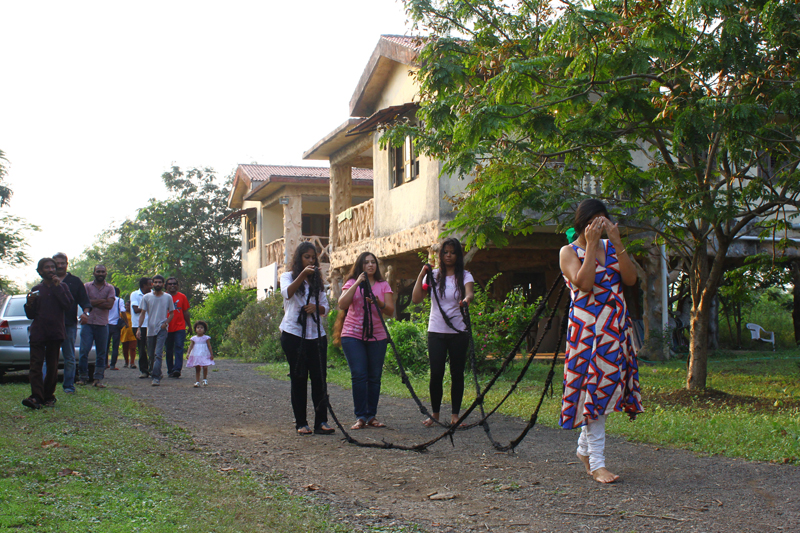
On the ninth day, Mithu joardar comes out of the room with long braids of artificial hair fitted to her own hair and held by her sakhis (friends). The ritualistic procession comes out of her room. Priyanka Govil leads the procession with pot full of plaits. Dhara, Neha and Pari hold the hair; they too open their hair as if they were in a celebration or in mourning.

(The procession reaches the tree)

Mithu covers her face with her cupped palms that she holds before her as if she were looking into a mirror, hiding her face from the public, mourning or averting the glances out of shyness. The veiling of face connotes the different stages in a woman’s life. And the procession moves on.

(Pari helps Mithu to tie the hair around the tree)

Finally, it reaches to the tree under which the camp participants often sit around to chat. Mithu climbs the raised mound around the tree and starts untying the braids one by one. Her sakhis help her to do so and finally they tie these long plaits around the tree.


(Pari, Neha and Mithu at work)

A celebratory procession slowly comes to have the mood of death and desolation. In the forced severance of the plaits has a violent nature in itself. A woman is forced to lose her hair when she become socially unwanted; when she becomes a widow or when her exercise of the sexual rights outside the wedlock is detected or she chooses to live with someone of her own choice.


Nature is forced to shed its adornments as culture enters its zone. Mithu connotes this act of violnec through the act of this hair procession. Then the tree stands alone like a ghost, a tree of memories. 

Thursday, November 11, 2010

Automatic Telling Machines (ATM): A Performance of Murali Cheeroth at Sandarbh

Memories and imaginations get entangled in the performances of Murali Cheeroth. Magic and reality go hand in hand in his gestures. Illusion and lived experiences interface in his words and performative deeds. Murali Cheeroth is a painter, video and performance artist based in Bangalore. His performances are interventionist in nature, theatrical in execution and discursive in content.

(Murali Cheeroth)

In Sandarbh, Murali Cheeroth comes to meet the young artists. He comes prepared to perform before them. He covers his head with a black hood and moves amongst the camp participants and visitors. He wears black clothes and of course, he is mourning the death of our beloved poet, A.Ayyappan. ‘Automatic Telling Machines’ is the name of his performance.

(Late Poet A.Ayyappan)

Murali appears before the audience with three minimal architectural forms tied to his head and hands respectively. He takes the seat in the middle of the lawn and before him there is a tray with two identical wrist watches, one egg and a candle in it. Murali’s assistant comes forward and light up the camphor filled miniature homes. While the fire goes up in the air consuming the innards of the ‘homes’, I recite a poem written by the late poet, A.Ayyappan titled ‘To My Pall Bearers’.

(An assistant setting fire on Murali's head-home)

This has been pre-planned. The words cut sharply through the cold air and the aromatic flames fill up the nostrils of the audience. Murali gets up and walks around. He takes down the house from his head and he keeps the burning houses in the three corners of an imagined triangle on the field. The memories of rituals come to him. He removes his hood and puts into the fire. He removes his reading glasses and puts it into the fire (actually he does not. Like a magician he puts it back into his pocket).

(Murali with Burning Houses and Murali burning his hood)

With a heart laden with poetry and a pair of eyes that showers the drops of compassion Murali walks forward to pick up the plate with his contemporary ritual objects; the watches and the egg. “I have a secret to share/which is not in my will/with those who bear my coffin’- Ayyappan’s words reverberate from the deep forest behind the viewers. Murali wants to share a secret with the people who are around him.

(Murali performing)

Murali picks up the watches from the plate and tells the audience as if he were explaining a linguistic dilemma; the sign is not the signified. In the process of signification, the real meaning is lost. An image/object detached from its memories and context, bears the meaning of something else. A pipe is not a pipe for Margritte and Foucault. For Murali a watch is not a watch. ‘It is not a watch. It is an automatic telling machine (ATM)’, he tells at the faces of the viewers.

(This is not a watch...this is an automatic telling machine)

Automatic Telling Machines are the temples where the banks retail blessings for those who have the right cards and the right passwords. These are the modern ways of worshiping the gods of prosperity. These booths represent the watering holes of richness; the emblems of commerce. Watches tell you time. But for Murali they are not watches. They are memories. They are the ATMs that recount the memories of your ‘rich’ life once you enter the right password.


Murali’s performance is a password. He transcends his body and act. These watches are closely associated with his life. They appear and disappear in his life as if they were objects with their own lives. The egg, the artist says, what a shape! Read the egg not as an egg but as an automatic telling machine in its literal sense. Eggs are the forms where all stories are hidden.


While walking around with the burning memories, Murali asks people about the definitions art has gained in history. Four from the audience are already prepared. They read out definitions given by famous artists and philosophers. Murali responds to these definitions with spontaneous outpouring of ideas and words. And even he calls them ‘Automatic Telling Machines’. Art and automatic telling machines. Does art dole out money?


Murali laughs and screams. He like a modern time Diogenes examines the faces of the people in the candle light. He looks like an image from Fuseli's oeuvre. His face reflects too many emotions. Home is homelessness. In his childhood, Murali had seen his thatched house burning down several times. Each time a crow or a rat brings a lit wick from the lamps of the near by temple, one can be sure one of the houses is going to go up in flames tonight. It had happened to several times to Murali’s house.


A surreal vision, isn’t it? A rat bringing fire to burn up a house. But the rat does not mean it. It lifts the wick from the lamp for sucking the oil from it. But it can burn up people. Simple pleasures of the thoughtless rendering masses of people homeless, jobless, territory-less. Are you preparing war machines, man? Murali’s performance is a pointer to these vital issues of political dispossession of people.


Murali comes back to the centre stage. He picks up the homes, destroys them, screaming. The one on the left has only burnt partially. Murali tries to destroy it using it all his strength. He shivers and scowls. He uses all his might to destroy it. And he does destroy it while chanting out all what he felt whenever he witnessed his home getting gutted by the rats. Then once it is done, he retires to peace and tranquility.

Murali is the shaman of Indian contemporary art. His shamanistic art of post capitalist world will be recognized if not today, tomorrow. 

Wednesday, November 10, 2010

Story of a Tree: Ethics of Intervention by Priyanka Govil at Sandarbh

There is a deep silence in Priyanka Govil’s landscape paintings. At times she too goes into some kind of isolation. But as a person, otherwise she is fun loving. She could gather a number of people around to help her whenever she does large scale works. That’s what exactly happened in Luhari Village where Sandarbh Nature Art Workshop was held during the last ten days of October 2010. Mugdha Joshi, one of the photographer volunteers in Sandarbh steals a moment from Priyanka’s life and registers it in her camera. Here is that moment.

(Priyanka Govil)

Priyanka, after the first two days of trekking and site seeing, zeroes in on her pet idea of creating a landscape within the landscape. This time she chooses to have a tree at the bend of the village path as the central motif of her work. When she decides on ‘her’ tree, kids from the village gather around her. They all ready to help her.

(Priyanka with her local army of kids)

The idea is to convert the tree trunk itself as a landscape. And to do that she adopts the method of the village folk who plaster their floors and walls with cow dung and mud mix. This act of plastering has got both secular and religious meanings. When done with reverence within a spiritual context, the very act of plastering the floor becomes a method of worship. Otherwise, it is a part of their daily chores.

(Preparing cow dung and clay paste)

For Priyanka, the act of plastering the tree trunk with mud and cow dung mix is primarily an act of simulation; the simulation of the village life, next it carries symbolic values for her as the covering of the tree trunk virtually prevent the cattle from grazing their bodies on it. Third, the act has its own aesthetics. Plastering is a simple act but it draws you in, the way a potter gets absorbed while throwing clay at the wheel.

(Priyanka plasters the tree trunk with the cow dung and clay paste)

Priyanka has already done a drawing so that she could approach her work quite methodically. In her drawing, you see the typical landscape strokes that she creates in her studio, on the bark of the tree. Somehow, the same strokes are not repeated on the bark though initially she attempts to get the effect of it.

(Sketch for the work)

Finally what Priyanka gets is a completely plastered tree trunk. You feel like seeing an idol kept just in front of it. Seen in isolation it resembles a folk temple. Seen in connection with the nature around, it looks like an oddity. Priyanka seems to have a little bit of struggle in negotiating the result with the modalities of the intended drawing.

(Plastered tree trunk)

In the village, you see the villagers protecting their tree trunks with twigs, sticks and thorns. This is a preventive act during the harvest seasons. The trees are laden with fruits and they don’t want the kids and thieves to climb up and loot the fruits. While that could be one of the intentions of making fence like structures around the trunk, the others could of preventive in terms of keeping the cattle away, or even for hanging stacks of grass and leaves so that the baby animals could eat from it.


(The fence work starts)

Visually, these fences would catch your attention from any distance. That must be one reason for Priyanka to create a fence around her chosen tree. With the help of the kids around, she collects tender branches of some plants and tying them together she ‘fabricates’ a fence. Later she places it around the tree. This could be an act of protecting the tree and the mud plastering that she has done on it. It could be symbolic of demarcating lands. This could be symbolic of the public and private.


(Fabricating a fence/net)

This is here exactly I remember two personal experiences. In Mukteshwar (Uttaranchal) as a part of an art camp, we spent one night inside a forest. We pitched tents and cooked in the clearing. Tall trees looked at us with some feeling that we could not decode. Sumedh Rajendra said, ‘If these trees could talk, they would have chased us away right now. They have been standing here since ages. They are living beings. They don’t want people like us in their home. Do we allow strangers to camp inside our homes?’ This is what exactly Paribartana Mohanty said in Sandarbh. ‘Had these plants with sword like leaves got the capacity to move, they would have pushed it into us right from the bottom.’


Priyanka is aware of that. Hence, her interventions in the nature are subtle and tender. The fences are not menacing. The clay covering is vulnerable. The tree remains the same. Perhaps, the tree has protected her through out. But the storm that lashed out at night has not. It blew away a lot from Priyanka’s work. But in the documentation, the work remains. That’s how all nature art works remain in memory.

(Final form of Priyanka's work)

For the last few days I have been getting comments from artists and friends (who generally don’t want to commit a comment in public, so they either send emails or they come to chat with me online) regarding the ‘moral- ethical’ aspects of artists’ intervention in nature. ‘Aren’t they spoiling nature by doing art?’ they ask. If you see it fundamentally, anything done in nature by human beings is an act of vandalism. But then you cannot live in this world. What you could do is this much: choose your aesthetics which is less hurting. Fundamentalism is a sort of fanaticism even if it comes from artists.


Tuesday, November 9, 2010

A Requiem for Nature: Sukesan Kanka’ Earth Works at Sandarbh

Friends call him Kanka Swami (Sage Kanka), Kanka ji and Philosopher Kanka. He has a way with the worlds and words. The saying ‘one for all, all for one’ is apt to describe Sukesan Kanka. In an art camp he is everywhere to help everyone and in turn everyone works with him. A graduate in painting from Thrissur Fine Arts College, Sukesan Kanka is an interesting artist who could be completely selfless with nature. Here he is.

(Rastaman Live Up- Sukesan Kanka)

At Luhari Village Sukesan comes for the Sandarbh Nature Art Workshop. An avid painter and an intricate sculptor who takes pride to have worked in goldsmiths’ workshops at the tender age of nine, Sukesan finds art even in the smallest of things. If you promise me to keep your eyes in control I will introduce the first work that he did in Sandarbh. Look at this…

(Look at the dangling ornament in her ear)

Don’t delve too much into the beauty of the girl. She is Neha Naryanan, an art student from Delhi College of Art who came to volunteer in Sandarbh. She wears the first work done by Sukesan. He plucked out two leaves from a plant and put it into Neha’s ear rings. And isn’t it a pair of covetable ear ornaments? Sukesan’s experience as an ornament maker worked here very well. And of course, he has an eye for the details.

(Neha Narayanan modelling with Sukesan's ear rings)

Sukesan twists language to give new meanings to what he says. That’s why even in a ‘spiritual high’ Paribartana says, ‘I wouldn’t quote Derrida. But I would quote Kanka’. For Sukesan, Suprabhatam (Good Morning) is Super- Bhatam (Great Morning). As he hops around the Luhari complex, Sukesan thinks about the nature around him. He loves it and he knows that this nature is going to die at the hands of the uncouth human beings.


So Sukesan starts his work. Like a romantic poet who wrote the requiem for earth, Sukesan makes a grave for nature. He collects clay and sand, mixes them and builds a mound, near the dining at Luhari. The more he works, the more he gets absorbed into it.

(Sukesan Kanka at work)

Sukesan remembers those graves that he has seen back in Kerala. In Kerala, people plant a tulsi (Holy Basil/Ocimum Sanctum) on the graves as an offering to nature. Also the plant symbolizes the dead person and those who live cares for this plant as if it were the soul of the dead beloved sprouting out from the earth. Sukesan remembers all these in his work.

(Nature's Grave)

And this grave is for the nature. He creates certain abstract forms on it, not only as an embellishment to the elongated rectangular structure but also as the evocation of the traditional worshipping structures. These are just hints for making the viewer aware of the gravity of the issue. And he inscribes on it ‘Nature Worried Buried’.


(Worried, Buried)

‘Nature Worried Buried’. You may read a lot into it. Sukesan smears a paste made out of cow dung and mud on the grave. This is how the villagers keep their floor and walls plastered and clean. Sukesan remembers all those dying practices and he calls them back to his work. He proclaims, ‘We are Nature’ in another inscription.

(Nature We Are)

At night, a storm passes through the Luhari village. Along with many other works, Sukesan’s Nature Worried Buried also is blown astray. But Sukesan builds it back, like a fruit gatherer who picks back all those spilled berries in a meadow.

(Sukesan Kanka with Worried Buried)

In the expansive lawn of Luhari forest resort, where the Sandarbhians stay for the duration of the workshop, Sukesan finds another form. He carves out huge monkey form in the middle of the lawn. He carefully removes the grass bed in the shape of a crouching monkey. Sukesan reminds of our origins and he warns us their extinction and ours too. Then he smears the form with cow dung paste. Here it is for you.

(the Monkey by Sukesan)

Sukesan’s works are subtle. He brings the grass from the lawn on a table and makes a makeshift landscape on it. He invites everyone to sit around it. For him the grass table is an invitation to the last supper. This is the death of nature. And like cannibals the human beings eat the dead body of it.

(The Grass Table)

But as I mentioned before, Sukesan does not make any loud proclamations on it. None feels that they do the offensive act of cannibalizing the earth. But aesthetically Sukesan hints at the possibility.

(Vaibhav Sharma and Sukesan Kanka at the Grass Table)

Sukesan is an amazing artist to work with. His paintings are a delight to the viewer’s eyes. To give a taste of his drawings, I present this work before you.

(Gramophone- A drawing by Sukesan Kanka)

Let’s wish him all the best for his onward journey as an artist.  


Monday, November 8, 2010

Rocks and Roses: Medha Prabhakar’s Wall at Sandarbh

(Medha Prabhakar at work)


Walls and flowers attract Medha Prabhakar. In the beginning it was flowers, history of flower markets. Then she realized while working in a public project in Bangalore that the flower markets have a history of colonial divide. The flower farmers and workers were demarcated from the mainstream society through the creation of ‘walls’ that divide their locality from the main one. Medha saw this in Goa too.

(The Wall)

While in Luhari Village, as a participant of Sandarbh Nature Art Workshop, Medha has not expected to see something similar to her former experiences of walls. While walking around she comes to see a stone wall running through the forest land. Enquiries reveal that this wall was made by the Portuguese who once occupied this land. Maratha kings supported Portuguese to establish their colony in Silvaasa. They wanted the South Gujarat chieftains to be away from this land. The walls were made to demarcate the Portuguese land and in the process the villages also got pushed to the fringes.

(Medha decorates the walls with flowers)

To commemorate the lives of the poor souls who are pushed around always by the colonizing powers, Medha decides to adore this wall with flowers. She finds that some yellow flowers are used by the locals for decorating their hairs, idols and homes. She collects those flowers and with the help of the friends in the camp decorates the wall in all its length.

(Pari Baishya performing on the wall)

This act of decoration is supremely temporary. A wind can blow it away, sun can dry it up, rain can wash it out and the cattle can eat it away. Before things like that happen, Pari Baishya, a young volunteer artist comes forward to do a performance on this decorated wall. She decks herself as a ‘pari’ (a forest angel) with the borrowed clothes from a girl in the neighborhood and she walks along the wall, singing songs and acting out spontaneously. For Medha, the wall decoration and the act of Pari together emphasize a tribute to the times that had divided people and land through the making of walls.

(One final look)

Medha moves on to a field near by. The harvest season is just over. The fields are empty with the half dried stubs of paddy sticking out of it like the rough hairs on a man’s face. She sees some villagers stacking the hay for further use as a cattle fodder and manure. These hay stacks give an identity to the agrarian villages. Medha attempts to make one for her but with a different purpose.

(Medha making a phallic hay stack)

She goes around the village. People are reluctant. Medha pleads with them and some relents. She gets enough hay to build her stack. She wants it to be a phallic structure, showing the might of the earth. And she wants to see it as a condom also. Hence she gets some hay weaved like a ball and she fits it on the top of the stack. She puts a pot too up there.

 (Getting some help)


Hay stack with no ‘life’ purpose is not a stack worth respecting: that is the attitude of the villagers. They have seen Medha making it and they know for sure that she is not going to use it. So they wait for their chance. When Medha comes back on the next day to refurbish her phallic stack, she finds several things missing from it. The woven hay and the pot are missing.

(Villagers come forward to help the artist)

Medha brings it again and fits them to the stack. Documents it. And takes a last look at it. Yes, next day the whole stack is gone. People do not want ‘art’ which do not excite them. They want their stuff back. When they are not allowed to touch anything, they pilfer it. That is history.

(Stands alone)

While I appreciate the Wall work of Medha, I don’t quite understand why she calls this hay stack work, phallic. The critical association of phallic as the symbol of aggression and imbalanced power distribution does not quite work well in a village situation like this where people still struggle to make their ends meet. And the phallus of the encroachers? How can one associate that with a hay stack; it should be rock/steel strong.