Saturday, January 15, 2011
All Art is Contemporary Art- Really?
All Art is Contemporary- an invitation that I got from the Loft, Mumbai says. My initial response was this ‘Saas Bhi Kabhi Bahu Thi’. For those people who do not understand Hindi and what Ekta Kapoor does in Television, I will translate: Once upon a time Mother-in-law was also a daughter-in-Law.
Now connect these two statements. The Loft people say, All Art is Contemporary. And Ekta Kapoor says, Saas Bhi Kabhi Bahu Thi. For argument’s sake we should accept the truth value of these statements.
But then the issue is Saas cannot be always a bahu. She gets old, take stronger positions in family matters, from the door-mat status she gets elevated to the respectable ‘daadi-maa’ (grand mother), if not she becomes a weeping willow like Nirupa Roy. To put in normal words, Saas is saas because she is saas. She cannot be always bahu because time brings all changes.
Seen in the same way, all art cannot be contemporary. Like a Saas we have to see it in pre-modern, modern, post-modern and contemporary terms. Modern is modern because there is something called contemporary. Or, contemporary is contemporary because there is something called modern.
Contemporary is a word that shows the temporality of a scene. The immediacy of time that you share with your milieu is what makes your productions contemporary. You can paint like Raja Ravi Varma but then you will be called a pre-modern artist. Or you can paint like Souza, then you will be called a modern artist. If you instill certain contemporary elements into the Ravi Varma language, you will be called a contemporary artist.
Contemporary is a term of flux. Movements are in flux. Once they become settled, they are called schools. So we have contemporary pop movement or contemporary cutting edge movement but Baroda ‘school’ of art.
Modernism, in that case any thing that is qualified with classificatory terminology of (art) history, is an aesthetical and historical necessity for analysis. If you force all the –isms into one, you show two symptoms: one, you don’t know anything about history and historiography. Two, you know everything, but to sell your wares, you take this attitude, ‘I would stoop to any extent.’
Market makes right thinking people to behave funnily. They will even argue that Marxism is actually all about Economic imperialism, Arundhati Roy promotes militancy and M.F.Husain is a terrorist and so on. They can even argue that dog has four legs like a table. So Table is Dog and Dog is table. That’s vulgar logic.
All art is not contemporary. Contemporary art is supposed to be political in all sense and it contains all –isms; right from feminism to environmentalism.
You cannot force Benod Behari Mukherjee and Ravi Agarwal into one compartment and call them contemporaries only because both have loved looking at nature.
Then I saw this phrase in the same invitation- ‘Iconic Image’. Art is all about iconoclasm. A functional object becomes an art object when it is converted into icons. Each successive period attempts at breaking these icons. Henec an artist is an iconoclast. Modernism has a history of a series of iconoclasms. Post-modernism is all about the breaking of grand narratives into micro narratives. Hope you all heard of post-structuralist linguistics. This provided tools to the artists to deconstruct the grand narratives of all types.
How do you harness Tagore and Riyas to one yoke? Only by calling them all contemporary, would they become contemporary? If I use the same logic, shouldn’t I call Jamini Roy and Riyas by the same name- modernists or pre-modernists?
What’s happening here? To sell well will you kill all your Will to truth?
After reading this the Loft People must be quoting Deepika Padukone in Om Santi Om by Farah Khan:
‘Ek Chutki sindoor ki kimat tu kya jano Ramesh’
Translation: ‘JohnyML, what do you know about the pangs of a gallerist?’
Friday, January 14, 2011
Mild Terrors of Altered Objects
(Psychopathic Killer Fan)
Today evening my friend asked me about the shows that I am going to catch up in the coming days. Then he enquired about the venues. I told him, ‘get out of your home, get into your car and ask your driver to take to any direction. You will reach to a place/gallery where some art show is opening.’ I am not joking. In Delhi, in winter you have a spring; that is the spring of art. Consider Delhi as a tree and galleries as its branches, then you find each of them filled with flowers, I mean, works of art. The forthcoming third edition of the India Art Summit has made all the gallerists so alert that they all want to put up their best shows. And there is a lot of struggle in it.
(Newly Wedded Bucket)
So one day you start hopping between galleries. And you find a lot of interesting as well as boring works of art. It is just human tendency that during the bad times you think about the good times, the same way you think about King Fisher when you stand in the check in counter of the Indian Airlines. Hence, I think of an artist who is neither in the mainstream nor in the alternative stream. Someone recently asked me, ‘is there any alternative art?’ Yes, I told him immediately and added that alternative is the childhood of mainstream. Once alternative get matured or as the artist Alex Mathew once said about cats, when it grows facial hairs, it becomes mainstream. What about the art which does not have the hormonal support for growing facial hairs? I leave that to your imagination.
(Golden Broom)
Seriously speaking, I am thinking of my friend and artist C.K.Rajan. I don’t know whether Rajan accepts me as a friend because during the boom time relationships had gone for a toss everywhere. Recently C.K.Rajan had a solo show at the Galerie Mirchandani+ Steinruecke, Mumbai. Titled ‘Mad Furniture and Psychic Objects Part I’, this show was real treat to my eyes. And I am sure you also would find these works interesting, thought provoking without much laboring on the visual jargons.
(Ageing Question Mark)
C.K.Rajan studied painting at the painting department of the Faculty of Fine Arts, Baroda and later went to the Hyderabad University to do his post graduation. Ever since, he has been operating from Hyderabad. Born in 1960, Rajan lives a very different life. He is not the party hopping type and he is that kind of artist you tend to speak to in Hindi. Oh, yes it is like that. When you look at a person who does not have any airs on his educational background and does not pin up his laurels around his sleeves, you tend to speak to him in Hindi because you assume that he is a desi type. What a hypocrisy!
(Unemployed Axe)
If you look at the bio-data of C.K.Rajan you would see, he does not have too many shows to flaunt. He was a member of the Indian Radical Painters and Sculptors Association, popularly known as the Radical Group. Of late there are efforts from various intellectual quarters to call it ‘Kerala Radicals’. What a shame and this shame is supported by establishments run on the fuel of the University Grant Commission. Anyway, that is not our issue here. Rajan hit the scene with his ‘Mild Terrors’ in 1998, a time when the established and the struggling artists looked alike. So when Rajan came to exhibit at the Siddharth Hall of the Max Mueller Bhavan, New Delhi, nobody thought about his looks or complexion.
(The Silent Assassin)
‘Mild Terrors’ was an exceptional show because the whole show was made out of collages. They were not like the collages made out of grand imageries. They were simple and unassuming imageries collected from the discarded newspapers and magazines. And Rajan simply cut them and pasted them together and in the act he created a scene of terror both cultural and political before the viewers. Those collages told the viewer that as in a language, when certain syntactical rearrangement is done the meaning changes drastically and the shift in meaning reveals a terrible truth before us. And Rajan’s mild terrors were all about the terrible truths hidden like codes in the daily pictures. Rajan put them together as if they were the pieces of a jigsaw puzzle. And the show was noticed, of course not by the galleries, but the friends like us. Then it was dark age for Rajan…for a long time.
(The Corporate Pick Axe)
With the boom, Rajan was brought back. I say, Rajan was brought back because Rajan was always away and working. He did not care about what people thought about him or about his art. He did not even think what his friend thought about him. He was/is rustic in a very philosophical way. Those people don’t know Rajan personally would take him for an arrogant artist. But he is like that. He speaks truth with a smile and the truths that he spells out are very disturbing. Only solace is that Rajan uses tremendous amount of irony and pun in his works so that the truths hits you like music. It goes deeper into you but it does not hurt.
(The Absent Minded Cup)
Theories on Museumization of objects say that when a functional object is taken out of its functional context and defunctionalized and exhibited for philosophical contemplation, it achieves the quality of a work of art. In this sense, a work of art is a de-functionalized object incapable of performing anything of its own. The artist makes the functional into de-functional. This was what Duchamp did with his Fountain. But Fountain becomes a meaningless object when it is not interpolated with the author’s signature. In that sense, a de-functionalized object is like a patient. A work of art becomes a patient, observes Boris Groys and it needs the ‘curation’ either by the artist himself or by a curator. Rajan is an artist and a curator in this way.
(Seeking Ladle)
In ‘Mad Furniture and Psychic Objects’, Rajan defunctionalizes the functional objects through simple alterations on them. In fact he creates objects that show the possibility of being functional or herald their erstwhile functional status. But it is just an illusion. It is like a linguistic code that in fact does not exist. It gives a suggestion and also underlines the violence acted out on them in order to change the meaning and function. Rajan chooses the functional objects and adopts their basic forms for the alteration, almost the way a linguist approach a language. Then the form is re-articulated in a different fashion, almost evoking a feeling of fun and terror at the same time.
(Obsessive Compulsive Disordered Garden Cutter)
The titles of these works suggest the ironic and deliberate twist imposed on the language by the artist. In ‘Psychopathic Killer Fan’ one sees a fan in the middle of a room with long leafs filling in the room, thereby rendering both the room and the fan de-functional. But instead of being functional it becomes an object that could hurt, obstruct and divide human beings and objects. It is like a psychopath, whose linguistics of logic is altered in a different way. In ‘Newly Wedded Bucket’ you see a bucket looking like a mangalya sutra, wedding pendant. In ‘Ageing Question Mark’, Rajan plays between the political and social connotations of a sickle which has now become bent by age.
(Introvert Spade)
Each work has its pun, both visual and interpretational. When I exhibited Rajan’s work titled the ‘Silent Assassin’, a wrist watch with an unusually long strap, in a show curated by me titled, ‘Fly High My Beloved Birds’ in New Delhi in 2006, people asked me what was the relevance of that watch in the show. I told them to look at the watch and try to see what purpose did it served. They were offended and some even tried to pull the watch down from its display. I had felt a sense of elation as I could see people still getting offended by art, which did not have any political connotations. But the offended parties were just ordinary people who came to see the show only because they knew me as a friend. The gallerists in Delhi were not offended by Rajan’s work because they did not come to see the show.
(Enfant Terrible)
Time changes things. Rajan has not changed but his works have. So are the gallerists’ and curators’ approach to him. He does his work for his pleasure and purpose. That’s why Rajan could say in a work, ‘Time is Running Out’.
(Time Running Out)
Today evening my friend asked me about the shows that I am going to catch up in the coming days. Then he enquired about the venues. I told him, ‘get out of your home, get into your car and ask your driver to take to any direction. You will reach to a place/gallery where some art show is opening.’ I am not joking. In Delhi, in winter you have a spring; that is the spring of art. Consider Delhi as a tree and galleries as its branches, then you find each of them filled with flowers, I mean, works of art. The forthcoming third edition of the India Art Summit has made all the gallerists so alert that they all want to put up their best shows. And there is a lot of struggle in it.
(Newly Wedded Bucket)
So one day you start hopping between galleries. And you find a lot of interesting as well as boring works of art. It is just human tendency that during the bad times you think about the good times, the same way you think about King Fisher when you stand in the check in counter of the Indian Airlines. Hence, I think of an artist who is neither in the mainstream nor in the alternative stream. Someone recently asked me, ‘is there any alternative art?’ Yes, I told him immediately and added that alternative is the childhood of mainstream. Once alternative get matured or as the artist Alex Mathew once said about cats, when it grows facial hairs, it becomes mainstream. What about the art which does not have the hormonal support for growing facial hairs? I leave that to your imagination.
(Golden Broom)
Seriously speaking, I am thinking of my friend and artist C.K.Rajan. I don’t know whether Rajan accepts me as a friend because during the boom time relationships had gone for a toss everywhere. Recently C.K.Rajan had a solo show at the Galerie Mirchandani+ Steinruecke, Mumbai. Titled ‘Mad Furniture and Psychic Objects Part I’, this show was real treat to my eyes. And I am sure you also would find these works interesting, thought provoking without much laboring on the visual jargons.
(Ageing Question Mark)
C.K.Rajan studied painting at the painting department of the Faculty of Fine Arts, Baroda and later went to the Hyderabad University to do his post graduation. Ever since, he has been operating from Hyderabad. Born in 1960, Rajan lives a very different life. He is not the party hopping type and he is that kind of artist you tend to speak to in Hindi. Oh, yes it is like that. When you look at a person who does not have any airs on his educational background and does not pin up his laurels around his sleeves, you tend to speak to him in Hindi because you assume that he is a desi type. What a hypocrisy!
(Unemployed Axe)
If you look at the bio-data of C.K.Rajan you would see, he does not have too many shows to flaunt. He was a member of the Indian Radical Painters and Sculptors Association, popularly known as the Radical Group. Of late there are efforts from various intellectual quarters to call it ‘Kerala Radicals’. What a shame and this shame is supported by establishments run on the fuel of the University Grant Commission. Anyway, that is not our issue here. Rajan hit the scene with his ‘Mild Terrors’ in 1998, a time when the established and the struggling artists looked alike. So when Rajan came to exhibit at the Siddharth Hall of the Max Mueller Bhavan, New Delhi, nobody thought about his looks or complexion.
(The Silent Assassin)
‘Mild Terrors’ was an exceptional show because the whole show was made out of collages. They were not like the collages made out of grand imageries. They were simple and unassuming imageries collected from the discarded newspapers and magazines. And Rajan simply cut them and pasted them together and in the act he created a scene of terror both cultural and political before the viewers. Those collages told the viewer that as in a language, when certain syntactical rearrangement is done the meaning changes drastically and the shift in meaning reveals a terrible truth before us. And Rajan’s mild terrors were all about the terrible truths hidden like codes in the daily pictures. Rajan put them together as if they were the pieces of a jigsaw puzzle. And the show was noticed, of course not by the galleries, but the friends like us. Then it was dark age for Rajan…for a long time.
(The Corporate Pick Axe)
With the boom, Rajan was brought back. I say, Rajan was brought back because Rajan was always away and working. He did not care about what people thought about him or about his art. He did not even think what his friend thought about him. He was/is rustic in a very philosophical way. Those people don’t know Rajan personally would take him for an arrogant artist. But he is like that. He speaks truth with a smile and the truths that he spells out are very disturbing. Only solace is that Rajan uses tremendous amount of irony and pun in his works so that the truths hits you like music. It goes deeper into you but it does not hurt.
(The Absent Minded Cup)
Theories on Museumization of objects say that when a functional object is taken out of its functional context and defunctionalized and exhibited for philosophical contemplation, it achieves the quality of a work of art. In this sense, a work of art is a de-functionalized object incapable of performing anything of its own. The artist makes the functional into de-functional. This was what Duchamp did with his Fountain. But Fountain becomes a meaningless object when it is not interpolated with the author’s signature. In that sense, a de-functionalized object is like a patient. A work of art becomes a patient, observes Boris Groys and it needs the ‘curation’ either by the artist himself or by a curator. Rajan is an artist and a curator in this way.
(Seeking Ladle)
In ‘Mad Furniture and Psychic Objects’, Rajan defunctionalizes the functional objects through simple alterations on them. In fact he creates objects that show the possibility of being functional or herald their erstwhile functional status. But it is just an illusion. It is like a linguistic code that in fact does not exist. It gives a suggestion and also underlines the violence acted out on them in order to change the meaning and function. Rajan chooses the functional objects and adopts their basic forms for the alteration, almost the way a linguist approach a language. Then the form is re-articulated in a different fashion, almost evoking a feeling of fun and terror at the same time.
(Obsessive Compulsive Disordered Garden Cutter)
The titles of these works suggest the ironic and deliberate twist imposed on the language by the artist. In ‘Psychopathic Killer Fan’ one sees a fan in the middle of a room with long leafs filling in the room, thereby rendering both the room and the fan de-functional. But instead of being functional it becomes an object that could hurt, obstruct and divide human beings and objects. It is like a psychopath, whose linguistics of logic is altered in a different way. In ‘Newly Wedded Bucket’ you see a bucket looking like a mangalya sutra, wedding pendant. In ‘Ageing Question Mark’, Rajan plays between the political and social connotations of a sickle which has now become bent by age.
(Introvert Spade)
Each work has its pun, both visual and interpretational. When I exhibited Rajan’s work titled the ‘Silent Assassin’, a wrist watch with an unusually long strap, in a show curated by me titled, ‘Fly High My Beloved Birds’ in New Delhi in 2006, people asked me what was the relevance of that watch in the show. I told them to look at the watch and try to see what purpose did it served. They were offended and some even tried to pull the watch down from its display. I had felt a sense of elation as I could see people still getting offended by art, which did not have any political connotations. But the offended parties were just ordinary people who came to see the show only because they knew me as a friend. The gallerists in Delhi were not offended by Rajan’s work because they did not come to see the show.
(Enfant Terrible)
Time changes things. Rajan has not changed but his works have. So are the gallerists’ and curators’ approach to him. He does his work for his pleasure and purpose. That’s why Rajan could say in a work, ‘Time is Running Out’.
(Time Running Out)
Thursday, January 13, 2011
Malini Chib and Khushwant Singh: You Changed Me
I am a changed man in 2011. I am a changed man not because of the New Year resolutions that I had taken on the New Year eve. Yes, of course, I believe in the saying that one needs a resolution to make a revolution. But then, one needs to do a revolution unto oneself to make a resolution too. So neither did I make any resolutions nor did I attempt a revolution on that particular night. However, I am a changed man today; you may ask why? That is what exactly I am going to tell you now.
The two books that I picked up on two different occasions from the Mumbai and Delhi airport respectively caused all those changes in me. If you are a good reader with an eclectic taste for anything written/printed, airport bookshops are the best places from where you could pick up the books that you really enjoy reading. Hence, while returning from prolonged vacation in Goa, I picked up this book titled ‘Absolute Khushwant’ from Mumbai airport. After a few days, while I was on my way to Kerala, I picked up ‘One Little Finger’ written by Malini Chib.
My life changed considerably after reading those books. Though I am not going to delve deep into the writings of Khushwant Singh, the grand old Indian writer in English, I was deeply moved by a few statements made by him in the book. When a ninety four year old man speaks, he is all transparent. At that ripe age he does not have much to hide, nor does he have too many things to defend. All what he could do is to just look at his own shrinking body and the soul that ever expands like the vision of sky; infinite, limitless and deep.
Khushwant Singh does the same. He says, ‘Work is the cure of all ills’. When a man who writes for around eight hours a day without a fail even today, one could do nothing but believe. When he faces a huge set back, he tells himself, ‘It doesn’t matter.. I don’t give a damn!’ Yes, why should one give any damn to the adversities at all! So long as you enjoy what you do, why care? He quotes Nathaniel Cotton (1707-1788):
“If solid happiness we prize,
Within our breast this jewel lies,
And they are fools who roam.
The world has nothing to bestow;
From our own selves our joys must flow,
And that dear hut, our home.”
I am deeply touched by the line ‘they are fools who roam’. When the jewel is right here, why hunt for it in the yonder lands?
Khushawant Singh tells us about his life and relationships. He does not hide his political stance. He had supported the political emergency. But in a decade’s time he became a big critic of Indira Gandhi for supporting Bhindran Wala. Then he criticized the Congress for carrying out Operation Blue Star at the Golden Temple. Khushwant Singh adores only two people in his life and they are Mahatma Gandhi and Mother Teresa. He has written a touching note on Mother Teresa in this book. And Singh is highly critical of Nehru.
This is an autobiography compressed into two hundred odd pages. He says, ‘Don’t waste time. You don’t have time’. You are reminded of Vaikom Muhammad Bashir one of the best Modernist writers in Malayalam. Bashir said, ‘It is only in the treasury of God, there resides all time in the universe’. Then as in a great coincidence one of my artist friends sent me a link with the adieu of Gabriel Garcia Marquez, who is now in a French retreat, nursing his own loneliness and illnesses. As a parting note from the public life Marquez said, “If I take birth once again, I would do things better than the way I have done them in this life.”
I don’t approach books as self-help books though there are several of them in the racks. I believe any good literature is way and tool to happiness and self realization. Almost a decade back when I was down in the dumps, I happened to read ‘Who Moved My Cheese’ by Dr.Spencer Johnson. I was moved. I felt confidence. But when I read his next book, ‘The Gift’, I did not consider it any more a piece of motivational literature. Instead I approached it the same way I approached St.Excupery’s ‘Little Prince’.
Books talk of real people in their imaginary situations as well as imaginary people in their real situations. And if you are reading a gifted writer, you feel the imaginary world as real and the real world as imaginary. But when real people write about their real lives, you should be careful; you need a different approach. They are not here for literary flourish. They write these books because they want to tell the world about their lives. Writing is a performance; performance of life. When they perform in this way, they touch their own souls and they touch the souls of many others. They find friends in the virtual world of writing and reading. They motivate people in a different way. They give courage to people who feel frightened by life. If you call an autobiography the best form of motivational literature, I would say, yes, it is.
I like the lives of the ordinary people who are extra ordinary in their own ways. Malini Chib could have been another ordinary person. But she was/is different by birth. During the child birth, the umbilical cord got stuck her around her neck preventing the supply of oxygen to the infant’s brain. This incident later proved detrimental to her normal growth and she became a victim of a health condition called cerebral palsy. Those people affected by cerebral palsy have slowed down motor movements of the body if not complete disability in coordinating bodily functions.
Malini Chib could have been one of those people who are affected by cerebral palsy. But now she heads the event department of the Oxford Book House, Mumbai. At the age of forty four, Malini Chib is the head of the organization called ‘ADAPT’ (Able, Disable and All People Together), which she herself founded. She holds three international post graduations in Women Studies, Library Science and Information Management. She is wheelchair bound and writes with one little finger.
I bought this book only because I saw the picture of a wheel chair bound girl in the cover. When I flipped through the pages, I found her born in 1966. It is the same decade I too was born and I felt that she also would have grown up in the same India and experienced the same in India. I wanted to know how she felt like to be a disabled wheel chair bound woman in India in the pre and post-liberalized era.
What I liked about Malini Chib is her firm belief in the saying that nobody is totally independent or fully able-d. A wheel chair bound person might need an assistant to do the daily chores. But the so called able bodied people also need other people to carry out daily things. If a flush breaks down, you don’t repair it yourself. You call a plumber. When you carry a heavy bag, you call a porter. So who said we are all ‘independent’? Malini believed in this and she waged a strong war with life and she still wages it but now she is a different woman; many times able than the real able bodied ones like us.
Malini was lucky to have born in a rich family. Once she was diagnosed of cerebral palsy, her parents took her to London where she had a very protected schooling. But all the lucky people are not determined like Malini. Once back in Mumbai, she found herself in a different place with no disable friendly atmosphere. But she got her graduation in literature from St.Xavier’s in Mumbai. Her family stood with her so were her friends. Her mother established the first spastic society in India and soon many chapters were opened in all the metropolitan cities in India.
This book tells you about how cruel and apathetic we are when it comes to the people with different abilities. Most of the public buildings don’t have ramps so that the wheelchair bound people could ‘walk’ through. Everything is meant for the so called able bodied people. Malini recounts several incidents in which a person like her is treated like a ‘non-existing’ thing or a child. People speak of her condition in her presence without heeding her sentiments. In parties they just leave the disabled person alone. The public toilets are not friendly. The public transport system is not friendly.
Malini fights for these facilities even today. What touched me most was the recounting of a few incidents. Her brother took her for a vacation in Goa and after a couple of beers she wanted to ease herself. The brother and sister had to walk to a different place to find a disable friendly toilet, where the brother helped the sister in the toilet. Malini speaks of her need for love and caring from the opposite sex. She speaks out the sexual urges that a disabled person also feels. She speaks of her failed love affair. And above all she speaks of her continuous efforts to be independent. Today she give lectures all over the world, besides heading the event department of the Oxford book house in Mumbai. Also Malini heads the activities of the ADAPT.
‘Nothing about us without us’ is the slogan of the different abled people all over the world. Everything including the urban planning should be done taking the different abilities of the affected people into consideration. Malini works for it. Malini works for the women who are double incapacitated by physical deformity and gender. One cannot read this book without the feeling of the growing sense of love, respect and affection for the author as every page is turned.
I just remembered, when I finished the last word in the book with tears in my eyes, an incident happened in 2002. I had a few friends (still have) who are differently abled. I was living in London at that time pursuing a Masters Degree at Goldsmiths College. Wherever I went I saw disable friendly conditions. Even the smallest of the galleries had a ramp and a toilet with additional fitting for the disabled people. Inspired by these sights and also agitated by the sad plight of the Indian galleries at that time, I made an email campaign (there were no social networking sites then) demanding disable friendly conditions in each gallery in India. I cited that even the public establishments like the Lalit Kala Akademy, the NGMA and the National Museum did not have such facilities.
Many gallerists in India blocked me in their mailing list. Some people asked me never to write to them at all. Only one person in Indian artist responded positively to me then. It was a woman artist. Arpana Caur. She replied my mail with a lot of pride: “Look Johny, I have made ramp in my gallery at Siri Fort Institutional Area.”
I salute Malini Chib.
Tuesday, December 21, 2010
Growing Up with a Friend- To My Children 8
I don’t remember having too many close friends in my village. We all knew each other, we played together and shared a lot of things amongst us. But we were not close as there were certain restrictions I had in moving around with them all the time. They came to my home to play with me. I hardly went to play with them where they played very tough games. Most of them were tough kids and this toughness was the result of the general economy of the village. I was lucky to have the parents who were educated and employed in the government sector. It gave us a sort of insularity from the hardships that the children of my same age faced in their lives.
Vakkom was a backward village with no significant industries or job opportunities. People belonged to different castes lived in harmony as meager existence was common to all the households. Anchuthengu Fort (Anjengo in British documents) was across the backwaters and it was the place where the British settled during the colonial times and they used the fort as an administrative center as well as a business center. Attingal was under the Travancore kingdom and Maharani was the ruler of Attingal. And there are several reasons to believe that Vakkom was one place where all the socio-economically backward class and castes were pushed to reside.
E.M.Sankaran Namboothirippad (the ideologue of Indian Communist Party Marxist, CPM and the first Communist Chief Minister) in his book titled ‘Kerlam, the Motherland of Malayalis’ observes that the etymology of the name ‘Vaikom’ lies in its geographical position as a land retrieved from the water. One could apply the same logic in the case of Vakkom also. Vakkom should have been under water ages ago and thanks to the receding of sea a land portion might have come up. If you walk a kilometer from the main junction of Vakkom, you reach Anchuthengu Kayal (Anjengo Backwater) and if you cross it by ferry, you reach the Arabian seashore. If you go by the observations of EMS, one could easily find out that the early settlers in this area belonged to the fishing community and as coconut trees were abundant, the people who subsisted on the produces from these trees also might have settled here. Then came the other people as the communities developed around the sea and backwater needed other products for survival. The other people must have been living at the fringes of the Travancore kingdom as well as the sub-kingdoms like Attingal and so on. They found Vakkom and the places around it less prejudiced in terms of class and caste. This observation also justifies the presence of so many Muslims in this area and also the near absence of the Nair community that preferred to live near the seats of power as the Nairs formed the king’s armies.
Production of coir was the basic industry that we had in Vakkom during my childhood. Illustrious painter Raja Ravi Varma had chosen the Anchuthengu region to start a coir factory as he wanted to invest his wealth into an industry. I grew up in the vicinity of a coir factory, which was located a few paces away from my home. This factory was owned by a man named Anandan, a pious stocky man with a smear of sandal paste always n his forehead. He always wore white dhoti and white shirt, and most of the time he spent with the workers. Though the workers and the people in general addressed him as, ‘Anandan Muthalali’, which meant ‘Anandan, the Richman or the Business Man’, he was just like any other person in the village. His factory did not produce any coir product instead it produced coir mats, which were exported to different parts of the world. Besides the coir mats, this factory also produced coir bundles, which were later used for making many other coir products.
Though this coir factory was the hub of people’s life in my village, there seemed to be a limitation for Anandan Muthalali to branch out or expand his industrial operations. He basically remained as the producer of raw materials for coir products throughout his life. His business was connected to the main coir business center of Kerala, Aleppy (Alappuzha district) and from Aleppy two trucks came every weekend and collected the coir mats and bundles and drove away. We knew that the trucks were going to come as the workers spread huge coir mats along the road to give them a finishing touch and then roll them up into huge stacks. Right in front of the coir factory there was a long building and all the rooms in this building was used for making the coir bundles, which were called ‘mannu’. A few people well versed in making these bundles out of single coir threads. These rooms were mostly dark and at time we could see men sitting on the floor and arranging the single threads on the floor and at other times we could see them standing and rolling these single stacks with their legs while they held the tying pieces of coir like a leash in their hands. The rooms were always damp and there used to be a sharp smell; a mixture of damp coir and sweat. This was an art form in itself and now I don’t think too many people know this art of making coir bundles.
Our mornings and evenings were marked by the music of the coir factory machines and the heaving sounds of the people who worked in it. Coir making was a very long process and my occasional outings with some friends to these places where coir was made helped me to learn the process from the very beginning. These outings used to be hidden programs. My father did not like me hanging out with the workers’ kids not because he disliked them but because he thought that they would take me to certain places where the kids from ‘good families’ were not supposed to go. These places were ponds, paddy fields, backwaters, coir making fields and so on. The more we were restricted to go to these places the more we were interested to haunt such places. I had some partners in this conspiracy and they took me to these places directly from the school especially when the last period was free.
Coir making was/in interesting affair and the process was quite long. They separated certain shallow areas of the backwater with bunds and these demarked waters were called ‘Vattoms’ (Circles). The vattoms were meant for decaying the coconut husks collected from all over the village. There were middlemen to collect coconut husks from different houses. They paid a small amount for these husks and in the village economy everything was bartered for things or money. Husks were also collected from those people who made oil out of coconuts. There were ‘kopra kalangal’ (the coconut drying fields) and in these fields they peeled coconuts and each part was sold to different agents. The husks collected thus were brought into the vattoms where some people immersed them in the water around a stick. You could imagine it as an inverted hay/husk stack. It went a few feet deep into the water and was left to decay for a few months.
The people in the industry knew when the husk was ready to be taken out as some kind of smell emanated from these vattoms. And the vattoms are handled by certain people and they took the husks out carefully from the stack without it getting collapsed into the water. These decayed husks were taken to the ‘pakkalangal’ (literally means the fields where mats are made). These pakkalangal are the places where women worked. A certain number of decayed husks were given to each woman worker and they sat on the floor along the fringes of the field and using a wooden hammer called ‘kottuvadi’ (tapping stick) they made fine fibers called ‘chakiri’ out it. The outer peel of the husk was thick and once it was dried it was sold as a sort of firewood. A thick powdery stuff came out of these husks and it was called ‘chakirichhoru’ (rice of the fiber). This chakirichhoru was used as fuel when it was in the dried form or as manure or as a bund making material. The fiber thus made was then sent in bundles to a mill where it was cleaned in some crude machines. This refined chakiri was brought back to the pakkalangal where another set of women made small little bundles out of these and made coir.
The actual process of making the single coir thread started when these women made small bundles out of refined chakiri. At the one end of the pakkalangal there would be a series of ‘raattukal’ (spinning wheels) and at the other end there were a series of ‘kada vandikal’ (Churning Wheels). While raattukal were static, the kada vandis were movable. To make around twenty or twenty five meters of a single thread, three women were needed. While one woman (mostly a young working girl from the family) turned the handle of rattu, two women at the either end of the raatu fixed their chakiri bundle and walked backwards and as they walked the thread was formed along. These separate threads made by two women walking backwards were supported by some structures made in between on their reverse path. Once they reached the other end of the paakkalam, they together fixed the ends of their thread to a common peg in the kada vandi. Then one of the women took over the charge of the kada vandi and started spinning it while the other woman fixed a long triangular wooden tool with grooves on either sides (it is called Acchu) between the threads and walked forward towards ratttu. The woman at the kanda vandi rotated the shaft in clock wise and the girl at the rattu rotated her handle in anti-clock wise direction. In this way, once the woman with the acchu reached the rattu, a single coir thread of twenty or twenty five meters was created. Once she reached the rattu end, she made a shrill noise called ‘kookku’ (a sort of whistling) so both the women at the wheels reversed the rotation to give the coir an ample amount of strength and suppleness. After the kookku, the woman at the kada vandi pulled it back to its original position while the other woman took the thread off from the peg of the rattu and folded it in equal length according to the length of her hands across her chest and this measurement was called ‘maaru’ (literally means breast) and hung the coir at one stick. Then they repeated the process again. Each movement was so coordinated and in harmony with the movement of the others that not single moment was wasted in the process. This efficiency in working was developed as they were paid as per the number of maarus they had made in a day.
I used to go and sit at the paakkalangal. I watched these women working. They all knew me as ‘Lakshmanan sir’s son’ and they had a sort of love towards me which was tinged with a pinch of respect. I knew all the young girls who beat the husks along the fringes of the pakkalams. They used to give me an opportunity to beat the husks. While doing it I realized how difficult it was to lift a heavy wooden hammer like that and beat the husk continuously and rhythmically so that the fibers with the correct temper and fineness were made. These girls were very thin and they used to roll of their skirts till their thigh ends and their legs were mostly hidden by the chakirichhoru. At times you could not make out the difference between the color of the chakirichhoru and the complexion of their thighs. I liked to watch the women moving backwards and making coir. You could spend any number of hours there watching them at work. The older people who were not so agile used to take over when the maarus of coir are made. Their job was to dry them along the edavazhis. They did it with a lot of care and attention and if any boys rode their cycles or cycle tyres over them, these old people showered them with abusive words. A part of such coir threads was sent to the factory to make the mats.
The loom in which the coir mats were made was called ‘Thari’. There were two tharis of two different sizes in the factory. The smaller one made mats of four feet width while the bigger made the mats of eight feet width. To make a coir mat, they needed to prepare the coir as warp and weft. This coir for the warp and weft was prepared as spools that fed into the main spool of the thari. Making these spools was done in two different processes. The first one was called ‘Vandi Kettuka’ (means tying to a vehicle) and the second one is called ‘Unda Chuttuka’ (making balls). In the former process they made long coir threads out of the maarus and spun them around a wooden spool. Crude machines with rotating appendages and shafts were used for this. There was a special technique called ‘pirichu kuthuka’ (twist and tie) in order to join two coir pieces without making a knot. The two threads of one coir piece were forcefully separated and it was twisted with the similar loose end of the other piece. It demanded some kind of expertise otherwise it developed bumps, which killed the smoothness of the mats.
Unda Chuttuka was all about making small nest like coir bundles to fit into the ‘odam’ which was a sort of bobbin that the workers threw between the two layers of warps. Once these things were loaded in the tharis, the workers climbed on the thari platform. They all wear loin clothes and I was afraid that the shafts they alternatively pushed down with left and the right legs would somehow injure them at their groins. But the shafts were made in perfect lengths that they never hurt anyone. When the odam was threw from one and to the other it made a hissing sound and to complement it the worker at the other end who received the odam made another sound. Then they pushed the shaft down and with the hand they pulled a long horizontal wire mesh, which fixed the warp and weft permanently and strongly. A mat took weeks to months to finish. Once it was finished, they with a lot of festivities took the mat out of the spools and brought to the road. There used to be a demand for colored mats and during those sessions, they prepared red and green colors in huge vessels. They boiled the color and dipped the maarus in it before they were sent for vandi kettu and unda kettu. When the trucks came, the same workers helped the truck people to load the huge mats and bungles into the trucks. While hauling and heaving, they made sounds like ‘Abesh…aaria…aabesh …aaria’. And for children like us it was a spectacle and we stood near the factory to see them loading the truck.
You may wonder how I know all these things in their finer details. I owe all these knowledge to my childhood friend Sunil Lal, the one who took me to all these places, where, thanks to the poor economic condition of his family he worked at very tender age itself. Sunil Lal not only conducted me through things but also taught me to do whatever he did. He was the smarted of kids in the block. He was one year senior to me but we studied together till the tenth standard. He had one elder brother and one younger sister and they all lived with their parents in a small room across the road. These three kids almost grew up with me and my sister. When we were growing up my aunts and other relatives had shifted to other places and my paternal grandmother was left alone in the old house where I used to chase the golden eggs. So Sunil Lal and his brother and sister came to my grandmother’s house to spend the night. Actually they were giving company to the old woman. In return, they were given food.
Sunil Lal was not interested in studies. He was always looking for opportunities to do something. But my mother made him to sit with us and study. We had not even heard of mixers or grinders at that time. So we made the batter for idlis and dosas all by ourselves in a device made up of granite. Wet rice and wet uradu dal were put it in a cavity and a granite pestle called ‘kuzhavi’ was used to grind it. Once adequate amount of water was added the batter came up slowly. It took almost two hours to make one kilogram of batter. So once in a week it was we, the children came together around the granite grinder and worked on making the batter. We took turns to do it and Sunil Lal was an expert in making the batter. Next morning we all were given equal number of idlis or dosas. There was no discrimination between children.
In our village there was only one cinema theatre and it was called Sree Narayana Talkies. Black and White movies of the seventies came there after almost three or four months of their actual release in the city centers. We desperately wanted to catch up with these movies and we were not allowed to go on our own to watch movies. But when we were in the fourth standard, we got this opportunity to go and watch movies in this theatre once in a while. There were two shows every day and on Saturdays and Sundays there were three shows. And only on holidays we could go for the movie. The matinee started at 3 in the afternoon and got over by six in the evening and we got back home by 6.30. Sunil Lal and I were the team that always went to watch these movies.
Finding money for the ticket was a big issue for us. My father was not that lenient in giving us pocket money. And mother had to take permission from father to send us for movies. But my father was a Gandhian in certain sense. We needed fifty paise per person to buy tickets. With the fifty paise we could buy a ticket for the front rows where we seated on benches without backrest. So my father advised us to generate our own money by doing some works. So Sunil Lal and I used to create some ‘jobs’ for us. We cleaned the plot, plucked the weeds, cleaned the cycles, bathed our dog, Kuttan, took old newspaper to the market and sold them and cleaned the attic. And once these works were finished, my mother gave us lunch and father gave us fifty paise each and we rushed to the Sree Narayana Talkies.
I was afraid of the fights in the movies whereas Sunil Lal took all interest in fights. Even if there was a huge crowd, he somehow got the tickets once the counter opened. He elbowed his way through the crowd and interestingly we were hardly nine years old then. Sunil Lal had this habit of tying his knickers with a piece of coir around his waist. And he would tie it tight before he got into the crowd. Once inside the hall he untied the coir around his waist. As we sat on the first row we saw everything in ‘upclose and personal’. And we never wondered why all the images were distorted beyond a point. We thought that whoever sat behind us were fools and we caught the images before they could see it. Just behind the bench rows, there were a few rows of folding chairs, which was called second class and just behind those rows there were a series of cane chairs and that section was called ‘First Class’ or ‘Reserved Class’. I sat in the reserved class only when I went to watch a movie with my mother and whenever mother took us to a movie, without any doubt it was a religious movie. My father never came to watch movies with us. Instead, he came to pick us up from the theatre as mother was there and got us back home if it was dark. He went to the movies alone and he was a fan of Jayabharati, a very sexy actress of that time.
It was Sunil Lal who took me to the coir making fields and taught me the techniques of its making. His mother worked as a coir maker and his sister occasionally went to beat fiber out of the husks. His father worked in the coir factory as a mat maker. We called him uncle. Sunil Lal also worked in the factory as a Vandi Kettu and Unda Chuttal expert. He was just ten years then. And to make some extra money he lifted the coir bundles from the storage places to the main road where the trucks came to collect it. It was a very hard life for him but he never showed that he was suffering. He was always jovial and during the school years he was almost like my protector and body guard. My mother used to send our lunch boxes in his hand. She used to pack three lunch boxes equally; one each for me, my sister and Sunil Lal. We sat together and ate our lunch. Only difference was that we used steel tiffin carriers and his was made of aluminum. I wonder why my mother could not by one more steel tiffin for him!
In the coir factory, whenever I could squeeze permission from home, I learned the techniques of twirling the machines to make coir spools and undas. Sunil Lal conducted me around to tell me techniques of making the mats. His father also explained at things. Once in a while I visited these coir making fields with Sunil Lal. He took me to ponds and plucked lotus flowers for me. He could make garlands out of the tender stems of the lotus. He taught me to catch fish using a fishing rod, which he made himself. Also we collected small fishes from the streams using a piece of cloth and put them in glass beakers and watched them moving inside. We did several experiments together. On Fridays, there used to be a change in the movie at the Sree Narayana Talkies. After the school hours we waited before the projection room of this theatre to collect the clipped films.
These films were used for making our own film theatre. We made a projection system out of some discarded cardboard boxes. For a lens, we carefully removed the filament holder from fused electric bulb. Sunil Lal was an expert in crushing the innards of a bulb without breaking it. Anything dangerous attracted him. We filled water in the bulb and hung it inside the box. And in front of the bulb we placed the films one after another and using a broken piece of mirror we reflected sunlight into this box. The light passing through the bulb enlarged the film into four feet size on the wall and we took a great pleasure by doing it. We dug caves, we built make shift houses, we cooked rice in small pots all sourced from different houses and we were almost inseparable entities till we reached the school final.
By the time we entered the high school Sunil Lal had started washing cars in the market junction. While he washed the cars, he learned driving on his own. When we all passed and he failed in the tenth standard, he came up with this news that he was going to get married. At that time, he was working in a provision store in the market. This girl was a senior student in our school and she used to come to this shop to buy things. Slowly they fell in love and decided to get married. Hence, before any of us could think about a girl, Sunil Lal was married. Then I saw his different phases. He became a village terror as he joined a group of young thugs to terrorize the rich. Most of them were my classmates and they treated me with love and respect as I could go to college and study further. Even when they were active in the gang, I used to hang out with them. I never accepted him as a thug, I always treated him as a friend. I had seen him fighting in the street with a sharp sword in his hand. When I saw him, the fight had just got over the opponents had run away. He was high on drinks and anger. The moment he saw me, he walked up to me and asked me to go home as there were all the chances of police coming and picking them up. Then he went to gulf countries. There he did bootlegging, was incarcerated and deported. Once he came back, he joined the head load workers union in the market junction.
Today Sunil Lal’s children are grown up people and his son is now working in some gulf country. Whenever I visit my village, I go to meet him in a provision store where he works as a helper. And whenever trucks come to the market, he works as a head load worker. When I go to meet him, he takes permission from the shop owner and comes with me to have tea and chat up. If I have a few days in my village, he comes to meet me every night before he goes home. We stand near the gate in the darkness and try to remember those good old days. And in those moments we become those boys, Johny and Suni who used to explore the world together.
Monday, December 20, 2010
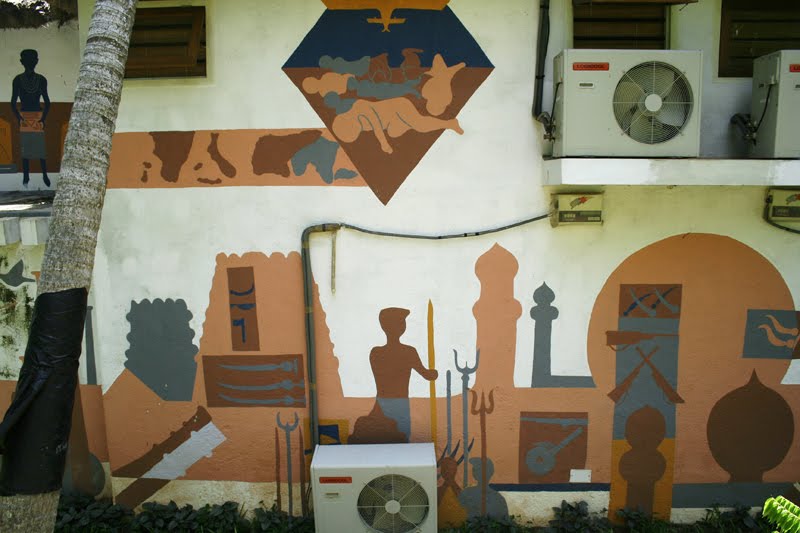
Archeology of Memories: A Mural Project by Ajayakumar
‘Archeology of Memories’ is a mural done by Ajayakumar. Former Kerala Lalit Kala Akademy Secretary and currently the Principal of Trivandrum Fine Arts College, Ajayakumar has been interested in combining personal mythologies and history in his painterly works. A strongly committed Marxist ideologue and pedagogue, Ajayakumar looks at history as a contestation between different social forces that results into the production of new materialistic and spiritual contexts. Ajayakumar interprets material contexts as the backdrop against which human beings construct their lives and spiritual context as the system of values that the human beings create in and around his products and actions. Hence, in his works one could perceive these contesting forces coming into play, often vivifying their struggle for supremacy and hegemony. And for him, portraying this struggle itself becomes a registration as well as a critique through painterly methods.
When Ajayakumar was invited by his young architect friend, Syriac to do a mural in his newly created village resort near Poovar, a few kilometers away from the city centre of Trivandrum, Ajayakumar thought of creating a series of images, which could represent and debate the violent interfaces between the local history and the history of colonial incursions in this region. Being a seashore village, Poovar had been close to the trading centers created by the colonial forces. The history of Kerala after the 13th Century AD is intricately connected with arrival of the Western forces along the sea coast of the state. Though it does not hold any visible remnants of erstwhile colonial presence, while watching the sea from the hill top where the resort is located one cannot help but wonder at the history of forced juxtaposition of cultures that has produced both good and bad results.
Micro histories constitute the macro history. But ironically, in the larger picture of macro histories, the small incidents get submerged and forgotten. The big picture does not allow the small pictures to emerge and tell the world how these small confrontations made all the difference. However, when an artist with a very inquisitive mind approaches the history with a purpose of analysis, he diligently digs up the micro histories of the location/place and region and highlights it against the larger narratives. When Ajayakumar came to Poovar in 2006 and saw the single unimposing structure that his friend had created as a central module of a future resort, he could connect immediately with the location and the small narratives that constituted the location as in the present. The liminality of the space, which is virgin and unarticulated, attracted Ajayakumar and today his mural, which took almost four months to finish tell us how the artist approached the places which had not been addressed earlier and how he could transform those areas into condensed narratives of materialistic and spiritual struggle of a people against the hegemonic forces.
The first image that hits the viewer/visitor/tourist is a combined image of three different civilizations; a combination of the perfect ratio as imagined by Da Vinci in the human form, the Egyptian civilization as represented in the Pharaoh-ic figure and the Asian civilization in the image of a standing Buddha that reminds one of the Bamian Buddhas. This unified figure does not need too much of clinical analysis as it tells the tale of civilizations that had been in confrontation with each other for ages. But here Ajayakumar does not become overtly critical about the hegemonic powers. Instead, he concentrates on the harmony of the three images and it is a way of telling the viewer that the contestations between the civilizations in fact create ‘culture’. But as an artist he is aware of the brutalities involved in this creation/production of culture. And these brutalities are symbolized in a series of seals with hieroglyphic inscriptions around the central figure. As the viewer proceeds towards his left, he could see war images. War often came by sea and then by land. Ajayakumar represents both these locations and also in different tiers he gives the suggestions of modern warfare. By bringing the modern and ancient war scenes in the upper and lower tiers of the building respectively, and also by suggesting the collapse of Iraq through the presence of a historical architecture, Ajayakumar forwards a critique on the imperialist forces that are still on rampage.
A closer look would reveal that all these wars are happening against religious structures. There is a subtle connotation that all the imperialist wars have got a religious justification as well as a religious backdrop. The inexplicable brutalities of the hegemonic wars are represented by a heap of human bodies in writhing positions. Above this heap one could see the disc thrower from the classical Greek sculptural tradition with a changed body posture aiming at something and he is set against the silhouette of a nuclear missile. Here Ajayakumar becomes clearly critical about the modern western civilization as an incursive force that aims at destroying the varieties of civilizations elsewhere and producing a steamrolled and unified culture.
Without making overt judgments on the so called pacifist nature of the Eastern civilizations, Ajayakumar compels the viewer to see an Egyptian scholar of the ancient times standing before two pyramids and revealing his findings to the world. He is positioned as a giver not as an aggressor. The artistic self could be seen in this surrogate image as this portion is clearly marked away from the war scenes.
In the upper tier of the front wall, the artist has rendered a narrative from a mythological story. This is the story of a serpent who wanted to swallow the celestial bodies like moon and sun. But in the process he was cut into two by the Gods. Ajayakumar uses this narrative in order to reinterpret it as a refined story of hegemonic aggression. The serpents were the low class people who wished to attain the higher positions through the ‘intake’ of the celestial knowledge as represented in sun and moon. But fearing their future positions, the scheming upper class, the Gods, cut them into pieces. Through the recounting of this story in his own visual format, Ajayakumar brings the class struggle also in the picture but without overtly pronouncing his political lineages.
On the other side of the building that faces the sea in a distance, Ajayakumar paints secular stories as if he were talking to a set of students about the beauty of the place. It is a soothing section with the images of mermaids, Apsaras, sea creatures, fishes, turtles, butterflies, peacocks and many small creatures. These images also constitute the archeology of memory, Ajayakumar feels. The nature around you, the creatures that crawl on the earth, the birds that sing, the mermaids that sing to allure, the butterflies that come to flit around your face and every other simple thing in our life are important. And in the final count these micro narratives stand against the macro narratives. And the pain of the people turns into mythologies and once you re-read those mythologies they tell you the stories that had never been written. In this sense, Ajayakumar’s ‘Archaeology of Memories’ is an enquiry into the liminal, the unwritten.
Sunday, December 19, 2010
Edavazhikal, Radio and Me- To My Children 7
‘Edavazhis’ (alleys) were an integral part of the village life. They were/are the arteries of a village. People lived in the plots on either side of these alleys. Some plots had boundary walls and many didn’t. For the children, these edavazhis provided playing grounds; they rolled the old cycle tyres along these alleys and imagined that they were driving cars. They made a continuous burring sound from their mouths emulating the revving engines that they thought to have controlled. We, the children tied two ends of a long rope and stood within it in a long line with the boy in the front acting as the driver of an imaginary bus or train and the boy at the back acting as the conductor. From different points of these alleys girls and boys waved these buses down and got into it to ‘go to the town or to the relatives’ houses’. Grown up boys cycled through these alleys to catch the glimpses of the girls who they thought were in love with them.
During summer, the weavers prepared their white threads on stands kept along the length of these edavazhis. During monsoon months these pathways became puddles where the children happily played like piglets. During the cold days of December and January children came around to burn the dried up leaves and enjoyed the warmth of the fire. The grown up people had a different feel about the edavazhis. As they were grown up people, they lived their lives realistically. They did not find the edavazhis as treasure troves as felt by the children. Only the drunken men and mad people found edavazhis equally exciting. And in any village you would find permanent drunkards and resident mad men. Women going to the market avoided those edavazhis where they expected the sudden appearances of the drunken men or mad people. When it rained, we the children sat in our verandas and watched wet black umbrellas and plantain leaves moving along these ways. People did not always carry umbrellas so when it poured they just entered any plot of land and plucked some large leaves including those of the plantains and used them as umbrellas.
It was in these edavazhis that I learned the primary lessons of being friends with other boys and girls in the village. I remember a few of us moving like some creatures under the white threads horizontally stretched on stands by the weavers. We did not disturb the threads and the weavers allowed us to enjoy the feeling of walking through a white cave. From the one end of the edavazhi where these threads were dried and prepared, it looked like a never ending white sari stretched to perfection. Like any other child I too liked the feel of it and the children always enjoyed passing through any cavity that perhaps reminded them of the security of their mothers’ wombs.
Today, I find you, my son, mumbling things to yourself. He speaks to himself and he keeps transforming into several characters at every passing moment. When he is at the washroom, we could listen to him speaking in different tones, reliving some television program that he has been watching for ages. This is one drawback of kids growing up in the cities with over protective parents. The parents don’t allow the children to go out and play. There are reasons for it. The streets are no longer safe for children. With the changed ways of life, we anticipate threat at every corner. We live in perpetual fear and anxiety about our children. And we fix time for our children to go out and play in the parks or we take appointments with the parents of other kids so that we could send out our son to their homes to play. But I have observed one thing, the children love to play with other kids but as they are so much engrossed in their television programs, they prefer not to meet their friends. They refuse to go to the park and play. They are glued to the television sets or computer screens. So they get more intelligent and more obese.
During my childhood there were no televisions. Mornings were announced not by an alarm clock or the honking of school buses in the streets making their first trips. Evenings were announced by the slanting rays of sun and the chirping of the birds that flew back to roost. For the kids, night meant a sort of liquid dark and think magical potion from which visions both soothing and threatening came out. Grand parents told us stories and the cousins and other elderly people around discussed their lives and we gathered some anecdotes and episodes from their mouths. We also did our homework and the home work started with the recitation of a prayer before a lit lamp. Then we opened our books and read out aloud. When a new pencil was given to us, we wrote words and digits on our slates. We were not given notebooks till the age of ten. We wrote everything in slates and rubbed it off when we were supposed to write other things. We used the stem of some juicy plants to wipe the slates clean. When none was looking we used our saliva also to clean it up. After doing that we smelled our own palms to feel the nasty smell the saliva had created. It gave us a strange kick. Children did their homework mainly for getting their supper on time. Mothers said that children did ‘Chottu Vaayana’, which means ‘reading for supper’. Once the supper was served all homework ended. Sleep came soon and kids huddled together under the blankets and bed spreads.
There used to be several children around in the families. The families were not strictly joint families though children of aunts, uncles and the children from the neighbor’s houses always gathered during these evening rituals. The elders entertained them and seeing us playing and fighting in turn was a great entertainment to them. People had all the time in the world. Radio was the only technological device that brought the world into the homes. Most of the houses did not have a radio set. And having a radio or cycle at home was a big affair and to posses one, we had to take license from the Panchayat office. Everything went on quota basis. Even cement was rationed and one had to take permits to buy cement from the public market as government controlled the sales of construction materials.
Ours was one of those households where there was a radio set. It was a huge valve radio. When there were some state level or national level important political incidents, people from the neighborhood gathered in front of our house to listen to the radio news. My father switched on this valve radio and I always thought that this radio set had a personality of its own. Perched on a high stand, this radio looked at us with its cold face. And when it was switched, it took some time to wake up from its slumber. First, it made some cracking and creaking sounds and we waited for its single eye on the left side to open. Its eye was green in color and it parted in the middle. Once it was correctly tuned and heated enough to function, the green pupils dilated from either sides and touched in the middle only to part a little bit and expose a grey streak between them. Then it started talking to us in different voices. My father tuned it to different meters and waves and he listened to the news items. Once he was retired to bed, my cousins took over the control of it. They listened to the film music, radio plays and the sound tracks of movies. ‘Sabda Rekha’ (Sound Track) was one important program that the teenagers and the jobless cousins always anxiously waited for to listen. Through the familiar voices of the actors and actresses, they imagined the scenes one by one, laughed and shed tears as per the mood of the movie.
We, the children never listened to any program fully. We enthusiastically waited with the cousins to listen to film music or the sound tracks. By the time the program was half way we all fell asleep in different forms and shapes and in different corners and laps. Later, the respective mothers hauled the sleeping children to their beds as if all of them were log woods. The kids from the neighbors’ houses also fell asleep at our home. Later in the night their parents also came and made them walk in sleep and whenever I was awake I could see their feet being dragged along the sand in the courtyard. Though we were not allowed to handle the radio, Sundays were our radio day. There were two important programs for children on Sundays. One was Balalokam (Children’s World) and Kouthuka Varthakal (Wonderful News). For ages we recognized someone in the radio as ‘Uncle’ who entertained us telling stories, reading out letters sent out to him by children from different parts of our state, inviting children to the studio in Trivandrum to sing, act and deliver speeches. In Kouthuka Varthakal, the news reader told us about the curious and funny incidents that had taken plays during the last one week in different parts of the world.
Today, the kids fancy themselves as power rangers, Doremon, Shinchan, Chotta Bheem and so on because they see a lot of television programs. As we had only radio programs as a way to the world, we imagined ourselves to be the characters in the radio. We wanted to grow up and become someone in the radio programs. We wondered at that virtual world of sounds. We were curious to know what exactly went on inside the radio. At times we used to think that a miniature world existed inside the radio box. Once in a while the radio went ‘dead’. The best remedy was to slap it left and right as if it were a truant school boy. The tapping worked most of the times. As if from sleep it woke up and spoke to us again. But sometimes it was more than a slumber. It really needed some medical help. So we waited for one of our uncle to come home, open it and find out what exactly happened to our beloved radio.
This uncle came by cycle. He used to live around twenty five kilometers away from our home. He cycled to any place and he had this special capacity to open up anything and repair them. He repaired clocks, wrist watches, cigarette lighters, torches, radios, table fans and anything that had some ‘mechanics’ involved in it. This uncle always had a suitcase on his cycle carrier and this suitcase contained a few tools of different sizes and shapes, torches, soldering iron, led and a host of cigarette lighters of various shapes. Some of them worked with a few drops of kerosene in it and some of them worked through the activation of two special stones. While focusing at some work, this uncle always smoked a bidi (a locally made cigarette). We waited anxiously behind him when he opened our radio.
The personality of the radio was different when we see it from behind. From behind it looked very vulnerable with those wires going in and coming out. From the front it looked like an ambassador car with a serious face. When the uncle opened the back cover, it exposed a different world to us. So many lights and machine parts that looked like electricity transformers at the junction were there inside it. Once when he opened it, this uncle found out a few newly born mice inside it. It had a lot of vacant space and the holes behind the radio were big enough for the mother mouse to go in. There was no wonder why she found the radio the safest place to deliver her babies. My mother took these babies in a coconut shell and put it in the backyard where she expected the rats frequented. We waited for the mother mouse to come and pick up her babies. Every morning we went to the backyard where old pots were stacked and looked at those babies. After a couple of days they disappeared. We were sad as we were not sure whether they were taken away by their mother or scooped away by the crows, which were always there or the cats that sat philosophically on the boundary walls waiting for my mother to come out and cut some fish.
There was a wall clock in the drawing room. It was a spring clock that needed winding every morning. My father religious wound it up and when he climbed on chair to do the winding I stood below and looked at it and watched the wonder spring that got tightened at each winding. When father turned his hand towards left to wind, I made the sound ‘Kikkidee kee’ and in the second time the sound came differently; it was like ‘Kidikidi kee’. This ritual went on for several years till I was grown up enough to climb and wind the watch for myself. Even when my father allowed me to do this ritual, while doing it I used to mumble along with turn of my hands, ‘Kikkidee kee, Kidikidi kee’. And like the radio the wall clock also had a face, but a very smiling face with a tongue like pendulum always wagging left to right and then right to left marking the passage of the moments in our life. I used to stand before it and looked at it intently. It spoke to me in a different language, which I never attempted to decipher. But happy I was to stand like that and communicate with it. When years passed, it became an ornament as it was declared dead by my visiting uncle. He said, it was beyond repair now.
I had this wish to become a radio star. This was in a way fulfilled after several years. I had a friend named Nizar Syed. We met each other when we joined for the pre-degree course at the Sree Narayana College, Varkala. He used to be an enthusiast and took interest in so many things including theatre. His elder brother wrote and acted in plays and his uncle was from my own village and was a famous professional stage actor. As we had these similar interests we became thick friends soon. After pre-degree, like me, Nizar also went to Trivandrum and one day I found him a very famous personality. And he became a radio star! Everyone was talking about the program that he was doing.
This program was called ‘Prabhatabheri’ (Heralding of Morning). In today’s parlance if we translate the nature of the program, we could call it a ‘reality show’. Nizar befriended some produces in the AIR, Trivandrum (All India Radio). They gave him a tape recorder and mike. He went around and talked to people. He was addressing the vital social issues. And each morning, through the AIR Trivandrum station, the local people were expressing their feelings, observations and criticism on the government and governance through this program. People were talking through Nizar and there was no wonder why he became a star soon. I was feeling jealous of this guy. I contacted him and he put me across to his producer in the AIR. She was a good soul and she asked me to do radio features.
I had become an intellectual by then. I had already started publishing my poems, stories and articles in some magazines and the Sunday supplements of some newspapers. And I never wanted to do anything journalistic; I wanted to do creative stuff and I thought my friend, Nizar was doing journalistic things. So I told the producer that I would do features related to art and literature. She agreed and gave me a tape recorder and mike. I had already done a script and had decided to interview a few budding poets in Trivandrum. My topic was ‘the New Wave Poetry in Kerala’. I went around, interviewed friends and poets and all of them talked about that day, that glorious day in which the poets and artists ruling the world. They lashed out against the growing commercialism in all the walks of life. They talked about their poems and dreams. And the program was broadcasted and I was happy. The producer asked me to do more programs but by that time I had lost interest in walking behind people and taking interviews. I was hanging out more with fine arts college students and spending hours after hours in libraries.
A few of those poets whom interviewed for the program became news readers in television channels when channel revolution hit Kerala. They all used to look very shabby in those days. Years later when I saw them in the television screens, they looked different; totally different. All of them had grown thick moustaches and chubby cheeks. All of them started looking like Mammootis and Mohanlals (two superstars in the Malayalam film industry). The transformation was fantastic. Even today, when I go to my village, people who knew me as a child, as a young boy and also as a young man, keep fingers on their nose and make ‘tut tut’ sounds with their tongues. They ask me what has gone wrong with my life. I smile at them. I know why they ask these questions. They want me to be pot bellied (like the Malayalm film stars) that shows prosperity by forty, they want me to have a proper hair cut and they expect me to wear clothes of their choice. And above all when they ask me what I do for my living, I don’t have any specific answer for that. I tell them I write. And they still don’t believe I can make a living through writing only. To tell you the truth, I don’t do anything other than writing. My profession as a curator also is one form of writing for me, the way I perceive it.
Nizar remained a friend for a long time. He started writing in the mainstream journals as he had this stardom. I felt irritated at times because he was getting more attention than me. Besides, I thought that I was more qualified to become a radio artist or a writer because I had appeared for one of the AIR examinations towards the post of a news reader. Perhaps that was the only one examination or test that I have ever given in my life for getting a job. My mother used to force me to fill up public tests for jobs. I used to get these hall tickets. On the examination day (mostly Sundays) I went to the examination center and after hanging out there for sometime, went to the near by places to see the life around. Once I sat for a test as my mother accompanied me to the examination center and left me with no option to slip away. I passed and got an appointment letter in some government department but by that time I had escaped from Kerala.
But the AIR Examination was my choice and I went to Calicut (Kozhikode) to give the test. I was nineteen years old then. It was my first trip outside Trivandrum district alone. I went by a train and it took nine hours to reach the place. I took a room in a lodge and the next morning appeared for the exam. It was successful and a couple of months later I got a call for the interview. Once again I went to Calicut and appeared before the interview panel. I did well. Read news in the studio for the voice test and I was cleared. But I did not get the job. The job went to another person who later joined the Doordarshan (DD Trivandrum) and became one of the successful newsreaders. In that trip I went to see Vaikom Muhammad Bashir, a legendary writer in Malayalm literature. He was very old by then. His admirers were allowed to visit him at any time. When I went there he was sleeping. His wife asked me to wait but I had to catch an afternoon train. I told her (Fabi Bashir) about that and she opened a window for me and asked me to see him sleeping inside the room. I saw him through the window and went back to the railway station.
Life is always strange and it has its own game plans. Nizar, after spending a few years with the AIR, went to Gulf Countries and became one of the biggest radio stars in the region. From there too he used to write articles for Malayalam journals. And I am sure he must be one of the experienced radio personalities from my generation. We were in touch with each other for a long time. When I was doing my graduation in Trivandrum, I used to get invitation from the Trivandrum Doordarshan to present poems and participate in quiz programs. I never found success in quiz programs though I used to appear in them quite often. But the poetry sessions were good. At least amongst the classmates and family circles I got a temporary star status.
But several years later I did become a news reader in the AIR. Now I was not reading at the AIR station in Trivandrum. I was reading it from New Delhi. The senior new broadcaster, Gopan met me in one of the parties and he liked my voice. It was in late 1990s. I was a struggler in Delhi and Gopan asked me to meet him at his office. I went and met him and I was given a formal test and the next week I was reading news from the AIR, New Delhi. I read three news a day, the early morning news, the mid noon one and the evening one. It was the Delhi relay of national news in Malayalm. They gave us PTI news feed and we had to make readable news out of it. There used to be two people in a session and while one read the other stood stand by. If anything went wrong, the other person should take over.
‘Akashavani, Varthakal Vaayikkunnathu JohnyML’ (This is All India Radio and the news read by JohnyML). Soon I became a radio star in Kerala and I did not know this was happening till I once visited Kerala and people recognized me as JohnyML who read news in the AIR and the same person who did political reporting from Delhi for a famous Malayalam magazine. Life takes you to places. As an appreciation to my voice, my ability to translate news fast, I was selected for the midnight news, which was strictly relayed in the Gulf countries. So I started reading the Gulf News. This went on for three or four years till I grew tired of the boring nature of it. I was no longer thinking about me as a radio-television personality. As my work was based on temporary contracts I decided not to renew it though the authorities insisted that I remained the readers’ panel.
Let me go back to the edavazhis and the evenings of my village. As I said earlier, it was in these alleys I met my friends and created life long bonds. It was in these alleys, I received the first side glances from a girl whose white shirt was wet at her mid rib thanks to the hair that she had washed a few minutes back. She appeared before me from nowhere and she was holding a bunch of books close to her bosom. She had a one red bangle each on her wrists. As she passed by me I smelled the cool fragrance of the ‘cuticura’ powder. And she had a small red bindi on her forehead. Did she smile at me? Oh my god, I would have died then and there if she had. I decided to live only to see her again in these edavazhis and to tell the stories of my bonding with childhood friends.
Saturday, December 18, 2010
The Leader and the Accused- To My Children 6
Two different pictures: In the first one, I see myself sitting on the shoulders of a few young men, with garlands around my neck. Students and white dhoti-shirt clad men shout slogans, ‘KSU Zindabad, JohnyML Zindabad.’ The second picture also has a procession in progress, though this time I am not seen in the picture. It is a protest rally and it comes to the gate of my house. They render slogans in the air and it sounds like, ‘Vakkom Lakshmanan Murdabad, JohnyML Murdabad.’ I look for myself and finally I see him there standing behind the doors and looking at the protestors. Both these incidents happened when I was a student in the Vakkom Government High School where I studied between 1978 and1984.
Unlike the primary school years, my high school days were eventful. My father, after a few years of political silence had joined the Indian National Congress under the leadership of Indira Gandhi. He had a great disillusionment with his Revolutionary colleagues. My father never tried for any positions in the party nor did he try to contest in any elections. Even today I don’t have any clue about his political disillusionment. He used to be a reader of history of India. He read all the works of Marx and Engels. He also had the works of Jawaharlal Nehru and Mahatma Gandhi in his collection. During the years of estrangement with the RSP, he was negotiating with the ideologies of different parties. Somehow he could not come to terms with the left ideologies. He was critical of the Congress party but eventually as a political being he had to publicly pronounce his alignment with a political establishment and it was the Indian National Congress.
Even before my father officially became a Congress member, he wore Khadi clothes and he was very particular about washing his own clothes. To whiten the Khadi dhoti and shirt, he used a mixture of Tino Pal and Robin Blue, two brands that have gone out of the constellation of our consumerist desires. In the place of Robin blue, a fine blue pigment, there came Ujala, a brand that produced liquid blue. And it was mandatory to have some worn out parts in these Khadi clothes. These torn off portions of the Khadi were symbolic of a life spent in penury, struggle, idealism and humility. My father’s Khadi dresses also had this kind of holes here and there and he flaunted them with a certain amount of flourish. As you know, a true Quixotian he was, he did not find any problem to wear a pair of dark goggles to cover his eyes. Perhaps, he liked the Dravidian politics of the neighboring state of Tamil Nadu where MGR ruled the roost for several years. As my father was balding by the time he got married to my mother, he started even wearing a cap like MGR. With the black glasses and cap, he resembled a DMK leader than a Congress leader. But when he officially joined the Congress party, he left the habit of wearing the cap.
One day father took me to the near by town Attingal to see Indira Gandhi, who had come to campaign for one of the elections in the state. Political Emergency was over and it was her come back trail and Indira Gandhi was traveling all over India in order to gain the confidence of the people and to campaign against the Janata Government. I never wondered, why my father, a former socialist and revolutionary party member, decided to join the Congress party. The answer was clear; he never wanted to go the extremes. During the Emergency days, I remember seeing the major newspapers and magazines coming out with censored news items. The local weeklies were campaigning strongly against the Emergency. Interestingly, my father used to get all the journals that opposed the Emergency. I could see all those radical cartoons and writings by O.V.Vijayan in the local magazines that my father used to bring home.
During the Emergency period most of the intellectuals in Kerala were under political surveillance. Many of them went underground and those who were working in open were caught and tortured by the Police. There was a strange combination of political force working at that time in Kerala. The Communist Party of India (CPI) was in alliance with the Congress then. K.Karunakaran, who later became the Chief Minister of Kerala, was the Home Minister during those black days of Emergency. The state police hunted down young people who were influenced by the political radicalism. One engineering student, Rajan, fell victim to the police atrocities. There were several temporary torture camps in Kerala at that time. There were several custodial deaths. Rajan was one of the several young victims. Rajan’s death became one of the pivotal incidents that created real turbulence in the modern history of Kerala politics. In his award winning movie, Piravi (Birth), film maker Shaji N Karun treated the Rajan Case in a very sensitive way. Without directly referring to the murder of Rajan, Shaji portrayed the waiting of an old father whose son was disappeared in mysterious political circumstances.
Had I given a chance to judge my father’s move or an opportunity to tell him about his decision, I would have definitely opposed him joining a party that had just implemented political emergency in the country, committed a series of politico-cultural atrocities and just got routed in a public election. But what a six or seven year old boy could do that time? He never explained why he left the RSP. He did not explain why he joined the Indian National Congress either. Except for one Panchayat Election, I don’t remember him contesting any elections as a Congress person. And he was a member of several trusts and societies in the village and there used to be fierce campaigning and contests for the positions. But those were not on political lines. It had a lot to do with lobbying rather than politics. Politics, in that sense played a very minor role in a village like Vakkom. People were united for social causes and they expressed their opinion through vote when it came to politics. Politics and religion were not major issues in our village. Practical issues ruled the life there.
To tell you about the practical sense of our village that went beyond political and religious affinities I could recount a very interesting story for you. There is a bend in the main road near to our home. This road that came from the town Attingal ended at a small jetty in the backwaters a few minutes walk from our home. One day my father, in his own Quixotian way found out that there could be some accidents if the bend in the road is not straightened. He spoke to the authorities and they told him that the Public Works Department should have taken the responsibility. At that time there were only three or four buses that came to our village. One Kerala State Transport Corporation’s Benz model ordinary bus that came around 10 O’ clock at night from Trivandrum city and halted near the jetty and left the village at 6 O’clock in the morning was the main source of conveyance between the outer world and the village. This bus was mainly meant for patients who went to the Trivandrum Medical College for treatment. The bus used to take almost two and half hours to reach Trivandrum. Today the same distance could be covered within one hour by bus. And two other private buses came to the village in fixed times and the bus workers and the villagers knew each other very well. So there was no scope of having road rages.
Still my father thought futuristically! He thought there could be accidents because of that small bend in the road. Hardly cars came to our village. There were two or three Mark two Ambassador taxis in the junction. People called taxis in three occasions; when someone fell ill or broken a leg or something, when someone got married or died and someone went to gulf countries to do some menial jobs. So they were also not life threatening. Most of the time the taxis stayed idle, so were their drivers. They killed time by playing cards and gossiping, and they ogled at the women went to the market to buy fish and vegetables. But there were some cycles in the village. At that time very few people like school teachers and shop owners owned a cycle. Rest of the people rented a cycle. There were certain shops from where you could hire a cycle against for twenty five paise per half an hour. There was no distance in the village which couldn’t have covered in half an hour. Most of the people walked all the time. Youngsters hired cycles mainly to go behind their love interests or to see girls loitering in their courtyards by evening. None in the village was like a superman who could ride a cycle in forty kilometers per hour. So cycles were also not life threatening.
My father spent some sleepless nights thinking about rectifying the defect of the road. I don’t know he was being selfish at that time. We and our friends were the kids in the area and unlike the children of these days we were always careful while crossing the roads, jumping across boundary walls, venturing into thickets, climbing trees and so on. Was my father trying to protect his children from a possible accident that could have caused by the bend in the road? Whatever may be the reason, eventually he got a few youngsters, who believed my father in socio-political and cultural matters, as volunteers and they started making bump across the road. The logic was simple the vehicles coming and going would slow down at this place as the speed breaker was made. The volunteers worked throughout the night. The neighbors and well wishers came around to lend a supporting hand. Women brought in tea and snacks, we children hovered around them and cheered ourselves.
Next morning, the speed breaker was formally inaugurated by my father himself and the youngsters who built it came to applaud him in his feat. Generally speaking, people were convinced of the sudden appearance of this speed breaker. But everyone was not equally amused. Amongst them, there were hand cart pullers and bullock cart drivers. Trucks and pick up vans were things of rarity at that time. Trucks came only when there used to be some construction or road work. Pick up vans came when someone brought some furniture. But that was very rare. People got their furniture made in the village itself. But the hand cart pullers and bullock cart people used the road for bringing materials in and out. Mainly they brought provisions for the government run ration shops that sold rice, wheat, sugar and kerosene for affordable rates.
The speed breaker became a big issue for these people. The bullocks found it very difficult to pull the cart across the bump. So were the hand cart pullers. They struggled a lot when they came in front of the house. Slowly, they lost their patience and they started saying bad words about my father. They spoke so loudly that we could listen even while sitting inside home. Finally, they decided to remove this speed breaker. One of them, who was living across the road brought his shovel and pick axe and started digging the bump. He was muttering to himself and soon people gathered around him. He explained his problem to them and soon the very same people who helped my father in making the speed breaker joined forced with the hand cart puller and removed the bump in no time. They were convinced of his logic also. Practical issues were more important than cosmetic futurism, they thought.
Before I go into the details of the two pictures that I introduced in the beginning of this episode, I should tell you a little about my father’s entrepreneurship. I told you how the young boys used cycles to move around in the village. More and more boys were coming of age and they were having this perennial need to see girls every evening. In a conventional society, only side glances and occasional smiles or a chance meeting in one of those edavazhis (alleys) were the ways through which the youngsters satisfied their rising Eros. My father realized that there needed more cycles for hiring. He had one cycle already and he bought one new cycle (Hercules company cycle. In those days cycles were produced by Hercules and Atlas, or we knew only about these two brands as we knew only about Ambassadors and Premier Padminis in the four wheel sector) and an old cycle. So there were three cycles owned by him. He made an agreement with a small tea shop owner across the road. He would rent out the cycles and the income would be handed over to my father every evening. A small commission would go to the tea shop owner.
My father believed in DIY, Do it Yourself. He took out one cardboard sheet and pasted a white paper on it. Then, using his ball point pen, he made an outline of the following letters: New Cycle for Hire. Then he thickened the words with a set of ball point pens. Once the board was ready he went and hung it before the tea shop and strictly instructed the man that he should not give the cycle to anyone who wanted to carry heavy loads on it or wanted to go out of the village. The business was going on smoothly and one evening the new cycle did not come back. My father was agitated and he asked the tea shop owner for explanation. He told my father that the cycle was hired by a person known to him and he would definitely come back. For three days the man did not come.
Friends came around and my father discussed the issue with them. They thought of giving a complaint to the police. But a government servant running a business for profit was a punishable offence. So they did not think in those lines. Instead they decided to wait for some more time. And on the third day, surprising everyone the person who hired the cycle came back to the shop, of course with the cycle. He had gone to a village near Trivandrum city, with a calf in a bamboo basket tied to its carrier. Both the rules set up my father were broken. He was made to give double charge as a punishment. But that was the end of my father’s cycle on rent business.
So I grew up as my father’s son but I was not interested in his Do It Yourself attitude. My father used to paint boards for his social activism. He and his friends set up a new establishment for reforming the village. They rented out a room and an office started running from there. They intervened the issues in the village and solved it through both official and personal ways. They did not have much funds to work like that so when the question of making a signboard for the organization my father volunteered to paint one. He got one tin sheet board made. He bought paints and cut stencil forms of letters from newspapers and pasted them on the board. Then he painted them over and could make a decent sign board. And his membership in the Congress Party made him busier than before. Now he had political matters to attend besides his usual village reformation activities.
A Congress man’s son could not have become a Communist ideologue or activist at the age of ten or eleven. So when I went to the high school I was made a member of the Kerala Students Union (KSU), the student wing of Indian National Congress. So I started off as a Congress student politician at the age of eleven without knowing a thing about real politics. Whenever there is a student agitation elsewhere, the local Congress leaders came near the school, called me and other senior members of the student union out of the campus and explained us the need for disrupting classes on that particular day. They explained things to us but we did not know why we were agitating. I led strikes and shouted slogans like KSU Zindabad.
At the age of twelve I was elected as the speaker of the School Parliament. I was a good debater and orator, I should add that I was good considering the village standards. I was a member of the Boys Scout and I enjoyed wearing the Scout Uniform and even imagined one day I would become a police or army officer. But I was always drawn to the libraries and girls. I craved for the presence of books and girls. As I was a student leader, I got the chance to speak to girls. Girls had a different wing in the school and only the leaders could go to that wing that freely. The non-leaders, I mean the followers could watch girls standing down at the assembly ground. I used to participate in most of the competitions including story writing, poetry writing, recitation, elocution, mono-act, light music, drama and so on. I used to be a jack of all and master of none. But I had some mastery over words. I could move students through my speeches.
I had a convincing victory over my opponents who came from the Students Federation of India (SFI), the student wing of the Communist Party of India (Marxist), CPM. Prime Minister post went to a girl who was in the tenth standard. The school elections were miniature forms of the public elections. People from all political beliefs gathered around the school and waited for the headmaster to announce the names of the winners. When the names were announced the villagers rejoiced as per their political leaning. During those days the high school at Vakkom was the hub of village activities. When there was a function in the school, the whole village considered it as their own function.
In the first picture what you see is my picture after being elected to the school parliament. I was taken around the village on the shoulders of party activists. My father did not come to the scene. He might have shed the tears of happiness sitting at home. After the circumambulating the village, I was taken to my home and the people came behind me, shouting slogans and cheering me up. JohnyML Zindabad. JohnyML Future’s Promise. Whoever got a chance to shout these things through the loudspeaker did not waste the opportunity. As you think, as a school parliament speaker do not have too many responsibilities. Whenever school parliament is on session that was once in a month, I was supposed to chair the proceedings, which I did very well. I debated different issues mostly related to education than politics. And in the daily assembly gathering, the speaker and prime minister took turn to recite the national pledge, ‘India is my country. All Indians are my brothers and sisters…’ Next year I was defeated by the SFI students. And on the next day of my defeat I wore my first Bell Bottom pants. And I remained a KSU leader throughout my school years and by the time I left school I had come out of the thought of being a politician. I had started seeing my life differently.
In the second picture, I am not there. But you see a procession coming to my home, shouting slogans against me and my father. The year was 1982. The Government High School, Vakkom was celebrating its Platinum Jubilee. A committee was formed to celebrate the event and most of the social activists from the village became members in the committee. My father took up charge as the editor of 75th Year Souvenir. The same year I had won a prize in the State School Youth Festival for poetry writing. These youth festivals were large scale affairs with selected participants from all the high schools in Kerala contesting in different art forms. That year I was selected from the Attingal Education District for poetry writing and theatre. While I won the poetry competition, after two stages, the theatre team led by me lost a chance to go for the final. The play was ‘Makudi’ (The Snake Charmer’s Flute) and I acted as the Snake Charmer. The play was heavily symbolic. Written by Balachandran, this play had all the characteristics of the School of Drama experiments of 1970s. To become the snake charmer, I had to do paint my complete body in pitch black. I was already dark in complexion but the director of the drama insisted that I should be painted over. The black grease paint stayed there for almost a week after each stage.
I used to get this ‘best actor’ award in the high school. Every year, for the annual function, the teachers and students jointly rehearsed some professional drama script and presented the play in a very professional way. We all worked for these dramas even if we knew that this would not last more than one stage. We hired sets, light and sound systems from the professional troupes and whole village came to see these dramas. I grew up watching my seniors getting all praises for their theatre activities. It was quite natural that a young boy with a lot of imagination falling for the charm of theatre. I still remember an incident when I was on stage as a doctor whose one arm had broken in accident. My hand was in a cast and I was supposed to get a cigarette lit by my wife. This role was enacted by a girl whose mother sold vegetables in the local market. Everyone in the village knew this girl as she also sat with her mother during the holidays. But she was not a good actress. She could not deliver a dialogue in normal pitch. For her dialogue delivery meant a sort of screaming. So whenever she opened her mouth to deliver a dialogue, the mischief makers in the village, hiding behind the back rows called out the names of the vegetables and it was extremely difficult for us to control our laughter. In that particular scene she came close to me and lit my cigarette and from the back rows I could hear some one screaming, Johny, your father is waiting here with a chooral (cane).
I should say I was forced into acting because of one incident happened during one of the summer vacations. I was in the sixth standard and during the vacation we went to Trivandrum where most of our relatives lived. One of the cousin brothers of my father lived in Madras and in the family circles he was known as a film produced. He had produced one movie with Prem Nazir as the hero. The film did not do well and he never made another film. However, he lived the life of a film producer. He always wore silk kurtas, white dhotis and black leather shoes. During those days, the movies with family themes always had two chubby children, Master Raghu and Baby Sumathi, to add sentimental value to the movie. Any chubby children of that time wanted to become a Master Raghu or Baby Sumathi and I was chubby too. This film producer uncle saw me in Trivandrum at some family gathering and he asked me whether I was interested in acting in films. I don’t know whether he was serious or not he even told my father that he would look out for a role for me. My father was elated and when we came back to the village I told a few close friends about my impending stardom as a child actor. Soon it became a talk of the village. Everyone started asking me when I was going to act in a movie. The queries became almost regular that it was difficult to give evading answers and finally the news that started off as a very ‘serious’ one turned into a joke. I had a very difficult time in saving my skin from the poking of people. Both the children and the grown ups derived some strange pleasure by asking about my film career. And in a small village everyone knew each other and most of them had a lot of time to put their fingers in other’s matters.
Slowly, I was recovering from the insults and injuries caused by that one lucrative offer made by my uncle who never kept his word other than presenting me a silk kurta and a pair of Kolhapuri chappals that I had demanded from him after seeing him in such attires. But I was already bitten by the acting bug. So I decided to write a play of my own and present it in the school anniversary. It was a family drama and in the family drama an ailing old man and an unmarried daughter were a must. The brother should be an educated drunkard. There is a mandatory scene in which the villain is shot down by a police inspector. This was to show our skills in making an egg filled with red ink and hide it under the shirt and break it when you were shot at. The brother decides to take care of the sister when the father dies in their presence. The school provided make up men for all those theatre aspirants. As the key role was that of the old man, I chose to act that part. My friend Suresh became the unmarried daughter. After the death of the villain and so on I was supposed to fall on a bench, which was supposed to be a cot and die. I fell, but along with me the bench also fell down. So I got up, straightened the bench and died once again to the ultimate merriment of the audience.
These track records of mine as a student union leader, actor, writer and a hopelessly aspiring all rounder made my father think that I was a genius and I deserved all attention from the public. During the same period I had won a state merit scholarship and my photograph had come in the local editions of some newspaper. My father was really inspired by all these and it was his paternal desire to feature me in detail in the souvenir that he was editing as a part of the Platinum Jubilee celebrations of my high school. All the commotion broke out when the souvenir was released as my photograph was published in two places in the same souvenir. Besides, in the section of literature he published my prize winning poem. In the editorial section, along with the other members in the committee my father published his photograph also.
If you look at the issue in an objective manner, my father had not done anything wrong in doing all these. My photograph was published for the right reasons along with the photographs of many other students. My poem had won a state prize so it naturally deserved a space too. My father was the editor of the magazine so his picture with his team members was inevitable. My sister was the topper in her standard and along with all the toppers her picture was also published in it. The protesters interpreted this as my father’s highhandedness and they said he should have published his wife’s picture also. Looking back, I feel that he could have exercised his editorial discretion in order to reduce the presence of his family members from the souvenir. But in a way it was impossible to do injustice to his own kids who deserved such acclamation along with other kids.
The protest march came to our doorstep and they were demanding an explanation from my father. And they wanted the souvenir to be reprinted with necessary changes. They shouted slogans and I found many of my friends, classmates and acquaintances from the village in the crowd. The issue was fizzled out in due course of time thanks to the intervention of other social activists in the village. Once again, the protestors became our friends and people stopped talking about that issue altogether. But the picture of the protestors shouting slogans against me and my father is still vivid in my mind. Whenever I go back to my village home, I pick up that souvenir from the shelf and flip through its pages to see what had gone wrong there. This is one souvenir that has contains the real meaning of a souvenir for me.
Subscribe to:
Posts (Atom)