Saturday, January 16, 2021

Beautification and Mural making are two different Things’: Trespassers and their Public Art


(Artist Vishnupriyan spearheading the Trespassers Project)

They are ten and call themselves ‘Trespassers’. The logo is impressive; a black cat carrying a while space between its body and a flourishing tail. They remind one of the famous graffiti artists in the US, ‘Space-catcher’. Space-catcher’ grabs space; it could be an inconspicuous space under a bridge or a ledge. It could be a wall or a building façade; or even a moving bus. This incognito artist, like Banksy does only one thing; he grabs space and people’s eyeballs. He does not do much other than sticking a logo, a small android image. But he seems to say, look I am here, I am an artist and I make art, and in spaces unimaginable my works will confront you at the most unexpected moments. ‘Trespassers’ differs fundamentally from the Space-catcher, but they evoke something similar.


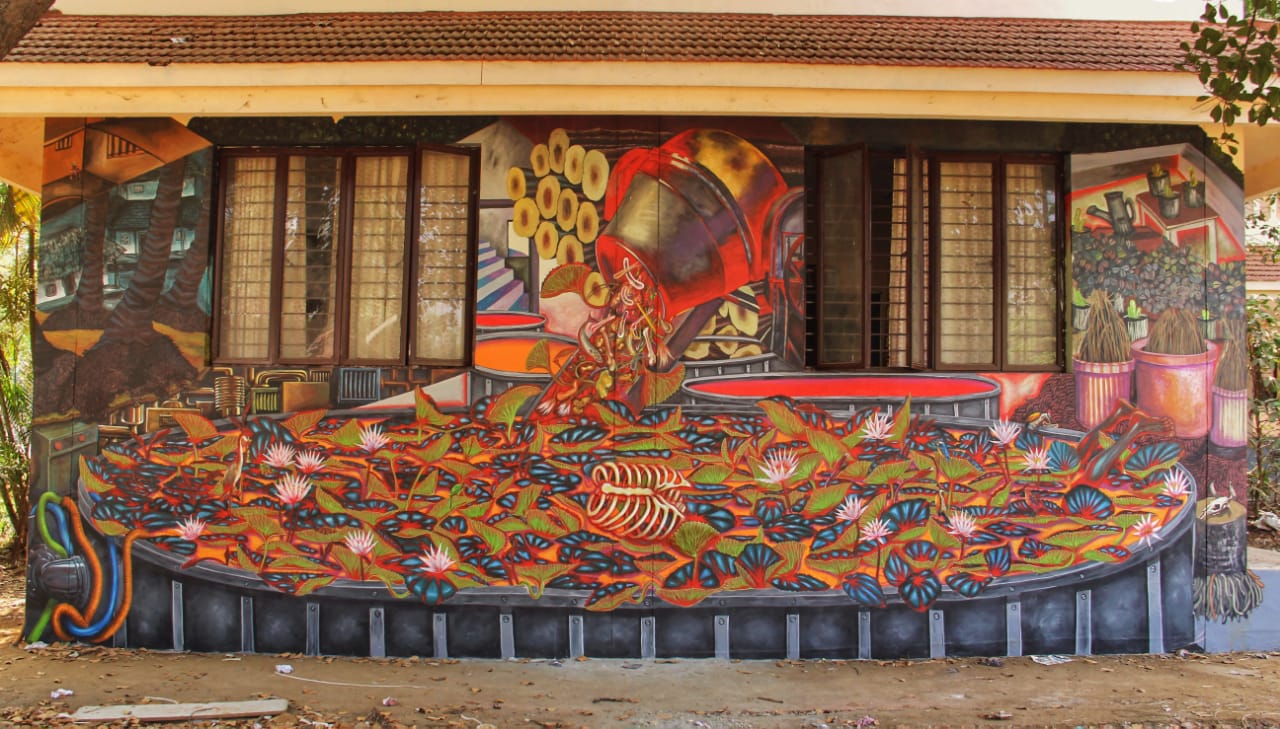
(Trespassers mural projects)

It all started in 2018. Vishnupriyan, an artist who is currently pursuing a PhD from the Kalamandalam deemed university in a north Kerala performance art form, after finishing his post graduate course in painting from the Kaladi Sri Sankaracharya University, decided to launch a graffiti program with the help of his friends namely Arjun Gopi, Ambadi Kannan, Bashar, Jinil Manikandan, Amith, Sreeeag, Pranav Prabhakaran, Vishnukumar and Sijoy Poulose, all graduates or post graduates from the same university. They had a manifesto; they wanted to take art to the people as they realized a majority of them do not go to the art galleries and have a lot of skepticism towards art. These artists also thought that they could eke out a living from doing public art. Sooner than later they found out that graffiti art does not pay, but their passion for the public art was so much that they embarked on a difficult journey by making visuals in the public spaces.


(Trespassers mural projects)


Trespassing is all about encroaching a place or space without permission often inviting persecution. These artists trespass with permission and the visual they create in the walls and building facades and any available spaces literally trespass into the mindscape and visualscape of the people around. Their initial work was in their alma mater itself. They painted huge murals in the campus and they were offered Rs.100 per square feet. They could make some money and they decided to keep aside ten per cent of the amount for furthering the activities of the group and divided rest equally between them. Most of them are doing their higher studies while engaging with the Trespassers activities. So far they have created around thirty murals in the villages and towns; a couple of them were funded by the local bodies and all the other works were self-funded, deriving artistic satisfaction from the works and the public response they get.


(Trespassers mural projects)


No funds but how do they manage? Vishnupriyan has the answer. “We choose spaces for doing murals near friends’ homes. That makes the food and accommodation free. We go to the local hardware shops that sell plastic emulsion and enamel paints and explain our case. They give us paints and a lot of encouragement.” Armed with supplies they go around the village and collect stories from the elders and local enthusiasts. “We ask them what kind of images they would like to see in a public mural. Lot of them tells us about the images they want to see again and again. So we have an archive of local lore, human stories and their visual imaginations. Then we start working on the mural.” Interestingly, while working some people give them company and even give creative inputs making the mural a real public art project.


(Trespassers mural projects)

If there is a will there is a way; this ongoing mural project of the Trespassers proves the adage again. As ten people collaborate in a single visual project there could be differences of opinion emerging at any moment. “We do not have any issues in developing the project visually. We work in tandem and each ensemble of image gives rise to another set of images and as all the artists are aware of the local stories they go by them and keep the color strains more or less the same.” However, only when they work on very large scale projects, they visit the site in advance, see the possibilities and make an initial sketch before starting the actual work,” says Vishnupriyan and adds that, “It is all about incorporating a window, a flight of steps or an air-conditioner duct or something.”


(Trespassers mural projects)

Vishnupriyan also has done a huge mural project in his own village, Pang. One of the images is of an old woman with no upper garment. She is seen sitting in the middle of some men and playing cards. “People immediately notice a half-naked woman amidst men playing cards. She is also playing cards and smoking beedis.” This image comes from a woman in real life in Pang village. She used to roam around without a blouse and did all what men did, including playing cards and smoking beedis. Vishnupriyan is because people are growing fond of the work as days pass by. Nobody has made any objection to the works of the Trespassers. But there are incidents when certain images in their murals have offended the public sentiments.


(Trespassers mural projects)

“We did a mural in a market. The central image was a pig. The Muslim shop owner thought that the presence of a swine in our mural was deliberate and he said that it hurt his sentiments. Finally we had to do some adjustments,” says Vishnupriyan. These artists are still struggling to make money and they are sure that by doing murals alone they cannot survive. But they do have hope as they believe in the power of art in creating a visual sensibility. “What we lack is the training of the public eye. We intend to create one,” “Vishnupriyan beams with confidence when he says this. What about the idea of beautifying the public places through art, I ask. Vishnupriyan says that while that is possible this thought has never crossed his mind. “Beautification is not the idea behind our projects. None of us has thought about making ‘beautiful’ paintings on the public walls. We create paintings resonating with the surroundings and we hope people would see their own local histories in it and feel proud of it,” he says.


(Trespassers mural projects)


Government of Kerala has decided to spend lakhs of rupees for beautifying cities including Trivandrum city. It is urgent that the government and the Minister of Tourism see these young artists’ efforts in creating visual sensibility among the public, without seeking any financial aid from the government. Out of the thirty murals that they have done so far only two of them have got financial aid; one from Kalady University and the other from the Koilandi Municipal Corporation. These artists work as daily wage earners. It is a shame that our authorities make these educated artists toil like migrant laborers. It is high time that they are honored and funded for doing more works all over Kerala. I may even say that the third phase of the Trivandrum beautification project these artists should be invited as special guests and funded them adequately to make wonderful murals that ‘beautifying’ the city with some pre-selected artists.


-JohnyML

Monday, January 11, 2021

Remembrance of Things Past and Recent: The Works of Syed Ali Sarvat Jafri


(Artist Syed Ali Sarvat Jafri)

‘Garden of Remembrance’ sounds like the Garden of Eden. May be they go together for Eden is an eternal remembrance of the things past and lost due to human folly. Hold on! Here none is accusing a woman who has done the deed so that the humans are force-ejected by the God. However, remembrance of a garden definitely foretells an ouster from the places those friendly, habitable and conflicts contained amicably. An artist hailing from erstwhile Faizabad, which is now ‘Ayodhya’, when he names his latest exhibition as a ‘Garden of Remembrance,’ one cannot overlook the Eden from where so many humans were ousted due to aggressive politico-cultural forces. Syed Ali Sarvat Jafri is the artist and if his name doesn’t tell the history of a syncretic India, his works does.


(Works by Syed Ali Sarvat Jafri)

Cultural specificity and the linguistic uniqueness make Sarvat Jafri’s works a bit dense despite the simplistic format of clay tablets that he has chosen for making them. The Urdu script that has now been become a byword for the classical, cultural, North-Indian Muslims, is deliberately used for questioning or rather problematizing the very same identity fixation. Urdu, a language of North India was never an Islamic language till Devnagari script got Hindu overtones. True the language was the medium of finesse and sophistication, of poetry and love, of intoxication and dreams, and a cosmopolitan life. Perhaps, all these virtues were present in the Islamic life of the North, especially in the Audh region, the Nawabi courts there. Sarvat Jafri belongs to one of the Nawab families, keeping its sophistication of language, manners and literary and artistic cultures intact against all odds.


(Works by Syed Ali Sarvat Jafri)

The general mood of Sarvat Jafri’s works is of mourning. Perhaps, it’s my misreading for the artist may be celebrating his culture especially in a time when a name could invoke suspicion and a particular food could land someone in Jail. In a country where justice is skewed and mobs deliver blind justice in the streets celebrating a bygone culture which has been alienated by force of the dominant religious and political discourse could be seen as blasphemy so I do not dare to say it as a celebration but a mourning, a silent and elegant one, like a piece of mournful gazal sung in a moonlit night when the archangel brought the God’s messages to the human beings. Silent mourning itself is an act of defiance; Umberto Eco says that when everyone is making noise, silence is rebellious. Sarvat Jafri’s works intend such a silent rebellion.


(Works by Syed Ali Sarvat Jafri)

Though that is a critic’s interpretation based on the political facts and contextual details of Faizabad which is now Ayodhya, as a resident of the place the artist, Sarvat Jafri does not feel the heat and dust, and mistrust that the people from elsewhere feel upon hearing the news from the district especially after the demolition of Babri Masjid on 6th December 1992 and now after the Supreme Court verdict of giving away the disputed space to the Ramajanmabhoomi Trust for building the temple. Sarvat Jafri says that the discord among the people is not obvious; people in the district try to pull it off with equanimity and cordiality. None openly shows any hostility. But the mutual mistrust has been sown and the political parties thrive on it. Hence, for an artist from a community that is held under suspicion, the best way is to fall back on what the best that the culture could offer and show that a simple flower could bring a smile on a ruthless rogue’s face; that is the grace of simplicity.


(Works by Syed Ali Sarvat Jafri)

Unpacking Sarvat Jafri’s imageries is a bit difficult for as I mentioned above they are cultural specific and linguistically bound. However, the works remind the viewer of the collective unconscious of culture that we all share and the deep rooted understanding of the syncretic nature of India, and that re-awakening to that dawn of understanding is the beginning of recognizing the image repertoire created by Sarvat Jafri. He draws from the subtle stories of Sufism and the Quranic teachings. These stories have found their ways into various cultures, taking various forms and narratives so that the Semitic nature of certain religions do not look so strange; if at all the language has grown unfamiliar that is because of the slow removal it from the official dealings. Urdu finds its continued life in selected pockets and perhaps Sarvat Jafri’s works are one such avenue where the language and its cultural nuances could find an abode in the visual realm.


(Works by Syed Ali Sarvat Jafri)

Sarvat Jafri’s family has been the poets who sang at the courts. Spontaneous in versification and elegant and mesmerizing in imageries these poets had created the sonic ambience of society and it took a long time for the dominant religion to overpower it with the wild beating of drums and blowing of conch shells. Sarvat Jafri’s works are the silent vignettes of history. The choice of the medium is quite noticeable because the meaning of life is so close to the earth and the Sufi philosophy that pervades in the cultural make-up of the artist speaks of the journeys of man on the earth. God’s words and healing power came through these tablets. And on this mitti/clay/earth, Sarvat Jafri etches the memories of a city that once flourished in full glory of the Awadhi culture. He does not show the ruins; instead he gives the suggestions of the phantom edifices eaten away by time and man. He has also created Urdu alphabets using rickshaw rims, suggesting the community’s dependence on the rickshaw business. Syed Ali Sarvat Jafri’s works belong to a different class of contemporary art; a class of art that does not speak of urban glossy surfaces, war, migration and money. It deals with a history and it’s a struggle against forgetting.

-JohnyML

Sunday, January 10, 2021

Re-minding ‘the Lockdown’ Days: Latest Installation by Subodh Kerkar


(Subodh Kerkar)

Subodh Kerkar could turn any material into a piece of work of art. He started off with sun and sand, first in water color and then embarked on journey of dealing with the natural elements in real time and space turning anything and everything in and around Goa into ephemeral installations in its truest sense. The origin of installations lies in the innate need of the rebellious artists who moved against the all devouring appetite of the money market that turned art into money and vice versa. Ephemerality was a quality that they sought out in their works and they wanted to see their works decaying like any other organic matter would, in due course of time, denying the markets a chance to monetize or museumize them.


(The Lock Down by Subodh Kerkar)

A quick learner from materials and a quick responder to the ideas Subodh Kerkar makes curatorial overtures with both materials and ideas, tinged with a sort of Goanese madness for life and art. In his hands sand, waves, sunlight, moonlight, electricity, seashells, rubber tyres, tubes and anything and everything become an ensemble of forms, performing in time and space, at times registered as a spectacular event and other times as photographic moments captured in controlled ambience. Museum of Goa is his brainchild and has been doing well ever since its inception, which houses not only the contemporary works of the Goan artists and also a large segment of his own works.


(The Lock Down Detail)

Corona Lockdown days did not let Kerkar down. He has been active in and through short youtube videos, ideating and inspiring, coaxing and cajoling the artists whose morale was considerably down in those days. The latest installation by Subodh Kerkar is titled ‘The Lockdown’ and it has an oversized pair of human lungs as the dominant image. Slightly Hirst-like in his approach Kerkar, as befitting to a medical doctor which is also one of his early incarnations, makes thorny pair of lungs out of fiberglass and is fitted to iron pipes that resemble the organic trachea and the adjoining vessels, whose edge is locked up by a very familiar lock.


(The Lock Down detail)
The choking imposed by the lockdown days is palpable in this semi-didactic work as the literalness of the image is not hidden by other embellishments than making its surface a bit tricky and precarious by sticking a host of Trifala thorns. The prick of pneumonic bout due to Corona virus and the resultant choking are presented directly through the semi-anatomic imagery. However, the metaphorical meanings would reel out once you look at it in a detailed fashion or rather spend some time contemplating its relevance and endurance as an art work. Corona or no corona (or Go Corona), the environmental pollution caused by our own callous behavior has brought in an asthmatic world wheezing for its life support. If care is not taken, if the erosion of environmental stability is not stopped, especially commenting on it from a state like Goa where rampant mining is not only a political problem but also a socio-cultural issue, sooner than later the sylvan sides of the universe may turn into living hells.


(The Lock Down detail)

The stark imagery that Subodh Kerkar has brought in through this installation makes the viewer wake up and think about his/her own act of sophisticated vandalism of the earth through constant plastic garbage production. There is an alluring tactile quality that is quite common to the sculptures but not of the installations. This allure created by the installation is threateningly fascinating almost reminding the viewers of the sensitivity of the issue that has engulfed the earth, now in the form of a deadly virus and much before in the form of another entity called human beings.
-JohnyML

Babu Maney: A Painter Who Wandered a Lot


(Self-portrait by Babu Maney)

 “Many journeys and meeting many people don’t really help to make art,” says Babu Maney. “You need to sit in one place and make art.” His voice no longer has the agitation and his feet do not itch to set out for another unchartered journey. Rolling stones, they say, do not gather moss, but once they settle down at some place, a major portion of their chunk must have been rubbed off. Some shine and some turn pale and weak. Even in the weakness such stones could reveals the innards of its existence, its veins of pain and a quivering soul. Babu Maney in his early fifties is now like that stone that has settled at Edappady in Kottayam, Kerala, after a long life of a rolling stone.


(Paintings by Babu Maney)

Was it the travel bug or some kind of a search? Babu thinks deeply and he is not able to figure out the answer. Perhaps, it was for both. He wanted to know the lands and also he was in search of something which eventually revealed him the truth of settling down in one place at some point in life and pick up the tools that he once considered dear. After finishing the National Diploma in Painting from the Mavelikara College of Fine Arts in 1990, Babu looked around and saw nothing to support him as an artist. He did not want to become a banner and poster artist. In one of his meetings with a local artist who went by the name ‘Varnam’, Babu chanced upon a book on World Art. Leafing through the book he thought that whatever he had learned in the college were just exercises of minor effect.


(Paintings by Babu Maney)

National Diploma was a kind of educational pattern followed in the Fine Arts learning in which the students were not supposed to give written examinations. That means, those who had a diploma were not supposed to write theory and history papers. Artists, once upon a time, came from artisans communities and many were not good at reading and writing. Diploma helped them to have some qualification. But even after many years into modern education, still many fine arts students preferred diploma over degree because they could escape the tedium of written examinations. Babu Maney got a Diploma and it was enough for him to get an admission in any institution like Santiniketan and MS University, Baroda. (A few diploma holders, with proof said that they too had to write theory and history examinations and pass with 40% marks. I need a bit more evidence to make the difference between a Degree and Diploma). 


(Paintings by Babu Maney)

Babu followed some friends to Delhi and from there to Santiniketan. Failing to get admission there, he reached Baroda in early 1990s and got admission after a couple of attempts. Sooner than later Babu became a ‘figure’ in the faculty, moving around with a promising sculpture student, Gopan Perumbada. Armed with a smile that did not betray any of his emotions, Babu waded through the difficulties of language and money and managed to pass out from the faculty with a Post Diploma in Painting. Lands were calling and he kept moving from one place to another; sometimes as an assistant to a friend and sometimes as a cook to an officer in Kolkata. Upon coming back to Kerala, Babu found himself alone and lost. He couldn’t pursue a lucrative career in the commercial field for he thought his calling as different. Nor could he make anything in the art scene despite his ‘good hand’.


(Portrait of Mother and self-portrait by Babu Maney)

Late Rajan M.Krishnan found Babu’s potential and started helping him by providing him with canvases and colors. Babu bloomed soon; his paintings though stylistically addicted to Rajan’s for some time, took different forms, shapes and hues and the artistic attitude evolved in definite directions. Like an ambitious artist of the time, Babu too attempted to make large scale paintings; dilapidated buildings, old parts of the cities, collapsing architectures and so on became Babu’s favorite subjects. Looking back at those works one could see why the artist was keen on the collapse and decay. He was looking at his own life, collapsed and showing the signs of early decay. Despite his efforts to shake off wanderlust, he found it quite fascinating and his feet were his only carriage that took him to distant lands. He kept on looking for the solution for his art. Epiphany set in when he saw nothing happening to his art in terms of monetary results. He realized that it was imperative to paint and stay in one place. Itinerancy in art is possible only when the artist could find a stable patronage, which was no were to be seen in his case.


(Hampi and Fish by Babu Maney)

The days of boom went by without making many changes in Babu’s life. He was working as a mason in the construction sites. He accompanied his elder brother who is an accomplished mason and got suspended once in a while for his love for bottle became a nuisance in the worksite. “I painted during the days of suspension,” chuckles Babu. During his student days acrylic was not a major medium and today he works more in acrylic for its affordability. Suspension from work turned out blessing in disguise for Babu for he could chuck the habit slowly and steadily while his output grew considerably. He fell in love with himself and started painting self-portraits a la Shibu Natesan. Also he turned his attention to nature and started painting it with a renewed vigor. “I have been traveling and I was not seeing nature, perhaps,” he says, “but once I started painting the immediate nature I recognized the beauty of the surroundings.”


(Paintings by Babu Maney)

Chirico, the Italian painter has been an inspiration for Babu and one could see his works literally making references to the master’s works. He has even painted his mother’s portrait against a famous Chirico works. Once upon a time Babu was obsessed with homes; perhaps, homelessness and incessant wanderings must have triggered such imageries in him. He painted a protagonist carrying homes on his shoulders. Had he been considering homes as a burden or the longing for it was dreaming them down on him? Babu does not say a conclusive answer. Once settled, he is more comfortable with interiors and domestic imageries. Once in a while he makes a small trip to the nearby places and comes back with the mental images of the places and paint.


(Paintings by Babu Maney)

Babu Maney (as in Manet) is not a usual name in Kerala. “It was supposed to be Babu Money,’ he says. He did not know how to make a facebook account and a friend pitched into offer help. While naming him according to the social media requirements, Babu Mony was misspelt as Babu Maney and it got stuck. Money (Mani) is his pet name; an irony, he says as he does not have any money. But it is good to be known as Maney because it gives him the comfort of the great Impressionist, Edward Manet. Babu Maney still goes for his mason work as none has come to pick up his works. “Whatever I have painted in my life are with me,” he says. Unlucky? Not sure, some people strike gold late in life. Babu Maney hopes to make it big as he is a determined painter today. However, he needs help; yes, monetary help to survive.


-JohnyML