Sunday, November 5, 2017

What’s Sophisticated International Art for Indian Artists? Conflict of Methods and Materials


Several young artist friends ask me one interesting question. They come in different articulations but all of them express the same thing: Why Indian artists are not able to create finest of installations and extremely innovative works of art using unconventional works exactly the way the European and American artists do? There is always a second part to this question even if they don’t ask it, hence let me articulate it on behalf of them: Like them we too live in a globalized world, but we still lag a lot behind in the finesse of aesthetics, why is it so? One of the artists mentioned that perhaps India is still a ‘developing’ country hence we may need to wait till India turns fully ‘developed’. Here is a third question then: Consider India sooner than later becomes a developed country exactly and externally the way the European and American states look. Would we be able to make the kind of art that they are doing today? These questions are to be answered for dispelling the pall of inferiority complex that shadows the abilities of the Indian artists.


First of all we have to accept the fact that those people who suffer from this kind of self doubt and a sense of inferiority or wonder do so mainly because they consider the global/globalized experience as the ultimate equalling measurement and the kind of art that they practice is the ultimate form of sophisticated art. The primary need is the removal of this ceiling and this benchmark. Indian artists should re-think their approach towards the global art as if they were approaching a sort of aesthetical benchmark. Art of a country need not necessarily be standing in comparison with the art of any other country for the simple reason that the art, culture, language, food, social attitude, politics and so on are fundamentally different in each country despite the fact that they all are connected to the world economy in many ways similar. Even if the pattern of cultural consumption has become apparently similar (but not the same), the cultural production is not mutual reflective. The very global/globalized experience itself could differ drastically depending on the intellectual, physical, spiritual and materialistic conditions prevailing in one place. Now, finally, consider, any country becomes ‘developed’ according the Euro-American standards, still it wouldn’t be able to produce a so called global art except emulating the existing mainstream cultural or aesthetical trends.


Globalization or globalized experience of anything is a primarily a market ploy; a political-industrial-commercial nexus that works towards amassing profit by slightly enhancing the spending power of the people all over the world while making sure that this enhanced spending power mainly flows towards one direction, from individual pockets to the profiteers’ coffers. Globalization divides the society into three watertight compartments as it used to be in the feudal times; the upper class, the middle class and the lower class. The hierarchical relationship between these three classes is defined only by the market forces. While the global forces try to create a unified sensibility of the culture of consumption, most of the people in the world believe that they are invited to take part in the benefits of the global capitalism. Without realizing that the global capitalism’s main effort is to prepare the upper class to set the mood, the middle class to consume this mood and dispossess the lower class. The illusion created by the global capitalism always shows a refracting and distorting prism/mirror at the lower class making them believe that it is possible them to transcend the class and enter into the middle class by putting in a lot of human energy and labour in order to uphold the structures of globalization. This downward inculcation of aspiration is illusionary because the globalizing forces only care for the skilled middle class whose labour could be sucked up against a salary and the same salary could be re-directed to support the global capital and profit making. As the lower class is lower class by virtue of their lack of skill, all the unskilled and socially useless people, means people who do unproductive labour would be pushed further down almost into the vicinities of being ‘outclasses’ (another word for being absolutely dispossessed).

 The global cultural diversity is an antithesis to global capitalist uniformity. A unified global economic engine would never like to have culturally diversified societies. It would always like to have the kind of aesthetic desired by the artists from all over the world. Today, we see the Euro-American aesthetical establishments compete with each other to produce the ‘best’ possible global art and establish it as ‘the’ global art through various global art fairs, biennales and blockbuster shows. All these platforms are funded by the global capital leaders (in India you could see Skoda, Absolut, BMW and many such global brands investing in or promoting art and the kind of art comes to these platforms is always the art with a ‘global’ tag). It is logical and commonsensical to ask whether all the works of art produced by the artists from all over the world would get the same patronage from the global capital leaders or corporate establishments. Never, is the answer. These companies and patrons produce a global feel good factor about the art that are universally addressed and in turn address the universally identified issues and subjects. Whether it is Syrian Refugee Crisis, the debate over global terrorism, environmental issues and so on, all the globally discussed issues are addressed in the global art. This is an interesting change in the present time; even artists from the South East Asian regions who are not directly affected by any of these issues, share these ‘global’ issues in their works. That is not a wrong thing to happen. Here, in this process artists get universalised in their approach and addressing, but it kills the provincial and regional nature of art, almost erasing the provincial and regional issues unworthy of being addressed by (global) art.


The irony is that any kind of crisis addressed by the so called ‘global’ artists gets reduced into a sort of abstraction in discourse, which takes the aesthetical object not as an end of the artistic effort but as a reason to deal with another set of issues including global capital, global cultural and museum discourse, all meant to enhance the global economic moves. An artist who works from Kochi and addressing the Syrian Refugee crisis is soon sucked into this discourse and is slowly forced to do what is global in art but never what is art in the artist. Many a artist is forced to make a self positioning as a global artist while their efforts themselves ease them out of the provincial/regional responsibilities as artists who could also have addressed the very local issues. In this situation, two kinds of artists come into the aesthetical discourse of any country; artists who do art and artists who do global art. And we do not need heightened imagination to understand that prominence and recognition would always go to the artists who do the global art. These artists immediately find patronage within and without the country, sharing the same parlance, interest and targets. Today’s gallery circuits shamelessly accept these global networking efforts. The rest of the artists do not find immediate patronage mainly because their art are regional and the issues that they deal with are concrete and needs footnotes to understand. That means, the contemporary art that does not address the global issues remain regional contemporary art not the global contemporary art. To make matters worse, the regional contemporary artists are often seen as artists ridden still by existential angst. A global artist celebrates his existence without any prick of conscience (though his or her art is all about guilt and prick of conscience on behalf of the human race!) while the regional contemporary artist is in his/her perennial existential angst and is in the pursuit of finding individual solutions to the problems without the help of global economics.


The idea of sophistication of materials comes out at this juncture. Most of the global contemporary artists use very sophisticated materials including computer technology; many of the materials are even unheard of in the regions, even if they are heard of they are phenomenally expensive and no regional contemporary artists could afford to make work in art. Anybody who uses sophisticated materials could create very sophisticated looking art. Anybody uses conventional materials could create art look like absolutely old! That is the irony that rules the art world today. But I have another point to make here. Any artist who chooses his/her material with a reason; this reason could be lack of availability of financial means to get another medium. Or even if there is no lack or dearth of means, the choice is deliberate and therefore political. To put it in other words, choice of a medium underlines the stance of the artist. An artist chooses the medium with a particular purpose. When the creation of a work of art is no longer an innocent act to flaunt the individual creative dexterity of a person with an artistic bend of mind, the very making of art is the declaration of a particular stance on art, life and society, including politics. When an artist decides to make a work of art with clay or a piece of gold, he/she makes a stance on a series of socio-cultural and political values. This choice is decided by the circuit in which he is a part besides him being a part of the middle or upper class.
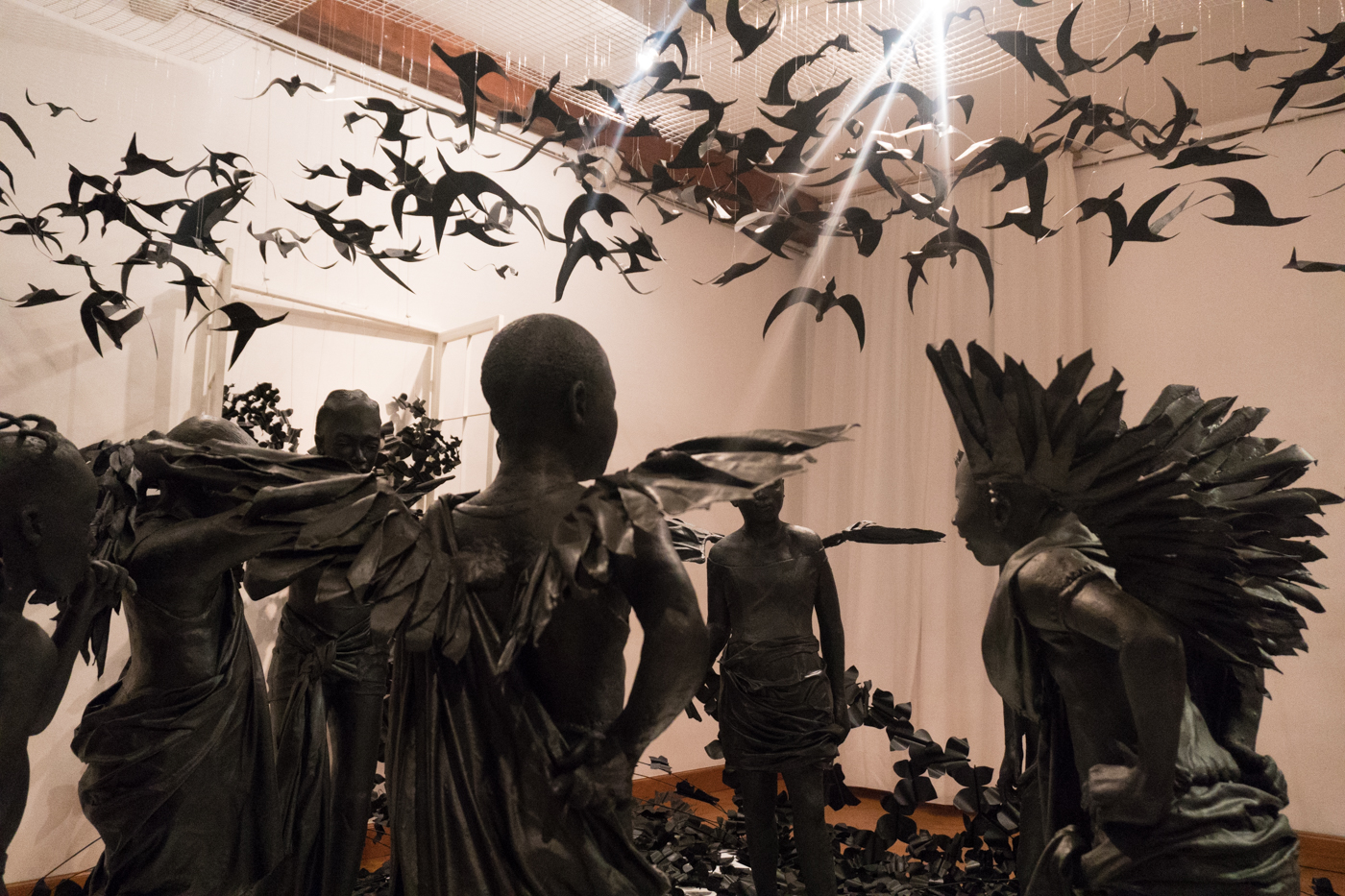

To sum up the arguments in this essay, I would say that an artist who for the sake of producing sophisticated art, pursuing sophisticated materials which are used liberally by the so called ‘global artists’ need not necessarily be making a global art because it all depends on what kind of an issue that is being addressed in the art. While at times the mode of art making would set up hither to unheard of fashions, one cannot pursue newer modes more than a body of works for the fear of being repetitive or the mode itself becoming stale by over use (examples are many before us). At times, the subject itself could elevate the artist and the newness of execution to the global scenario even if the materials used are crude and unsophisticated. Most of the artists become global by making extremely bold stance (like Ai Weiwei or Anish Kapoor) on issues. Some artists become global only because they are addressing global issues from the regions and they are sucked in by the global economic circuits maintained by the galleries. The desperate ones go after unconventional materials to create art; but sooner than later, in art the unconventional materials are going to become conventional. Global art is a capitalist ploy and it cannot stand without the support of the global capital. Even if the art produced within this stream are politically powerful, eventually by co-optation they are going to lose their cutting edge in the long run. Doing art with local materials can become a powerful tool to create global art because the regions are what holding the global discourse possible. African artists produce powerful contemporary works using locally available materials, addressing local issues and forms, but they become global artists. Global art, as we understand today is the fashion trends created in Paris and other parts of the world. They are just seasonal and become obsolete in three hundred and sixty five days; among them the lucky ones would make a re-appearance at regular intervals with minor changes here and there. But art is not supposed to be like that. Art has to hold up the eco-human values; art’s global nature should be measured by the amount of humanity and nature gone into its philosophy. While I stand for innovative and sophisticated art from the regions, I do not discount the fact that the conventional art is capable of creating a more powerful aesthetic discourse in the global platforms primarily addressing the regional and provincial issues. Perhaps, only such art would stand the test of the time as the rest would change according to seasons and the introduction of new materials and technology.   

(All images from net and sourced after Venice Biennale. For representational purpose only) 

Wednesday, October 18, 2017

Indian South Explodes Aesthetically at the NGMA, New Delhi


(Dhwani se Shabd aur Chinh at NGMA, New Delhi, display view)

(My article in Indian Express Malayalam Weekly. This article questioned why KCS Panicker was excluded from the Golden Jubilee celebration of Indian Independence held the NGMA in 1998)

When I look at the exhibition ‘Dhvani Se Shabd aur Chinh’, with the works of a large number of artists from the Indian South culled out from the collection of the National Gallery of Modern Art, New Delhi, my memories go back to an exhibition at the same venue around nineteen years back. The name of the show was ‘Indian Contemporary Art: A Post-Independence View’ and was put together by Delhi’s Vadehra Art Gallery and the NGMA. The occasion was the golden jubilee celebrations of India’s independence. I was shocked to see that there were no works of KCS Panicker who had singlehandedly established an art movement as well as an art village (Neo-Tantric Art and the Cholamandal Artists Village respectively) in this show. I approached the director of the Vadehra Art Gallery, Mr.Arun Vadehra and according to him the absence of Panicker was due to ‘circumstantial factors’. With some amount of journalistic fervour and moral agitation as an art critic hailing from Indian South, I approached the then director of the NGMA (I remember it was Anjali Sen) and asked why KCS Panicker’s works were absent in a historical show like that. They informed that other than giving the gallery space, the NGMA had nothing to do with the exhibition. In my article written in the same year (1998) in the Malayalam Vaarika from the Indian Express Group, I had discussed how the ‘Brahminical’ North wanted to suppress the ‘Dravidian’ South and its modern art history.

(work by Jankiram from the show)

Today, ‘Dhvani se Shabd aur Chinh’, almost after twenty years corrects the historical faults that the NGMA had done during the golden jubilee celebrations of India’s independence. The National Gallery has a vast collection, mostly untouched by the in house as well as invited curators. Somehow during the last sixteen years when Mr.Rajeev Lochan was the Director of the NGMA, all the retrospectives were about the Bengal School. I cannot complain because those retrospectives were mammoth in size and deep in curatorial thoughts and presentation. But it had often raised the question in the minds of many people why there were no other retrospectives than the so called artists accepted by the mainstream modern and contemporary art history of India. Jitish Kallat’s was the last one to happen and we had Subodh Gupta and Anish Kapoor in the previous years. While it is always good to have such exhibitions which are to be ‘block buster’ and ‘chart buster’ shows, in the case of the National Gallery it has been a fact that what used to get burst was the expectation levels of the organisers. During the last sixteen years when Mr.Lochan was in chair the foot fall was bare minimum. But with the new Director General, Adwaita Gadanayak (despite all the ideological burden that he has to carry whether he wants it or not), the National Gallery seems to be on its way to make certain corrections (so far definitely not in the usual BJP way) and of late the ‘aam’ artists in Delhi have started crossing the threshold of the NGMA, which has been an extremely elite and English speaking domain for more than quarter of a century.

(display view)

The present show has a rich representation of the Indian South artists though the emphasis is on the ‘Madras School’. The presence of the works of KG Subramanyan, A.Ramachandran, Ravinder Reddy and so on have helped to push the boundaries of the Madras School or the Cholamandal aesthetics. At the same time, the in house curatorial attempts fail on this count because they couldn’t cull out many other major artists from Indian South from the NGMA collection. But if we look at the show as a dominant ‘Madras School’ show, then definitely it is an interesting show and a must watch exhibition. The curatorial team of the National Gallery has taken great pains and efforts to create additional structures to define spaces and establish niches and pedestals to raise the works to greater visibility and some sort of divinity. The works of late Nandagopal are displayed with elegance and exclusivity as the innate themes of the works demand. So many works that were functioning almost like garden sculptures in the lawns of the National Gallery are cleaned and brought into the gallery. Imagine, most of works spread in the lawns unattended and uncared for have been the works of the artists from the Indian South. Once they are in the gallery, we get a chance to see them in their art historical context.

(work by Nandagopal)

Some rare paintings of KCS Panicker, Jayapala Panicker, KV Haridasan, AP Santhanraj, P.Gopinath, C.Douglas, J.Sultan Ali, Janakiram, Ramanujam and so on are on display. Each historical exhibition like this tells us that the artists did their best work when there was no market or they were not heavily depending on their works to eke out their living. The very history and philosophy of the Cholamandal Artist Village inform us that the artists were not thinking about making money out of their creative works but from the works that they created in terms of craft but never compromising their aesthetical profundity. Cholamandal thus created a benchmark for the artists and taught them how they could survive when there were no takers for their art; not even the state patronage. But some egalitarian souls were in the advisory boards and purchasing committees of the national cultural establishments and they were instrumental in getting those works collected even when there was no private patronage for them. So today we have a rich collection of the works done by the artists from the Indian South in the establishments like NGMA. The difference is that while the so called Brahminical art historians who led the scene (like Geeta Kapur, Gulam Mohammed Sheikh and so on) tried to suppress these works, the ideological Brahmins find no problem in showcasing them. The shift from Amrita Shergil and Family to KCS Panicker and the Indian South art really shows a paradigmatic shift in the art historical discourse in India.

(display view)

Till recently V.Viswanathan’s works were not really ‘looked at’ by the Indian art movers and shakers. Then one day he was picked up by the Nature Morte and the Kiran Nadar Museum; then his fate changed. How does this happen? This kind of picking up of artists who are physically frail with failing health for promotion by the art market shows how inhuman their approach is; age and the imminent death of any artist with a considerable period of work/ing history help the auction houses to add yet another vintage artist in their lot. So here is an artist who has worked for more than fifty years, hasn’t enjoyed real success in terms of fame and money, but with a gigantic oeuvre is a treasure mine to be dug into. Now they could create new stories and histories around him/her and give birth to a new golden goose. But Viswanathan’s works done in late 1960s are precious gems and a good number of them are in the collection of the NGMA, which is decently displayed in this exhibition. So are the works of SG Vasudev and P.Gopinath. Unfortunately there is no list of artists or an illustrated catalogue, which is a must for these kinds of historical exhibitions. There is a small take away pamphlet which does not have much to offer. So I am not able to do justice to all the artists either. There are so many sculptors and painters from Indian South in this show who are no longer even mentioned in any kind of modern art history in India. I wish I had all the names for ready reference in my hand. What I could tell you at this juncture is to go and see the show. 

Sunday, October 15, 2017

Every Good Thing Has to Come to an End: Curating in Baroda Concludes (XII)


This is the last article in the series that I have been writing during the last twelve days on the curatorial projects realized by the cub curators in Baroda. For me, the project, ‘Magic of Making’ was an exceptional experience because it gave me an opportunity to work with a set of very vibrant students at the Fine Arts Faculty, MSU, Baroda. When I commenced my lectures on 11th September 2017, I had no clue about the direction that this module would take. But towards the end of my lecture on the first day itself I could understand that here was an interesting and interested lot of students who were enthusiastic about realising certain curatorial projects of and on their own. For the students the phrase ‘curatorial practice’ did not ring in any surprises which had done to me as a student quarter of a century back in the same faculty. Today students are familiar with various kinds of curatorial practices though they do not have any hands on experience in it. To my surprise I found at least a couple of students who were directly or indirectly involved in curatorial practice elsewhere. I did not find students were approaching the lectures with some kind of anxiety or scepticism. In this series of articles I have explained how the students developed their projects and curated them successfully. What I could say as a preamble to a concluding article is that today I stand more benefitted by my interactions with these students than they are. My students may dispute it but I am extremely thankful to them for surprising not only me but the department and the faculty as a whole with the enthusiasm and determination to realize their projects.


There were eighteen curatorial projects in total of which I have written in detail only about ten projects. I would have continued in the same vein had those other projects been by the first year MVA students. The reason why I do not want to write about the projects done by the first year students is this that they have one more year to go in the faculty and as a teacher if I give them a sort of high praise perhaps it would go directly into their heads and it would proved detrimental to the guide who would go there to initiate them into the final year module of curatorial practice. If they believe that whatever they have done in this year along with the final year students are good enough to be passed off as rounded curatorial projects, then their chances of working on much developed and mature concepts in the next year would be less. I do not put them into the self congratulatory mode not because that is a sort of ego checking mechanism but also because the projects that the junior students have taken up to realize this year were not conceptually mature in fact. When I was in the class I did not put them through the rigour that I had forced on to the senior students mainly because I knew for sure that those projects were just a warming up exercise for the next year. Whether it is me who would teach them next year or another teacher with another methodology, it is imperative for them to have a very fresh approach in the next year. They should never feel that they have done their best and they ‘know’ it.

Ryan Bhegra, Dhara Mayavat, Leticia Alvares, Hiral Patel
The biggest folly that a (cub) curator could commit is his/her belief in a singular model and in a time tested method. A curator is a person (a facilitator, a mediator, an ideologue, a collaborator, a co-creator and a creator in him/herself) who is presented with newer challenges every day. He/she has to face a new artist, a new work of an established artist whose style and method are well known but the one in your hands is entirely different and you need a different approach altogether, new space, new context, new understanding, new infrastructure, new bureaucracy and so on. So a curator cannot insist that ‘I am so and so, therefore I would be doing like this only.’ Such a person would be an utter failure. Similarly, a cub curator him/herself believes that he/she has done something in twelve days and has got appreciation from seniors, scholars and well wishers therefore he/she could curate a project in no time is definitely digging his/her professional grave, ‘professionally’. Always remember that what a curator has done within the campus is a campus project and not a ‘real’ one out in the world where you have to have a series of encounters with unsympathetic elements in the art scene. Overconfidence could finish your confidence itself in the real world. Another important what all the cub curators should remember is this: what you have done in the campus is one of the modules out of the many other modules that you study. Having done a curatorial project does not assure you any place automatically in the curators’ world elsewhere. Out of the twenty or twenty four students, all are not expected to become ‘curators’ even if they have done the module very well. It all depends on the choice that the students make. There are a number of avenues opened by the art history education; curatorial practice is one of them. And mind you, there is no money in it until you become a big name in the scene.

Sheetal Rathod
It is time for me, however to say a few good words about the junior students who have done some impressive projects. I am not going to go into the details of it. But an overview of these projects would give the readers an idea about the promises that these students make for the next year. Sheetal Rathod remained a very enigmatic student throughout the concept presentations and the debates. She hardly spoke up her ideas but she finally came up with a quick fix idea, which perhaps worked well for her. Sheetal wanted to do ‘Wisdom Tree’ and the tree was developed out of a ply board which she fixed at the entrance to the foyer of the Art History department. She painted a tree like form and provided the people with the sticky notes. The audience could contribute their wisdom and slowly and steadily the ‘tree’ grew and the fruits of wisdom were hanging from it. It was a successful project by default (I saw an opposite to Chandni’s Rhetoricity which had a high dose of idea behind it) and cannot be qualified as a fully developed curatorial project. Dhara came from architecture background and she has been studying the re-adaptation of the historical buildings in and around Baroda for some time. She wanted to present the photographs of these buildings. Besides she wanted to work with a few artists who drew such architectures. Somehow she could not manage the drawings and what she could do maximum was exhibiting the photographs of the re-adapted old buildings. Curatorially speaking this project was not meeting the high expectations of the concept had offered.

Nishith Mehta 
Nishith Mehta had a very interesting concept and called it ‘Sanima/Cinema’. His idea was to develop a parallel narrative that resembled to the sentimental narratives of a typical Bollywood movie using the film posters. Only thing that stood between Nishith and the project was the dearth of original posters that really wanted to build his narratives. The time was not enough for him to run around and source posters from the rare poster collections. Hence he decided to stick to the posters available in the net and put them together into a video format and supported it with Bollywood background music (BGM) and sharply cut silences. This project would have become a museum scale project had Nishith worked on it more diligently, with more research and resource. The result was unsatisfactory though as a first step it was impressive. Abhi who goes by this first name had so many ideas and little will power to realise them. However, he put his resources together to create a wall of contemporary works’ images with a central statement made by Harold Rosenberg: “A historically ignorant art have not better claim for attention than an economist who haven’t heard of market crash.” Abhi’s basic argument in the project titled ‘P square’ was that any work of art has a referential point in history or the history of another work of art. To prove him point, he arranged a brief lecture by Dr.Jayaram Poduval on the same subject. Realized on the side wall of the art history department building this project however did not attract people due to unimpressive visual presence. That area where students this time chose for putting up their projects thinking that there would be more foot fall seemed to be jinxed in a way.

Marzanah Mimi
Marzanah Mimi from Bangladesh curated one of the most visually impressive performances/ Happening art in her project titled ‘Hues of Pride’. Mimi wanted to curate the idea of the colours of her country where each colour sari was used for expressing certain seasons and certain national festivals and celebrations. Mimi wanted to recreate the feel of her country through saris worn by the girls/models. She was sceptical about getting her models but finally she could manage around fifteen of them and did an impressive show and in due course she doubled herself up as a curator as well as a performer. Sachin Ryan did a plain ‘print making’ show with three friends of his working in the printmaking department. Three female printmaking students who worked in the same hall got Ryan’s curatorial attention and he converted their studio into an exhibition space and called the project ‘Three Printmakers’, as plain as that. This project could have been a wonderfully developed on had the curator been a bit more serious about what he was doing. Moksha Kumar had a grand idea that involved six LCD television screens, a dark room and a performance. Her concept was interesting and the project was taking shape but somehow she grew cold feet and withdrew from doing it. Finally she came up with a one time performance with a poetic enactment of a commemorative poetry on death and life. Poorvi Sultania and Gopi Shah partnered together to curate a project titled ‘How are You?’ which became a successful project with its interactive nature and playfulness. But how far it went successfully curatorially was questionable as it did not seem to elevate itself beyond a festival fair stall with some curious game. However, I should appreciate their diligence in completing all the curatorial formalities.

Poorvi Sultania and Gopi Shah

Moksha Kumar
Any curatorial project owes its success at least twenty five percent to the background players. They may not be seen in the final display of the project works or they may not even have a direct hand in the curatorial idea but their curatorial inputs are invaluable. We could call them assistant curators who perhaps could grow into curators of their rights in future. I had four students who did a lot for the other cub curators but could not or did not do their projects. Mohammed Rafiyan from Sri Lanka was one student who strongly believed that he was not prepared to do a curatorial module. I did not want to force him either for I knew well that unpreparedness is a part of dislocation and readjustment. He was taking his time to adjust with the new educational system, language and so many other components. But Rafiyan soon grew into one of the most reliable curatorial assistants and his contribution was there in every project that the other cub curators did. So was the case of Dwip Aher, who had a wonderful idea but I discouraged him from doing it. Dwip’s curatorial idea involved a sort of an enactment of a very uncomfortable scene where I also should have been a willing partner without the knowledge of the rest of the class. He wanted to secretly register the reactions of the other students and see whether it could explain his ideas on social justice and humanity. But somehow, so many tender human emotions were involved in it (as he discussed with me privately I could not say no or say yes either) and I did not want to risk anything. Dwip, however gracefully repositioned himself as a curatorial assistant and helped most of the cub curators in realising their project.

Dwip Aher

Prajakta Bhogle Gaekwad

Mohamed Rafiyan


Prakhar Vidyarthi had a project in hand and also he knew how to go about it. The project was a about the ‘idea of space’ and how different people ‘materialized it’ when they were asked to do so. As a student with a background in architecture, he knew what he wanted to do. But in the discussion table itself the other curators shot him down saying that his project would not make a visually impressive one. Prakhar went back and did some ground work for a couple of days and came back and accepted before the class that they were right. So now he would be doing a much scaled up project within three months within the campus. Prajakta Bhogle Gaekwad is another first year student though had a project in her hand but took a backstage player’s position willingly. As a designer and graphic artist with experience in advertising, Prajakta took the responsibility of styling the curatorial projects and giving them an identity through colour coding and a sort of branding. She worked efficiently to design the invitation cards and posters, besides making a common format for printing concept and curatorial notes separately. She took up the responsibility of inviting the chief guest and the press and got a good coverage for the event/s which otherwise would have been passed off as a college affair. I should also congratulate Dr. Jayaram Poduval for giving freehand to me and to my students and supporting it throughout especially in overcoming bureaucratic hurdles in obtaining permissions and releasing a modest students’ fund. Ravi Kadam, the assistant in the department was throughout there do the important errands including the logistics and lighting. Jitto George, Shubhankar, Father Antony and Tarushikha, the PhD students and aspirants were there with their angelic presence instilling confidence and cheerfulness in all. To put it in nutshell, it was a wonderful experience of teaching and learning.

Saturday, October 14, 2017

Female Body in Performance as a Curatorial Project: Madhubanti Chanda. Curating in Baroda XI

Madhubanti Chanda 
Madhubanti Chanda, final year MVA Art History, MSU Baroda is an accomplished Bharatanatyam exponent with so many performances to her credit. A graduate in BA Hon. in History from the Lady Shree Ram College, New Delhi, when it comes to the curatorial project, Madhubanti cannot think anything but dance, that means a performing body in space, not really meant to be opened for the audience to take the position that they want to but to manipulate their position vis a vis her performing body, a reversal of the proscenium theatre or temple courtyard stages where Bharatanatyam is often performed. The project she has in hand is titled ‘Nazariya’- A Way of Looking perhaps. Once again she would like to contradict the ways of seeing. In the concept that she presents before the class room/board room, Madhubanti explains how she wants to make use of the space as a neutral entity made available to the body in performance but to arrest the audience movement in certain ways so that the performing body could be completely in control of the audience not by its ability to move the finer feelings among the audience but by its authority over their gazes. Here is the core of her project. According to Madhubanti, she wants to re-present the age old Devadasi system, though which is obsolete now, has its stigma attached even to the modern performing bodies of the Bharatanatyam dancers, if not overtly, covertly. In her concept note she delineates how the Devadasi system, giving away of girls as God’s servants, who would later become accomplished singers and dancers not only servicing the Gods but also the people who wield godly power in the world.

Devdasi Parmpara or system had its pros and cons. There used to be tremendous exploitation of women in this field at the same time the exponents in the field had high reputation as fine artistes. They often became consorts of the rich and feudal patrons, paving way to the collapse of the safe family system and also it had given a false aura of being the incubator of high end prostitution. Whatever be the reason the Devdasis, reputed dancers and singers were looked down upon by the society as a sort of decorated ‘sex workers’ and from the polite societies it became a shrill demand for the abolishing of the Devdasi system. Immediately after the Independence of the country, some of the conservative legislators moved against the Devdasi system and in one stroke of legislation, exactly the British had rendered several tribes into criminal tribes, made Devdasi system a criminal offence. The sudden fall from grace affected the dancers and singers and it took many years of efforts from the modern exponents of Bharatnatyam like Balasaraswati and later by Rukmini Arundale to regain the lost glory for this dance form. The body of the performer/dancer was considered a polluted body and in her curated performance Madhubanti wants to focus on the idea of ‘pollution’ and how the stigma is held proudly by the contemporary dancers like late Chandralekha in whose stage appearance each performance becomes a cleansing act not only of the imagined body of the dancers but also the ‘polluted’ minds of the public/audience.


The concept is clear though the choreography is yet to take shape. Madhubanti does not want to ‘cleanse’ her body for the sake of the audience’s catharsis, on the contrary what she wants to do is to act out the cleansing process before the audience, the process neither as a self cleansing one nor as a cleansing of the audience. It is something in between where the performer’s body gains complete power and the agency of her body is snatched away from the gazing public, and the audience is rendered completely powerless even with their power to gaze is snatched away from them. Madhubanti identifies three spaces for her performance where the curatorial part is more about curating her acts as well as curating the spaces and audience response. She takes up the responsibilities of an artist and curator at once. Madhubanti has to manage space, live singers and any other partners in action if need be. In the initial presentation Madhubanti has three spaces in her mind, the famous pond right in the middle of the faculty, the old building and the sort of stage that the old building provides. Madhubanti wants to start the act at the banks of the ponds where she would start her cleansing act by pouring water (dirty water!) over her choreographed body in movement. From there she would like to move towards the old building and come out to the stage through a room which is currently used as studios by a couple of student artists. But Madhubanti is adamant on one thing: When she finishes her cleansing act, she does not want the audience to see her frontal body but the gaze should be falling from the right end of the lawn where she anticipates the public would gather. She wants the collective gaze fall on her the right side of her face.


Here is a problem, with no instructions given to the audience (as she does not intend to give any instructions) and the audience with a free will (as I said in the last article about the audience with individual ‘I’s) may not move the way the performer wants. Then there is the second problem. The girls (art students) who are working in the hexagonal room adjacent to the stage are not ready to give ‘their studio’ to Madhubanti for a few hours. I see it as a sheer case of non-cooperation, lack of sympathy and arrogance. But that is the challenge of the curator-performer. Madhubanti immediately re-works her strategy. Priyanka Kundu is already preparing her ‘Object—Icon’ project in the main central hexagonal hall of the old building. Priyanka being a great friend of Madhubanti agrees to ‘enter into a temporary collaboration’ with Madhubanti in realizing the ‘Nazariya’ project. Somehow, Madhubanti would incorporate the magical ambience created by Priyanka in her curatorial project. Her search for alternatives continues for a few more days and we see a small whirlwind of a Madhubanti moving in the campus making negotiations with different people in different levels. She keeps coming back to the board room to individual and group consultations.


Then happen the magical turn of events. As I have mentioned before, this is the Garba time. The faculty Garba is very famous in Baroda. Former students who are now nearly seventy years old, driven by nostalgia flock back to the faculty like migratory birds during these days and a huge interest has been developed around this Garba of veterans and contemporaries in the city. After the Indian festivals have been radically politicised during the last few years and the reporting of unfortunate incidents, the faculty Garba now takes place in a fortified space and the attending of it needs special passes, registrations and so on. So the workers now erect temporary fortifications using bamboos and clothes. Suddenly it becomes a blessing in disguise for Madhubanti. She could now manipulate her audience easily as they cannot surround the building from all sides. She just needs to make an illusion that the performance is going to be in the foyer of the old building. She gets into action and with three spaces available to her as different from the original plan, Madhubanti’s curatorial surprise is intact and she initially thinks of three repeated performances and finally decides to have only one focused performance on 21st morning. As the ‘cleansing’ act at the pond is now rendered obsolete, I suggest her to add the same component in another pre-recorded performance and Madhubanti being a contemporary choreographer and dancer understands the possibility of immediately.


Now, Madhubanti has the following components in her curatorial project, Nazariya: a live performance by her and a live music as background score not really as accompaniment music as in the traditional sadir. A video element in one of the side halls where we see in a hollow vacant hall, Madhubanti is seen in a choreographed act of cleansing in extremely tight contemporary dance clothes. A possible wide range of public/audience.  Priyanka Kundu’s curated space. The corridors. The portico. It’s time to start the performance. As the live music is at the portico (right at the entrance of the building that directly leads to Priyanka’s space) the audience gathers there and many of them including the chief guests take their seats in the available spaces. A new element comes into play. Another painting student comes in the costume of a traditional pujari and does some pujas and gives holy water from brass pots to the audience. The live music is on. With these two components working well a traditional temple atmosphere is automatically created. Everyone is anticipating the appearance of the performer/curator/dancer from somewhere but nobody knows from where. Suddenly, when all attention is on the music and the pujari performer, Madhubanti appears in her red Bharatnatyam costumes at the main walkway of the faculty as if she manifested there from nowhere. I could see her initial idea working perfectly. With no knowledge of her next move, the audience remains where it is and turns their gaze at her side. Lo! The collective gaze falls exactly on her right side! She moves further in slow, rhythmic and lascivious fashion with her eyes drilled into the horizon. Each time her gaze shifts it grills into a person or into a space.


Now the members of the audience are in trouble. They do not know whether to move along with her or remain seated to let her finish her whatever and come to the foyer space where the ‘real’ action would take place, as they think. Madhubanti now enters the building through the steps on the side and she holds a male member of the audience and looks into his eyes; he shudders visibly. Madhubanti imposes (in a way implicates) the collective accusations against a performing body (the Devdasi body) generated by the society on to the hapless young man; I find the shuddering of his body as the shuddering of the society when it comes in direct confrontation with a powerful performing body of the Devdasi. From there Madhubanti enters the room where the video element in played. She just lingers there for a few seconds with a host of enthusiastic youngsters following her silently, with their mobile phone cameras on. Then she crosses another threshold into Priyanka’s magical space. The transcending of the spaces is very important here (both as a choreographic need and a deliberate curatorial decision); Madhubanti starts her performance in a non-space (a walk way), then she climbs the steps (as if to a stage), then she comes in ‘touch’ with the male gazer (the patron) and she crosses over to a new vacant hall where a self cleansing is virtually performed in the video and her crossing of the space becomes a sort of washing herself in the mythical Ganges. Then the other threshold to be crossed to the divine space (Dev/God’s space-Priyanka’s space) and from there she emerges to the portico. The music goes on without dominating or distracting the attention from the performance. Madhubanti wafts through the corridors (the liminal space between life and performace) and finally comes down to the earth, the portico. She bows before the pujari/priest and he blesses her (which would bring her scathing criticism during the de-briefing). She continues her dance; not really a Bharatnatyam dance but carefully crafted as well as spontaneous movements which would evoke different emotional responses among the audience and at the same time possibility of the body in performance).


Madhubanti enthrals the audience with her every enigmatic presence and she walks off into infinity or obscurity, depending on the mind of the viewer but I would say she walks into glory as it would prove that this curatorial effort has given her a lot of confidence that she would perform another ‘curated’ performance in the same space within days, this time curated by another fellow student and cub curator, Chandni Guha Roy. Madhubanti’s idea as a curator-performer is well conveyed in this project. She could push her idea of the allegedly polluted body of the performer/dancer and also the idea of cleansing without distributing pamphlets or curatorial notes. The biggest criticism however that she gets after the project presentation is regarding her re-assertion of the male dominance by accepting the blessings of the priest. But according to her, it is an act of ‘quotation’ not an act of real ‘writing’. This particular part of the act is a scripture that is meant to generate a point at its religious or social connotations. It is a quotation taken out of the dominant discourse of the Devdasi system. It is not really a celebration of the male gaze or male patron of the system. Besides, the point according to Madhubanti is the framing the very act of criminalizing the Devdasi system. It amounts to criminalizing anything fine, tender and aesthetical. Reducing the dancing body into a sexual body is the problem of the erstwhile discourse. But in the changed scenario, decriminalization of the performing female body or the female body in any performance should be done, demands Madhubanti.


Curatorial lessons learnt: One, when a curator doubles herself as a performer, the responsibility increases than a curator curating the works of other artists. Two, especially when a curator-performer wants to incorporate a series of spaces with disparate meanings and connotations, larger negotiations with the space as well as performance are needed. Three, unexpected unavailability of spaces could redefine the performance/project for advantageous ends and results, so trust in your ability to move the space than the space’s innate meanings. Four, if the performance is really powerful and curiosity could be generated around it, the audience would respond to the curatorial work the way curator wants. Catching the public with different ‘I’s for temporary negotiations is the success of such projects.