Saturday, November 12, 2011
I Don’t Need Your Help: Manmeet Devgun Hits at the Male World
When a single mother says, ‘I don’t need your help,’ we should heed it with respect. We should listen to it with respect especially it does not come from a woman who belongs to a very affluent class. It shows the courage to be alone, the courage to rear up a child ‘without’ a father and above all to have sex with whoever she wants to or choose not to have sex with anyone. Sex cannot be avoided from the discourse of ‘single mother’ as this is one marker that upholds her virtue as a ‘devoted’ or a ‘wanton’ single mother. If her body is not claimed, or if she does not allow her body to be laid, then she is a great mother and if she does, she is a woman of loose morals.
Hence, our sexual morality is what drives us towards defining and judging the women who take courage to be alone, to mother a child all by herself and to have sex with anybody she wants. Manmeet Devgun in her first solo show at the Abadi Art Space, New Delhi literally screams to the world that she does not need anybody’s help’. The show is titled ‘I don’t need your help’. This exhibition has Manmeet’s photography works, videos and a performance.
Interpreting a set of works of art through the authorial intentions and autobiographical references could be debilitating as far as the works’ intrinsic ability to transcend times and stay as aesthetic objects. Against this we could also say that a work of art or an aesthetic form of expression becomes relevant only when the authorial intentions are addressed as a part of the readerly interpretations. Therefore, it would be always good to approach this new body of Manmeet’s works independently as well as through her auto/biographical references.
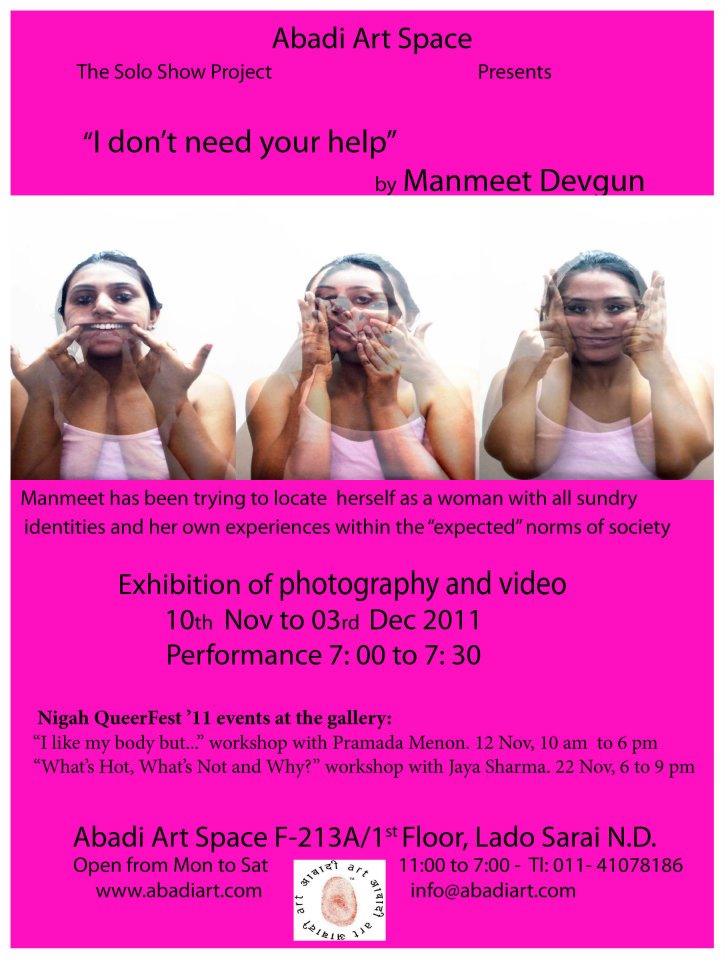
Hailing from a Chandigrah, Manmeet came to Delhi in late 1990s to study fine arts and she graduated in painting from the Jamia Millia Islamia. Though she was a trained in painting, perhaps, Manmeet is one of those women artists who abandoned the trained completely with no regret almost a decade back. She moved around in Delhi with friends and helped them in documenting their works and independently did photography as she had the access to a camera.
Manmeet partnered with Shantanu Lodh, initially in art and later in life and they together did a few wonderful project. Considering the fundamentalist censorship on personal freedom prevalent in a post-Ayodhya scenario in India, Shantanu and Manmeet took it up as a pivotal issue in their performance and photography series. In 2003 they made a bold attempt by distributing large posters of them kissing in public. By that time Shantanu had assumed a different artistic personality. He called himself ‘Art Maharaj’ and distributed scooter step-in covers inscribed with Art Maharaj. Also he did a series of performances with Inder Salim Tikku. Manmeet, by them had assumed an artistic identity and she started calling herself as ‘Mrs.Manmeet’.
Manmeet also did two independent projects in 2001 and 2002 respectively. The first one was a series of objects for masturbation and their digital prints which she exhibited in a group show titled ‘Closet/Closets’ curated by Mrinal Kulkarni. In 2003, when Mrinal and myself curated a show titled ‘HEAT’, addressing gender and sexuality in visual arts, Manmeet created a series of photographs in which she enhanced her body parts with inflated balloons. Manmeet was one of the much written about artists of that time. Later in 2005, Shantanu and Manmeet did the boldest of performances ever in Indian art scene at Khoj International. ‘Hamam Mein Hum Sab Nange Hai’ (We are all nude in Public Bath), the project was called and in this both of them stripped themselves into nudes and let their bodies to be inscribed by others.
Perhaps, this is one project that faced both internal and external censorship directly in Indian art scene. The documents of which are still available at the Khoj International. But it is not released thanks to certain very sensitive reasons. It is sure that this performance will be hailed as one of the pivotal performances of India when the proper history of performance art is written.
In due course of time Manmeet got married to Shantanu (interestingly, senior sculptor K.S.Radhakrishnan and myself were the ‘uncles’ who signed for Shantanu in the marriage register and Mimi Radhakrishnan and Mrinal signed as ‘aunties’ for Manmeet). Relationships could sour if they professionally too much involved. It is always better to work separately. Even Marina Abormovic and Ulay separated after doing a series of path breaking performances.
In the meanwhile a beautiful daughter was born to them. She is named ‘Brushti’. Slowly Shantanu and Manmeet moved apart.
‘I don’t need your help’, the solo show could be read against this backdrop. But as the time passes, none is going to recount the personal trips and traps that the artist has undergone. In that case, we could also read the works away from this biographical background.
Most of the works in this project are done after Manmeet separation from Shantanu. The haziness and the troubles that she has been going through during the post-separation days are quite palpable and Manmeet is successful in bringing all those elements in her photographic works. Inside the decorated interiors of a drawing room, well arranged kitchen and bedroom Manmeet makes movements and caught in slow shutter speed they look like apparitions. There is a feeling of non-belonging-ness and even in her own domestic space where she has spent her time as a ‘family’ unit, now she feels herself like an apparition.
I am sure that this series is the outcome of a passing phase. The non-belonging-ness is not going to prevail as Manmeet has the courage to say that she does not need anybody’s help. These hazy photographs could develop themselves into as separate aesthetic projects with different aesthetic and philosophical reasons soon.
In another set of photographs Manmeet shows herself as a mutilated person. She portrays herself as an ugly creature with displaced organs grown all over her face. This series must have come out of the scepticism that she has felt after the separation; scepticism about her beauty, appearance, demand, desire and recognition.
In another brooding set of photographs, arranged as if they together created a narrative story, Manmeet is seen sitting with her daughter, now her own world and focus of attention. She is totally absorbed into her thoughts while the child does her own things unaware of her mother’s internal turmoil. The world that is and that would be for sometime is caught well in the scribbles that Manmeet’s daughter has made on the walls with colour pastels. Also the scattered tiffin boxes and pencil boxes tell the story of the child’s growing up.
In a lighter mode, Manmeet portrays herself as a beautiful and ‘available’ (marriageable) woman in traditional saree attire. Interestingly her towering presence is kept against the ‘Groom Wanted’ columns in the newspapers. In one, Manmeet seen with a two fire extinguishers for her crown/horn suggesting that as a bride she could do ‘fire fighting’ jobs at home and in the second portrait she is seen as a multi-tasking woman with multiple hands and multiple utensils, tools and implements in them. The grooms’ expectations are fulfilled in one go. The sexual potency of her own self is shown in her red silk saree and the inviting (menacingly) smile.
The video ‘I don’t need your help’ starts with a close shot of Manmeet uttering expletives and hurling abusive words at them. In the beginning they are inaudible but from her lip movements one could make out the words. And like in a musical symphony, these words reach a crescendo and she screams ‘I don’t need your help’.
One of the most interesting videos that Manmeet has done in this project is a 2002 unreleased video. In this small projection on the wall we see a Lucian Freud painting that almost look like Shantanu lying nude, smeared with some clay like substance and sleeping unaware of someone’s gaze. Here Manmeet sees the painting/him though a pair of magnifying glasses. Each and every part of his body is scrutinized and the genitals are observed clinically. This work should be treated as one of the best counter gazes ever that any Indian woman artist has produced so far.
Manmeet has also added a performance element to this project. In a furry red rug placed in a corner of the gallery, she cuts several of her portraits and stitches them together to create a creature who resembles her but with a displaced and distorted appearance. Perhaps, this shows the current mental situation of the artist. And if we read it out of the personal context it could also suggest that often (single) women are viewed in this way, cut and pasted body parts.
One element that repeatedly appears in Manmeet’s project is that of screaming. Except for one video Manmeet does not literally screams out in any of her works including the performance. The performance is one of the most silent acts in the whole show. But the screaming is quite palpable.
Screaming is a way that a child uses to get attention from its mother. To read it inversely, screaming is the first step towards demanding recognition and identity. Here Manmeet by screaming that ‘I don’t need your help’, literally sears herself away from the past as ‘wife’ os someone, partner of somebody and so on, and she demands recognition not only from the man whom she has left behind but also from the world that has so far seen her as wife and partner of someone. There is an element of attachment and detachment to this aspect of screaming. The child wants the mother to listen to this screaming at the same time it wants to move away and start everything independently. The distortions that Manmeet give to her portraits must also be seen similar to those distortions often the children make to grab attention of his/her mother or the people around. Manmeet becomes a child once again to do her rebellion and all the indications are there that she would grow into an independent woman and artist without any confusion in the nearest future.
Friday, November 11, 2011
About (some) Women as Artists and Their Stories
I have so many girlfriends. The emphasis on girlfriends because they are ‘girls/women’, in the sense, as one of the T-shirt logos say ‘I am a Virgin’ – It is an old T-shirt, by gender. Don’t get me wrong. There is no sexism in this comment. These women are my friends and most of them are artists too.
An art critic’s job involves a lot of listening. You have to do a lot of couch sessions. Again, please don’t get me wrong here too. I am talking in a very Freudian sense not in Shakti Kapoor-ian sense. To become a good art critic and a curator you need to develop a strong sense of listening. A sense of seeing is a different issue. “CD bhej deejiye….or send me a mail with low resolution images of your works,’ is the common refrain that most of the art critics do; this lot includes me too.
So basically, an art critic listens a lot and he/she is expected to absorb a lot from these sessions. While speaking about listening and talking, Osho says, the Westerners have made listening into a profession. And they call it psychoanalysis. They make a lot of money out of listening because none listens to none there. One day, a friend of Freud asked him, “You listen to people a lot. Don’t you get bored?” To that Freud answered, “Who listens? I just pretend to listen. If you listen to all those you will go mad.”
In that sense, an art critic cannot be a Freudian. He/she has to listen; listen absolutely. Men artist folks do not talk too much. Even if they talk they talk about so many worldly things. If Malayalis meet another Malayali they start with Marxism and ends up in old romantic Malayalam songs. If Bengalis meet Bengalis they only talk Bengali and it starts with and ends in Robindro Shongeet. I am not being parochial.
Women artists speak and they speak a lot. Most of them are beautiful and beautifully existential and existentially spiritual, spiritually materialistic, materialistically troubled, troublesomely materialistic and spiritual, confused on ideas, confused with ideas and confused by the very notion of ideas, they are feministic to the core and conventional to their teeth, outgoing in many ways and ritualistic for protecting their family peace. Some are deeply vague and many are vaguely deep. Many are beautifully shallow and therefore too vehement on what they do.
The degree of this confusion increases as per their belief in auto-diktat-ism grows. The same observations could be made on male artists too. But they carefully cover it in their indulgence in property price and the properties of the new car that they have ecently purchased.
Also, please don’t mistake that a silent male artist is quite a deep person. In fact he does not have much to say. Even if he has he has said it in his works, which is sadly mute, dumb and in all possible ways handicapped.
In couch sessions I hear a lot about their supporting husbands. That is just a beginning. Now I am sure, by the third session the husbands will have grown into devils.
Often these women artists speak that they need to earn from their art and the more they emphasis on that you become sure that they are nearing their thirties or mid forties. This lot is hated both by the young women gallerists and women curators. But the solace is not even there in the old women gallerists. They too hate these women artists.
Then for whom do they work for and for what they still do their work? They say it satisfies them spiritually. But they want material success. And their age is not conducive for them to move around with a CD in their hands and say, “look I am an artist, please see my works.”
Often, the moment they enter in a gallery, all the lights come into life. The errand boy would come with a glass of water and then ask for chai or coffee. The gallery director would come out and give them a conducted tour in the ongoing show. They have been taken for a ‘buyer’ because of the chauffer driven car, designer clothes, Gucci bag, Swarovski diamonds and all.
Then they literally ‘burn’ the CD inside their bag. Some women artists bury it in their vanity bags. Whether you burn or bury, you are gone.
Many like to make page 3 appearance.
They will be in group shows, which will have minimum thirty artists. And they curse themselves to be a part of that show. Yet they participate. And each woman artist in the show hates the other woman artist in the show. See the group photos in FB. You could see hatred largely written on their painted face.
There are yet another group of women artists. They are like Andy Warhol’s girls. They are famous because they are famous. They are famous so they get entry everywhere. They are seen with the right people but participate always in the wrong shows. When they are the daughters of the rich and powerful there works could be even framed upside down. They will coolly justify the blunder with some vague Picasso quotation.
And if they wear a skirt-pant, a mutant dress, god alone knows some anti-woman activist might have designed it, their intellectual quotient will go a bit high till it is removed for good or bad reasons.
Many prefer to be seen with anybody foreign. One speaking in Spanish and the other speaking in English would not make much difference. After all free food and drink don’t need any language.
So I welcome my dear ladies….if you have anything to tell me, please do. You give me a lot of stories. And let me tell you, you may not be a star in the art scene. You might not have achieved the kind of success you want to have. But you are wonderful people. Your confusions and tribulations and happiness have contributed a lot in my life; it helps me to grow everyday into a new person.
I am a listener. I can listen to your stories without judging you.
Thursday, November 10, 2011
Food and Sex in Delhi Metro
Like Celal Salik, the great columnist in Istanbul as seen in Orhan Pamuk’s novels, I too like look at the faces of the people. Mr.Salik reads letters out of them and he believes that there are greater secrets written on people’s faces. And also when he walks along the streets and travels by ferry, he listens to people almost eavesdropping in their conversations.
I too like doing it. From the bits and pieces of their conversations, one could weave a story; an imagined story of and about their lives. These stories may be absolutely false but if you recount them to the people they would believe it and they would feel like living those stories for themselves as stories always make people desirous of such fantasies lavishly strewn into them by the story tellers.
That justifies the success of the pulp fictions. People like to read pulp fictions because it makes them desirous of their own lives with imagined complications; they see their lives through someone else’s eyes and feel that the ideal spaces where the other posits them is real and worth desiring. People prefer to shut themselves in such ideal spaces in their vacant hours.
May be conversations are like pulp fictions; complications made out of nothing and nothing made out of complications. Most of the conversations between the male and female friends are filled with sexual connotations and references; but subtly and sophisticatedly rendered. It is like a cat and mouse game. The one wants to pounce upon the other and the other want to move away on the right time. Some rats have death wish.
I travel by metro, one of the public conveyance systems in Delhi that makes the otherwise lawless citizens of Delhi a bit calm and sophisticated. And I believe it is in these metro coaches that most of the people here really relax. Many of them are seen dozing off, many listening to music through ears phones plugged into their selves, yet another lot speak incessantly into their mobile phones as if it was their last chance to utter rubbish and a few read.
I belong to the last category. But my reading is not in full concentration. I am watchful about the movements around me. I could tell who is speaking to who.
If the call is from the office, the person who speaks transforms into an official. If it is from his wife, his muscles tense up. If it is from the girl friend, he melts. If someone is scratching the walls of the shiny metro coach, make sure that he is speaking to a girl.
Just before the door closes, when the girls pass by, hapless working class boys stand close to the door panels and murmur, ‘hi darling, hi darling’. When the door closes with a wheezy sound, these boys remain calm and nonchalant.
A lady in good clothes and with her nose up in the air gets a seat quickly, even if the coach is sardine-ed by hopeless human beings. A woman with a shrieking child in her lap, if she is in her tatters, will never get a seat. There are thirty six lucky men in a coach who elbow their way to the seats because there are only thirty six seats. And all of them will pretend to be lost or asleep when such women from lower classes push their way into the coaches.
Girls and boys sit on the floor of the coaches though it is prohibited because they find it cool.
The other day I overheard this girl talking to this boy: “You know, those boys in the school uniform were trying to take my picture with their mobile phone.”
“What did you do then?”
“What could I do? I kept shifting on my legs so that they would get only a shaky picture.”
“School kids are like that.”
I looked at them. They might have come out of the school a couple of years ago. The baby fat on the girl’s cheeks is yet to say good bye.
I thought now they have many more serious things to say. So I closed my book and decided to stand as if I was trying to relax my eyes.
“So when did you leave Central (must be a Mall)?” the boy asked.
“It must be around eight. My god…I don’t know they were asking me to eat gol guppa …but I refused my stomach was full.”
“Then what did you eat?”
“Oh I had chocolate tarts, strawberry shake and creams. And the cake was so filling.”
“My god..that sounds great..So what’s strawberry shake?”
“Yaar..nothing ..I thought it was strawberry creamed whipped in fruity.”
“What did you do then?”
“We met Milli Aunty…and she took us for ice cream…and you know this aunty lives in Trans Yamuna…the other day I went there..my god..what a stinking place…it is so bad. I hate this river…it is stinking….”
…..
I was wondering what they were trying to communicate. Were they serious? I thought so. They were very serious and intense on their talk.
Then, is this the way this new generation people communicate among themselves? Do they talk a lot of small little things which have no consequences?
I understand when my six year old son when he tells his friends something like this: “Hey Ayush…(pointing to a ledge near the park where they go to play) you go and make a house there. You can have your breakfast there. You can eat your lunch and dinner too. For ice cream you can come to this shop (pointing at an imaginary shop)…”
I understand this because at this age they don’t think much beyond cartoon channels and junk food.
But what about the sixteen and seventeen year old people? I know I am generalizing. But the conversation I overheard cannot be forgotten just like that.
Then I remembered Osho and his take on communication between the enlightened and the non-enlightened.
When two enlightened people meet there is utter silence because they already know. When two non-enlightened people meet they talk and out-talk each other because they don’t know. When the enlightened and the non-enlightened meet, the former remain silent and the latter talk.
Going by the Osho way, should I call these kids non-enlightened people? May be they are. They just want to fill their vacant space with chattering. Or they must be so full that they need to chatter it out.
Or are they really enlightened people, even when they talk about food and snacks? When we are thinking about Jitish Kallat and Skoda Price, they don’t have any confusions; they just talk about ice creams, chocolate tarts and strawberry shakes.
Isn’t that a simple way of tackling life? Or for them food is a surrogate for sex?
I don’t know.
I prefer silence to talking.
Tuesday, November 8, 2011
Performance Art in Context: A Provocation to Discourse
(JohnyML as Malcolm X, Mumbai 2008)
When the performance piece, ‘Migrant Art Critics Eating Banana’ with Premjish Achari and Anurag Sharma (with Anush Singh as technical supporter) was published as a series of photographs, several of my friends came forward to tell me very frank opinions about it. The observations range from ‘great’ to ‘bullshit’. On behalf of the team that made it possible, let me express my gratitude for all those who expressed their views without mincing words.
One question that people pose before me quite often is this: are you an artist? I am and I am not. If writing is an art form, then I am an artist. If only visual art practices come under the purview of ‘art’, then I am not because I cannot draw a straight line; the moment I try, it takes different curves and become letters. However, years before, categorically I had stated that writing/blogging was a performative act. In that sense I remain a performer at each and every passing moment. I keep performing in a very private space and only the outcome is shown to the public.
One may wonder why JohnyML, all of sudden start performing. I am a very reluctant performer; but when I perform, I do it with flair. In 2008 October, when I was trying to explain the logic of my blogging, I published the photograph that you see above along with that article. I was enacting the posture of Malcolm X who was retaliating at the white aggressors outside his home. This picture of Malcolm X was published in the Life Magazine. I became a great fan of Malcolm X when I was studying in London and learning more and more about black people and their histories. I took ‘By All Means Necessary’ from a Malcolm X speech. And I wanted to perform like Malcolm X.
(JohnyML performing with a nude sculpture at Chintan Upadhyay's Home)
Since then I had performed on several occasions. One of my performances was with a nude sculpture at Chintan Upadhyay’s Juhu residence and Chintan had documented them in detail. On another occasion, again at Chintan’s home in Juhu, I performed with Somu Desai and it was called ‘Artist and Critic’. Quite provocative with its blasphemous acts, Chintan only has the pictures of that performance. I hope one day we could release those pictures for public perusal.
I have a special interest in performance art and its theatrical varieties because in me there is always a performer working sans fatigue. As a keen art history student, I am quite fascinated by the evolution of performance art from its early 20th appearance in Duchampian intervention in art till date. Till recently, in India at least performance was a part of a larger work, or an outcome of a process, which could be a video or photographic piece of art. Though Nalini Malani, Ayesha Abraham, Pushpamala to Sonia Khurana, Shilpa Gupta to Atul Bhalla to Ravi Agarwal performance is an integral part of their works, the outcome is not pitched on the performance; performance remains an integral but un-articulated area in these works. Perhaps, ‘Bird’ by Sonia Khurana was one performative acts that invested the energies on the very act of performing/performance.
(Bird by Sonia Khurana)
However, by the end of mid 1990s itself we see a new crop of artists making attempts to do performances in their own regions. Umesh Madanahalli was one amongst pioneers of performance art (though we call his work as ‘earth art’) by physically acting in a space with machines and mechanics to help him. One could say that it was a scripted act on the earth. Subodh Gupta, before he became a ‘bartan’ artist he did a performance at the Khoj Artists Workshop at Modi Nagar in 1997-98. Gupta smeared his body with clay and cow dung and lied down before the energy house that he created out of the dung cakes.
(Umesh Madanahally)
(Subodh Gupta)
However, there are some unheralded performative acts that literally defined performance art in India. ‘I Slapped my Traditional Father’ by Santanu Lodh was one among them. In this series of eleven photographs taken from a performance Shantanu did with his father. Here you see a nude son/Shantanu serving tea to a fully clad father (to know more read my article from 1997-98 in this link http://artindia.net/johny/art6.html). It was one of the defining moments in Indian Performance art practice.
(Shantanu Lodh)
Later Shantanu did another sado-masochist performance in the memory of his mother. Shantanu was a teacher in Mira Model School in West Delhi then. He brought a group of fresh water fish with sword like mouths in a large tank made out of rubber tubes (the way Bengalis buy fish from the market). He tried to catch them one by one and in the process got attacked by the fish. Then with the bleeding hands he cut his hair in separate tufts and put them into the water. (I don’t know whether the photographs of this performance exist today)
(Kaushal Sonkaria)
(A work by Manish Kansara)
Koushal Sonkaria, Manish Kansara, Manmeet Devgun and Sushil Kumar were the artists in Delhi who did provocative and deeply meaningful performances. In 2000, Koushal performed with two pencils and went on drawing for hours in a roll of paper that ceaselessly unfolded before him. Manish Kansara brought his child’s funeral ashes into the artistic context. Manmeet Devgun, even before she did the nude performance with Shantanu Lodh at Khoj in 2005, in 2001 she had created a prosthetic body using balloons to exaggerate her breasts and stomach, in a show curated by Mrinal Kulkarni, titled ‘Closet/Closets’). Even Sabrina (Osborne) did a performative act in her work where she portrayed herself in all her bridal fineries. Vidya Kamat was another artist in Mumbai who indulged in performative acts in her works.
(Manmeet Devgun)
(Vidya Kamat)
Somehow our art history is lopsided. Today performance art is hailed in such way as if it had never happened before. As we often say, public memory is very short. But art historical memory, considering the recent events, is shorter. While we hail Nikhil Chopra’s very daring performances, we fail to mention Manjunath Kamat’s performances. Manjunath was one of the first artists in India who did a real take on Andy Warhol’s ‘Sleep’ by literally showing his own sleeping face on a tilted black and white television monitor, in between opening his eyes to watch the people watching him sleeping. While we mention Inder salim, we fail to acknowledge Murali Cheeroth and his performances.
(Manjunath Kamath)
(Murali Cheeroth)
I was shocked to see how history is blackened out or erased to create space for certain monopolistic moves in the field of performance art, when I went to see Inder Salim Tikku’s workshop at the Kiran Nadar Museum. While it is completely appreciable that a private museum is taking interest in performance art and facilitating a workshop on the same art form, I found Inder Salim’s idea of being and ‘becoming ‘ a performance ‘guru’ quite appalling. He had forgotten that performance art cannot be taught! He was telling the young people (me excluded from this young category) who came to attend that in Lahore there was a college that taught performance art.
(inder Salim Tikku's performance at KNMA)
I strongly believe that while performing arts could be taught, performance art is out of all pedagogic clutches. Taking a workshop is one thing and misguiding youngsters with ‘structures’ of performance is another thing. The serious danger that I find in this whole process is that the ‘new’ performance artists’ performances are not registered beyond a few photographs and facebook appearances. Instead, all these workshops and acts are credited to our ‘Guru’s account. Isn’t it necessary that each performance should be analyzed and contextualised for keeping this aspect of art at least unconventional and non-conformist? The moment it is hailed as a Inder Salim’s workshop (call it Harkat or anything), a school is slowly formed. Then it would not be different from Udayshankar’s Ballet Troup or PC Sircar’s Magic Company.
Joseph Beuys was a great performance artist. He did not become a Guru. He said he was a shaman. But he did not create a Beuysian school of performance. Let me tell you, pedagogic intervention of performance art is possible only when the performances are individually analysed, studied, contextualised and interpreted as per the needs of academic and cultural discourse.
(From 'Migrant Art Critics Eating Bananas Performance)
Seen against that backdrop, ‘Migrant Critics Eating Bananas’ is a very conscious attempt to create a context for a series of individual and group performances. My idea is to construct a discourse around a series of performances ‘performed’ by a variety of artists/people irrespective of their educational background. Their individual take will be recorded along with possible interpretations (I can see people telling me, ‘that’s what we too do’) and place it for public interventions in a discursive realm. I don’t intend to invite too many people to attend these performances. There could be no audience for a performance!
(Premjish Achari)
‘Migrant Critics Eating Bananas’ was a simple performance with no cynicism intended. But the act itself became cynical in its outcome and the strong homo-erotic connections became quite evident. That is a beauty of performances. The performance that we were planning to do was totally a different one and we did that too. The first one, which was titled ‘Blow Job- A Tribute to Andy Warhol’ was discussed between Premish Achari, Anurag Sharma and myself for almost a week, we watched the youtube version of the original ‘Blow Job’, prepared ourselves to do the act and even found a similar backdrop in my office at Chattarpur, New Delhi.
(Anurag Sharma)
We did act out ‘Blow Job’ performance, which was in a way scripted. But once that performance was done and we were relaxing, we thought of this second one, ‘Migrant Critics Eating Bananas’. The issue of migrants came as Premjish wished to get himself photographed amongst the migrant labourers in Delhi, especially in and around the new ‘aero-city’ coming up near the T-3 Terminal, New Delhi. Also, Anurag was discussing his pet theme of having people over the studio/office with their favourite undergarments in their hands. Somehow the idea of migrant art critics eating bananas triggered in me. And in no time with the consent of all three we decided to do this performance. We are still negotiating whether we should release our ‘Blow Job- Tribute to Andy Warhol’ or not.
When the performance piece, ‘Migrant Art Critics Eating Banana’ with Premjish Achari and Anurag Sharma (with Anush Singh as technical supporter) was published as a series of photographs, several of my friends came forward to tell me very frank opinions about it. The observations range from ‘great’ to ‘bullshit’. On behalf of the team that made it possible, let me express my gratitude for all those who expressed their views without mincing words.
One question that people pose before me quite often is this: are you an artist? I am and I am not. If writing is an art form, then I am an artist. If only visual art practices come under the purview of ‘art’, then I am not because I cannot draw a straight line; the moment I try, it takes different curves and become letters. However, years before, categorically I had stated that writing/blogging was a performative act. In that sense I remain a performer at each and every passing moment. I keep performing in a very private space and only the outcome is shown to the public.
One may wonder why JohnyML, all of sudden start performing. I am a very reluctant performer; but when I perform, I do it with flair. In 2008 October, when I was trying to explain the logic of my blogging, I published the photograph that you see above along with that article. I was enacting the posture of Malcolm X who was retaliating at the white aggressors outside his home. This picture of Malcolm X was published in the Life Magazine. I became a great fan of Malcolm X when I was studying in London and learning more and more about black people and their histories. I took ‘By All Means Necessary’ from a Malcolm X speech. And I wanted to perform like Malcolm X.
(JohnyML performing with a nude sculpture at Chintan Upadhyay's Home)
Since then I had performed on several occasions. One of my performances was with a nude sculpture at Chintan Upadhyay’s Juhu residence and Chintan had documented them in detail. On another occasion, again at Chintan’s home in Juhu, I performed with Somu Desai and it was called ‘Artist and Critic’. Quite provocative with its blasphemous acts, Chintan only has the pictures of that performance. I hope one day we could release those pictures for public perusal.
I have a special interest in performance art and its theatrical varieties because in me there is always a performer working sans fatigue. As a keen art history student, I am quite fascinated by the evolution of performance art from its early 20th appearance in Duchampian intervention in art till date. Till recently, in India at least performance was a part of a larger work, or an outcome of a process, which could be a video or photographic piece of art. Though Nalini Malani, Ayesha Abraham, Pushpamala to Sonia Khurana, Shilpa Gupta to Atul Bhalla to Ravi Agarwal performance is an integral part of their works, the outcome is not pitched on the performance; performance remains an integral but un-articulated area in these works. Perhaps, ‘Bird’ by Sonia Khurana was one performative acts that invested the energies on the very act of performing/performance.
(Bird by Sonia Khurana)
However, by the end of mid 1990s itself we see a new crop of artists making attempts to do performances in their own regions. Umesh Madanahalli was one amongst pioneers of performance art (though we call his work as ‘earth art’) by physically acting in a space with machines and mechanics to help him. One could say that it was a scripted act on the earth. Subodh Gupta, before he became a ‘bartan’ artist he did a performance at the Khoj Artists Workshop at Modi Nagar in 1997-98. Gupta smeared his body with clay and cow dung and lied down before the energy house that he created out of the dung cakes.
(Umesh Madanahally)
(Subodh Gupta)
However, there are some unheralded performative acts that literally defined performance art in India. ‘I Slapped my Traditional Father’ by Santanu Lodh was one among them. In this series of eleven photographs taken from a performance Shantanu did with his father. Here you see a nude son/Shantanu serving tea to a fully clad father (to know more read my article from 1997-98 in this link http://artindia.net/johny/art6.html). It was one of the defining moments in Indian Performance art practice.
(Shantanu Lodh)
Later Shantanu did another sado-masochist performance in the memory of his mother. Shantanu was a teacher in Mira Model School in West Delhi then. He brought a group of fresh water fish with sword like mouths in a large tank made out of rubber tubes (the way Bengalis buy fish from the market). He tried to catch them one by one and in the process got attacked by the fish. Then with the bleeding hands he cut his hair in separate tufts and put them into the water. (I don’t know whether the photographs of this performance exist today)
(Kaushal Sonkaria)
(A work by Manish Kansara)
Koushal Sonkaria, Manish Kansara, Manmeet Devgun and Sushil Kumar were the artists in Delhi who did provocative and deeply meaningful performances. In 2000, Koushal performed with two pencils and went on drawing for hours in a roll of paper that ceaselessly unfolded before him. Manish Kansara brought his child’s funeral ashes into the artistic context. Manmeet Devgun, even before she did the nude performance with Shantanu Lodh at Khoj in 2005, in 2001 she had created a prosthetic body using balloons to exaggerate her breasts and stomach, in a show curated by Mrinal Kulkarni, titled ‘Closet/Closets’). Even Sabrina (Osborne) did a performative act in her work where she portrayed herself in all her bridal fineries. Vidya Kamat was another artist in Mumbai who indulged in performative acts in her works.
(Manmeet Devgun)
(Vidya Kamat)
Somehow our art history is lopsided. Today performance art is hailed in such way as if it had never happened before. As we often say, public memory is very short. But art historical memory, considering the recent events, is shorter. While we hail Nikhil Chopra’s very daring performances, we fail to mention Manjunath Kamat’s performances. Manjunath was one of the first artists in India who did a real take on Andy Warhol’s ‘Sleep’ by literally showing his own sleeping face on a tilted black and white television monitor, in between opening his eyes to watch the people watching him sleeping. While we mention Inder salim, we fail to acknowledge Murali Cheeroth and his performances.
(Manjunath Kamath)
(Murali Cheeroth)
I was shocked to see how history is blackened out or erased to create space for certain monopolistic moves in the field of performance art, when I went to see Inder Salim Tikku’s workshop at the Kiran Nadar Museum. While it is completely appreciable that a private museum is taking interest in performance art and facilitating a workshop on the same art form, I found Inder Salim’s idea of being and ‘becoming ‘ a performance ‘guru’ quite appalling. He had forgotten that performance art cannot be taught! He was telling the young people (me excluded from this young category) who came to attend that in Lahore there was a college that taught performance art.
(inder Salim Tikku's performance at KNMA)
I strongly believe that while performing arts could be taught, performance art is out of all pedagogic clutches. Taking a workshop is one thing and misguiding youngsters with ‘structures’ of performance is another thing. The serious danger that I find in this whole process is that the ‘new’ performance artists’ performances are not registered beyond a few photographs and facebook appearances. Instead, all these workshops and acts are credited to our ‘Guru’s account. Isn’t it necessary that each performance should be analyzed and contextualised for keeping this aspect of art at least unconventional and non-conformist? The moment it is hailed as a Inder Salim’s workshop (call it Harkat or anything), a school is slowly formed. Then it would not be different from Udayshankar’s Ballet Troup or PC Sircar’s Magic Company.
Joseph Beuys was a great performance artist. He did not become a Guru. He said he was a shaman. But he did not create a Beuysian school of performance. Let me tell you, pedagogic intervention of performance art is possible only when the performances are individually analysed, studied, contextualised and interpreted as per the needs of academic and cultural discourse.
(From 'Migrant Art Critics Eating Bananas Performance)
Seen against that backdrop, ‘Migrant Critics Eating Bananas’ is a very conscious attempt to create a context for a series of individual and group performances. My idea is to construct a discourse around a series of performances ‘performed’ by a variety of artists/people irrespective of their educational background. Their individual take will be recorded along with possible interpretations (I can see people telling me, ‘that’s what we too do’) and place it for public interventions in a discursive realm. I don’t intend to invite too many people to attend these performances. There could be no audience for a performance!
(Premjish Achari)
‘Migrant Critics Eating Bananas’ was a simple performance with no cynicism intended. But the act itself became cynical in its outcome and the strong homo-erotic connections became quite evident. That is a beauty of performances. The performance that we were planning to do was totally a different one and we did that too. The first one, which was titled ‘Blow Job- A Tribute to Andy Warhol’ was discussed between Premish Achari, Anurag Sharma and myself for almost a week, we watched the youtube version of the original ‘Blow Job’, prepared ourselves to do the act and even found a similar backdrop in my office at Chattarpur, New Delhi.
(Anurag Sharma)
We did act out ‘Blow Job’ performance, which was in a way scripted. But once that performance was done and we were relaxing, we thought of this second one, ‘Migrant Critics Eating Bananas’. The issue of migrants came as Premjish wished to get himself photographed amongst the migrant labourers in Delhi, especially in and around the new ‘aero-city’ coming up near the T-3 Terminal, New Delhi. Also, Anurag was discussing his pet theme of having people over the studio/office with their favourite undergarments in their hands. Somehow the idea of migrant art critics eating bananas triggered in me. And in no time with the consent of all three we decided to do this performance. We are still negotiating whether we should release our ‘Blow Job- Tribute to Andy Warhol’ or not.
Monday, November 7, 2011
Spermsformation in Art Scene
I love this concept of ‘butterfly effect’; you make a small gesture somewhere and its results are reflected somewhere else.
Paulo Coelho, in his novel, ‘Eleven Minutes’ portrays the grief of Maria, the protagonist. She sits on the bank of a river and throws a pebble at the water. After some time, a duck that was floating on the other side of the river just moved as the ripples created by the pebble thrown by Maria touched it.
Buddhism also speaks of the same. Your gestures transform something somewhere depending on the quality of your gesture.
Try to abuse a rash driver from your wheel while the windows are closed. The abuse comes back to you because it does not have a space to go. Your words come back to you as ‘vulture’s effect’.
Butterfly effect could be drastic too. Many a war had started with reasons not related to politics or diplomacy. Flimsy reasons could trigger a war. A bad stomach of a monarch could end up in invading a neighbouring country.
Monopolies in any field could facilitate bad butterfly effects. Let me explain it with a story.
Consider we have a small state/country. A lady cultural impresario handles all the cultural activities in that place. Without her knowledge none would sing in public, none would exhibit in state owned galleries. Nothing will happen without her permission.
Now I take you to a land that lies beyond seven seas. There near a beautiful sea, a young couple relaxes on their beach chairs. The young man is silent. The girl too is silent. In silence they sip their beer cans.
She gets up, goes to the sea and swims in the beautiful blue shallow water for some time and comes back. The man is still sulking.
Impatient and irritated, the girl finally blurts out at him. “Why the hell are you sitting like a sullen monkey? Can’t you talk?”
The man looks at the horizon line. It looks like there is something sour that has been brewing up between them for quite some time. He looks at her face with apprehension.
She gets up in huff and walks towards the hotel where they had checked in by Friday evening.
By the night, the beach transforms itself into a land of carnival. Differently clad people throng the beach and walk against the soothing breeze. It is a full moon day with a clear sky.
Our protagonists are at a restaurant table. Both of them look fresh after a day’s sun bath and swimming. They seem to have sorted out their issues, at least partially.
The dinner is gorgeous. The music is enthralling. The atmosphere throbs in romance.
Back in the room, they make love, intensely, as if it was their last day on the face of earth.
After three months, the telephone of our cultural impresario rings and she picks it up: “Mom ... I can’t handle it alone. You have to come,” the girl sobs at the other end.
“My sweetie...don’t worry... I am there in a week’s time.”
“Will you stay with me till my child is six month’s old?”
“Of course, beta...”
The Ministry of Culture in that place gets into action. Our madam’s trip is planned as a year long research trip.
Till then....nothing will happen in the cultural front back home. That’s an order. The government facilities should not be opened to the artists till she comes back.
I call this phenomenon ‘Spermsformation’. A sperm could stop all cultural activities being presented in a state/country.
Monopolies work on butterfly effects.
Wednesday, November 2, 2011
Love, Sex and Violence; Graffiti Art Project in Goa
Norman Tagore paints violent images. He paints the images of love too. Is that because he considers love as something a refined and sublimed form of violence? Levinas had once said that you could shed blood by making someone blush.
Love could be violent and for some, violence could be love too. When violent love happens Macbeth takes birth and when violence becomes love, Fascists take birth. Only love and lust for life could make you write diaries. What would you do when you don’t have a pen and diary in your hand and you find yourself confined in a cellar waiting to be gassed?
Then you scribble your love on raw walls with your nails, till your fingers bleed. Picasso once said if he was confined in a place without a paper and charcoal, he would draw on the walls with his tongue.
(Suhas Shilker and Norman Tagore)
In love too you use tongue to taste the saltiness of your lover. Tongues are used when you want to spread hatred too. When love happens you wail. Then you spray the walls of the city with your color cans. You write ‘Love’ in big bold letters.
What we need is love. That’s what Norman Tagore says through his spray cans. And artist, Suhas Shilkar too uses spray cans to speak of the abstract emotions.
Love was that united them in this project and it is called, ‘Sadak Chaap’. Sadak Chaap means ‘Street Stamp’ or Street Smart. And it is a graffiti project that Norman and Suhas took up in a street near the Miramar Beach in Goa.
(Graffiti by Norman Tagore)
Norman Tagore and Suhas Shilkar are two artists based in Goa. Norman has been interested in learning about ‘graffiti art’ or street art. He followed the works of Banksy, Shepard Fairey, Swoon, MBW, D*Face and so on.
Then One day Norman watched a movie titled ‘Exit Through the Gift Shop’. This Oscar nominated movie speaks about Banksy and street art. Norman was hooked. He contacted Suhas to collaborate. Then this project happened. It was between 24th and 25th of October.
Norman wants people to see art. And he wants to tell the world about Love because in the name of Love he had been tortured by a friend.
Perhaps, Norman does not want anyone to know about this story of his suffering. May be he wants. But I want to recount it for you:
(Norman Tagore)
Norman was a student at the Goa Fine Arts College. Tall, lean and handsome, Norman was a darling of everyone (He remains to be one). Then one day Police came knocking at his door. He was accused of raping a fellow student. She accused him and two other boys of mass raping her.
They were detained. The news hit the headlines. The boys were sent to jail. They languished there as ‘rapists’ for almost a year. When the case came for trial, it was categorically proved that the girl had schizophrenia. She was imagining things.
Norman came out unscathed but with a deeply hurt heart. His family was going through the worst of its times. He found his solace in art. Norman painted all about love and sex too. Now he paints simple images of couples in sylvan landscapes. He is an artist to watch out for.
Perhaps, the old wounds are still smarting. That’s why Norman still speaks about love and the right to love. No violence.
Suhas Shilker paints abstract art. When the project was proposed to him by Norman, he took it up with all enthusiasm. He painted spontaneously on the shutters and walls of the shops in Miramar. Norman stenciled images and sprayed them to his heart’s content.
Sadak Chaap turned out to be a success as people gave it due attention. In Goa, in the art front there are exciting things on the move. There at the Kerkar Art Complex, artist Subodh Kerkar invited the Goan artists to paint a huge tear drop made out of fiber glass. That came out to be a graffiti project on a given surface.
If there is a wall, be sure, in the coming days there are going to be utterances on love, sex aur social dhokas.
Tuesday, November 1, 2011
Makers of Indian Contemporary Art 2: Story of Jobbii Chakkoroo
(Jobbii Chakkoroo at work)
Jobbii Chakkoroo speaks when he draws. He looks at the hagiographic details of his sitter and his large, inquisitive and smiling eyes measures each part for its finer details. When friends come around Joby speaks without stopping even for breathing, while his moving hands make criss-cross lines to capture the last bit of resemblance from the sitter’s face, posture and ego.
At times, Jobbii hands too falter. Then he looks at the person with some kind of resentment. His eyes would plead for one more sitting. He has committed an error. Now he wants to correct it. And as a sitter you are more enthusiastic than him for he does not take any money from you; the organizer of the event pays him. And Jobbii is an event in himself.
Jobbii Chakkoroo is a well known name amongst the instant portrait makers in Kerala. He travels all over the world to make portraits of the people who are interested to have their semblance of the self captured in graphite powder. Have you observed one thing? When you are forty plus you feel like having a portrait done by an artist. You want to see it hanging from your wall minus a garland and a flickering lamp.
Portraits remind you of death. You need not read Roland Barthes to know that. Portraits are like Life Insurance Policies. They guarantee some kind of safety and security from the fear of death while it gives you the assurance of the same happening to you in the near or distant future.
Hence, the portrait maker in a way helps you to understand your own mortality in graphite powder, if it is quick, in water colour wash if it is quicker and in oil or acrylic if it is permanent. Photographers are the messengers of death. Each click of their camera takes away one minute from your life because the more you are photographed the more you become a ‘past’. Photographs capture the moments of ‘past’ to be enjoyed and relived in the ‘present’.
That’s why present has the meaning, ‘Gift’.
Jobbii knows it. So when he is called to make portraits of the people in melas and social events he takes up the job with a lot of happiness. It was long back, when he was a student at the Fine Arts College, Trissur. He was a batch mate of T.V.Santhosh, Murali Cheeroth and ‘Panorama’ Prasad. Jobbii skills were known to the Trissurians. So he was invited to make portraits of the dead, alive, living dead and dead living. Then it became a passion, then a habit, then a source of income, then a profession that brought Jobbii all the fame.
Jobbii lives in Trissur and he knows most of the people by face. Like the way a cobbler know the person by his shoes, looking at the facial features Jobbii could now tell about a person. And he is a repository of stories. Friends gather around him while he works at a portrait. And he keeps speaking while draws as if it were an effort to ward off evil and death.
Personal sacrifices make a person greater than the ordinary mortals or successful mortals like us. Jobbii has not looked for any other job than doing portraits. Nor did he look for a permanent job that demanded most of his time. He chose this kind of freelancing as he realized that her daughters could not walk.
Jobbii devotes his time to these two school going girls. Perhaps, he realizes the strength of the people in his lines because he wants to overcome the weakness that the greater forces had imparted to his darling daughters. There is no justification for destiny. And we are the only people who could fight destiny and surrender to it.
Surrendering without giving it a fight is not a good thing, Jobbii knows it more than anybody else. But none would come to know that he carries a deep sense of pang in his mind. None sees him brooding over his destiny. He faces it with a smile. And he shakes hands with it when he draws the faces of the other people on the white paper on his drawing board.
Only once Jobbii cried. That was when he was in some Middle East Countries. He had gone for a ‘portrait trip’ invited by some friends there. He had collected enough money for his young daughters. But in the airport he came to know that his money was missing. It was stolen by someone. Jobbii fainted and when he woke up he cried.
(My portrait done by Jobbii)
Jobbii is a great friend of many. I got this rare opportunity to sit before him for a portrait. He captured my semblance in no time. I looked handsome in that and I was very happy. I thought in a momentary death everyone looks handsome.
Jobbii still works on in Trissur and around the world. When friends come back with their success stories, Jobbii tells them about the stories of those people who were once dear to them all as young boys. He tells them about the girls with whom they had flirted. He tells them about the sky of the city, the changing rituals in the temples, the sizes of the elephants that come for the temple festivals…But he does not speak anything about anybody’s face.
That he draws on his papers.
Jobbii Chakkoroo speaks when he draws. He looks at the hagiographic details of his sitter and his large, inquisitive and smiling eyes measures each part for its finer details. When friends come around Joby speaks without stopping even for breathing, while his moving hands make criss-cross lines to capture the last bit of resemblance from the sitter’s face, posture and ego.
At times, Jobbii hands too falter. Then he looks at the person with some kind of resentment. His eyes would plead for one more sitting. He has committed an error. Now he wants to correct it. And as a sitter you are more enthusiastic than him for he does not take any money from you; the organizer of the event pays him. And Jobbii is an event in himself.
Jobbii Chakkoroo is a well known name amongst the instant portrait makers in Kerala. He travels all over the world to make portraits of the people who are interested to have their semblance of the self captured in graphite powder. Have you observed one thing? When you are forty plus you feel like having a portrait done by an artist. You want to see it hanging from your wall minus a garland and a flickering lamp.
Portraits remind you of death. You need not read Roland Barthes to know that. Portraits are like Life Insurance Policies. They guarantee some kind of safety and security from the fear of death while it gives you the assurance of the same happening to you in the near or distant future.
Hence, the portrait maker in a way helps you to understand your own mortality in graphite powder, if it is quick, in water colour wash if it is quicker and in oil or acrylic if it is permanent. Photographers are the messengers of death. Each click of their camera takes away one minute from your life because the more you are photographed the more you become a ‘past’. Photographs capture the moments of ‘past’ to be enjoyed and relived in the ‘present’.
That’s why present has the meaning, ‘Gift’.
Jobbii knows it. So when he is called to make portraits of the people in melas and social events he takes up the job with a lot of happiness. It was long back, when he was a student at the Fine Arts College, Trissur. He was a batch mate of T.V.Santhosh, Murali Cheeroth and ‘Panorama’ Prasad. Jobbii skills were known to the Trissurians. So he was invited to make portraits of the dead, alive, living dead and dead living. Then it became a passion, then a habit, then a source of income, then a profession that brought Jobbii all the fame.
Jobbii lives in Trissur and he knows most of the people by face. Like the way a cobbler know the person by his shoes, looking at the facial features Jobbii could now tell about a person. And he is a repository of stories. Friends gather around him while he works at a portrait. And he keeps speaking while draws as if it were an effort to ward off evil and death.
Personal sacrifices make a person greater than the ordinary mortals or successful mortals like us. Jobbii has not looked for any other job than doing portraits. Nor did he look for a permanent job that demanded most of his time. He chose this kind of freelancing as he realized that her daughters could not walk.
Jobbii devotes his time to these two school going girls. Perhaps, he realizes the strength of the people in his lines because he wants to overcome the weakness that the greater forces had imparted to his darling daughters. There is no justification for destiny. And we are the only people who could fight destiny and surrender to it.
Surrendering without giving it a fight is not a good thing, Jobbii knows it more than anybody else. But none would come to know that he carries a deep sense of pang in his mind. None sees him brooding over his destiny. He faces it with a smile. And he shakes hands with it when he draws the faces of the other people on the white paper on his drawing board.
Only once Jobbii cried. That was when he was in some Middle East Countries. He had gone for a ‘portrait trip’ invited by some friends there. He had collected enough money for his young daughters. But in the airport he came to know that his money was missing. It was stolen by someone. Jobbii fainted and when he woke up he cried.
(My portrait done by Jobbii)
Jobbii is a great friend of many. I got this rare opportunity to sit before him for a portrait. He captured my semblance in no time. I looked handsome in that and I was very happy. I thought in a momentary death everyone looks handsome.
Jobbii still works on in Trissur and around the world. When friends come back with their success stories, Jobbii tells them about the stories of those people who were once dear to them all as young boys. He tells them about the girls with whom they had flirted. He tells them about the sky of the city, the changing rituals in the temples, the sizes of the elephants that come for the temple festivals…But he does not speak anything about anybody’s face.
That he draws on his papers.
Subscribe to:
Posts (Atom)


