Monday, February 1, 2016

Cracks Showing Up in the India Art Fair: Make it People’s Platform to Survive


Has the India Art Fair transformed in terms of quality and quantity? Has it become a spectacle and ritual than being a real business platform for the Indian art? With the culmination of the eighth edition of the India Art Fair, a very prestigious brand created by Neha Kirpal in 2008, we need to ask some disturbing questions and also need to find some futuristic answers. During the first three editions, India Art Fair was India Art Summit and as the name suggests the thrust was on the ideological and academic discourse of the Indian contemporary art. It was an egalitarian platform that sought critical and art historical discourse to provide adequate philosophical and spiritual backup to the works of art so that they could be converted into pure commodities. Art is fundamentally a commodity that is patronized by the rich and the affluent but that commodity part is always played down deliberately by all those people who involve in the art scene. It is a very egalitarian view because certain things have to be understood rather than spoken about. Art is one of them. A work of art gains its value in a collector’s drawing not because of the amount that he or she has paid for acquiring it but because of the cultural value involved in that unique piece finer human expression. The money is always understood but never overstated. If someone does, then just be sure it is all about the speaker’s ill-confidence, snobbishness and the lack of refinement.

Since 2008, our discourses of art and its market have considerably been changed. The academic involvement has become one of the complimentary and supplementary events within the main narrative of the India Art Fair. The move was clear and unapologetic when the Summit adopted the name fair with the deserving flair. The India Art Summit moving from Pragati Maidan to the NSIC Grounds in Okhla was not only a locational shift but also it marked the shift in the ideology of the fair and its directors. Neha Kirpal started speaking about the kind of art that she was presenting and the kind of market that these art forms were creating. There was a clear aspiration to become international than cherishing a national identity. The move was right as far as the market realities were concerned. Involving the same company that made the Frieze Art Fair pavilion for making the India Art Fair pavilion itself was a potential statement of it growing to the international standards. The money in the art market was allegedly focused on the South East Asian countries and the arrival of the European galleries, in hind sight was their effort to cash in on the market existed there. Ironically, though it was said, China was leading in the Asian market for Art, it was not taking much interest in the India Art Fair. Despite the repeated visits of the Chinese delegations, neither Chinese art nor the Chinese artists become so big in the market this side of the world despite the influence that many Chinese artists had exerted on the Indian artists.


(Neha Kirpal, director of the IAF)

The shift in focus which was forced upon the India Art Fair during the last two editions and becoming more concentrated on the ‘south east Asian’ parlance (though the organizers flaunt it as a gain) reflects a very grave market reality; that is, the international art scene or art market is not really interested in the contemporary art from India or other countries of this region. Hence, it is necessary for this region to develop its own fairs and market for survival. While the international market cater to the Indian modernism or rather the modernism from the sub-continent, may be because of crass repetitions and imitations, the contemporary art has fallen out of favor in the international art market. Deliberation in inflating the prices of Indian contemporary art works during the boom years definitely is one of the reasons why today our mid-career artists (erstwhile heroes) relegated to small time galleries as just paintings and custom made works. Anyway that falling from grace cannot be used as a stick to beat the contemporary artists; they were part of the system that exploited them and their works for monetary gains though they were willing participants to this game of exploitation. So what we see today in the India Art Fair is the last ditch effort to prop up a market for the contemporary art from the South East Asian region. We have to accept this fact with some amount of humility.

Most of the people who visited the India Art Fair 2016 were talking about the spacious lay out of the fair. Spaciousness directly translates into the reduction in the number of the participating galleries. From the 90 odd galleries in the last two years, the number has considerably come down to seventy and most of the European galleries and some of the Indian galleries have expressed their unwillingness to participate in the India Art Fair. That does not mean that they all have grown hostile to the India Art Fair. They all remain friends with the India Art Fair but the market realities make them opt out of the present fair. The platitudes like they are preparing for the fair in Dubai or Dhaka should not be taken for face value. It is the sheer lack of funds and it is like saving for the harder days. The chest thumping and posturing of these non-participating galleries who still behave as the patrons of the India Art Fair is pathetically funny. They can openly say that the India Art Fair is not getting business for them. And accepting that would help the fair to plan it differently and realistically.


Now consider the spaciousness in isolation. It is fantastic; the viewers get enough room to see the works. The areas to sit and relax are also spacious. Three tents have more vacant spaces than the booths. That is not a good picture. Now let’s come down to the fact of the organizers of the fair distributing booths for museums in India like Bhau Daji Lad Museum in Mumbai and Kiran Nadar Museum in Delhi. And look at the special projects jointly supported by the galleries and the IAF management. There were around 17 such projects. There is a huge space taken by the Delhi Art Gallery on the third tent (Hall number three). There are so many booths for magazines and other business partners. If you calculate all these spaces and compare them with the spaces actually sold to the galleries, one will get a very grim scenario. Almost thirty percent of the whole space is used for charity purpose. It is not a bad thing if we look at it from a humanitarian point of view. But from a business point of view this sheer ‘misuse’ of the space is not so rosy. The shrinkage is bound to increase in the coming editions provided the art fair organizers do some serious brainstorming about the future of the India Art Fair.

There are a few things that I would like to suggest for the sake of the public and if interested the organizers also could take some clues from my views for bettering the future of the India Art Fair. I was there on all the four days. The fair opened on a weekday (Thursday). There was a special preview (VVIP Preview) at 11 am. The visit was lower than expected. The auto major BMW is one of the prime partners of the fair and it had arranged plus BMW car for ferrying the VVIPs from the gate to the Pavilion. (One should know, this is not to provide a cosy ride to the VVIP clients, but it is a different way of marketing a high end luxury car by giving a short term feel of the qualities of the car through quick ride from one gate to the other). But I did not see these cars ferrying in VVIPs. The VIP preview was at 3 pm. The footfall was still not picking up. Towards the end of the day the halls were full of familiar people from the art scene, all having VIP passes (arranged, looted, threatened and taken, begged, forged and so on) and were high on wine. I did not see many VIPs moving around. Perhaps, I lack the eyes of identifying a VIP. On the second day the pull was a little more. I could see potential buyers walking in, making deals and bidding good bye to the artists. On Saturday, it was completely the ordinary man’s day. On Sunday people said there will be a larger haul. But at 3 pm in the afternoon (a time auspicious for the beginning of rush hours in such expos on the last day) the halls were still empty and the streets leading to the halls were scantily populated. At the reception desk and the ticket counter executives were yawning. The security men were sad for the lack of action.
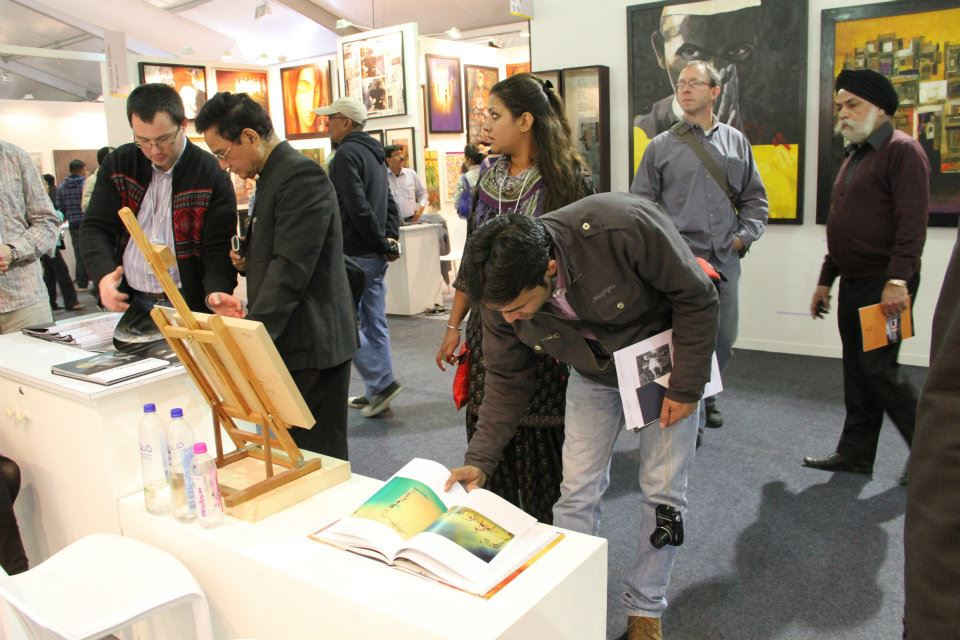

What was the real reason for that? Let me start with the media in Delhi. People go for an event when it is adequately covered. The major newspapers in Delhi covered the India Art Fair on a daily basis. What they covered was however not exciting enough. Most of the journalists were either parroting the press releases or choosing the same works as the press releases said. Some journalists were looking for exciting pieces of work and they really did not have the eyes to make a choice. Some of them were highlighting some kind of radical art which unfortunately were not visually catching. In short the whole reports came during the three days of the events (four days including the curtain raiser) were full of details with non-exciting illustrations. The public were not pulled in. There were not many showman’s pieces. No huge names as in the case of last few years; Anish Kapoor, Ron Mueck, Subodh Gupta, Marina Abromovic and so on. K.S.Radhakrishnan’s works were exceptionally different and good. But somehow the newspapers failed in highlighting them. Even the large scale works of Paresh Maity did not get enough attention even if for the wrong reasons.

Moving from the news reports to the ticket price, I would say that the poorer sections of the art community stayed away from the art fair mainly because the ticket price was so high. There used to be a time when students from different cities came with their backpacks and waited for someone at the gate to give them passes or they could some how afford those ticket prices. With Rs.500 per ticket, most of the students did not even plan their trip to the fair. The northern winter cultural corridor extending from Jaipur (literature festival) to Udaipur Music festival to Delhi’s India Art Fair also remained sort of dry this year as I could not see many foreign nationals paying a visit at the India Art Fair. I could see a lot of Indian boys and girls trying hard to look like foreigners in their own land of birth and failing miserably. Another major drawback is the usual suspects in the seminars. Generally seminars are attended by the student crowd or the academic crowd. But who will pay such high ticket prices to attend the seminar. Once you are inside the venue of the India Art Fair, one cannot eat or drink because everything is priced sky high. Why should we pay tax for a glass of water? The local crowd and the student crowd will not only stay away but also turn against such venues if things go hopeless corporate in this way.

 (from IAF)

The driving philosophy has gone fundamentally wrong with the India Art Fair. But there is still time to correct it. If you look at it closely, it is still working on the Brahminical basis. The well known galleries such as Chemould, Nature Morte, Vadehra, SKE, Lakeeren, Experimenter Kolkata, Grosvenor and so on are given the prime place (I do not know the economics of it. May be there is another economic side to it). Automatically people are supposed to believe that they show the best kind of art. And the best kind of art this time is also the worst kind of art. Most of the works of art looked not up to the mark. I do not know how many art collectors are going to buy the works of Shilpa Gupta, Michelangelo Pistelletto, Daniel Burin and all (I am not criticizing the gallery Continua from Italy). While these galleries occupy the prime place, the actual action is happening elsewhere. Smaller galleries make brisk business and most of the people are in those booths. Why so? Is it because the people in this country (including the buyers) do not understand the kind of art in the major galleries or the major galleries do not give any damn to such people because they are here to make contacts with corporate houses and museums that could accommodate those high end and large works?

While India Art Fair basks in the reflected glory of these few galleries and artists whose names are internationally known, the fair organizers forget to acknowledge the fact that if the people of a place reject a fair, however much financial back up it has, it will not be able to stand. In the US itself people have resisted the super markets like Walmart from their counties so they had to shut shop from there. It is unfortunate that the fair organizers think that these biggies represent Indian art. No, they do not. They represent Indian art and artists who are internationally known via an economic root. It is nothing else. Look at the Gallery Espace or the Guild Gallery. They have all the right ingredients and the contemporary artists. But they are largely neglected in whatever discourse of the India Art Fair. Is it because these galleries show the ‘bad’ art or bad artists? I do not think that they will agree with it. But it is unfortunate that contemporary art is still in the hands of a few, who in fact had contributed a lot in promoting the very same artists during the boom time and now reluctant to touch them with a barge pole. Further behind these galleries you see the smaller galleries with different kinds of works making good business. But their art is not talked about in the seminar halls or the discourse that the India Art Fair is instrumental in creating.

(from IAF)

How do you balance this imbalance in the India Art Fair and the answer to that would help India Art Fair to move from this edition to the next. For this India Art Fair has to make the participating galleries understand that this is not a platform to sell but to showcase their kind of art. And in that showcasing there cannot be very huge discriminations. The idea that one really does not make a buying or selling on an art fair platform, would help the people to focus on working on the business relationship and establishing brands of their own. Unfortunately, Neha Kirpal has been repeating the same fault for the last few years. She has been saying that the sales have been good. It is definitely not for her to say this. This statement should come from the galleries. Even if it does not come from the galleries, the galleries should be able to present a white paper to the IAF management within six months after the conclusion of the fair saying that they could garner a particular amount of business through or helped by the platform of IAF. This could come from the all the galleries that participate in the IAF editions. Based on this the succeeding edition should be promoted. Neha Kirpal is a space seller in the fundamental sense. She cannot speak for the aesthetics or the kind of sales happening in different galleries. If she speaks she should be speaking equally about Subodh Gupta and Shampa Sircar. When she is not ready to do that, and still treats the small galleries as space fillers, the truth of the fair will go down. The best remedy is to sell the space and let the galleries make their business relations than the actual business.

Once the India Art Fair becomes a business interface where relationships are made (like Cannes Film festival and auto expos where the product is not really sold but business commitments are sought) then there will be no difference between the higher galleries and the lower galleries. The proposal for booking should be based on a white paper issued by the IAF organizers. If we go by it, the next edition will be featuring more and more moderns and the selling contemporary artists. If business is the aim, it should be based on real figures, not on speculations. In my opinion, India Art Fair should leave the platform open for the galleries to show whatever they want (I am sure they do it even now) but make them aware that the business they do is not directly proportional to the ‘sales’ they do here. Let’s go by the other industrial expos. Auto expo is the best example; the people who come to see the cars do not buy it from there. They make their choices and go to a showroom to buy it. Dealers strike deals with the manufacturers. Companies make MoUs between franchises. Governments sign MoUs between governments. India Art Fair should take such a turn so that this petty bickering of selling from there and selling the ‘right’ thing wouldn’t be a problem. It would make the fair more varied and full of surprises. Now it looks like most of the front row galleries are presenting works which are meant to go to some museums. The buyer is predetermined. What’s the fun in such art?

 (IAF venue)

Lucky that there are not too many curators in this edition of the India Art Fair. Too many cooks spoil the broth. During the last few years where the project directors and curators were involved in the making of the shows, India Art Fair was a clumsy affair. Now it is really neat and clean. The other major factor that needs immediate attention is the seminars. It is a cruel thing to do seminars during the opening hours of the fair. In fact the seminars should be happening in terms of economics. It should be teaching the galleries and the buyers rather than discussing vague themes like ‘boundaries unlimited’, ‘partition experiences’ etc. It is a comedy that people discuss vegetarianism before a full non-vegetarian meal waiting to be consumed. What you talk there in the seminar halls should make some sense to the listeners when they come inside the booths. Most of the speakers are the ‘yes sayers’ of the market. It is ridiculous to see them pretending to be the soldiers of socialism.

The India Art Fair organisers could do one thing to save the grace of the speakers in these seminars. The seminars of the India Art Fair should start at least three days before the opening of the actual fair. It should be in one of the spaces like the NGMA or KNMA. It should be in democratically accessible places and there should not be any entry fee so that students and the young crowd could attend the sessions. Only because the BMW or Yes Bank or Absolut are the business partners and most of the executives as well as the artists come by car that does not mean that art is their property. It should be accessible to the people if the seminars are meant to be spreading democratic and humanitarian values. Bottles of water and basic tea and biscuits should be given free to the audience. The seminars should discuss the pointers of the ‘soon to be opened’ art fair so that people could engage with the works and the ideas discussed. There could be artists talk before the commencement of the fair. Academics should be treated with high respect and they should not be treated as jokers in a circus (now that is case. It is pathetic to see them grapple with ideas while people talk money in the next tent).

 (booth of Gallery Continua, Italy at the IAF)

If that is the case, the booths in the fair could be much more liberal spaces, where immediate selling would replace business deals and also whatever is displayed becomes eye candy for the visitors. The galleries could show their best pieces and the viewers could connect with exhibits as they have some kind of an intimation about what they are going to see. The fake show off of being important in this world shown by art people should be completely wiped off by the sheer presence of the art loving people coming back into the tents of the India Art Fair. People should come to the booths and ask questions to the artists while the business deals could be struck on the white leathered sofas. People would reject India Art Fair because they are no longer able to see the Indian works of art. The foreign galleries are deserting this platform because they know that the business of their wares is not really here. If there is a market for the moderns as evidenced by the present edition of the IAF (and also by the activities of the auction houses), then that is a marker for the growing interest in the provincial and the regional, and even the national. People will take interest in the works of art by our artists if they do the art of this earth. This does not mean that they should be ‘nationalistic’ and narrow in a parochial sense. They should be global by highlighting their local traits in their aesthetical expressions. How long are we going to produce our own Jeff Koons, our own Chapman Brothers, our own Tracy Emins and Shirin Neshats and Marina Abromovics and even our own Yoko Onos? Make our own contemporary art. Make our own global art. And be proud of being world citizens. Make art a part of the people, if not, the India Art Fair is bound to fail.    

Saturday, January 30, 2016

City Lights 6: Culture and the City


Religion precedes the cities while culture succeeds them. A city does not bring culture as a predetermined or established entity; culture grows as the city grows and interestingly it never stops growing. Mechanical views on culture always posit it as something that has started at some point of time and consolidated over a period and remains static for the succeeding generations to pick up, emulate, choose, discard or use it as a touchstone for furthering their activities. Culture, as we understand today as a pack of finer sensibilities developed by the people in country, city or province, is not really a system of finer sensibilities deliberately articulated for the future use. In the final analysis culture is the common characteristics developed and distilled in and by a society, that continue in different forms till the present. Though sectarian thoughts of today have made us to think about culture as created differently by different groups of people in a society exclusive of each other, in reality a culture cannot exist in exclusivity unless it is militantly guarded by exclusionary practices.


Eating, drinking, dressing and anything related to the public and private practices of human beings in a society carry the traits of the cultural peculiarities of a particular place. The idea of culture or the manifestations of it that we see in a given place is the continuity as well as re-adaptations of the cultural practices existing elsewhere. In the process, most of these practices are improvised, refined, added and re-positioned in the social sphere, which become the part and parcel of the awareness and social consciousness of the people who live in that particular place. Therefore a country’s culture is not really different from the culture of the neighboring country though apparently they look different in their manifestations. The overlapping that is palpable in the cultures of the two countries stand as a proof for the intermingling, transition and transference of cultural practices in the geographically connected areas. Even if the countries are separated by a mountain or by sea, or even if they are racially and linguistically different, one could see certain identical threads that connect the birth and death rituals, which confirm the erstwhile connectivity of those different cultures.


Even if countries are disjointed by mountains and seas, commerce that had started ever since the settlement of human beings in certain regions on earth (and even before that the explosion of human race from the mythological and biological places of origin to other parts of the earth through nomadic activities), cultures have been in communication with the other cultures though in a surface they all look different and separated by disparate practices. Considering that the primary conditions that differentiate one social practice from the other therefore forcing the cultures look different are weather, geography, food habits and source of economy, we have to understand that the apparent differences in cultures are consolidated by the above mentioned conditions. As the distance between two places increases the customary practices and the resultant cultural outlook also change accordingly. However, fundamentally they remain the same.

If countries are different in cultural practices, provinces within the country also could look different with the change of climatic and geographical zones. Commerce and colonialism since the origin of history have made considerable contributions to the composite cultures within the same region. Mythology has played a very crucial role in making the culture of a country through the common thread of mythological stories. As I have argued in one of the early chapters, religions help the cities form around them therefore culture also gets focus in cities mainly because the mythologies that help the culture grow and connect with the provincial cultures originate from the religions. All the finer sensibilities interestingly are developed around the religions. Mythologies are created and performed through grammatical articulations of the same in different forms of expressions mainly in the city centers where the patronage for such expressions are often found. The same grammatically oriented cultures move from the cities to the rural areas losing the grip of grammar slowly and take the form of very daring cultural experiments. It does not mean that the rural areas are passive recipients of the urban cultural practices. They in turn also imbibe the beauty and rawness of the rural expressions in order to embellish the grammatically structured cultural expressions.


Those who understand the fact that culture is not an exclusionary practice but an inclusionary one that develops over a period of time and is practiced by various kinds of people in the same place, making their own views on it also understand the cultures of different places and of people should be respected and if need be taken into their own lives. A city becomes interesting to live in when all cultures are celebrated as a part of living continuity and other cultures are not disparaged or resisted. The culture of a city is not just about having a lot of avenues to express the finer sensibilities of the people who live there, on the contrary it is the same people’s ability to live harmoniously with various cultures and celebrate all of them with some kind of participatory zeal. Unfortunately, our cities have forgotten this basic lesson of having divergent and vibrant cultures. In an attempt to make the city life unified in a monotonous fashion, the state and the people who hold power in various strata of social life make one culture dominant over the other thereby creating schism between people who uphold cultures different from the dominant one.

A city is a conglomeration of different provinces and the provincial cultures also migrate with the people from the rural areas and fringes. One could say that it is the arrival of nature into the platform of culture or in other words we could say that it is the entry of grammar-less structures into the grammatical structures. These juxtapositions further result into a new culture where everyone finds a bit of their culture within the dominant one or in other terms, each culture looks dominant therefore adorable like the pages in an interesting novel. Each time we read one page we find it so important to be neglected; while it remains as an independent narrative in itself, it constitutes the larger cultural outlook of the city.


With religion becoming the defining factor in the cities culture becomes subservient to the domination of the religions and pertaining narratives. People mistake culture as refinement in social manners. While one could be very much refined in social manners he or she could harbor extremely retrogressive ideas about the culture. It could range from holding one culture over the other to the refusal to acknowledge rest of the cultures. A city is a cosmopolitan space where culture is being produced and reproduced. There are so many factors that influence the growth of the culture. It is not a static entity that remains unchanged with the time. The changes that influence the general culture of city and society make it a part of the universe and not too different from the people living elsewhere. One we understand that the cultures are not mutually exclusive, then we would learn to respect all what is foreign to us. The respect does not mean that subservience. The moment culture renders us to be a part of the universe we automatically become universal citizens devoid of nations and religions, and at the same time carrying the traits of the nations and religions that we happen to belong to. Being cultured does not mean that being refined in taste. Being culture however does mean that accepting the other cultures with reverence and love. Somewhere we lack in this understanding that’s why on the same platforms we respect the art forms from different places but just hate the people and their religion and nationalities. That’s why we make war with the same people who sing for us. The day we recognize that culture is not personal refinement but making our personal existence a part of the universal existence and realize it in our personal lives, we could call ourselves really cultured or having a culture of our own. Till then we will remain barbarians who could hold a champagne glass, talk elegantly and listen to Chopin while we dine well. 

Friday, January 29, 2016

City Lights 5: Lonely in the City

(Cindy Sherman; Lonely woman in the city)

Cities engender lonely people. Loneliness is the reigning character of any city. Perhaps, that is why most of the cities have a lot of lights, discotheques, cinema halls, malls, shopping centers and too many distractions. Each sparkling thing in the city is meant to distract people from their loneliness. Shrouded in their aloneness and lost in the streets even within the crowds, people struggle with their left- aloneness in various ways. Some anchor themselves in chanting scriptures, some read books, most of them look at the screens of their smart phones, some people involve in empty chats, some look vacantly into the thin air, some sleep off and if you look at the hands of the loneliest people, you could see them clutching on something as if that is the last straw that would save them from the impending doom. It could be a hook that hangs from the ceiling of a bus or a metro coach. It could be a fancy clutch, it could be a computer bag or it could even be a faded umbrella- they hold on to them with that mortal fear of losing themselves into the gaping hollows of existence in the city.


Lonely people are alike everywhere that’s why most of the city people look alike. They go for the same fashion and all of a sudden all the girls in a city would wear a particular color in certain cut. All the boys without any rhyme or reason would sport the same kind of hairstyle, wear same kind of trousers and even walk and talk in the same way as the other boys in any other city. In their likeness they immerse their identity and individuality because they are so afraid of being unique and they are so frightened to let their individuality to flourish. They avoid their extreme aloneness by becoming one amongst the crowd. They in turn believe that they are the trendiest of people in the city. It happens with the office going middle class and the working class people. In one season all of them would wear the same kind of sweater in the winder, the same kind of shirt in the summer. They would wear the same kind of sari, consume the same kind of food- all in order to escape from their loneliness. They want to identify themselves with other people in the city therefore they could just disappear and be a part of the crowd and feel safe.


Recognizing one’s individuality is the fiercest form of aloneness and exercising it needs a lot of courage. Cities generally do not allow people to be alone. If people are alone, they would start thinking for themselves. Lonely people will walk alone and stand alone. The state and the corporates that rule the cities are afraid of lonely people who walk and stand alone. Religions, organizations, establishments and all those edifices where the state has a hold ideologically are afraid of the lonely people. To keep the people engage and to kill their loneliness and aloneness the state always provides distractions in the forms of entertainment and consuming. Food, travel, cinema, music, books, art and everything these days are organized as group activities. People no longer walk into a restaurant alone and eat or drink silently in a corner. Rare are those people who do so and they definitely are treated as nut cases and somehow they are kept apart and aside, and none just wouldn’t mess up with them because they are lonely people therefore dangerous people. Most of us these days do not watch movies alone, listens to songs alone; everything needs some kind of a group activity whether it is reading a book or enjoying art.

In literature you would see people or individuals exercising their right to be alone or enjoy loneliness. There is a small difference between loneliness and aloneness. Loneliness is often understood as a forced thing on an individual and he/she is lonely because of certain social pressures or lack of confidence or even that person’s inability to make friends. Aloneness on the other hand is understood as some social positioning of the self and one prefers to be alone in a given situation or otherwise. Some people have a general disposition to be alone. Some people prefer to enjoy loneliness that need not necessarily be interpreted as melancholic demeanor. One could be absolutely happy in one’s loneliness and one could joyful or even blissful in one’s aloneness. Standing alone needs a lot of courage and cities often give the opportunity to be alone, walk alone, talk alone and live alone. The more it gives such opportunities the more it takes away the possibilities to enjoy or exercise such loneliness or aloneness. Through the mix match of opportunities and possibilities cities always allure a person to be alone and at the same time indulge in group activities.


Lonely people prefer to walk into a building alone. The people who want aloneness prefer to use even an elevator alone. It is not because the other is hell but because the other could intrusive. The city has its very peculiar tendency to interfere with the individual’s life. The city prepares its own citizens to do that. One cannot just sit alone on a park bench; if he/she does some people would approach either to heckle them or to peddle something. But people who prefer aloneness fiercely fight for their freedom. They choose go alone into a theatre and ask for the seat of their liking. They prefer to sit alone in a library or a café. Neither they would poke nose into other’s matters nor would they let others do so in their lives. But somehow the society at large does not entertain the lonely people. In cities it has become increasingly difficult for single people to find accommodation though singledom of a person does not assure his or her loneliness. But mostly the single people are single because they value their aloneness and loneliness.

Cities themselves have this inherent quality to be alone. Have you ever seen a city from the outside; to see a city from outside one should live in the city for a long time, leave and then come back with some kind of affected disinterested-ness. As we approach a city we feel it like an organism trying to extricate itself from the clutches of uncouthness and the chaotic activities at the fringes. A city just does not happen all of a sudden. One has to travel along the vast tracts of farm lands and little hamlets before one reaches a proper town with buildings and activities in human scale. From there as one moves further the activities increase and the height and the glitter of the building grow in size both vertically and horizontally. The chaos slowly gives away to some kind of orderliness which would submerge into the planned lay outs and regimented movements. Even if the apparent movements and activities of people in a city look a bit chaotic and random, a deeper look would reveal that there is always a sense of order in those movements. The city slowly transforms before our eyes and becomes just a backdrop for varied human activities to take place. The city without its people is the loneliest sight in the world. That means people make a city; not the buildings and the streets. A city becomes a city in proper sense only when the people respond to the buildings and streets and also in turn create their own buildings and spaces. There is a constant stream of claiming the spaces by the people in a city which gives the final meaning to a city.


To understand the loneliness of a city, one should use imagination and erase the city away from the human activities that take place in a city both in day and night. The people would look absolutely lost in a nowhere space and suddenly all their movements and activities would lose their meanings. They would become the participants in an absurd drama of existence. That means, the physical structures of a city also give meaning to the lives of the people. Once separated, they are absolutely lonely and useless. One has to approach a city in the dead of night to know how lonely a city looks like. The same place that looked so buzzing with human activities look abandoned and eerie at night. Even if there is human presence certain places in a city look more dream like in night. Everything washed in loneliness at night in a city. The city itself is a lonely being with its tired lights refusing to sparkle and at the same refusing to die. The lights that fall through the blinds inside the hotel rooms and office halls that function at night give a special hue to the places that enhances the density of loneliness of a city. Even if there is traffic on the road in the midnight, each vehicle that moves looks like a lonely planet with one or two people trapped inside it eternally lost. One should see the people driving back home; you could touch loneliness there. One should see couple driving back home or driving around after a tiff between each other. You should see a young woman is picked by her husband, father or brother from the office in the evening and you should them driving back home. You can measure the depth of loneliness in their faces. However they try to distract themselves they remain lonely and alone. That is the loneliness of the cities.

The loneliest people eat alone. Perhaps, seeing a person eating alone in a restaurant or inside a room is the gloomiest sight in the world. It is gloomy because one could feel the depth of loneliness surrounding them in that darkness. One could watch them doing the act of eating in slow motion. Everything is focused. The head is hung. If it is held high (how one could) the eyes would be staring into something beyond. But only the sight of these people eating alone is a gloomy one. For them this must be a very enjoyable experience. One could repeat that ritual of eating in certain way for years on without getting bored. They are not bored that is why they continue with. Even if we feel pity for such lonely people, we do not understand that it is not their pathetic state that has put them into that condition but their ultimate sense of joy that is making them continue with the same ritual of eating alone. They are mysterious people as most of the lonely people are mysterious. Their mystery is depended on their aloofness. They arose some kind of curiosity or fear amongst the onlookers. And there will some moments when we also feel like becoming those people who are lonely and seem to be enjoying it to the hilt.


Lonely people also take selfies. But they take the selfies with their shadows. Sometimes they are interested in clicking their shadows alone. They are not interested in places, people, events, occasions, spectacles, beauty, excitement etc. They are simply interested in their shadows. They could look at their shadows for a long time. They could measure the size of the shadow and understand the time of the day. They hear the music of the unseen creatures. They travel in the unseen planets. They see the landscape of shadows where the memories of the loved ones whom they have never seen or would never see lurk like angels in a dream. Their effort to capture the shadow comes from the idea of capturing angels in silence. And each picture of their own shadow is framed by an unwritten poem and also by a thoughtless thought. There is a secret smile that sheds light on the shadow so that the edges of the shadow look like drawn by dews and shining snow. Lonely people would allure us with their shadow pictures but they should be let alone. Any attempt to make them your companions would end up in disaster because they are people who enjoy the company of their own selves. They love their cities because they know that the cities are also like them. 

Wednesday, January 27, 2016

Photographing the Neighbor and the Neighborhood: Alternative Art of Manoj Bharti Gupta

(Photography artist Manoj Bharti Gupta at his interactive studio in Kirti Nagar)

India Art Fair is a day away and many art galleries in Delhi are opening new shows in the hope of increased footfall and discerning eyeballs. Few have the balls this time to show extremely unconventional works in their galleries and perhaps this is one last time they could anticipate a new life for the Indian contemporary art in the market especially in a time when some of the major Indian galleries have decided to keep off from the eight edition of the India Art Fair (2016) for making gold in art fairs including Dhaka and Dubai. Far away from the madding and maddening crowds of the plush art openings, there at Kirti Nagar in West Delhi, at a park in an inconspicuous middle class housing colony namely Mansarovar Garden, B Block, an exhibition of photography titled ‘Padosi’ has just opened in the august presence of the people from the neighborhood. I travelled twenty two kilometers to reach there because I like the photography artist, Manoj Bharti Gupta who has initiated this neighborhood project and also has been taking photographs of lonely women in the metro stations.

(Padosi exhibition)

Kirti Nagar is famous for a different kind of art; the furniture art and the interior furnishing shops. Huge shops resembling malls sell expensive furniture and decorative items but none in the area seems to have cared to visit an art gallery in Delhi. Manoj Bharti Gupta says that just behind the glitter and glamour of these furniture shops there lies a long stretch of slums where young carpenter boys play cricket during the recess that they eke out from their working hours. “They make wonderful furniture for dirt cheap prices but none buys from them,” Manoj Bharti says pointing out his bookshelf in which he has tastefully kept his art book and literature collection. “This came for Rs.6000/- and the same is sold for Rs.25000/- in the showrooms in the same locality,” he smiles. It is from these ground realities that Manoj Bharti decided to initiate a project like ‘Padosi’ in his own colony.

 (viewers of Padosi exhibition)

Looking at these works hung from the makeshift frames made of bamboo poles and the sharp white light flooding on the photographic images, one would think how alternative could an alternative art practice be. Can it be stretched to this level so that the project gets no attention from those galleries and community development art projects but is attended by those people who have become reluctant as well as willing participants in this project? Manoj Bharti is a photography artist who has a different view on things and whose first solo exhibition was the shadows of a shining India. Images culled from the working class who make the shining India and eventually discarded by the same India became the key subject for his first solo exhibition. In his second group show too he worked on the similar lines and this time turning his lens towards the workers who make the sprawling sub city of Gurgaon. In him there is a social activist but he asserts that being a Banya (the merchant community in India), he knows where his money is.

 (one of the exhibits in Padosi show)

‘Padosi’ means neighbor in Hindi. Manoj Bharti started working on this project that captures the varying moods of the people in his own neighborhood after an interesting confrontation with a six year old little girl from the same block. When Manoj and his family shifted to this colony couple of years back, on a day he met this girl in the park and he said ‘hello’.  But the girl immediately turned away from there saying that ‘I do not talk to strangers’.  This was an eye opener for Manoj. He says that Delhi has become such a paranoia ridden city that the kids no longer believe anybody. Their childhood has been taken away from them. “I cannot question the warning of their parents because they too are scared by the atrocities happening to the children in the city,” says Manoj. But he wanted to develop trust amongst people in the same colony through photography. He started photographing people without intruding into their privacy. As usual people took offence in the beginning but soon they grew friendly. Manoj kept on documenting the people and children and now he is the official visual chronicler of the colony. The large turnout of the people who perhaps never visited an art show before is a standing evidence to his popularity and the growing mutual trust of the people within the colony.

 (this is how the show looks)

To satisfy my curiosity, I asked a few kids whether they would like to become photographers and definitely they want to become one like ‘Manoj Bhaiyya’ (Brother Manoj). I overheard people talking about the meaning of the images that Manoj has deliberately created by making some of the pictures grainy and out of focus. The people, some of them the subjects of those photographs wonder why they look like ‘that’ in those photographs. I could sense the growing curiosity in order to find meaning in the day to day images. They may not be talking this deeply about the images if those were in fact from their own mobile phones. But here is an artist, who is also a social activist and has been doing this project, which for many a mad and useless pursuit for a Baniya boy, for a long time and if that is the case there must be some meaning. Soon comes a lady only to complaint that her daughter’s face is not visible in the picture. Manoj explains that his effort was to capture her drawing on her picture book from behind so that he could get her physical and mental focus on her act. But the mother does not seem to be satisfied.

(inside his interactive studio/archives)

Manoj Bharti has planned to keep the show on for coming four days with the same hope that some interested people would take the pain to travel all the way to see his works exhibited in an unconventional space. He hopes that people would see the truth of his act. Even if they do not really give much attention to his activities, Manoj is not worried. He has bigger plans. He has just rented out a small apartment in the same locality which he for the last two months has been using as an interactive space for photography. He has brought a lot of books that include the books of Prabuddha Dasgupta, Banksy, R.K.Laxman, H.D.Phadnis (Marathi cartoonist) and some interesting foreign designers; all collected from the second hand bookshops in Daryaganj. He invites his friends and his sisters friend there in the apartment and they start bringing interesting stories of their own.

 (display in the interactive space)

For Manoj Bharti, this apartment is an archives and a personal museum. He has brought out his personal archives in this space and interestingly this archives is not full of visuals rather they are all paper cuttings from Hindi newspapers. He points out that most of those paper cuttings which are meticulously catalogued, are mostly economic and political articles. Why so? Manoj has an interesting story to share. In one of his school vacations his teacher gave him an assignment to collect newspaper articles of his liking. He started doing it and even after leaving school for more than a decade he is still collecting those articles. Besides, he has developed personal connections with those writers as many of his exhibits are accompanied by these articles. He invites these authors for his exhibitions and they are happy to see how his visuals have taken inspiration from the points that they have argued in their articles. As the interactive space became active, Manoj slowly found out a few interesting people who had not stopped some kind of archiving that they had started in their school years. One of them is an insect collector who became fascinated with the insect life after she was asked to bring a couple of insects to the class as a part of some assignment. Another is a person who writes down the names of each person he has seen for some reason in his life. He has not stopped it yet. “It is a pleasure to bring them into my working scheme,” says Manoj. AT the same time he reiterates that his work is also like a home work which is never finished.

 (another view of the interactive space)

Manoj Bharti Gupta has another interesting contribution in his sister’s life and as she is also now groomed as a photographer by her brother. Komal Bharti Gupta is a close associate of her brother and is a keen learner. The story goes like this: Komal did not have good numbers to get into a college. She was slightly depressed. Manoj gave her the camera and asked her to click whatever she wanted. But that year she was lucky and she could join the famous Jesus and Mary College. She finished her graduation and also had her solo show of photographs in the college hall. Now she pursues her post graduate studies and helps Manoj in organizing his works and activities. If Manoj is an avid photographer of women in Metro, Komal registers the images of women in Delhi’s buses, which she hopes would grow into a very important visual document.

(JohnyML with Manoj Bharti Gupta)

Amongst the new crop of photography artists in Delhi, namely Vicky Roy and Vinit Gupta, Manoj Bharti Gupta also has made his niche in the emerging scene. A protégé of Dinesh Khanna and Aditya Arya, ace photographers, Manoj has deeper social interest than a party hopping ‘fine’ artist. With a political background (his father has fought local elections three times), Manoj has extensively documented certain political movements including the birth and growth of the Aam Aadmi Party purely using still camera. He was a video editor with Door Darshan (for Nalini Singh’s Aankhon Dekhein program) but never did he feel the urge to document these political movements in video. “I am a still photographer and I want to be a still photographer,” says Manoj. Is he ready to release his works on the political movement? “No,” says the artist. “I do not feel the urgency to release any of those images now. I want them to grow with time and become the document of a time than just registration of the passing moments.” People come around Manoj and wish him all the best. Some are really happy about his works and some are worried why their faces are in shadow. Padosi could be risky at times, but for the time being, Manoj seems to have struck the right chords with the people in his neighborhood. 

City Lights 4: Religions and the City


Which one came first, a city or the religious shrines? This is like the proverbial question pertaining to egg and chicken. While we cannot be so conclusive about this, in the case of cities we could say that the religious shrines came first and the cities came around it later. Religions of any shade, degree and strength are theoretical codifications extracted from the human beings’ ultimate quest to understand the meaning of his existence on this earth. This organization might have taken so many centuries before those dictums came to have gained larger acceptance. With the religions, there occurred two things; one, the origin of myths and two, the origin of human hierarchy. Human societies were not hierarchic as the way we see them today. They were loose structures with men and women alternatively holding prominence in the given life depending on the situations that included habitations and food gathering. When religions started forming, those people who happened to have become instrumental in codifying the social rules with a supra structure of divinities for adequate sanctions of the same became the automatic power holders in the society. They were expected to guide or lead the society based on the heard and remembered rules of divinity. And the rest of the people became the followers, perhaps willingly because it was good for all of them to lead a peaceful life in their transition from beast-nature to human nature and also from their nomadic existence to settled lives. That means, leadership is not the outcome of a person’s or a collective’s desire to become the leader but the society’s general need to create and posit someone to that position. The building of the cities thus became the responsibility of such elected or naturally selected leaders.


Whatever views we hold about politics and religion, the fact is that religion is the origin of politics; not the other way round. Religion established social order theoretically and to certain extent symbolically. But it was not enough to perpetuate the idea of order and supremacy amongst the large number of people who came to have shared the same language, gesture or the developing customs. The theoretical as well as the symbolical nature of the religions needed some sort of a practical expression so that the total hold of these could bind the rest of the society together without much conflict. But so long as human beings are different in thinking and outlook there are the possibilities of strife and differences. The religious leadership wanted such outbreak of dissents to be curbed and the dissenters be brought back to the fold. This needed persuasion of different types. The primary persuasion was through the religious and spiritual warnings by showing them the torturous after life for the dissenters. Most of the people confirmed with such ideas and remained in the fold accepting the dictums of the religious leadership. But still there were people who really did not give any damn to these social codes and the spiritual leadership. Such people were to be brought and kept within the fold. Coercion was one of the means and it had to be expressed through punitive measures. But how could one exercise the punitive right without someone holding that authority? Therefore there occurred a need for the religious leadership to carve out a civil leadership with divine and secular authorities and the right to punish the dissenting ones as sanctioned by the religious authorities. The origin of kingship or someone with political power became a reality by this.


Kings adopted two things; one the sword, the tool of punishment and two, the paraphernalia of religious symbolism. A king had to appear before the public with all these paraphernalia. He had to hold the severest of punishing machines as symbolized by a sword. And he had to wear befitting robes that resembled the robes of the religious authorities. Religions gave sanctions to these kings because partly they were representing and safeguarding the interests of the religions. Kings on the other hand had to develop severest of punishing methods not really to punish the enemies but to punish his own clan or tribe people. This established his authority over them. He became god and father rolled into one. He also at times replaced the religious authorities by holding both the secular and divine powers. He had to develop more and more different, exciting and frightening methods of punishment so that without exercising or using these tools he could keep the people under his control by simply evoking the fear amongst them. As people became his slaves and agreed more or less of his authority, it became imperative for the king to expand the scope of his power and also expand his jurisdiction. Territories were carved out and also territories were breached. In both cases religion stood with the kings to provoke, guide and even promote territorial aggressions.

When territorial aggressions became a reality kingdoms were formed and now the kings had to establish their power in terms of physical opulence. Mere symbolism would not have served the purpose. They had to loot, burn, pilfer, tax and snatch from the people in order to create kingdoms and also to underline the existence of the kingdoms, they had to build the cities that allowed people to live and do commerce and pay taxes to the king. Religions and religious leaders stood by the kings and before the establishment of cities, they established the places of worship. These places of worship were done under the name of gods or goddesses so that they automatically gained an unquestionable divine sanction. When kings came capturing the territories, they looted the religious centers first and then established a rapport with the religious establishment there via cooptation as the interests of the both parties were one and the same; exercising power over the people. Cities were built through the help of the religious funds and blessings of the religious leaders. Religious leadership made money in turn by instilling fear in the minds of the people. So both religion and politics helped each other in creating fear and also in establishing cities. People, despite all kinds of looting and burning, lived in the cities peacefully under the ‘benevolent’ watch of both the king and the reigning deity, because they thought that it was through the religious path that the cities came into existence.


This continued for a long time and in due course of all these centuries human history saw kings coming from foreign lands after a period of fighting and looting, making compromises with the already existing religious and political establishments and becoming the new kings. Political leadership in the modern world also does the same thing as they keep religion as a binding concept. So long as the religious authorities are in harmony with the political leadership, things would move more or less fine. The moment religious sentiments are hurt by the political leadership there will be problems. The modern world suffers from a new problem; that’s one religion claiming supremacy over the other religion. In fact the cities become the contesting platforms for these vying religions. The people and the political leadership that sway according to these religions forget the fact that whatever be the religion, their primary interest is to keep political power so that the petty interests of whatever nature could be protected. Here when we see the political establishments fighting with the religious dissenters what we see is not the real politics doing political governance but in a pathetic way protecting the primordial powers of the religion over political establishments and the people. Irrespective of the religious color or complexion, and irrespective of the kinds of terrorism that we face today what thrives is the commercial interests of the religious establishments who exercise their fatal power over people through political establishments. Even if people believe that one political establishment would save them from the other, nothing is going to happen because it is the vicious interests of the religion that is going to be protected.

Most of the people who live in the modern cities do not understand this. They in their own levels staunchly believe in one or the other religion and one or the other political parties. Interestingly, the political belief of a person is perversely connected with the religious belief that he carries. This was not the case for a long time. There were some kind of enlightened thinking and the application of scientific logic when it came to the socio-religious and political issues. So people could choose themselves to be secular even when believing in one or the other religion for their spiritual purposes. One’s religion could have been directly oppositional to his political belief. The religions were not really asking for steadfast adherence and blind faith from people. People could choose their political ideology and could discard their religions. People could become radicals and discarded both religion and politics. Yet the civil society could have thrived in harmony. But through some strange twists in history or perhaps the naked outlaying of the nexus between religion and politics, today people, even the level headed ones at times are forced to justify their religious extremism through a related political outfit or the political extremism through a related religious outfit. What suffers is the lives in the cities and lives of the cities because it is in the cities such antagonisms are played out. The recent history of the world proves that religion has become either a problem for the development of the human beings as the members of a society driven by logical thinking and goaded by the ideas of spiritual sublimation where religions do not play any role but the philosophies extracted from all the religions become directive principles.


The idea of saving the world from further crises perhaps should start from dismantling the cities that are created out of unholy nexus between religions and politics. But is it possible as we perceive it? One may think that it is impossible as things are intricately and inextricably connected, besides a majority of the people who live in the cities (in villages as well) has been brainwashed to believe that we cannot do without cities where religions and politics meet and make some nefarious pacts. One cannot say that we could disband the cities or as some people dream it that they could remove all the unholy relationships between religion and politics. It is not possible because if one is removed the other cannot exist in a vacuum. If religion is removed in an ideal situation then there will not be any need for politics because as we saw at the outset of this chapter, if there is no religious organization, none will feel the need to exercise and extraneous power over the people who by that time will be capable of controlling their own lives within the minimum alternative governance. If you remove politics from the human societies, then definitely there will be no role for the religion. If politics is played on economics and social welfare then where exactly one would find a reason for talking about religion. A person who needs health care is to be given health care; his religion will not be a hindrance at all in an ideal situation where religion has not relevance. If a person is to be given education, his religion should not be a problem at all. If governance is all about economics and human dignity, then who is really interested to outwit the other in terms of religion? One may strive for a better job based on merit and ability and the other may try to excel by bettering his possibilities by equal opportunity and competition. Who is going to stop anyone from prospering in whichever ways? If someone wants to prosper in spiritual matters why one should resort to a particular religion at all? If listening to certain spiritual discourse the way one listens to music or attends to kindness, then why the conversion and elevation of human mind needs the crutches of a religion? When religion becomes irrelevant, what will be the politicians basing their votes on? They will have to perform in a society that demands progress and dignity. If someone fails to give it, he fails as an administrator.

Such an ideal scenario would bring forth very interesting outcomes in our society. That ideal society will not ask anyone to stop eating anything that the other person does not like to eat. Eating will be based on healthy life styles. Nobody will think about killing someone for eating a particular food because the very idea of killing someone would make people laugh like anything. What a ridiculous idea will it be if someone asks someone else not to eat something? In that scenario, nobody will be offended by seeing a work of art because a work of art will be an expression of a human being which will involve divine creatures, spiritual beings, leaders and so many other things. Nobody’s sentiments would get hurt because nobody’s sentiments will be connected to such trivial things as religion and politics. People would look at those people in cars as the way they look at people who pass winds from their rear ends in polite societies or belch without apologies. Nobody will be offended to see someone wearing a particular cloth. Most importantly nobody will ask a woman to behave in a particular way only because she is a woman. If someone does that, they will look at him as if he is an alien and will be thrown away by the civil police without much ado. Nobody will feel like regulate the time of a kiss on or off screen. Nobody will speak of the color of a man’s skin. It will not be significant as the color of one’s eyes. The word censorship will ultimately become obsolete if religion goes out of our lives.


I am not saying that cities and countries would flourish if we do away with religions. I am saying that in the final analysis, in today world, to progress in this world and the world beyond, one does not need religion or politics. What one does need is an administrative system that gives equal opportunity and justice to all. What we need is a system that assures education and health to all. What we need is the distribution of wealth as per work. What we needs is a situation where consumption is based on discretion. We want a situation where food is a privilege to one and all. We have to develop a situation where one need not pay for air and water. We need cities where people could walk freely without fearing offending someone. We need cities were people could breathe their spirituality without blocked by religions. We demand a city where pedestrians could walk without the fear of being knocked down and the cyclists could reach home safely. We need a society where women are respected and we need a society where people will not punctuate their conversations with expletives. To facilitate that we need a society, which is not based on religion and politics. I am not saying that politics should go. It should be there as an assisting mechanism to people. When religion is not there to make rampant sectarianism politics will lose its ferocious nature.

I am a dreamer, but I am not the only one, as the bard singer says. I know that our cities are built by people and those people who believed and still believe in religion. As they believe in religion they cannot think differently from the conventional politics. Brick by brick the people have built the religious shrines and establishments. The sentiments attached to those structures created by the generations of people are so strong that they cannot be wished away. But as we progress, or as we take our society towards one that offers dignity to one and all, we need to shed those genetic codings that have made us very touchy people. In fact though our efforts are there in creating these cities based on religion and politics, nothing is better that leaving them behind when we understand for sure that these are the same organizations that we have given birth to today kill us indiscriminately, without even considering that we too belong to the same religion that is now striking the sword against our necks. Definitely the people are the makers of the cities. But unfortunately they are not the takers of the cities. They become slaves of the establishments that they helped in making. There is only one solution to it: forget religion and embrace spirituality. It is not an easy task. When one is spiritual there is no comparison. There is no white spirituality or saffron spirituality or green spirituality. Spirituality is like water. It does not have shape or color. It takes the shape of your and color of you. When everyone becomes spiritual, political establishments will wither away; even countries would, one day, why cities alone? 

Tuesday, January 26, 2016

City Lights 3: Crime in the City


Cities are open places where people could move around without much social and legal restriction. There are sanitized zones and demarcated locations where entry is restricted by order in every city. Those edifices are either government installations or other strictly private enterprises where some amount of secrecy is maintained for the smooth running of such establishments. While they keep this secrecy in functioning they exude a sort of transparency and authority that eke out some kind of respect and admiration from the people who happen to pass by them. Despite the presence of security men, CCTV cameras, armed guards and policemen, barriers, metal detectors, body frisking, automatically moving walls, luggage scanners, warning signage and so on, people tend to look at these places as democratic set ups where they could seek service, support and justice. Cities thrive in such kind of deception. People who hail from different strata of the society learn to read the markings and markers, signage and restrictive presences with taking much offence and restrain themselves from entering into such places. Stories and news items that narrate the plight of the trespassers and the kind of punitive measures taken against them also function as social deterrents. To put it in others words, cities at once allow people’s movement and also in many ways direct their movement within the city limits. While anybody use public roads and streets, the roads leading to gated properties are often avoided even by the freedom loving people even if there are no signs that prevent people from entering.


This social conditioning pertaining to the free movement of people within a city considerably adds to the mental makeup of an ordinary citizen living there.  He/she learns to accept, judge, respect and fear both the visible and invisible restrictions without complaining much about it. The youth, who often breach social restrictions, also behave when it comes to the public and private establishments’ physical limits for the fear of them getting branded as terrorists in the newly emerged scenarios. This particular idea of control has its by products and repercussions in the social body and psyche. Most of the time, we could see a city getting vandalized by unknown people and also the cities witness the criminal graph rising, at times in uncontrollable pace. Compared to any other human habitats, cities are the places where increased presence of crime and criminals is felt. Most of the sensational crimes happen in the cities. Though the governments take so many measures to control the crime level in a city, criminals make their presence felt through the acts of crime. However harsh the punitive measures are, the criminals still repeat, ironically the silliest and the most atrocious sort of crimes in succession. At times, a particular kind of crimes like rape, passion related murders, heist etc., happen like a windfall. One may wonder why only in cities such things happen where people have freedom to move around, a sense security imparted by the security personals as well as the CCTV cameras. A deeper analysis of this issue takes us to an interesting answer and that answer is the inseparable nature of crime and the very idea of a city.


A city is an organized space with a dominant presence of governance as manifested in the town hall, assembly building, police station, military outpost, carefully planned streets, bridges, flyovers, parks, housing areas, offices, markets, commercial centers and so on. An individual who lives in a city is expected to negotiate between and through these spaces and places on a day to day basis even if he is not consciously aware of such personal negotiations. An ordinary citizen understands the city of his dwelling through different levels of narratives that include newspapers, television and his own personal journeys through the streets and other places of the city. A persona has to meet, confront and negotiate these spaces in different levels and together they make him/her aware of the general lay out and character of the city. Some people develop a deeper understanding of the city either by reading about it or by wandering through the lanes and inner layers of the city in order to know the complexion of the city life from close quarters. Most of the people however are not interested in such deeper and closer engagements with a city because of various reasons including the busy schedule one follows and the general apathy. The more people are disinterested in knowing a city from the close quarters, the more are the chances of the criminals moving around, mixing up with these disinterested people and behave as if they were just like anybody else. Their very knowledge of the people being disinterested makes their works easier for them.

However, the question is not who the criminals are, but why there are crimes in a city. As we imagine, a city and crime are not two different entities. The seed of both lies in the very notion of organization. When we say a city is an organized space/place, we need to see that what is left out in the organization form another parallel network or remain as scattered dregs in the social body which apparently looks organized. Interestingly, the people who organize the city themselves also cause the birth of crime when they create different interest groups within the organization. For the smooth functioning of an organization or a city, the governing bodies cannot take care of all the suggestions and opinions. This exclusion of certain opinions give birth to disgruntled elements within and without the organization that try to make their presence felt by acquiring power by other means. When the greed and avarice that precipitates within the members who are already a part of the organization causes the gravitation of the disgruntled elements towards them and together they start creating a power group through the amassing of wealth by the means of syphoning out from the public exchequer. This parallel power group is the primary cause of corruption within and without the organization that creates a series of networks that would help the primary corruption remain intact and undetected. But like any other organic system in the course development necessitates branching out and allowance of autonomy to such branched out systems this organic nature of corruption too makes other autonomous corrupted units that resorts to criminal means to maintain and exercise power by developing further parallel and intersecting networks.


A story of a murder reported from a city may apparently look ‘innocent’ (yes, innocent in its exclusivity and general nature at the same time) for many of us. But if one looks at with the above mentioned perspective one could understand that the ‘innocent’ murder is no longer an innocent murder or not even general in its nature. Let us take the example of an angry husband killing his wife suspecting of her extramarital affair. This is one of the commonplace incidents that we read in the newspapers reported from different parts of the same city or from different cities. This murder, from a shallow point of view looks like an innocent case, which is not connected to any political party, religion, caste, dowry issue or any such thing. The cause of the murder is the lack of trust or the actual finding of the husband. He got made and he killed his wife. In the same week perhaps we would read similar incidents reported from elsewhere too. Even at times we may think whether one incident caused the other. We need to see the ‘innocent’ murder as a complicated social outcome. The trust issue of the husband is not an autonomous issue created all because the suspecting nature or a psychological state of the husband. It may be created because the husband’s point of view must have been developed by watching a particular kind of movies or reading a particular kind of novel, or watching pornography, or his affiliation with certain friends who are interested in spreading such rumors about others’ wives, his affiliation with a political party that gives him some sort of legal insularity, his job as a very influential officer and above all his belief in his right as a man to have the sole power on his woman or his strong faith in the ideology of treating woman as the ‘mother’ who is saintly like the mother nation. The provocation must have been triggered by one of these. Even a daily wage earner who lives in a shanty does the same crime, if not any other reason, his idea of maleness must be one reason behind the murder, which renders the crime connected to a series of social, ideological, economic and political relationships that take us to the primary case of organization residues.

This particular case of a murder also cannot be generic because it is like any other suspecting husband killing a wife even if the circumstances are different. The crime cannot be generic because each murder like this is triggered by the aggressor’s blind faith in one of those powers that I have mentioned in the earlier paragraph. One may kill his wife because he thinks that he has money power and he could come out of the legal system using money. Another person may think that he has political power. Some may take knowledge as a cover and with the added knowledge of things he may think that he could hide from the legal hands of the state. So there is not generic crime as such; they may look alike but they differ from case to case. So is the case of rapes that are in the increase in many cities both in India and in the other developing countries. Rape is not a biological aberration or aggression that vandalizes the innocence or dignity or the gender of the victim. It is an assertion strongly clad in the desire for sexual gratification but in the fundamental analysis it is an act of male aggression of proving his right over the woman’s body. Hence, each rape is a byproduct or an outcome of the socio-political, economic and religious situation caused by the state as an organization. A rich man raping a woman or an inebriated laborer looking for some fun and raping a woman are fundamentally an act of the social dregs caused by the organization (of the city). In the mind of the aggressor, somewhere he feels the need to assert his authority and as he is rendered useless by all other means what he could use is his body as a weapon to prove on/against another human body.


This ideological nature of rape is the ideological nature of a city. In my view, a city creates its share of rapists, robbers, thieves, pickpockets, murderers, hooligans, goons, sharp shooters, molesters and so on. The more a city gets organized, put under surveillance and security personals are adequately distributed, the more these bad elements become active in a city. In a country where population is in a disproportionate state with the security measures and is on the increasing side, the magnitude of security measures is always less than expected. Even if it is increased to make people confident and the other parties fearful, still the crime rate in a city will not come down unless and until the cities reorganize and redefine the very idea of city organization. Rape, despite all awareness campaigns and punitive measures is on the rise in the cities. Why is it so? Rapists are conditioned by the society and the city as an organization in itself in such way that they feel the aggression that they show could be at some point pardoned and excused because  the city as an organization begets and at the same time anticipates such anti-social elements in the process. They almost look like the entities that add color to the general narrative of the society. The more a city tries to curb them the more they will come up with new ways of raping and doing mischief. If a robber is caught and taken away from the social narratives, many other robbers in waiting think that the very removal of a robber from the narrative assures a space for them to make an entry. And this absence of narrative is also filled in by the popular mediums including cinema by creating new and celebratory narratives about thieves and criminals who are basically do gooders happened to operate from the wrong side of the law.

When such popular narratives fill in the gaps created by the city in the process of taking away the rapists and thieves (generally the criminals) from the real life narratives, a rapist could appear like a person who was in love with the girl but was spurned by her. The rape was just an act of assertion and he at times is ready to marry her even! The new spate of incidents that involve the videographing of the act of rape and then proliferating it through the social mediums like whatsapp and eventual suicide of the rape victims cannot be seen as the extension of crime into the new medium but it has to be seen as the result of the allowance of similarly ‘exciting’ videos via whatsapp by the city/state itself. It happens in a society where the law makers watch pornography when the assembly or parliament is in session. So the spreading of a rape incident by the perpetrators themselves is an act that seeks social sanction of their ‘brave’ act. I am not implying that the state should clamp down on the social media and censor such connecting platforms, but I suggest that the city/state cannot act innocent as it is the city that has created the crime which could be documented in real time and sent across to a large populace via social media.


If the aspect of crime is removed from the fabric of city, then I would say a city ceases to be a city. A city needs to cater to the criminals too exactly the way it caters to the law abiding citizens. But the cities do not accept this. They always pretend that the crime is an after effect of the city; they refuse to accept that it is a byproduct that came out along the very organization of the city. When a city is highly organized with the help of the civic and military authorities, the criminals who are automatically generated by this centralized organization become equally strong. That does not mean that all the city organizations should be disbanded and a new structure should be put in place. No that is not the solution. The solution lies in the redefining and re-visualizing the very idea of city organization. The streets should be inviting the people to walk on more frequently than that happens these days. That is the first step towards the decentralization. When more people are walking in the city, the criminals cannot just strike a lonely victim. When everyone is walking the power of some within the cars or other vehicles automatically collapses. When technology is used for making the governance more efficient, people really need to go to a ‘work place’ to work. They could work from anywhere including home. When someone spends more time at home, people develop closer relationship with the family members.

City, compared to a country is a small unit therefore easier to govern. A city needs civic authorities to help the people out; there should be an elected body that oversees the development works and the security of the people. There should be expert bodies who would device plans for the city. There should be cultural giants who would be an integral part of the city administration. When a society is open both in the streets and homes, the crime rate will come down. Then the police will behave like friends. The cities should be claimed by people than by the authorities. The moment we give away the authority into the hands of a few people, with the centralization of governance, crime will automatically develop. People should organize themselves as culturally inclined and politically aware and socially integrated cosmopolitan people. This needs the basic killing of one’s ego and desire. One should think about freedom of movement within a city. The cities should be reclaimed by the people. They should say roads belong to the pedestrians. They should say the roads belong to the cyclists. They should say that polluting a city is the primary crime. We can do it, provided we take off a little bit of time off from the smart phones and look at the people who are just like us; half angels and half devils created by the organization called the city.