Monday, March 13, 2017

Strange Encounters: My Journey 14


All destinations are not planned destinations especially when you have decided to become an Avadhoot, someone who does not stick to a place for long time mainly to avoid developing any sort of attachment with that place. Sometimes you get out of the place of your stay with a particular destination in mind but end up reaching a place which has not been really in the radar. One of my friends who travels a lot for the heck of it has told me how his travels are open-ended always with no return ticket in hand. I have seen him coming back to his station much earlier than expected by himself, yet with a burning itch to set off sails again to the places that he seems important. Mine too is open ended but with a difference. Though I have assumed the status of an avadhoot, I am not a jeevanmukt, one who has liberated from all his limitations even while having a body of his own, fresh and alive. I have my professional as well as personal commitments, not as burdens but as responsibilities that amount to the performance of certain kind of penance that would lead me to the ultimate deliverance. Hence, each journey at least in my case anticipates a coming back perhaps not to the same base/station. I wish everyone enjoys this freedom to set out on a journey and come back to the station without being heckled and harassed by the near and dear ones. It would impart such a feeling of freedom and deliverance, which eventually would make all journeys light, relevant and meaningful.


Aruvippuram has been not in my radar for a long time. It is a place where Sree Narayana Guru had consecrated a non-Brahmin Shiva in 1888. Before doing that he had done penance in a cave at the top of a hill near by the Neyyar river that flows through Aruvippuram. If you ask me about the destinations that I have thought of going from the home base in Vakkom I would recount the place names like Chempazhanthy where Sree Narayana Guru was born and Thonnakkal, the Kumaranasan Memorial is located. I had plans in my mind to visit Aluva Adwaita Ashramam which was established by Sree Narayana Guru for spreading Sanskrit and Vedanta education among the lower castes. But providence has a different narrative written for me; a different direction set up for me so that I could follow the cues of nature, not really as a professional traveler. If you ask me whether I would like to be a 'genuine' traveler I would answer in negative. My travels are not undertaken with an idea of 'traveling' to know or to gather experience. Traveling happens in my case as a part of the natural dynamics. There are people, causes and effects waiting for me in the places that I am not even aware of existing. They just happen in my life and when they happen the intensity of the happening is too strong to comprehend. Anything that goes beyond comprehension is understood as experience and however one tries to explain it all those experiences stay as reconstructions in words and gestures; perhaps that's the possibility as well as the limitation of creativity. 

By the time I reach Trivandrum by bus my plan has already been changed. According to the original plan I am to go to the Khadi bhandar to buy a dhoti and kurta. I would be participating in a panel discussion in Mumbai in a couple of days' time and I have thought of wearing a dhoti and kurta to share the spirit of the panel discussion which is titled, 'regional art writing'. I get down at Trivandrum bus stand and the first bus I see there ready to start has a name board stuck on its front; it says Neyyattinkara. Aruvippuram is just six kilometres from there. I could pick up an auto rickshaw if I don't get any other conveyance. I get into the bus. In forty five minutes I am at Neyyattinkara bus stand brimming with the enthusiasm of uniformed boys and girls from nearby schools. Sitting in a tea stall, biting into a crispy parippuvada and sipping a cup of hot tea I watch the boys and girls. Boys are boisterous anywhere in the world especially when they are going back from schools. When they are just out of the school gates their uniforms transform; they pull the waist of their trousers down, roll up the sleeves and trouser ends, they are so obsessed with their hair that one hand is always working on the hair. Girls are no less than the boys. They talk to each other with gestures and eyes. Boys ogle at them. Some take courage to talk to each other. Some are just in the supporting roles. They hang out for a long time in the bus stand and like the clouds shatter and vanish in the sky, the crowds of the boys thin and vanish as each bus picks up a set of girls and disappear from the station. 


I get into a bus which goes via Aruvippuram. There are a lot of boys and girls in this bus too. I am lucky for I get a window seat just behind the front door. I have a good view of things outside and all along the way the loudspeakers accompany me with various sings with each song coming into my sonic field reminding me of the presence of yet another temple whose annual celebration is currently on. It is harvest time in Kerala. Though agriculture is no longer a lucrative occupation in the state the harvest festivals are not in wane. On the contrary every year the harvest festivals are on the increase with old temples intensifying their ritualistic presence and the new and revived ones joining the fray. With the BJP's influence on the rise in the state one could understand a rejuvenated feeling among the Hindu temples. Despite all these heightened activities around the temples the arts related to temple festivals are now fading slowly due to the lack of audience. While people like temple rituals they do not like to leave their television watching habits and congregate to watch live theatre and dance performances. The atmosphere is charged and I breath in the festival ambience which has been lost to me for a long time.


A strong smell of alcohol hits my nostrils. I see a lean thin man whose age could be anything between thirty and fifty sitting next to me and talking to a woman talking quite animatedly. I look at him and observe what he is trying to talk to the lady in the next seat. The lady who is enthusiastic as well as impatient on something is being pacified by this man with his sweet talk, I understand. Soon I gather that the lady is impatient because she believes that she would be late for some ritual in a temple somewhere ahead. This man tells that she is not going to miss it. In her agitation she has overlooked the fact that this stranger is drunk. Then he turns to me. He asks me where I am heading to. I tell him that I am going to Aruvippuram. He suddenly turns himself into a guide. First of all he apologises for being drunk. As I am familiar with such people I smile and tell him that it is okay with me. He tells me what all I should visit and what all I should do. He tells me that I should walk along the Neyyar river and sit near a small cave where Sree Narayana guru used to relax. He also tells me about the kodithookki Mala where Guru had undergone deep penance and was watched over by snakes and leopards. After informing all that he asks me what I do and why I am there. I tell him that I am writer and my visit though has no particular aim I could come up with an article or something. At that point he tells me that his name is Udayakumar and he lives a couple of stops away from Aruvippuram. He also informs me that he is known as Kunjunni in the neighbourhood and I could tell anybody that I know Kunjunni for getting help if need be. Then he does a classic act; he goes to the driver and tells him to stop in front of the Aruvippuram ashram so that his 'guest' could get down there. Generally the transport bus drivers do not oblige anybody as they are particular about braking  only at the stipulated bus stops. But this man applies brake and Kunjunni comes back to tell me to get down. A little embarrassed, I thank him and get down.


There is a stately gate in front of the Aruvippuram temple and ashram. As I walk in I see a tree which has a cemented platform around it. A plaque says that it was under this tree Guru had initiated the social and religious reformist organisation called the Sree Narayana Dharma Paripalana Sangham in 1906. This organisation would become a strong socio-caste organisation unlike Guru had wanted and would influence the economics and politics of the state. Just behind it is the Guru Manduram, the house of Guru. One could see the easy chair and walking stick that Guru had used. The photographs of his primary disciples flank the sanctum sanctorum of the building. Though it is not meant as a temple, from the paraphernalia laid out there tells me that there is some kind of puja going in there. Next to the building there is bell tower and a glass house and a painted wooden peacock is exhibited inside the glass cage. The board there says that the peacock statue was gifted to Guru by a rich Christian merchant in Trivandrum. As it is a hot noon I do not see anybody there in the campus. The temple that has come up around the non-Brahmin Shiva consecrated by Guru is closed. I go there stand in front of the temple and say my prayers, 'loka samastha sukhino bhavanthu.' I do not have anything else to wish or demand from Shiva. What I notice is the absence of Nandi that looks into the temple facing Shiva. The iconography is not strictly followed here because it is not a Brahmin temple, I assume.


I walk along the river and reach the cave where Guru used to relax looking at the river and listening to song of the stream. A few boys lay still on the boulders above the modest cave. Some boys are taking bath and washing clothes upstream. Just behind me a few yards away, beyond the huge banyan tree a gang of boys and girls make revelry. They have brought food it seems. They take photographs and selfies. Though any place is a good place to picnic the behaviour of these boys and girls looks absolutely inappropriate considering the sanctity of the place. After sitting there for a while I climb up and come to the road. Just across the road kodithookki Mala starts. I ask someone at the foot of the hill whether I could go there on the top. She says I could. I start climbing the hill. Though steps are made most of them are broken. On either side I see plantations and forests. I stop, catch breath and climb again. At some point I see a few houses but they stand still with minimum human presence. Almost at the top of the hill I see a pump house owned by the water authority of the state. I climb further what I think is the hill top is really the hill top. I need to climb further. I use all my strength to scale the height and experience is quite humbling. Finally I am there at the top of the hill where there is a newly built temple. I go there and see none. There is a signage that tells me about Guru's cave. I have to climb three levels of stairs on the other side of the hill to reach the cave. I climb down by those steps and suddenly I am in front of the cave! Behind me there is an endless gorge and before me there is this cave. I do. It feels nervous at all. I look inside. It was here a hundred years back Guru had cut himself off from the world and meditated. I sit there for a long time; some sense of immensity engulfs me. I do not know how long have I sat there. When I open my eyes it is dark with the sky above me filled with dark rain clouds. I say good bye to Guru and start my descending.


At the bus stop a tailor from the nearby shop tells me that a bus is due to the Neyyattinkara bus stand. I wait there with a mind which is absolutely blank. I see the bus coming. As I am about to get in someone calls me out 'sirrrr'. I look up and see the animated face of Kunjunni. I too am surprised. He gives me a window seat and sits next to me. He says that it is a divine intervention. He tells that he kept on thinking about me after leaving me in the noon. He has taken a few more drinks since then, he confesses. He has taken bath and has worn new dresses. He tells me that he is on the way to buy a mobile phone. He says that he has been sincerely wishing to meet me again. He asks what I think about the late actor-singer Kalabhavan Mani. I tell him that I had qualified him as the first rock star in Kerala. He is so happy to hear that. He expresses his views on many issues including the rape cases becoming rampant in Kerala. He holds my hand and tells me that our meeting is predestined. I agree with him. At Neyyattinkara bus stand we get down and he wants to have a cup of tea with me. In the same tea shop I sit with him and drink tea as if we were long lost friends. He hugs me as he takes me to the bus to Trivandrum. He waits till the bus moves out of the station. As he fades into the unnamable layers of a distant town his touch and the smell of alcohol linger on for some more time. Then that too fades. Droplets of rain fall on my face. I am in another bus that runs through the darkness along an old highway where I see  the silhouettes of my own childhood enthusiasms now grown large enough to overwhelm me. I think of Guru and Kunjunni. 

Thursday, March 9, 2017

Looking at the Sea from the Sky: The Journey 12

Santhakumari Teacher with her husband and grandson
This again is an interim chapter; I tend to move away from the narrative around Thiruvannamalai for the time being and narrate another part of my journey for the sheer sense of awe that I have felt about it. Whenever I am in my village, Vakkom (about which I have written in detail in my series titled ‘To My Children’ which too is available in this blog, if interested you may read it) my young friend Dr.Amritjude Vijayan comes to meet and takes me to the places that I have not visited or rather visited long back but have forgotten. Interestingly, like many other people who come to life, make an impact, remain there or go, I was absolutely unaware of Amritjude living in my village though I had seen him as a very small child in school uniform. As he was growing up, I left my village and since then I have been a migratory bird here, a special one that does not keep any particular time to pass by. Amritjude is the son of my high school teacher, Santhakumari. She had a strong presence in school for several reasons; first of all she came from the next door. She lived and still lives in a house just outside the boundary wall of the school ground. Second thing is that she was the most beautiful teacher in our school (she still remains beautiful). Another thing that impressed us about her was the round shaped gold frames of her spectacles. Generally, it is a universal phenomenon that while school everyone has a nickname; teachers are no exception to this rule. (Forgive me Amritjude and Santhakumari teacher) We never dared to call Santhakumari teacher by any nick name though we had given her one: Vattakkanni, means Round Eyed, referring to the round golden frames of her specs. She taught us science and was extremely strict with the students irrespective of gender. I never remember her using the cane though she carried one. As she was young and beautiful, she knew the boys would be nasty in their behavior, so she always kept a very strict face, which made us nervous. She rarely smiled in the class as well as outside. With or without smile we all liked Santhakumari teacher; when I look back, I believe we never hated any of our school teachers. They were like mothers and fathers to us (unlike these days).


I never knew that Santhakumari teacher had told her son about me. Amritjude (later on he told me) grew up listening stories told to him by his mother and grandmother, who he thinks as his early spiritual guide. In many of the stories related to the high school where Santhakumari teacher taught, I was one of the characters. She had even recorded my first Doordarshan appearance as a poet in the year 1989 (or 1990?) in her Video Recorder, which was a rarity then. According to Amritjude, once teacher played the video tape for him and my image (a hopelessly romantic poet singing out the anxieties of a bachelor) got etched in his mind. Amritjude went on to become a Siddha doctor and he does not like to be called a doctor for he says that the image of a doctor these days gives out wrong signals. His practice is different. He makes his own medicine, using the ancient Siddha texts in Tamil and closely follows a spiritual life. He get so many lucrative offers to partner with entrepreneurs in the hospitality industry where Siddha treatment could be made into a package plan. Amritjude resists all those offers and leads a very simple life with is Siddha practitioner wife, Divya and two small boys. Amritjude moves around with a pious group of people who are involved in spiritual studies and archiving. Sreekandakumar Pillai is one such young person who left his job in the IT industry in the US, came and started an online portal for archiving spiritual and religious texts from the ancient times (you could learn more about this site from Sreyas.in and if you want to know more about Sreekandakumar Pillai please visit my article on him in this link http://johnyml.blogspot.in/2014/08/people-who-leave-things-behind-for.html). With the advent of facebook, Amritjude got an opportunity to look out for me and soon we became friends there. He says that it was difficult for him to connect the image that he had in his mind about me and the one he saw in the facebook. Then one day he came to meet me and ever since we remain friends and Amritjude takes me to such places which he thinks as meditative. He has never disappointed me in this case.


This time Amritjude messages me and the name of the place that he has suggested for the day sounds very unfamiliar to me. As I know that he cannot be wrong about the places of calmness and meditation I immediately agree to go with him. By five in the evening he comes with his new Enfield Bullet (generally he comes by his car and this time he chooses to ride the bike because he wants to give me the experience of his new bike. And while riding he constantly compares this Bullet to the old Ambassador car which he likes a lot with all its imperfections and the imprecision of its gear box). I am in my saffron dhoti and a khadi shirt; riding pillion wearing a dhoti is a task that a Malayali finds a pleasurable one but myself with no practice of sitting pillion on a bike wearing a dhoti finds it difficult to adjust for a few minutes. Wearing dhoti is an art and depending on the way it is worn, one could understand the health, wealth, educational qualification, social status, etiquette and so on. There are different levels of wearing a dhoti. I belong to that type of dhoti wearers who wear it for a purpose of being comfortable in it but remain uncomfortable for various other reasons. Carrying a purse and mobile is very difficult when you wear dhoti. In those good old days people used to use the lose end on the left side around the waist as a purse, which is as secure as a locked vault so long as you are not drunk. But today we carry a purse with all kinds of identification cards and plastic money and so on and it is difficult to put it inside this particular area of dhoti called ‘konthala’ (konthala, which means kon-thala which means angle (kon), head (thala) for the loose end on the left around the waist could be pulled out like a triangle to make a bundle out of it). Even today there are people who use a particular sort of underwear with a pocket to keep their valuables. Using it often creates some social embarrassment as you have to lift your dhoti in order to take out the purse. While Malayalis are wary of doing it the Tamilians do it so happily and liberally for them dhoti is a necessary evil around their underwear which is their real pride.

Dr Amritjude Vijayan
Amritjude rides the bike with a lot of care but my hands are firmly gripped at the small back support additionally fitted there. Alamcode is a place that we consider as the territorial limit that we could call as ours. The places beyond that are foreign lands not only because the highway NH 47 cuts across the place diving the familiar land and the foreign land beyond but also because the planes end there; across the road you start climbing to a different terrain with paddy fields, coconut groves, hillocks, estates and real rocky hills. Today’s destination is ‘Kadalukaani Para’, which means the Rock from where one could see the Sea. Generally sea and hills are separated by at least fifty kilometers. The Kerala landscape is divided into three vertically namely, Mala naadu, Ida naadu and Theera Pradesham (Mountain land, In between Land and Coastal Region). We live in coastal region and we could reach the sea with ten minutes. The in between land is the arable land where mostly one sees paddy fields. This in between land has mostly planes than undulating areas. Mountain region in fact begins as an extension of the in between land and then it becomes the boundary between two states (either Tamil Nadu or Karnataka). In Sangham literature too the land is clearly divided in to five namely Kurinji (Mountain region), Mullai (forests), Marutham (paddy fields), Neithal (sea shore) and Palai (desert). Hence seeing sea from a rock emphasizes the height of the rock/hill; it could cover a neat fifty kilometer direct in vision. We cross Kilimanoor, which is famous for Raja Ravi Varma (http://johnyml.blogspot.in/2015/05/foouckling-raja-ravi-varma-and-art.html ) and then pass by Nagaroor. With Nagaroor the climbing starts. Nagaroor means the land of hills. And in a few kilometers we reach Karette and we hit a small road on our left. It looks like an apparently small climb and we reach at the foot of a hill with huge boulders jutting out to welcome us. A small tea shop at the edge of shows some kind of human activity there. Besides there are some motor bikes parked. From the size and shape of it I could make out that they belong to some young boys who have come either for some thrills or for taking selfies. Confirming my ideas I could see a few boys taking selfies and groupies at a lower cliff. They do not seem to be interested in climbing the hill. We start our climbing after putting the bike on its stand.


By the time we reach the top of the hill, both of us are panting and heaving. It is a steep climb and the moment we are on the top of it, we keep our foot wear aside and settle down on the rock. From here we see the horizon line in a distance and between the undulating line just before it (this must be the tree tops) and the actual line of sky touching the imaginary line of earth we see a straight line of a solid grey, which Amritjude says is the Arabian Sea. If you try to train your eyes you will see the solid grey line. It stands still because we cannot see the waves. Amritjude mentions that people hardly see that line even if they know that somewhere there is the sea beyond that undulating line of tree tops. The vision from this hill top is exhilarating and awe-inspiring. If we are very familiar with the terrains that we have crossed by now, we could easily identify the places. But unfortunately both of us are not from this part. Still using our rudimentary understanding of the locale and geography we start identifying places. We hear the devotional songs coming from various levels. At times we feel that is coming right from inside the gorge down there. At times it comes from some far off places. Sometimes the voice of the singer is so clear that we think that there are some loudspeakers fitted at the nearby trees. There is a tree growing from down and reaching further above the hill top and as I raise my head I see three loudspeakers perched on the branches of it. They are silent and the very look of them tells me that they have been dysfunctional for quite some time. Darkness falls slowly. As the bluish misty blanket spreads over the valleys we see lights coming out from various sources. The areas which have been a blanket green, now surprisingly in the darkness comes distinctively alive through the mist and we see a galaxy down there; a galaxy of a different kind in which the beings are no longer alien but could turn into alien at any given time. They just need to be given some reason to fight with each other. There in the sky, at the clear patches of deep blue and grey with red borders stars try to flicker as if they were seeking out attention. We sit there still, silently for a long time. And then we start climbing down; slowly, step by step. I feel less daring these days and I ask for help from Amritjude. Finally we are down here. Behind us like the ancient giants the granite boulders stand still as if they were the externalization of the minds of yogis who are unmoved by happiness or sorrow, day or night and summer or rain. Amritjude’s Bullet drills a tunnel into the darkness ahead of us with its powerful headlight and the engine makes the rhythmic voice of machine heart. And Kadalkaani Para becomes a silhouette behind us as we wind the road down.

Wednesday, March 8, 2017

A Day of the Wrong Roads: The Journey 11


A day that starts with the rights notes could end up in chaos and a day that starts with a wrong note could prove unbelievably beautiful towards the end of it. This day is very important for us and I am very excited about today’s destination; Thiruvannamalai. From Sakaleshpur it is around four hundred kilometers away if we take the Bangalore route and more or less the same if we go towards Mysore and take a left turn. Anyway, as we have started quite early we believe that we would be in Thiruvannamalai by five o clock in the evening. I am eager to reach Thiruvannamalai because it was here in 2014 I had my first jolt that created cracks at the edifices of my materialistic thoughts. I have never been a seeker of wealth and despite several chances that had come to me for making more and more money at various stages in my life I have remained a staunch believer in moderation in everything. However, so many things are there in that life that tie you down to the materialistic thoughts and force you into the constant worries regarding money and material comforts. The more you are tied to the material world the more you are conscious of the disparities, discrepancies and disabilities of the society that mow down most of the people under the yoke of the striving for material success. The more you are conscious of such things the more you feel like self righteous and the more you demand justice for all. It is a good thing to seek justice for all but what you later on would come to know is that when you seek justice for all you are not sure whether you would dispense justice to all alike had it been in your hands. In those moments you turn selfish and you seek your comfort first than anybody else’s. Hypocrisy is so rampant in the materialist life that none wants to endure a little bit of inconvenience for the larger conveniences of all. In the blinding light of self righteousness one fails to see the purity of the soul one has and the falsehood of the body consciousness. When I went to Thiruvannamalai for the first time I was skeptical about the effects of the place would have on me. I resisted for a few days only to succumb to the charm of the spiritual influence of the place. I have written about those experiences in detail in a series that I wrote after the first Thiruvannamalai visit.


The early morning is cool and misty. The coffee plantations on either side of the road are still under the blanket of the fog which is cotton like and seemingly palpable. For a longer stretch I see a lot of trees cut down using machine saw, for widening the road. The ruthless of act of the human beings with varying interests stands like a raw wound all along the road. In the air the smell of the wood sap lingers on reminding us of the pain and death that they have endured. Further down the road we stop for a cup of tea and it is the place where we want to enquire about the road to Madurai (as Madurai direction would lead automatically to Thiruvannamalai). Tea shops are helpful in many ways; you could have your morning tea or coffee, you could take a leak, you could stretch your limbs and straighten yourself up, check your facebook and whatsapp, and just relax for some time. For us this is one point where we would get the direction towards the closer route to Thiruvannamalai. But it is rude to go to tea shop and ask for the route. We have the craving for a cup of tea and we ask for it. What ensues is a hilarious episode. The shop is run by a middle aged man who looks completely bored of his work. He is assisted by a lean, thin and a sickly woman who does not seem to be anyway connected to the man who makes tea. As if she is the bearer of the sorrows of the whole world, she mechanically washes the glasses and places before the tea maker and from there she hands over glasses filled with tea to the weary looking people gathered there in the shop. I ask for two cups of tea without sugar. The problem with me is that when I want to speak in Tamil (for I do not even know the basics of Kannada even if I could listen and understand what they speak) what jumps out of my mouth is Hindi. Where I am supposed to speak in Hindi I speak in English. In a professional situation when I speak to an elderly Bengali lady she speaks something in English and I answer her in English. And we do not understand a word each other. Then we repeat whatever we said in English in Hindi. Then we understand each other. But the catch is once we are over with the conversation, this elderly lady gains some South Indian accent and myself some Bengali accent. It takes at least five minutes to get back to normal.


I ask her for two cups of tea in Tamil. We want sugarless. She asks me “Coffeyaa?” I say, “No, No,Tea, Tea, Chai, Chai.” “Decoction-aaa?” she asks me without changing her expression. “Sakkar illama randu chai,” I manage. “Black teayaa?” the tea maker pitches in. “All ayyaa..tea..chai,” I repeat. “Illai..illai..No..No,” he dismisses me. What I hear from his ‘no no’ is ‘Go…Go.’ That person wants to get rid of us. Suddenly a good Samaritan appears from nowhere. He tells something in Kannada accent and now the couples’ face show some sign of understanding. We take seat at the table where the person who has come to help us to join in. Just a few minutes back I had noticed him. He was looking at the number plate of the car which has a Kerala registration. “Attingal alle?” (from Attingal, aren’t you?) He floors us with his ability to decode the number plate and tell us in which RTO the car is registered. We nod in agreement. He drives a taxi here and he is from somewhere near Attingal and has been living in Sakaleshpur for over twenty years. He seems a bit shabby and not to have had enough sleep. I look at his taxi; it is an Indica car. We are heading to Thiruvannamalai and we are just negotiating whether to go by Bangalore or is there any other road that leads to Thiruvannamalai. We present the case before the good Samaritan and he is ready to help. He thinks for a while and says that we should avoid Banglore route and hit the Mysore road so that we could avoid the Bangalore city and enter sideways to Thiruvannamalai. He gives some landmarks about turning left-right and about hitting certain bypasses. We are happy that we could avoid the tediousness of seeing the same route once again while driving back towards Bangalore from where we came two days back. We thank him, pay for the tea and get into the car and move from there.


There are certain circumstances in life when you reach the places where you have not intended to. I put the destination in my google map search and it shows almost half of Karnataka in there and somehow the road that has been mentioned by the good Samaritan is not seen anywhere. Anyway when we see a signage that shows ‘Mysuru’ we take the right turn and drive on. The road is smooth and seems never ending. The landscape is distinct for there is nothing particular to see other than barren fields and the occasional appearance of some villages and some odd business establishments. What I notice is the appearance of very post modern buildings with strange shapes standing alone in nowhere places. They are either engineering colleges or some other technical education centers. How do they find such places to set up educational institutions? An education institution should have a peaceful and sylvan atmosphere. Even if it is remote it should be away from the human habitat. There should be life inside the campus as well as outside the campus. But these educational institutions do not seem to have any life outside the campus. Even the campus itself looks like lifeless and inhuman with their glass facades and geometrical shapes. Hardly one sees any trees lining the roads that lead to these institutions. When campus life gets connected to the life outside, then only the students get full education. If they are cut off from the realities they would only be able to make themselves into Frankensteins or make a few for their nefarious uses.


There is something intriguing about this journey. We do not see any Mysuru signage after hitting the bypass. Or have we lost the way and taken some other road that leads to some other place. At one cross road a signage sends shivers to my spine. It says, ‘Mangalapuram/Mangalore’. Are we at the northern part of Kerala-Karnataka border? Aren’t we supposed to go to the North-East side of Tamil Nadu? We stop the car a few yards away from the cross road and I get out of it to enquire about Mysuru. A person who apparently understands Malayalam and surprises me with his fluency in speaking Malayalam says that we have to take a U-turn and go around fifty kilometers to hit the Mysore road. But if we take the straight road from here we could cross Satyamangalam and then take a left towards Salem and from there take the Chennai Road to Thiruvannamalai. There are a few moments of negotiation; whether to go back or proceed? We decide to proceed and cut through Satyamangalam. The name sounds familiar. It rings in something into my mind. Yes, I know Satyamangalam is the forest where the biggest Sandalwood and ivory smuggler Veerappan had lived for many decades and did his deed. This romantic guerrilla fighter against the state and a great helper of the poor in and around the Satyamangalam forests had been shot dead after a couple of decades’ effort of the joint forces and special task forces. Veerappan with his unmistakable nose and moustache and the olive green war fatigue was neither a terrorist nor a freedom fighter. He was a smuggler who might have worked in tandem with many rich and powerful in various South Indian states. At some point he had to retreat to the forests to expand and maintain his operations. Once he abducted Kannada super star Rajkumar and it had become a huge news making Veerappan a nationally recognizable Robin Hood. The truth of his existence is not revealed yet. Who were his associates and why he was hunted down are not clear. The romantic aura around this beloved thug made Ramgopal Varma to make a multilingual film ‘Veerappan’ though it bombed in the box office. The lesson is simple; Gabbar Singh looks good in silver screen, but a real one’s story is not that appealing to the people. Had Veerappan become a corporate head after surrendering, perhaps his story would have been more appealing for the contemporary audience. This is not good time for the Robin Hoods.

A person who is born and brought up in Kerala, the idea of forest is different that from the idea of a person who is born in the northern part of the country. What the northerners qualify as jungles look like thickets of shrubs and some babool trees for the southerners. Kerala with its Western Ghats and Sahya Mountain ranges with the thick and ancient tropical forests has given rise to a different imagination about forests. Those people who go by car through the inside roads of Kerala especially during the monsoon season would think that they are going through a never ending forests with homes on either sides of the asphalted forest paths. Only the north eastern people would find the forests of Kerala so natural because they too have similar kind of forest cover and paddy fields (I have to say that in Kerala too the forest cover is fast thinning, rivers are just drying up and the paddy fields of the yesteryears now sadly bear multistoried apartments and housing complexes and malls on them). Hence Satyamangalam forest looks less dense and less menacing for me. May be we are passing through the areas where there are no thick forest cover. Some sort of bamboo species grown beautifully on either side of the road turns it into a sort of very appealing boulevard. And it takes many hours to get out of Satyamangalam. Apart from sparse traffic and an occasional police post there is nothing so menacing about the Satyamangalam forests. However, when I think about the place as an erstwhile hunting ground of the legendary Veerappan, I feel good and some kind of inexplicable sensation inside me.


By the time we reach Salem it is already six o clock in the evening. We do not want to enter into the city but somehow we miss one by pass and lo we are there in the city outskirts which is full of traffic, dust and human chaos. As we drive towards the wrong direction some people direct us back to the main road and ask us to drive for another fourteen odd kilometers to find a left turn that hits the Madras Road which would take us to Thiruvannamalai. We are hungry. At place where there are a lot of eateries we stop. Most of the eateries sell dosa and idli. I try to read the Tamil signage but not able to read any. People are not in the small restaurants. So we walk towards a small restaurant at the far end of the road where an agile woman in her early forties is seen making dosa vigorously. We walk towards that shop particularly because that is the only shop where we see some activity. A traveler’s gut feeling is this to eat from the places that are busy. If you eat from the inactive places chances are more to get served with stale food. This lady is so quick in making dosas and multitasking including packing the parcels, handling her teenage daughter who is there hanging out with her Pomeranian dog, the boys who have come there in the pretext of eating dosas and gazing at the young girl. We sit at the only one table available in the shop. This lady, who looks extremely beautiful in her raw rustic appearance, serves us with dosas and chutneys. The boys who are there at the table are boisterous. She sends her daughter home, which must be behind the shop. Then she picks up a dried up wood. With a skillful move of her strong legs she breaks it into pieces and pushes it with force into the choolah (traditional stove). I find it as a covert warning to those boys. She could just hold any person who messes up with her daughter or herself, break him into two pieces and push him into the stove. I like her act. She is a warrior. However, the greatest gesture comes from her when she serves the best dosas to those unruly boys. (she was removing some dosas while serving them. One of them asks why she does so. She says that she wants to give everyone the same sized dosas and the removed ones are smaller in size). The day’s hardship is over by seeing that gesture of human affection. When we leave the place what I feel sad about is the fact that perhaps never in this life I would be able to see this woman in again!


I drive. I tail a truck in the lonely road. It goes on and on. The truck keeps a particular pace. It is already ten o clock at night. I do not rush because even if we reach Thiruvannamalai any time from now we are not going to have a settled night. So I go behind the truck. But at some point I feel that we have once again lost the way. I stop at some point and enquire where this road is heading to. They say that it goes to Chennai and upon asking about Thiruvannamalai, they tell us that we have to go around eighteen kilometers back and take a left turn to Thiruvannamalai. If I have not asked at this point for directions we would have been received by Chennai in a few hours. We go back. And the Thiruvannamalai road is calm and silent. The trees all along the roads stand guarding the wayfarers. By the time I drive into the Girivalam road, it is already past midnight. We cross Ramanashram, then Sheshadri Ashram. But it is time to stop and take rest till the day break. We drive into an area where we have a faint idea that one of the friends is staying. I park the car somewhere on the road side. There are three palm trees on the right side and an open field on the left. We push the chairs back and recline. The mosquitoes just start their work. But our fatigue is so much that we fall asleep soon. Somewhere from the top of one of those trees a strange bird hooted looking at a strange creature standing still down here; it flapped it wings and went back to sleep. The flapping of those wings kept on reverberating in my semiconscious mind throughout the sleep.

Tuesday, March 7, 2017

Fragrance of Jackfruit, Coffee and 12th Century Art: The Journey 10

Halebidu Temple
Jackfruit seems to be very precious in Karnataka. At the foot of the Chandragiri Hills we find a jackfruit seller and Leena Chetan wants to play a perfect hostess. She orders for two plates of jackfruit. It looks funny to me because back in Kerala, people find jackfruit as a liability though during the season (from December to April) people indulge in various culinary specialties made out of the raw and ripe jackfruit. In certain season the jackfruit trees go crazy and they yield so many fruits that none knows what would be done with it. Over the fences and boundary walls the neighbors exchange their cordiality via cut jackfruits and at some point everyone has more than enough of jackfruits in their plots that they do not know what to do with these fruits. James Moolakkattil had not written a book on jackfruit yet. He is one entrepreneur from Kerala who would comeback from the Silicon Valley to start his own enterprise using jackfruit as the main raw material for various products. Within a span of two years, jackfruit became an international craze especially amongst the organic fruit lovers who had been told by the doctors that it was a holistic fruit which could cure various health issues including diabetes. Facebook also had exploded with the medicinal properties of jackfruit. Come whatever may, Malayalis remain diehard lazy creatures and during the time of excessive yields Tamilians from the bordering areas come to the neighborhoods and take back truck loads of jackfruits only to sell it back to the lazy Malayalis who would like to have some jackfruit chips (fried like gold) on any occasion ranging from an evening drinking session to a marriage celebration party.

Kukke Subramanya Temple
The person who sells jackfruit here does it meticulously. He smears his palms with oil first in order to avoid the sticking substance that comes out of the fruit. Then he removes the fruit one by one and places it on a piece of paper. May be eight such pieces make one plate and it costs around ten rupees, I believe. We take two plates and relish it as if we were eating jackfruit for the first time. In several other places including in Tamil Nadu, I see the jackfruit sellers making special glass cases on the trolleys from which they sell the fruit in order to highlight the hygiene aspect of their fruit. What impresses me more it the meticulously extracted sheath of the fruit kept like decorative sculptures around the trolley just to invoke curiosity among people. There are different varieties of jackfruit; in our place one is called Varikka which is famous for its firm but ripe fruits, another is called ‘Koozha’ which as the name suggests once ripened gives out a gooey fruit spreading the juice all over the eater. The third one is called ‘Chemaparthu Chakka’; while all the others are golden yellow in color, this variety is red in color and is rare. Some other variety is called ‘Then Varikka’ in which each fruit pod is filled with some sort of honey which is heavenly to taste. Then there are other jackfruit species but not given complete jackfruit status; one of them is ‘Ayani Chakka’ which has small bulbs as fruits and even the fruit as a whole is small and yellow in color. Another variety is called ‘Kadacchakka’ whose fate is to be consumed when not ripe. Nobody tastes a ripe kadachakka. Everyone wants to make a curry out of the raw kadachakka which made with the right kind of condiments excels even a good non-vegetarian dish. One good thing about the jackfruits is that it would make you smell good. One could tell a house with a cut ripe jackfruit from a distance itself. But if the jackfruit is allowed to rot in the tree or on the ground it leaves out a strong stench which is difficult to stand. While fruits are such three dimensional shapes that make the drawing of it easier than any other 3D object, jackfruit may pose some challenge to the artist as its bulbous shape with so many thorns. Late Rajan Krishnan and Ratheesh TR are some artists who have painted jackfruits in their works. Once upon a time, the villagers used to carry a full ripe jackfruit to their urban relatives causing a major embarrassment for them. A person carrying a jackfruit is considered to be a rural person who does not know the ways of the world. Hence, jackfruit is a cultural marker too.


Luckily the fragrance of a jackfruit does not linger in the car. An enthusiastic Leena keeps asking us whether we would like to eat some raw mango with salt and chilly. The proposition itself brings water into our mouths as such kind of quick preparations used to be the staple of our summer holidays during the childhood. We could climb on the mango trees with some salt and chilly stored in our pockets and could pluck one or two mangoes and eat there itself. If you add a little bit of onion, red chilly flake and a spoon of fresh coconut oil into the chopped pieces of raw mango, you could eat anything with it and drink a lot of water. When you are eating such rural items, you cannot relish it alone. You need a few friends around you. With your mouth and eyes watering you look at each other after each bite and exchange some meaningful smiles and sounds, which is the most enjoyable part of eating such delicacies. Then you run to the well, draw a bucket of water and drink directly from it and heave a sigh with your chest panting and tongue still burning and the teeth feeling an odd and inexplicable sharp taste turning everything that you touch with it a very painful but enjoyable experience. The mere suggestion of eating raw mangoes itself is enough to bring back a load of memories. But we do not have enough time to test our taste buds. Hence the vehicles slowly emerges from the temple town and runs towards the next destination; Halebidu.


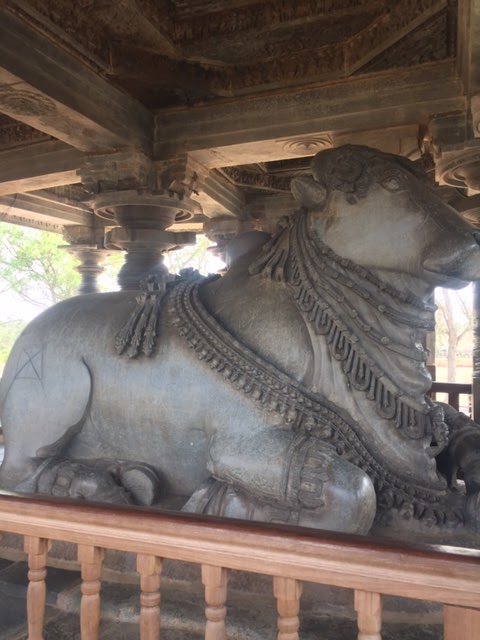
Halebidu is a 12th century CE twin temples complex established by the Hoysala King, Vishnu Vardhana. When we reach there it is already noon and braving sharp sunlight and heat people move in and out of the temple complex. There are two temples in the Halebidu complex; one is of the Hoysaleswara and the other is Kedareswara. Both are the incarnations/forms of Lord Shiva which is evident from the two huge Nandis sitting opposite to each temple complex. The temples are dark and cool; one could sit there for any number of hours because of the spiritual depth that the interiors invoke in you. Once in a while the peace inside the temple complex is broken by a group of visiting villagers or a group of foreign tourists led by a local guide who could make convincing stories for the tourists. I am approached by a few guides but I decline their service. The major problem of having a guide in such historical sites is that we would be forced to listen to the stories that they have conjured up. In Khajuraho, I had heard how the guides fool the tourists. They take the tourists to certain sites where the temple premises have some titillating erotic sculptures. The guides reduce the whole Khajuraho temple into a sculptural pornographic site. Perhaps that is what impresses the tourists most. In Fatehpur Sikri too once the guides had fooled us by telling us how one could make a sound in a corner of the architecture which would be echoed throughout the other chambers. They convinced me saying that it was specially done for military purpose. But it was not so. Any architecture with high arches to support it would reflect the voice in certain ways. It was also foolish to believe that the soldiers communicated with each other through whispering into the corners of the architecture.


Halebidu and later in Belur Chennakesave temple, which is comparatively smaller we find the heights of the Hoysalan architecture. If you are familiar with the Mysore sandalwood carving, then you could see how the same style has been derived from the 12th century artisans or vice versa. While the sculptures of the deities, yakshas, dwarapalakas and so on are slender yet voluminous one could see/feel some kind of lightness in all of them as if they were all done in some light materials like wood. These stones give out a feeling that they are wax forms. In fact these temples are made out of soap stones which are easy to carve. May be because the artisans were so good at doing intricate carving they chose soap stone as their building medium or the soap stone had given them a chance to focus on intricate decorativeness than focusing on heavy sculptures. Both in Halebidu and Belur one could see the outer layers of the temple tiered with various images. The first four to five layers depict war scenes and these scenes justify the view that King Vishnuvardhana commissioned these temples in order to register and celebrate a war victory. Ironically, a closer look of these tiered sculptural renditions reveals that the third layer where the horse regiments are depicted uniformly destroyed. Initially I think that it is accidental and the uniformity and regularity of the defaced the horses and soldiers make me look at the other tiers closely only to find out that wherever there is a war aggression (not mere procession) depicted, all of them are meticulously defaced and destroyed. Then I look up to the history of the sites and find that in 14th century one Malik Kafur attacked the Halebidu temple and had done major vandalism rendering the twin temples into ruins till the Archeological Survey of India took over and started putting the ruined portions together. What we see today as Halebidu is the reworked version of the original temple from its ruins.


The drive is long and by the time we reach the Planters’ Club at Sakaleshpur it is already dusk. Chetan comes out to greet us and he has ordered food specially for the starving team of three. We demand a quick retirement for the day and we sleep off the moment we hit the bed. The next morning Chetan and Leena come to pick us up. They are taking us to a famous Subramanyan Temple at Kukke. Chetan brings his new Scorpio and through the winding roads he drives the car with adequate skill and sharpness. For a long and winding stretch along the hills and gorges the road is not in a good condition. The road is a major one though in a very pathetic state. This is the business artery of Karnataka for most of the cargo vehicles from Mumbai and Pune take this route. I ask him why then the road is not repaired at all. Chetan reveals something very peculiar. A year back there was a major road repair project taken up by the authorities and for almost two months all the business establishments including the hotels and restaurants were closed down due to the lack of customers. When the road was closed for repair, the cargo movement took a detour a few kilometers away from here thereby deserting Sakaleshpur and the areas around it a lost and ghost town. Once the first phase of the road work was finished, the influential business people got together and impressed upon the government to drop the second phase of the road repair and development. They are ready to use a bad road but they do not want to lose business over road repair. Hence we have around fifteen kilometers of good road and another fifteen kilometers of extremely bad road.


Kukke Subramanya Temple is famous for it’s idol’s ability to fulfill the wishes of the devotees. Throughout the year people from different South Indian states visit the temple. The Chetan couple takes us inside and they have a puja to perform. We do not want to join the Puja as it is a family affair. We stand in a long queue along with hundreds of devotees. As we reach the main door of the temple, one young policeman posted there asks us to take off our shirts. We do it promptly. As every other person is there without a shirt we do not feel embarrassed. We go into the temple and say a few prayers and come out. As the Chetan couple does their puja we decide to go out for a walk in the town. It is a small temple town with a lot of small town business establishments related to temple. Chinese products are omnipresent. From Lord Muruga to Ganesh, laughing Buddha to Talismans everything is made in China. People buy them with a lot of reverence; the name of the factory and country are unimportant. What matters is the devotees’ trust in the object of worship. There is a huge Chariot parked outside the temple. Chariot pulling with the idol of Subramanyan inside it is an important ritual there. As I wait there, a young elephant comes out of a side lane. He does not have chains around his leg. He is free, hairy and happy. Later I see him wishing people by placing his trunk on the heads of the devotees. I had seen similar scenes in Guruvayoor and Thiruchendoor in my former visits. By noon Chetan couple finishes their puja and asks us to go inside the temple again. There they lead us to the special dining room where even special people wait in queue for free lunch provided by the temple. Finally we get entry into the dining that could accommodate around thirty people at a time. We have been waiting for ten minutes for the people inside to wipe off their leaf plates. Now it is our turn to do it quickly as people wait eagerly outside looking at the movements our hands and mouths. The food is simple and tasty. Chetan says that the taste of the food has been maintained for over fifty years without any change. Just outside the building from where we ate our food, I see, in front of another section thousands of people thronging and waiting impatiently in a winding queue. Chetan tells me that it is for the Aam Janta (for ordinary people). For a moment I feel not so good for being a VIP in a temple. The driving back is smooth and inside the car I linger between sleep and wakefulness.

Leena Chetan at the Coffee Plantations
Now it is time for us to see what we have been told all this while; Coffee plantation. Chetan takes us to his home. It is a palatial old home that looks moderate from outside but so spacious inside. Chetan takes us to the large court yard that could be of the size of three volleyball courts and two tennis courts where the workers are cleaning and sorting black pepper. Chetan introduces the coffee seasoning machine that extracts the seeds from the pods. He explains each part of the coffee seed making process. A work force of forty people is almost winding up for the day. They do not look like Malayalis. Chetan informs me that they are from Assam and Bengal. They are not skilled workers. They have been inducted into the workforce as the local boys and girls are no longer ready to work in the plantations. These Assamese and Bengali workers live in cottages given to them by Chetan within the plantation itself and they are happy about their living and earning. Only thing that is troubling the Chetan couple is the future of the children of these workers. “They are not able to send them to the school here for the problem of language. But we are trying our best to create some educational environment here,” says Leena. Later we have a very sumptuous snack session inside the home and a conducted tour within the home. From there we visit the plantation. There are three types of coffee growing. And with a new rain, the coffee plants have been bloomed. Leena is excited to show us the flowers. Inside the plantation Chetan has made three ponds; one for irrigation, one for growing fish and one for the daily use of the work force. One of the workers jump into the pond, collects the lotus seeds and gives us for eating. It tastes good. Chetan couple wants to convert some of the cottages into a bit more comfortable so that they could invite the artists and writers to spend some time inside the plantation, near the water bodies. Chetan shows us the tracks through which elephants and monkeys come. He also shows us a small plantation temple which is guarded by a faithful dog. They take us to a place called Bugudahalli and tell us that this place is good for night camping and day painting. All of us have ideas. We weave them and stand against the breeze soaking ourselves in the love of expanses below and above us. Back in the plantation we stand in front of an ancient tree which is also a temple. The workers come there to worship and once in a year they sacrifice a cock there. We see the huge termite mounts which have been hijacked by snakes. Ancient trees stand still around us. Suddenly a silence engulfs us. We could hear the trees whispering. We get into the car and drives out of the plantation. On either side, coffee plants in full bloom stood in a row to bid us good bye. As we come out of the main gate they turn their white heads to the silent trees, their ancient gurus, for a lesson or two.