Monday, March 20, 2017

Anil Janardanan of Kodaikkanal and Thiruvannamalai: The Journey 18

(Shibu Natesan and Anil Janardanan in early 1980s)

There are some friends who ‘come’ informed or uninformed. There are other friends who just happen, as if they were just appearing from nowhere despite the fact that you have been expecting him or her to be there with you at any point of time. That ‘happening’ has a beauty of its own. Even if you know that this person is going to be looking like this, wearing this dress and behaving in a particular way, you look at him or her as if you were seeing him/her for the first time. That is the flair of such friends; when you think of it, such friends do not cling on to you. They do not demand anything from you. They come like a breeze and goes like a breeze, leaving that good feeling of having been touched and caressed. There are other friends who come like breeze and go like a storm totally destroying you. You should be wary of such friends. Anil Janardanan, artist and story teller belongs to the former set of friends who just happen and also come and go like a gentle breeze. It is not fair that I qualify Anil Janardanan just as an artist, a friend and a story teller. He is much more than that. He is one of those rare friends who keep a safe distance between their action and the result of it. That detachment makes them pass through everyone like a breeze with fragrance. That does not mean that they are completely devoid of the life’s passions and desires. They do have it but they have this sense distance always which gives them a buffer zone to keep themselves out of the emotional collisions. Anil is one such friend and our friendship became a bit deeper without saying much to each other about it, in the recent visit Thiruvannamalai.

(Anil Janardanan and JohnyML at Vattakkanal, Anil's residence)

Anil Janardanan goes to Thiruvannamalai at least thrice in a year. With his white dhoti and kurta, dread locks and absolutely weightless figure, in Thiruvannamalai Anil is a familiar presence. Living in Kodaikkanal for more than a decade now, Anil could travel to Thiruvannamalai by bus anytime he wants. The choice of Kodaikkanal as his permanent dwelling place was a joint decision made by Simona, the Italian lady who is married to Anil and Kalki, their son. Simona came to Anil’s life in one of those wanderings and they got along very well. One good thing about the foreign women married to Indian artists is this that after certain point they let the artists go and do whatever they want. The enormous freedom, initially at the cost of a lot of emotions and silent heart burns that these artists gain in their post-marriage life is worth noticing when compared to the limited lives that many of the Indian artist friends lead in their marriages with Indian ladies. There is a difference in perception about marriage when it comes to the Indian ladies and foreign ladies. I do not want to propagate the idea that Indian male artists should marry foreign woman in order to enjoy the post-marriage freedom. Indian ladies who limit their husbands by holding a lot of control in the family life do that mostly because of cultural as well as social reasons. I do not say that it is a rule either. There are exceptions and I appreciate those exceptional lives that the artists lead. Anil however does not talk much about his family in Italy though he visits them once in a while and his son who grew up in the wilderness of Kodaikkanal is now a grown up young man doing a lot of football like other European boys these days.


(Anil Janardanan and JohnyML)

The story of Anil as an artist and as story teller is fascinating. I met Anil for the first time when I was in my high school. Anil was a different Anil then. He had come to my home with Shibu Natesan. Shibu met Anil in Varkala and Anil instantly became a close friend of Shibu. Anil did not have a clear direction in life then. As a young man with a lot of fat in his body and long curly hairs and innocent laughter emanating from his face, he used to catch the attention of all the people. Art ran in the blood of Anil’s family. Anil’s mother was a music teacher and father was interested in Art. Anil had both the talents but he never thought of developing any. Even if he was exceptionally fat, he did not carry any weight in his mind. Anil was a free floater, making stories about people and incidents around him and was leading a happy life. It was then he met Shibu who was a fine arts college student then. They immediately hit it out as both of them had a lot of eccentricities to share. The next week, when Anil came back to Shibu, he was wearing totally different kinds of clothes. He had changed his wardrobe overnight to suit to the trend of the fine arts students. He started wearing loose shirts and he kept the seams of the trousers rolled up above the ankles. He was quite a scene to look at. It was in one of those days that Shibu brought Anil to my home. We too became friends. But as a school boy, my mobility was curtailed and I envied their freedom to move around. I met Anil off and on and then as my life started catching up with its own trials and tribulations, I literally forgot Anil.

(Anil Janardanan at Adi Annamalai)

The art scene was booming. As my friend Anand Jyoti who lives in Brazil now with his Brazilian wife and children, succinctly expressed the changes in the Indian art scene when he met me sometime in 2005 in Delhi. “I go to Mattancherry, where I used to hang out with all these artists, Anoop and Dorry (the founders of Kashi Art Café). We used to conduct tree festival and so on. We had a wonderful time then. Now I came back and went to Kochi. None was talking to me. Everyone looked different. Above all everyone was talking only in English. To my shock, I found that they insisted taking appointments before meeting them. My own friends! Johny, I did not know that India had changed this much.” The same year, when I was still trying to figure out to do with this changing art scene in India, I got a call from Kochi. I was with some journalist friends and could not understand who the caller was. Then the caller laughed. He said, “I am Anil, Johny, Anil Janaradanan.” I had heard this name and had this vague idea that it must be Anil whom I knew when I was a high school student. In the days of boom, all the Malayali artists as a part of entering into the pan-Indian (before getting into the international scene) art scene had expanded their initials into full fledged names because the art market players were from North India and they had the habit of calling people by surnames than the first names. So Shibu N had become Shibu Natesan and K.Bose had become Krishnamachari Bose and so on. I think T.V.Santhosh is the only artist who remained T.V.Santhosh. But facebook came to give one and all a surname and in there T.V.Santhosh also got exapanded to Theyyarapparambil Velappakkutty Santhosh; exactly the way JohnyML became Johny Mulluvilakom Lakshmanan.


(JohnyML and Anil Janardanan at Thiruvannamalai)


I was happy to hear the voice of Anil after a long time. In my mind Anil was the same old fat guy so I imagined speaking to the same guy. It was a pleasant experience. I felt some sense of elation for I thought this guy called me after so many years. In fact, Anil, like many other artists who had settled elsewhere thinking that life would never lead them back to India, was in Italy when the art market boomed in India. Anil was painting and conducting small exhibitions there too. But with a market boom in India, Anil too came back like many others. Anil’s paintings were different. They used a peculiar blue and green to portray the sylvan landscapes filled with bamboo like figures. There was some pristine oriental character in his works. The Kashi Art Café, which used to function as the hub and coordination point for the North India driven market in Kerala, had exhibited Anil’s work and soon Anil’s name was everywhere. Anil shifted to Mumbai and rented an apartment in Borivili West and started living with so many other Malayali artists who were living in and around the IC Colony in Borivili West. It was where I met Anil for the first time after a couple of decades. I was shocked to see Anil. He was a changed man. He had lost all his body weight and looked taller than before. He had turned salt and pepper in his hairs and the beautiful curly hairs had gone matted and an imposing dread locks had grown. He looked impressive. But the two decades between us had not reduced an iota of warmth. He received me with happiness and I too was happy. I was happy for the success that he gained as an artist in the Indian art market for Anil was one of those artists who were self taught and never had a strong studio practice to pursue.


(Anil Janardanan at Yogi Ram Surat Kumar Ashram, Thiruvannamalai)

Anil’s journey as an artist starts with Shibu Natesan. When Shibu came to know about Anil’s ability to draw and more than anything else his enthusiasm to look like an artist in looks and behavior (remember he had changed his dress code within a week after meeting Shibu for the first time), he suggested that Anil should go to Bharat Bhavan in Bhopal and get trained there as Anil couldn’t have got admission in any of the fine arts colleges for his illustrious track record in school education. Anil packed the bag on the very next day and went to Bharat Bhavan. He was lucky to have J.Swaminathan as his mentor for some time. Swaminathan liked a little rebel coming all the way from Kerala to become an artist. And Anil learnt the ropes of art while staying in Bharat Bhavan. At the same time wander bug had bitten him very badly there. Anil started travelling to the northern parts of India and went to Himalayas. He stayed with some Babas there and became quite spiritually inclined. But the total change was yet to happen. After the Bharat Bhavan sojourn Anil came to Baroda where Shibu was a student in the Graphics Department. Once again Shibu directed him to join the Kanoria Art Centre in Ahmadabad. Anil went there and became quite famous for some of his interesting rebellious deeds. He became an overnight sensation thanks to some of his anarchic acts and history is silent for some time about Anil since then. Many years later we see Anil again, he is a changed guy. He is destined to become an artist and quite successful at it.

The Mumbai life as an artist was not that easy for Anil. Despite all his flamboyant ways and success in art, something had been gnawing him internally. He knew that there was no point in taking his works in the same direction that had brought him market success. Besides, he saw how some of the friends turning slowly foes. Some of them were developing some ego clashes with him. For them Anil was still an outsider without a University Degree and some of them thought that Anil was too impressive in crowds than themselves. Anil had a way with friends and acquaintances. As he did not carry much of emotional baggage with him, he could mix up with both the genders easily. And soon Anil’s presence in the Mumbai art scene created some scandals which interestingly were generated by his own friends who for the time being played the role of moral police. Anil was a dejected man. He withdrew into himself for some time and kept on working for a solo show at the Palette Art Gallery in Delhi. He did the works exceptionally different from what he had been doing as a successful artist. Contrary to the expectation of the art scene, Anil had come with a set of works in his latest solo show that expressed the dark recesses of not only his mind but also of the collective mind of the society. Anil had gone into the collective memories, rituals, abandoned spaces and so on in order to create the body of works that made into the solo show. The exhibition did not make much of an impact because people were expecting beautiful and soothing paintings from Anil. Soon the collectors moved away from the dark phase of Anil. There must have been some under currents too of which none is quite sure about. Then Anil wound up his stay in Mumbai and went back to Italy.
(Anil Janardanan with a friend)

That’s what I thought. But Anil had not gone anywhere. He was very much there in India, but retreating to a different zone. He went to Kodaikkanal with Simona and their young son, Kalki. They had stayed there years back when they were wanderers of sort. This time they wanted to build their own home. Anil and Simona bought a land in Vattakkanal, a couple of kilometers away from the main town of Kodaikkanal and built a house which is simple a large hall with a veranda opening to the great valley of Kodaikkanal. Far away from the maddening pace of the world, Anil now lives there alone. He has made another cottage which he gives out for rent to the travelers whom he likes. He sits there in his home with an attic where at least fifty people could spend a night comfortably, does his paintings and plays his music. At times a few Bison come there and stand still outside his home. Sometime the vast blanket of dews and fog cover the house and blocking everything from the view. Slowly as the sun rises, the scenes down there become clear through the clearing of the fog. It is a sylvan experience to sit and watch the day goes by. Anil says that he could make this life possible because at some stage he realized that he does not belong to the cities. He also wants to live without any baggage. He wants to travel from one hill to another where the gods reside. He is of the opinion that even a relationship with a woman that lasts for more than three years could prove to be a burden. That does not mean that Anil is a ruthless person who moves from people to people. He is very concerned about his fellow beings. When in Thiruvannamalai, he receives the untimely death of a young boy in his neighborhood in Vattakkanal. That day Anil remains disturbed, often telling us about the goodness of that boy who was a friend of his own son.

When I met him at Kodaikkanal last year, the scene was absolutely different. We were waiting for him to come and pick us up to his home which is beyond all vehicular access. We could not go directly there because we did not know where to park the car. Besides, then Kodaikkanal was going through a bad time. A lot of drug abuse was reported from there. It was rumored that there were movements of the unwanted elements in that area. Each tourist, each couple and each of the merry makers was watched in suspicion by the police. New comers to the town were checked thoroughly. Especially there are some home stays near Vattakkanal, the home owners were alerted of this and were even made informers. As a home owner in the locality Anil is quite connected not only with the other home owners but also with the police personals. It is a cold and when he comes he has covered himself with a blanket like Shawl in the Baba fashion. He has worn vibhuti on his forehead and everybody wishes him. Two police men have been watching us and the moment they see that we have come to meet Anil the whole thing change. They exchange niceties and we go into a restaurant to have some refreshments. As we sit Anil says ‘Om Namashivay Narayana.” He is a pacifist, it seems. He does not want to take sides. He is a Shaivite and Vaishnavite at once.
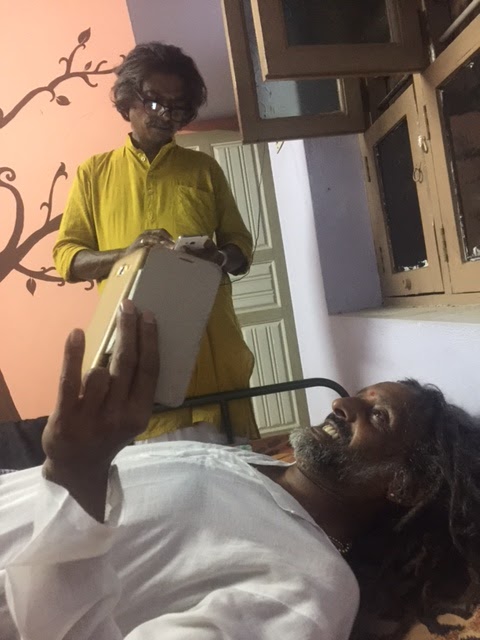
(Shibu Natesan and Anil Janardanan in Thiruvannamalai)

Anil is a great story teller. He could turn any incident into a beautiful and interesting story. As we lie down on our beds in the two corners in the attic, Anil stands in between and recounts some childhood incidents. In his neighborhood, when he was a young boy, there was a man whose name was Madhava Vilasom. By profession he was a caterer and also was a local chieftain with a very strange attitude towards life. He had a peacock blue Landmaster car, which in the morning was used as a proper car and by afternoon it was a pick up van. When the whole narration comes through Anil’s embellishment, Madhava vilasom becomes a very memorable character. Madhava Vilasom is also one person who had made his own bust and placed in front of his house and started lighting lamps all by himself! Anil stands in the middle of the attic, looking at us. We are tired after a long journey. We are desperate to sleep. When he sees one of us has fallen asleep he moves towards the next corner where he hopes the other person is awake. His laughter fills in the attic. My sleep flies away as I enjoy his stories. But sleep overpowers me. And in my fading wakefulness I could see Anil, a little bit frustrated for the lack of audience, and a lot amused by his own stories telling, climbing down the stairs to his kingdom down there. For a long time I could faintly listen to the laughter that Anil could not control thinking of Madhava Vilasom.


This time in Thiruvannamalai Anil happens and I feel that a fresh whiff of air has touched me. Anil kept my company throughout our stay and our visit to Adi Annamalai is great. He has a memory attached to anything and everything. I have never seen Anil reading anything. But he seems to have the innate capacity to grasp things by listening to others or simply by observing. When it comes to technical things, there too Anil has a few inputs to make and to my surprise I find all those technical inputs are perfect to the core. In the evening, we sit at the Ramana Ashram court yard. People of different kinds and traits walk in front of us. We keep watching them. Anil has a story to attach with every person. One gentleman walks politely behind his beautiful wife. Anil has a story about that couple: “He wanted more dowry. But at the same time he was happy with her beauty. At times he wants to remind her of the dowry. But thinking of his father in law’s face, he remains quiet.” Anil says with so much of conviction that it sounds real and I cannot help laughing out. Anil points at some fresh visitors there in the Ashram. “Look at them. Next year they all would look like emaciated and lost everything in life. They supposedly come here for happiness but all of them turn sad and they act out a lot of happiness on their face within a year.” Each night when we say good bye to each other, Anil looks for his TVS Moped, which he knows that he has parked here or there. Finally we find it in some corner as if it were an object fallen from an alien flying saucer. Anil rides back to his room and the laughter he has left behind lingers on in me for a long time. 

Sunday, March 19, 2017

Vayalvarathu Veedu, Sree Narayana Guru’s Home Reloaded: The Journey 17


Ramana Ashram in Thiruvannamalai takes you in. Is it because of the stories that you have already heard about it? Is it because of the histories that you have already read? Is it because of the people from different continents throng here? Is it because your mind is receptive? Or is there something with the place other than the divinity that we see in the life of Ramana Maharshi? The presence of Arunachala Mountain is strong and geologically it has proven that the mountains have some kind of an ability to pull people with similarly tuned minds towards them. Why do the people who have renounced their material lives and have become the seekers of truth, reality and beauty go to the forests and caves located at the mountain or hill sides? If not why do they go to the shore of seas or to the banyan tree groves? Most of the spiritually inclined people seek such places because they through their sensitivity identify the upward energy of those places. Ramana Maharshi had gone to Thiruvannamalai temple initially and later he moved to the Viroopaksha cave in the Arunachala hill and spent several years. Sree Narayana Guru had gone to the Kodithookki Malai at Aruvippuram to do his penance. You feel a strong ‘presence’ in these places. But it is not necessary that in all those places these great sages had been you get the same kind of spiritual pull. Sometimes (rather most often) Janmabhoomi (the place of birth) becomes almost irrelevant when compared to the Karmabhoomi (the place of action/work). Mahatma Gandhi was born in Porbandar; though the place has its own place in history, it is definitely not seen with the same reverence as Sabarmati Ashram in Ahmadabad. Aurobindo Ghosh was born in Bengal but his legacy is attached to Pondicherry. Similarly, Sree Narayana Guru’s birth place seems to be less attractive than the other places where Guru had travelled, stayed and worked towards the uplifting the souls of the human beings which in due course of time has been misinterpreted as the uplifting of a section of the society.


Gross interpretations of founding philosophies could happen depending on the caliber and intention of the interpreters. It has happened to Sree Narayana Guru in his life time itself. The same fate could fall on the places of birth of the sages. If the people in the area believe only in the spectacles related to the sage, not his or her philosophy and its social and spiritual uses, they would focus on the preservation and conservation of the materialistic remnants of the place than sustaining the spiritual ambience of the place in order to attract people who are spiritually and philosophically inclined. What happened to Vayalavarathu Veedu, a small hut like home in today’s standards, the home at Chempazhanthy near Trivandrum where Sree Narayana Guru was born as the son of Madan Asan and Kuttiyamma in 1856 August, Chathayam Nakshatram. It is an irony that myself born and brought up in Trivandrum district, I have never thought of visiting this place before till recently when I watched a movie on Guru’s life directed by P.A.Backer. The set where the initial years of Guru was depicted looked very soothing and worth a visit. Since then I have been thinking of visiting Vayalvarathu Veedu. There is another reason why I never thought of visiting this place before. Sivagiri is the final abode of Guru. This is the place where Guru went into Samadhi in 1928. I have a few connections with Sivagiri and always think that Sivagiri is the ultimate place as far as Guru’s life and philosophy is concerned.


Sivagiri is just ten kilometers away from home. Now there is a bridge, Panayil Kadavu Bridge that connects Vakkom Panchayat (which I consider as my birth place though I was born in Trivandrum city and was brought up till the age four only to be taken back to my parents’ native village to enroll in a village school. My parents had their reason to do this reverse process as they were government servants but instead of gaining urban education, I received a very rural education, which today I take in as a great blessing as it has helped me to keep some sort of rawness and rusticity in me to understand the pulse of nature and all the living beings on the face of the earth and beyond) to Cherunniyoor Panchayath and from there to Vettoor and Varkala. Sivagiri is located in Varkala which these days, is famous for the Papanasam Beach, Cliff and excellent beach accommodation and food. I did my pre-degree in Sree Narayana College, Varkala. In mid 1980s when I was a student there, the Panayil Kadavu Bridge was not built. So we used to take the ferry, a few meters away from my home, and go to Kayikkara, a sea shore village blessed with the birth of the great modern poet, Kumaranasan. I used to spend a lot of time in Sivagiri (which literally means the Shiva Hill) and without understanding what I was doing, used to meditate at the Sarada Madam (a temple propitiated by Guru to worship Saraswati, the goddess of knowledge and education) for many long hours. With these associations I never thought of visiting Vayalavarathu Veedu in Chempazhanthy. (More about Sivagiri in another chapter. If you are interested to read about my days in and around Sivagiri please read the 15th chapter of my ‘To My Children Series’. The link is https://johnyml.blogspot.in/2011/05/first-kiss-to-my-children-15.html)


I get down at Sreekaryam and take an auto rickshaw to Chempazhanthy. I wear a white dhoti and a very fresh and new light green or ocean blue kurta. The conductor in the state transport that I took to Sreekaryam was particularly polite to me. May be my dress has given him a different idea about myself. In Kerala or all over India traditional clothes give you some kind of respect; first of all it is traditional and secondly it is closer to the roots. Wearing of traditional clothes is seen as a subconscious or conscious resistance to the western ways and modernity in general. Those people stick to traditional clothes do it out of two reasons these days; some are very lazy and shy to get a pair of trousers stitched or bought. Some are very conscious of their looks in the traditional clothes and prefer to wear them for a purpose. I try my best to wear dhoti and kurta not because I want to prove an anti-modern or closer to root person. I find that it is so natural to me; despite all these years of wearing denim trousers (jeans), I have not forgotten the way of wearing dhoti-kurta, the way I have not forgotten my southern accent despite living in the North for around quarter of a century. Some people claim that they are not used to wearing dhoti as they have not practicing it for a long time. I do not think that it is a real explanation. Only inconvenience caused by the wearing of dhoti-kurta is that you do not have enough pouches in you to push your mobile phone and purse in. In the modern world you cannot move without a mobile phone and purse. Trousers become useful in this way. So whenever I wear dhoti-kurta I have to carry a small bag additionally to put the mobile phone and purse. May be if you practice it well, you could do away with mobile phones and purses. To do away with mobile phone, one should considerably cut off from the world. To do that you have to think two things primarily; one, you are not in demand. Two, you are not going to be in touch with people unnecessarily. Also you should kill this irresistible itch to take photographs and selfies wherever you go. If you could overcome these desires you could live in this world without a mobile phone because there was a world that existed beautifully even before the mobile phones came. The second thing is about how to do away with the purse. First of all you should carry a limited amount of money in your kurta’s pocket. Just for the need; not more, not less. The perennial itch to buy things at any provocation could be avoided like that. However, these days, we have digital transaction for many things hence, it becomes important to carry the debit or credit cards. That means while wearing Dhoti-Kurta, you should have provisions to carry the debit card and an identity card. At this moment I remember how foolish I have been all this while. I am talking about a person who is travelling by buses or public transport system. If you have your own conveyance, you could wear dhoti-kurta easily for your car would have a lot of space to carry your purses, mobiles, camera and what not.


The auto driver who is not that reverent but impatient enough tells me that my ride costs fifty rupees. This is a standard rate; anything down that might look very cheap for them though it would enthuse the rider. For the rickshaw drivers, it is a round figure. They know that this person has come to visit the Guru’s home and he would go back. He is not going to come back again. He does not belong to us. So charging any amount is okay; it could be done without a prick in conscience. That’s what most of the people do in the cities and towns. They consider you as a perpetual tourist. You are here for the time being and you are not going to come back again. As you do not belong here, there is nothing wrong in looting you. The logic is this: we did not ask you to come here. You have come here on your own. Now, to be here, there are some expenses. Why don’t you meet it? Though this is the attitude of most of the people in a greedy world, there are some people who treat any stranger well. I am sure those people move fast towards happiness and deliverance though they comparatively suffer temporarily. Their happiness eternal; the happiness of the greedy ones with falcon eyes is temporary. India has produced the greatest philosophy on right kind of living. Do away with desire and greed. Buddhism says that desire is the cause of all sorrow. Curtail greed, it says. Hinduism tells us to detach the action from the result. Take what you deserve and leave the rest for the world. That’s what the animals and birds in an orchard or forest do. They do not over eat and over kill. They just take what they want and leave the rest for the others. But human beings are not like that. They want it now and here because the other person who is pilfered does not belong to them. He is a stranger at the worst and a tourist at the best.


The gate way to Guru’s nativity home is comparatively new. I feel a sense of dejection the moment I confront those letters that say it is ‘Sree Naryana Gurukulam’. I am interested but at the same time there is a quick comparison comes up in my mind. Years back, near my college in Sivagiri, there was a gurukulam (the House of Guru/Teacher) where young boys lodged and studied Sree Narayana Dharma, the philosophy of Narayana Guru. I had a friend boarding there and I used to visit him. Each time I went inside, I used to feel that I am an outsider. This happened not because of the sense of rejection that I felt there. Rather it was a very welcoming place with the young Sannyasis moving around slowly. There was a studious atmosphere and each tree in the campus was had one placard attached to it announcing the great teachings of Sree Narayana Guru- ‘One Caste, One Religion and One God for all Human Beings’, ‘Whatever you do for self satisfaction, let it be for the well being of others’, ‘Whatever be the religion, the human beings should live righteously,’ ‘Organize and Strengthen yourself, Educate and Enlighten Yourself.’ Except the inmates none was allowed to enter the Gurukulam rooms. So I used to wait for my friend, looking at the trees and reading the great words of Guru. But this Gurukulam in Chempazhanthy  does not give me that vibe. It looks very dry and unwelcoming. The sun beats down with vengeance.

I walk into the campus and as it is one o clock sharp, nobody is seen at the reception desk. As a Malayali I am not surprised. That’s how the offices of any kind are in Kerala. Lunch break starts at least fifteen minutes before one pm and goes on for around two thirty in the afternoon. In Guru’s place though I do not expect such official lethargy, I could understand the general workplace ethos in Kerala. Religious places are not exceptional in this matter. The reason for this is that most of the officials who work in such places are not spiritually inclined or interested in the work that they do. I remember the attitude of the bookshop keeper at the Yogi Ram Surat Kumar Ashram in Thiruvannamalai. Yogi Ram Surat Kumar came to Thiruvannamalai after spiritually enlightened by Papa Ram Das, lived in the streets of Thiruvannamalai as a beggar for many years. He became another Baba in Thiruvannamalai and after his death his followers created a huge ashram. In that Ashram when I went to collect some books on the Yogi, I could not locate a particular book. The person at the desk, sitting hardly five feet away from the book shelf kept on saying that ‘there’. I looked at the shelf where he pointed and could not find it. ‘There’, he said again. The charade went on for some time. Finally I dropped my patience and told him, “Look, your Guru had wandered all those streets in this temple town. He never wanted to sit in one place for long. Can’t you just get up from there and pick up that book for me instead of saying ‘there..there’?” The person got up like a spring, gave me a very stupid smile and with apologies picked up the book and gave it to me. The book was lying in a corner which he could see from the desk and I could not see from where I stood. That’s how the people who work in spiritual centers behave.


As I stand there hesitantly someone approaches me from under a tree where he was relaxing in the shade with his friend. I ask where I could see Guru’s home and he shows me the direction. I walk up to that area and find that the hut, Vayalvarathu Veedu is down there and I have to climb down around fifteen steps to reach there. I remove the footwear as per the instruction and walk down. To be frank, my first impression is nothing but disappointment. Here is Guru’s home but now a large canopy is made over it reducing the hut into a small museum piece. The pristine simplicity that I had seen in photographs and the Backer’s movie is absolutely missing here. I take a deep breath and dispel all the negative thoughts about the place from my mind and go there. The canopy is huge and from a distance it looks like temple roof. Propped on huge concrete pillars with granite base, the central portion of the roof is made of transparent fiber glass to let natural light in. The roof as a whole is supported by an ugly armature made up of iron and painted over with white enamel paint. The signs of rusting are already seen. It was erected over the hut in order to protect it from the extreme climates and the contribution was done by a liquor baron whose name is written right in front of the canopy. The spirituality of the place is sucked out by this artificial structure. Of course, there should be some ways to protect the hut but it should have been done scientifically as well as aesthetically. On the left side of the large area now marked out by this structure, there is a hand cart/rickshaw propped up on a platform with a bronze of Guru in the seat. Wherever you go, you see this rickshaw and as if Guru had arranged a rickshaw for himself everywhere. Yes, in Sivagiri, in his last days he used to travel by a very modest hand pulled rickshaw. But this one here is made out of steel welded together; an emblematic representation of Guru’s vehicle. I feel sad.

Sitting on a bench like space along the base of the canopy, I try to concentrate on the small hut where Guru was born. Its outer surface is now given a neat finishing touch with cow dung paste. The thatch is new. Nothing of this hut except the front wooden grill and door and the two doors at the back side seems to be old from Guru’s time. One could understand that too. But giving some kind of permanency to the hut, they have made it ‘temporal’. The eternity that one could have felt had it been in the raw clay and not so finished cow dung paste, is much higher than what it is now. I focus on Guru again; what could have been his life style here. The name Vayalvarathu Veedu means House by the Brink of Paddy Fields. I look for the paddy fields. Once where the paddy fields stood are now converted into a play ground and a high school. On the other side of there is a hill and the famous Chempazhathy Sree Narayana College is located. I could hear the contemporary Tamil songs ripping through the air. The Youth Festival of the college is on. The sound waves from the college come and kill the possible tranquility of Guru’s home. People hardly come here. A family of old people comes, takes a look and goes back. Two young men come after an hour, go near the hut, fold their palms in salutation for some time and go back. I sit watching all these. I smell cow dung and I wonder whether it is from the hut. Training my attention and eyes I see just above where I sit there is a cow shed. Two women are seen tending the cow shed and the cows.


I go to the reception area there and after initial hesitation pull a chair out and sit there. One person appears from nowhere and asks my whereabouts. When he comes to know that I am a writer, he takes out some of his personal frustrations. According to him, this place has lost all its spiritual power; I agree. The whole campus was not a part of Vayalvarathu Veedu. This campus was initially a part of the land owned by the Travancore Kings. He points at a small temple and tells me that it is Manakkal Devi Temple. Once in a year, the King used to come and do rituals there. Then rest of the year it remained under lock. Guru, before he left the house to do penance, once stayed there inside the temple for fifteen days and nobody knew he was there. In fact he was lying sick. There was a sub temple next to it. Today that temple is at the farthest corner of the campus. The person tells me the funny story of that temple. It was there in its original place. Then some sannyasi came and took a portion of it to another side and started reading his newspapers there. Then another sannyasi came and took one portion of it to the present place and the local youth converted it into their recreation centre. Finally, someone brought a picture of Sarada Devi from Sivagiri and placed it inside the temple. Today they call it Sarada Madam. He adds that there no divine pull in any of these places. This place becomes active once in a year when the famous Sivagiri Pilgrimage takes place by the end of December and concludes on every New Year day. People who come from different places also come to Vayalvarathu Veedu. There is a weeklong festival in those days but it is not conducted by the trust. Local people make their own plans and celebrate the festival. I ask him about the Philosophy study centre as the name is Gurukulam. He laughs and says that it is just for the name’s sake. Nobody teaches anything here. He walks off. Suddenly the whole place seems deserted. I sit near an ancient jackfruit tree right in front of the reception area. I look at the glass like reflection of sunlight on the sands in the courtyard. Suddenly a person in saffron clothes comes in front of from nowhere. I have not seen him before anywhere in the campus. He looks at me and smiles. “Have you eaten lunch?” he asks me compassionately. I tell him that I would eat soon as I am waiting for someone. He smiles at me again and walks away. I look for him again and he is not seen anywhere. Who was he? I do not want to ask. I wait for the someone who is supposed to come and meet me.

Saturday, March 18, 2017

Christian Uhlmann of Thiruvannamalai: The Journey 16


When Christian Uhlmann recounts those good old days of his incessant traveling, rebellion and his Hippy days words and symbols mix up, climates and countries overlap, memories get dilated and the locations become irrelevant. What becomes relevant is the story of a man who has many lives in one guise; the guise of a wanderer. Today, Uhlmann looks much older to his age; the furrows that have channeled his tanned skin by the heat of the southern tropic are the tell tale evidences of his journeys. For him they look now remote. At the verandah of the one room cottage, one of the few that he has made in a three acre plot that he had acquired three decades ago, he sits on the red oxide floor, pulling at a beeri. Like an old general from the stories of Marquez he is full of memories and stories. I look around for a hammock in which I could imagine and image Uhlmann lying down and chewing the cuds of his yester years collected slowly but steadily. There is no hammock there. But this barefoot man moves around in Thiruvannamalai both on feet and by his scooty like M.F.Husain had once done in several other cities in India. While Husain’s bare feet had invited media attention, Uhlmann’s are taken as natural. None trains a camera lens at Uhlmann’s feet. But none could avoid training their eyes at Uhlmann’s face. There is a sinner and a saint living there; a philosopher and a jester; a rebel and the one who has succumbed to his own decisions; a bonded one and a liberated one; one with a pair of wings and one with a huge chain around his neck and feet. But the most interesting thing about Christian Uhlmann is that he carries all those with a lot of easiness and flair.


Uhlmann is an artist who uprooted from himself from his native Switzerland and decided to travel the world to see people and know them. The Hippies were all over the world. Still their tribe was a minority. They moved towards those climes where the materialistic philosophy took a back seat and let the spiritual and carnal liberalism took the van guard position. Carrying the weapons of nothingness for a battle of love in the war fields of dreams, music, hash and poppies felt so good when it was seen on the others and Uhlmann took no time to join the tribe as a new initiate. The Hippies erased all the man made boundaries in the world and crossed over to many continents; they did have passports and other travel documents. But with different languages and different tastes how did they know each other? Hence, they developed a common language; the language of hair. They grew hair as if there was no tomorrow. They became as strange as the ancient sages in a busy city street. A Hippy could recognize another Hippy easily by hairs. The other universal code was the cloths; they stripped themselves to the minimum and wore all those exotic and eclectic dresses; a trend which is a diehard one and has been followed like a genetic code by the rebels all over the world even today. Bodies were their landscapes where they could mark new territories for themselves letting their bodies to bear all those tattoos. They had music and smoke to burn out all the worries of the world.


One may spiritually overcome all the limitations but when it comes to the crossing of boundaries, legal papers, your looks and attitude everything become very crucial in getting the visa. Uhlmann remembers all those days of hoodwinking the authorities. As Uhlmann was planning to go to Australia from some other country his hip long hair became a huge issue. One day he was turned away by the authorities and like an impish attitude, the one which all the Hippies adopt for survival, next morning Uhlmann turned up at the office of the visa authorities, now with the hairs trimmed clean, even showing his nape. The authorities were surprised and the passage was allowed. Uhlmann says how he tricked the authorities. He bought a cheap wig and pushed all his natural hair into it and went to the visa office. He also says that perhaps the authorities smelt a rat there but they let him go. Then it became a ritual for him. Wherever he sensed the trouble with the hair, he fished out the wig, which had become by now a constant travel companion, and wore it with confidence. He says that it became a game even for self amusement. “In one of those days, I lost my girl friend and car,” remembers Uhlmann wistfully but with a smile filling in his eyes. He says as if that was something bound to happen. May be after having a series of girl friends and now Rani, a Tamil woman for wife, Uhlmann seems to be terribly enjoying the fate of the one who had cajoled his girl friend to Kabul. Allah is great. Afghanistan did not remain what it used to be since then. The reason may be political; but god has different ways of punishing people for betrayals.


Ulhmann came to India in late 1970s. As an artist he carried his works with him always. Besides, he always carried his flutes. Like Anil Janardanan, Uhlmann is also not a trained musician but both of them play music for their amusement. They have a musical sense and could create captivating music at times. But when anything goes excess it become a bit unbearable for those who have a decent musical sense. Uhlmann has a collection of musical instruments that include flutes from different countries and of different make; bamboo reeds and sandal wood. The latest acquisition is a xylophone that he has picked up from a Swiss flea market last year when he visited his parental family with Rani. The story of Uhlmann’s visit to India, to begin with Goa is interesting. While travelling the south east Asian countries, Uhlmann came to know that there was a place called Goa and which is an Eden for the international Hippies. Uhlmann reached Goa sooner than later. “The moment I touched down at Goa, I found out that in terms of Hippy eccentricities I was nothing in front of those lion like guys and girls who had taken Hippy life into a different level,” Uhlmann chuckles. He spent some time there and then started travelling India. He even spent some time in Kanvashram, ten kilometers from my home in Vakkom. And it was in one of those days Shibu met Uhlmann and became friends.


Thiruvannamalai was a natural destination for Uhlmann though today he is more like a native who does not take much interest in the Ashram related meditation and other things. Uhlmann goes to the temple town almost daily, primarily to drop his sister in law’s daughters in school, whose care he has taken upon his happily. Secondly he goes to the Ashram area to have a cup of tea. It is interesting to know that while most of the people in the Ashram area know Uhlmann as Christian, in the village where he has set up his home and cottages, most of the people in the neighborhood like to acknowledge him as Rani Christian; though people recognize Rani’s presence in Christian’s life and as the owner of the properties that Uhlmann has owned there, for the friends of Uhlmann the annunciation comes as ‘Rani’s Christian’. It is so heartening to see a man who has travelled the world has finally decided to become Rani’s Christian, which I find as a great surrendering of all kinds of ego. Uhlmann is happy about the kind of life that he is leading. He has his cows, dogs, hens and Turkey hens, trees and plants to tend and take care of. He has his memories around Ashram though he does not go there anymore.


My meeting with Christian for the first time was quite by chance. In 2014, when I went to Thiruvannamalai for the first time, Abul Azad, the photographer and director of the Ekalokam Trust for Photography who lives in Thiruvannamalai, organizing a lot of photographic activities was having an exhibition of Uhlmann at his own studio cum gallery. Uhlmann was not presenting any of his paintings. He mostly presented some drawings and sculptures made out of palm leaves and stems. They were looking mostly like the works of the tribal artists. Shibu was invited to inaugurate the show because he had a different connection with Uhlmann. Though both Shibu and Uhlmann had forgotten the incident of their meeting and spending time together in early 1980s in Varkala and Trivandrum (then Shibu was a fine arts student) Azad became instrumental in bringing them together. I was also present at the inaugural function where Shibu had recounted the friendship he and Uhlmann shared once upon a time. Shibu had done two portrait drawings of Uhlmann and had given to him. Interestingly Uhlmann kept those drawings as his precious possessions and once showed them to Abul Azad. It was Azad who recognized that it was the same Shibu who became the Shibu Natesan now. The opening of the show was a happy reunion of sorts for both Shibu and Uhlmann.


Now as we are in Thiruvannamalai, Shibu would like to do an oil portrait of Uhlmann. Though many people are happy to model for an artist, Uhlmann does not seem to be so keen on sitting for long time before an artist. He sits with his long legs folded, on the kitchenette slab on the side of the verandah where Shibu has set up his easel, canvas, paints and brush. Uhlmann lights and beedi and drags at it. While Shibu paints I take a look at the works of Uhlmann, which he has collected in two big albums. He paints like a company school painter. His perspective is more like Chirico the Italian painter. He has painted most of the Indian monuments while he was travelling all over India. He also has painted the people. A cursory look at the works of Uhlmann would show that he is like an itinerant painter, looking not for the images and events but for his own reflections in whatever he sees around him. Hence, in most of the paintings we see the obliqueness of his vision; he looks at them tangentially often unsettling the proportions of the architecture and reducing the people and their figures into schematic patterns. He gives a lot of attention to the perspective lines which reveal the artist’s position and perspective of things. Uhlmann is also a good photographer and has taken quite good black and white photographs. The portrait painting done by Shibu is finished in two sittings. To witness the second sitting Anil Janardanan comes with one of his friends and he plays different kinds of music in different instruments. Both Anil and Uhlmann have got a child like enthusiasm for musical instruments. Finally the portrait is done. Uhlmann is overwhelmed. He immediately takes a photograph of it and uploads it as his facebook profile picture. Soon follow the comments from his friends from other continents. ‘Why so sad?’ is the prominent of questions in the comment box. Rani, the better half of Uhlmann comes to take a look. She immediately comments on the apparent ‘smugness’ of the portrait. She is not happy about the portrait because her husband is sad looking in it.


Uhlmann is not sad. Perhaps while he was sitting for the portrait he was with himself; those rare moments. Shibu has an explanation for it; people generally do not like portraits because they think that they are not ‘beautiful’ in the portraits. When they model, in the initial moments they are conscious of their looks. So they put on appearances. Slowly, the painter as well as the model gets into their own respective zones of introspection. Painter sees what is in the model in those moments and the model is not aware of how he or she looks like. Finally, when the portrait is finished, they want to see those conscious moments of ‘beauty’ and ‘appearance’. But the artist has captured their ‘lost moments’, which need not necessarily be beautiful. The portrait has come out well. I look at Uhlmann’s feet. I remember one photograph of Husain’s feet taken by Nemai Ghosh. Those feet looked absolutely clean and unaffected by weather. Husain’s was a performative act. He took care of the looks of his feet even when he was not wearing shoes for the media glare. Uhlmann walks barefoot for his own beliefs and life style. He does not do it for the media. I have seen some of the photographs in which Uhlmann is seen wearing shoes. Those are the occasions of his show opening in Switzerland or elsewhere. With or without shoes Uhlmann is a genuine person. I look at him. Here is a person who has dared the violent of seas now seen sitting at a rain puddle and see the paper boats made by him just floating by.