Tuesday, August 25, 2015

Blessings that Come from Nowhere


I do not know from where the blessings come. But they do keep coming. I do not push my way into anything, whether it is life in general or getting into a bus in particular. I am always inside the life so I need not rush or push myself into it. Those people who believe they are outside of it feel the necessity to elbow others out just to get in. When I am inside a bus with full of people, with no space to even stand, the moment I open my book and start reading space comes around me. People adjust their bodies to give me enough room and light to read. Some even offer seat that I politely refuse. There was a time, when I was less confident about myself I used to fight with people for leg room inside a thickly packed bus. Today, anywhere I go space is created for me. Or is that I do not go to a place where I do not find a space for myself? I am not talking about place, but space. One needs space to feel oneself.


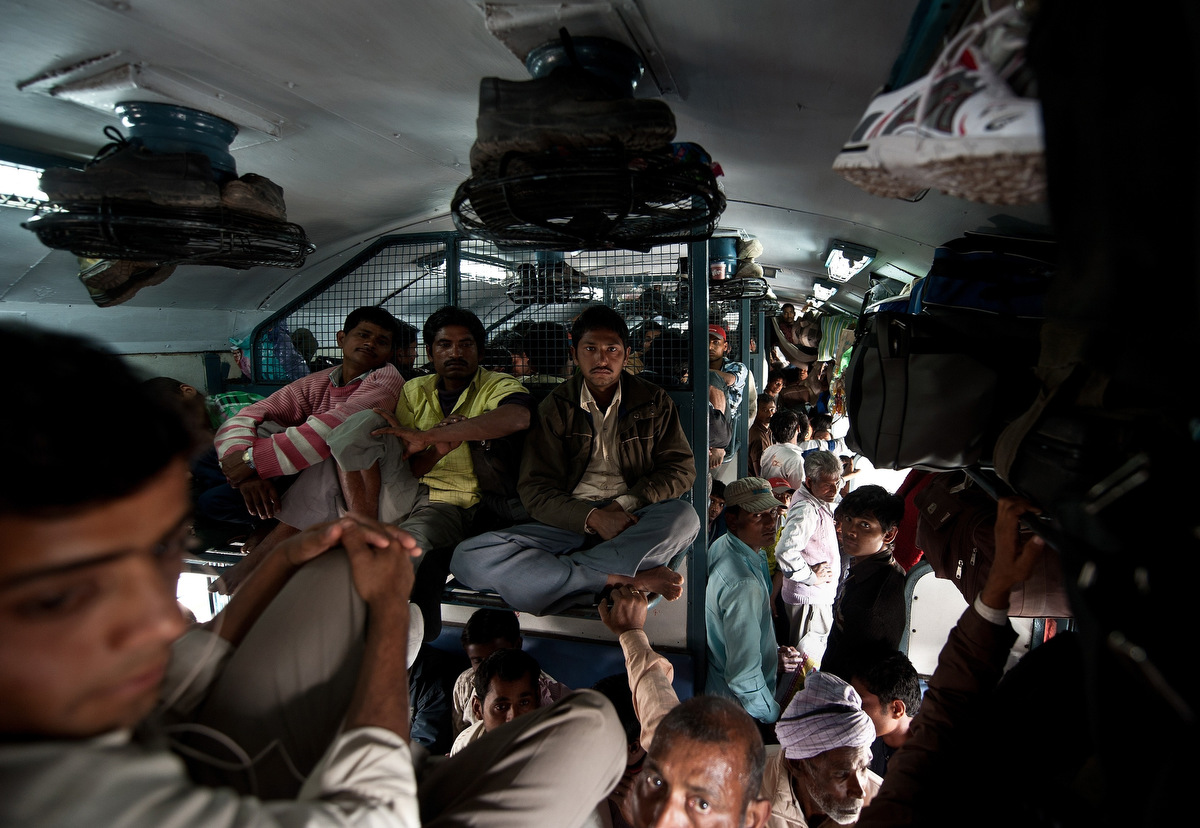
The other day I was in a heavily packed train compartment on my way to home from Trivandrum. When I entered the jam packed compartment there was not an inch of space. But people seemed to be cool about it and most of them were at their own mobile phones punching and sliding fingers on the illuminated screens. This could be one reason for that none of them get irritated as a new one makes an entry. Fights used to erupt in a pre-smart phone era when new people came to the jam packed compartments. To make matters worse there used to be no working fans in those rickety compartments. These days there are fans even if three fans in a coupe are not just enough for those thirty sweating bodies under them. But people do not mind if a few people push themselves into it. I too was one yesterday squeezing myself into the compartment. I moved forward, without forcing myself and lo I saw the change. People gave me way. I did not look at anybody I kept moving like a snake and I found myself not so comfortably standing between two long benches facing each other, filled with people. They moved their feet and made space for me to stand. To my surprise an old person got up from the iron berth and asked me whether I wanted to climb up and sit. I politely declined that invitation. The other person who too was occupying the other berth did the same. I declined that too. I opened my book and read till I reached the station where I was supposed to get down.

I do not carry my simplicity, piety, compassion, love for the world and anything like that on my sleeves. Sometimes, when I watch myself at the glass windows of the showrooms I see my reflection quite ordinary and at times arrogant. I could be passed off for an ordinary man and believe that I am an ordinary man. However, people make me very special at times. One day I went to buy a pair of jeans in a textile shop. On the fourth floor where the men’s wears were displayed, a salesgirl accompanied me throughout and helped me in getting the right pair. I told myself that I should not have felt something special. Salesgirls are deputed there to make each customer special. But even after I made the payment, walked out into the streets people were giving me space and I was too special to be there. I wanted to run away from that place. You may think that I am joking or feeling unnecessarily self important. I can get into a place like a breeze and get out of there just like that. None will notice me. But I believe they feel me just like they feel a breeze.

As I said before, I never tell people that I am compassionate. I listen to people when they tell me their stories. That does not mean that I am compassionate. They may be feeling that I am compassionate; that is their problem. I look happy and I want to look happy because I believe that I am a happy being and every human being should look and feel happy. And every human being has got the right to be happy as his constitution is the constitution of happiness. People make themselves unhappy because they feel that happiness is a crime. Our religions have taught us to be sad. When you are sad the God comes to help you. If god does not come directly, his middlemen come. That is the way the religious business thrives. They scare you of punishment if you really feel happy. They connect it with some kind of sin. So you should feel sad and removing the sadness comes with a price tag. You pay and get your momentary happiness. That’s how people feel happiness. The more their sorrows the more they feel their happiness. Even a little bit of happiness makes them so happy when they are nose deep in sorrow. But I am a happy being and it is infectious I feel. When I walk into the classroom, students get with an exclamatory noise and clap. It embarrasses me. They are so happy to see me there. My students curse the peon when he rings the bell. Have you seen students like that who just do not want to leave a teacher? My students are like that. I teach them and let them to learn than to be taught.


I was climbing down the stairs. I did not know when the train would leave the platform. But I saw a girl struggling with a huge suitcase. She could not even balance her feet as the weight of the box was rendering her absolutely anchorless. While climbing down, I went to her picked up the suitcase and came down and kept it at the foot of the stairs and walked off. She came running behind me and said thank you. I did not turn my head though I said, do not mention. I walked off. You may ask if it was an old man or an old woman would I have done the same thing. I would have done the same thing in the given context. I did not see an old woman or an old man climbing down with a heavy suitcase. It happened to be a young girl. I did not register her figure or face because I was seeing her legs wobbling. I picked up the suitcase while she was still hauling it. She might have been really surprised. It was an instinctual thing to do. I did not think too many things. Nor did I try to justify or critically view my act. I did that the way my reflexes allowed me to, and walked off. This was an act which demanded no reward or recognition. Even if the girl had not said a thank you, I would not have felt bad because hauling that suitcase was not an act of compassion. It was purely a reflex and an instinct. I have done it before; pushing carts, helping someone to lift a heavy load, taking somebody’s luggage and so on.

May be blessings come from nowhere exactly the way blessings are given out from nowhere. I came out of a railway station. A friend came and picked me up in his car. He took me around and showed me things. He took me to the venue where he and myself were participating in a program. He booked us into a hotel room. He took me for a drink and dinner. We slept on the same cot at the either edges. We got up on the next morning and he treated me with breakfast. He took me somewhere to a large museum where he was doing a great project. Then he took me back to the station and fed me with lunch. He saw me off and left for his home. The moment he left I realized that for the last two days he has been taking care of me. He never allowed me to pay for anything nor did he make me feel inadequate. Just before he left I sang a couplet; ‘the one who protects and the one who punishes would forgive us if something has gone wrong’. He knew what I meant. He shook hands with me and left. Did I ask for that hospitality? I had never asked for it. They say there is no free lunch. But everything cannot be based on no-free-lunch theory and barter. There could be some deeds that are meant to be that, that alone, nothing more nothing less. The moment we define it we lose the quality of that deed. Blessings shower on me from places and people whom I have not seen in my life and the ones I know as well. But they are blessings; the invisible gifts that trace their way to us for the deeds that we have done unknowingly sometime, somewhere. 

Monday, August 24, 2015

A Well Timed Relief for Farmers on Nana Patekar’s Welcome Back

(Nana Patekar, Indian film star)

When a sixty four year old actor decides to help the poor farmers in this country where they would even travel miles to commit suicide in full view of the live media (cameras) I should not look at that helping hand with doubt or cynicism. Like many in the media as well as in the public domain I too appreciate the act of the Bollywood start, Nana Patekar who has just declared financial help to the widows whose husbands have committed suicide due to crop failure and debt. Patekar has also said that if anybody feels like committing suicide, before doing that act of self annihilation, he or she just remember him and approach him so that he could extend his helping hand. Social media is abuzz with the news and the news has gone almost viral. Once again I tell myself, behave. Don’t be cynical. But I have to take this news with a pinch of salt.


First of all Nana Patekar, though he is a methodical actor and has been successful in reaping good at box office, has never been a social worker in the true sense. In his younger days he had acted in films like Gaman and Salaam Bombay where he acted more like a Tapori (an urchin) and his matured films include Parinda, Prahaar, Krantiveer, Agnisaakshi and so on. While Amitabh Bacchan played the roles of a brooding angry young man, Nana Patekar presented his alter ego. His characters were highly vocal and in more than one ways incited people for executing street side justice. His characters expressed thorough cynicism for law and order and he waited till the evil displayed all its colors and the weapons in store. His characters waited and watched like mad men who were not affected by the presence of evil. He exhorted other people take up cudgels for themselves and only when they failed he came up to vanquish the evil.

(Nana Patekar in the film Krantiveer)

Nana Patekar became very close to the people in Maharashtra than the film goers in the North Indian Hindi speaking Bollywood lovers for he expressed the Marathi-Manus character. If Amol Palekar was acting out the timidity of a typical Marathi or Mumabikar who would do some tricks to survive in the big bad city and would show all skills to flow with the stream, Patekar was the aspiring side of the Marathi, who would take all the dirt on him till he is provoked and become a tiger. That’s why his filmi dialogues were the staple items in the Shiv Sena processions and the Marathi youth in those days liked the cassettes of Patekar’s recorded dialogues. They cherished his dialogues more than the mainstream Hindi movie songs. Patekar could complete Palekar or the other way round. Though they did not act together in films, they complemented each other tremendously and became integral part of the Marathi pride.

From the anguished but cynical lonely man, Patekar moved to characters that showed patriotism. They could kill anybody for clearing this society of all kinds of human vices. Patekar showed tremendous skill in acting patriotic characters and at the same time his performance was unparalleled when it came to the presentation of psychotic characters. As he moved from cynical characters to the villainous ones, his ranting and peculiar dialogue delivery became more poetic, shrill and intense but by the time he started acting the roles of cops, his dialogue delivery became much more controlled and grave. While Amitabh Bacchan moved from his monosyllables to long dialogues in his later movies, Patekar took the reverse routes. His guns spoke while his tongue rested in the holster of his mouth. Patekar’s acting abilities found full fruition in Marathi movies like Baba Amte and his tested his comic bone in the mainstream Bollywood multi starrer like Welcome. We could say, as an actor, Patekar has done all kinds of roles that an actor would cherish to do. Now what is left for him?

(Nana in Ab thak Chappan)

I remember Patekar in an interview with the television journalist Rajat Kapoor in his program ‘Aap Ki Adalat’ (Your Court/People’s Court) reciting a poem on water. He could eke out thunderous applause including standing ovation from the studio audience as he could impress them with his oratorical skills. In fact that was an enactment of the younger Patekar who had enthralled the audience with his dialogue deliveries. When people see a matured and old Patekar doing the same but with lot of environmental concerns, he once again becomes the darling of the audience. But at the same time, in one of the commercials we see a rough, reticent but no nonsense Patekar acting as a middle class shopper in a shopping mall where he is offered a chocolate in the place of change. He reacts by giving his shoes as the total amount for the grocery. To the surprised salesperson he says that as they would not take his shoes for money why should he take their chocolate for change? Once again Patekar was playing to the gallery.

The new move of Patekar is a populist move because all the film actors in the country cannot come forward and give away money to the people who have committed suicide and who are intending to do so. It is not the job of the film actors and actresses or anybody in this country to distribute their hard earned riches to the poor people. You may be surprised to hear this. Nana Patekar or anybody else in that case could do so. But it is not their job. Philanthropy and charity are good but they do not fundamentally change poverty in a country. Changing the socio-economic imbalance through political programs and will is the duty of the elected governments. The governments that take tax from people cannot expect the film actors to do the public charity. Even if Patekar does it, is he going to help all those who have lost their kith and kin in this debt related- crop failure related deaths? What would he do if a whole lot of people in this country come before him and tell him that they are about to commit suicide? When there is an elected government, we should not expect a society or country could be run on charity.

(Nana's latest film Welcome Back poster)

The second reason I would cite for not accepting this move of Nana Patekar is this that it is not a political act. It does not have any ideology other than human compassion (which too comes under cloud and I would explain it soon). Any act devoid of an ideological aim or theoretical strength cannot run a long innings as it is bound to crumble under the weight of practical problems. Patekar claims that he knows Phadnavis, the chief minister of Maharashtra and it is time that the government should do something towards this calamity called farmer suicide. In fact, by giving away money to the affected, we come to know that Patekar was not intending to shame the government. Had it been so we could have appreciated the move. But here the actor is just performing his role as a Marathi elder who ‘knows’ Phadnavis even before he became the chief minister of the state. If it was a really a political move which could create a long term result, Patekar could have gone on record implicating the successive governments. Instead taking an appeasing route, he could have boldly spoken against the government/s. But his intention is not that.

The fact that chokes me with indignation is the timing of Patekar’s move to help the farmers. On 4th September, his new movie ‘Welcome Back’, a sequel to the rom-com, Welcome is going to be released where he share screen space with Anil Kapoor, John Abraham and Paresh Raval. Just before the release of their new movies, most of the Bollywood stars either do something good to the society or they get into some kind of controversy. Amir Khan is the best example of a do gooder before the release of his movies. Some stars paint or exhibit their works and give away all the money to some charity organization (Salman Khan), some stars take their families to some European trip (Akshay Kumar), some stars fall in or fall out of love with their co-stars (the younger ones like Ranbeer Kapoor et al) or someone like Shah Rukh Khan appear on a stage show talking about Hindu-Muslim unity. They are all stunts that are meant to promote their movies. Nana Patekar knows who is going to get the media space by announcing relief to the farmers. Who else knows the Indian psyche better than the people who move them with their histrionics? Hence, I have all the reasons to doubt Nana Patekar though I like him as an actor. 

Sunday, August 23, 2015

Momentary Transgressions of Body and Desire: The Black Shirt- Off White Dhoti Syndrome

(a poster of the movie Premam that triggered a fashion trend in Kerala)

Films influence people. Only those who are aesthetically as well as philosophically dumb, deaf and blind could gesture that the films don’t. When a Police Commissioner says that certain films of recent times in Kerala have influenced the young people hugely and wrongly, some people thought the Commissioner was just saying something very retrogressive. Those who say that the films do not influence do it just for the sake of saying it and for the time being they may look like the champions of freedom of expression. But the recent organized frenzy, shown by the college students in celebrating Onam shows that the observation of the Police Commissioner is nothing but right. Some people again argue that such organized celebrations have been on for the last few years and nothing new about it. Something is new; the death of an innocent girl who was supposed to celebrate her Onam also with her parents in her village. The revelers have taken her life.


When I see the video clippings from those wild celebrations of Onam, I cringe in shame. What do you see there? A host of young boys and girls wearing some sort of uniform, adopted from one of the recent super hit Malayalam movies, Premam. Though Premam was not a violent movie in itself, the dress code of the hero (state award winning actor Nivin Pauli) seems to have taken the youngsters by force. The black shirt-off white dhoti folded to show the aggression has become a deadly combination which has inspired not only the boys but also the girls. A recent photograph published by a leading newspaper in Kerala showed a group of girls wearing this black shirt-off white dhoti combo and doing a power walk in their campus. In the video clippings of organized revelries within and outside the campuses show them wearing the same dress like an accepted uniform of aggression. They are seeing shouting and dancing on fire engines, open trucks and even state transport corporation buses. I would like to accuse the concerned government departments that let these boys and girls hire public service and utility vehicles for a nominal rent. While they stand accused, I do not want to dwell at length there.

(girls at St.Theresa's College, Eranakulam acting out the new trend)

My concern is more on that dress code worn by those boys and girls in their impressionable age. In their adolescent camaraderie it is natural that young boys and girls wear similar looking clothes in order to affirm their affiliation to that kinship and friendship. While in schools, they wear uniforms reluctantly but at the same time take a lot of pride in them when they come in real as well as ideological collision with other schools and while in colleges as there are no such restrictions on dress code, they enjoy wearing similar clothes on a stipulated day and reiterate their kinship. There is something primitive and tribal aspect about it and also the trust and bonding formed through similar clothes help them both in containing and flaunting their good and bad energies within a given milieu and context. Though this kind of dress related kinship does not give them any kind of authority, the imagined unity helps them to forget their individual weaknesses and act as one either to do good or wreck havoc in the society. Unlike the youth wing members of the political, social and religious parties, these boys and girls who wear similar looking clothes do not have any ideological adhesive to keep them going or together. Hence this temporal kinship acts like an intoxicant that hides as well as reveals the collective mind of a group of people.


Often a film or a music album triggers such common tendencies in a society. The reasons for emulating a dress code from a film must have something to do with the collective aspiration of a society or the members of a society. Though there could be logical routes that could be traced for the sake of some sociological and psychological arguments, it is not necessary that it always needs a logical reason for such emulations. People imitate manners, clothes, foods and so on for the heck of it. There are people in our society who behave in a certain way only because they work in a hospital, for example the nurses behave more or less the same way within the hospital atmosphere. Policemen and drivers behave in a certain way because of the conditions within which they operate. There are young people behave in a certain way only because they are working in the IT industry. I have asked a few young IT professionals for the reasons why they eat wafers and cola instead of some organic food or drinks. They all have answered me that they do it because the others in their ‘company’ do it. Some of them know that it affects health badly but still they continue with it only because it makes them ‘belong’ to a particular tribe of professionals. 

(casual as aggression)

Sometimes the imitating of dress codes from a super hit movie happens without much rhyme or reason. The best logical answer possible that you get if you dare to ask the question why to those who imitate would be a smile of embarrassment, a shrub or an ‘I don’t know’ or maximum, ‘everybody does it so do I’. This mindset or this mindlessness is what makes people (of different age groups) do things that they are not expected to do. For example, in Kerala people go to shop in a particular mall, travelling around four hundred kilometers and buy a pair of shoes or some furnishing materials and come back. If you ask why they did not by anything special, they would say that all those ‘special’ items are very costly and even if they wanted they would buy it from the nearby shopping centers. To the question ‘why’ they went all the way, nobody gives a particular answer but we could deduce that they went because somebody else had gone there to shop. There is no peer group pressure in such act and there are no external persuading elements like advertisements or anything. It happens because of certain abstract reason.

This abstraction in consumption or presentation of the self image (individual as well as collective) is well expressed in his novel ‘Black Book’ by the Turkish Nobel laureate for literature, Orhan Pamuk. In this novel, while talking about the life in Istambul, Pamuk speaks about the posters of a chubby little white skinned boy shedding tears from his one eye find their ways into the drawing rooms of all homes in Turkey. There is no explanation why these posters become so dear to the citizens in Turkey. Pamuk says that such phenomenon does not have any logical explanation; it just happens. The films try their best to create trends through music, special effects and fashion. Some do catch up with the imagination of the people and some don’t. Most often they fizzle out because the trend setting solutions are so ‘fantastic’ that none would like to imitate them in real life. One cannot fight ten people so skillfully like a well trained dancer and still win the hands of the heroine without biting dust. One cannot jump from many floors up and still land without breaking a bone. Maximum a boy or girl could do is speeding in their mo-bikes and unfortunately the real life is not performed in ‘controlled condition’, one gets the skin peeled off in the process.


Going by the Orhan Pamuk theory, I do not find any reason for these boys and girls wearing this black shirt-off white dhoti combination. I understand that it evokes an imagined sense of the film narrative in the real life situations and a sort of catharsis could be eked out by using it. It is in an imaginary plain that these fantasies of transcending one’s personality are played out. The film character who uses this dress code with a purpose as the film narrative demands and the stylist and the director find this suitable in the given frame, do not come to re-create the same conditions in the real life. Hence, the displaced satisfaction becomes a fetish, therefore Freudian, related to a nascent and nebulous erotic satisfaction, which in fact is not connected to sexual organs. The macho of the dress is not even macho because this macho in the social plane could also be hijacked and used by the girls. For them too, this becomes a part of role reversal in an erotic sense, cross dressing performed in/as a sexual act. This cross dressing, whether performed by a girl or a boy, in more than one ways de-sexualises and re-sexualises the bodies, opening it for further aggressions than suppressions. It takes away the gender attributes and the related social restrictions and within the given context, even if you are not wearing the same clothes, as dominated by the chosen dress code, the gender specificities of your usual clothes also merge or dissolve to take part in the collective orgy of aggression and displaced display of erotic prowess.

I would say that this erasure of identity as a male or a female by the adoption of a flimsy dress code from a film, without any underpinnings of ideologies helps the boys and girls to enter into a social space without obeying the rules already written there. For many, it would be and should be seen as an act almost like the ‘desecration of a holy space’ and also as an occasion to flout the rules of the state and the home as well. However, I would say that such momentary transgressions of identity into a nebulous radical identity devoid of gender specifications cannot be productive as a political act or thought with ideological clarity because in this flimsy transcendence or transgression, which unlike a carnival that celebrates variety and polyphony, promotes a high amount of homogenization. It becomes an aggressive mind with a hundred bodies doing the same thing because they are wearing a dress code. This single mindedness cannot be compared or likened with the uniformed bodies in the police or military. These bodies are trained to perform that one singular duty with a singular mind. Here in the case of these revelers even if they are united by the symbolism of a dress code they are not meant to do the single act. But their acts that desire some kind of singularity fail utterly when the act goes wrong and causes the death of a fellow human being.

 (Unheard of Onam celebrations with fire engine)

The most pathetic sight that I see these days in the streets is the presence of so many men, both young and married and settled types wearing this black shirt-off white dhoti combination. Ideally they all should sport a thick moustache. I see them in railway stations, bus stands, markets, shopping malls and so on. In their collective transformation into a singular identity homogenized by an imagination they populate the public domain with the little presences of mindless and stupidity. Emaciated dark bodies that imitate the dress code of a middle class well fed young man look so caricature-ish. The only solace is that this mindless orgy is enacted not only by the slum dogs but also by the ones who live in high rises that hate the presence of slums in their vicinity. Yet, even this dress code does not unite those bodies; the social difference of physical attributes remains yet another marker that divides the society vertically and horizontally too. The cheapness of the clothes and the color black is another topic that demands the scope of a full article.  

Friday, August 21, 2015

Thesni Basheer’s Death and the Issue of Male Chauvinistic Educational Spaces

(a college campus- for representational purpose only)

Our educational spaces are fast turning into male chauvinistic spaces where the rules created by the males not only decide the complexion of the instructive spaces but also the quality of the possible recreational spaces. The spaces within the architectures of the educational institutions as well as around them are not really neutral spaces meant for imparting education and skills without heeding to the ideological undercurrents of the state and the agencies that run the given institutions. The rules that govern not only the society but also the homes get replicated in these institutional spaces where often the males get more freedom to move and also opportunities to play out his fantasies.

Stepping into the main gate of an educational institution itself is a territorial incursion as far as a female student is concerned as she suddenly has to re-design and modulate her movements according to the demands of the space design and decision. As I said earlier, there could a tremendous amount of social replications of ideologies within the institutional spaces, however the imaginary freedom that an educational space is supposed to lend to a student in fact facilitates both the male and female students to re-imagine the social space in a different way once he or she enters the main gate of an educational institution. But what she confronts is the reality of the sudden collapse of such an imaginary freedom and a forced introduction into the gendered spaces that clearly curtail the freedom of the students who do not agreed with the dominant (ideology of the male) therefore automatically rendered useless/weak/dispossessed/prone to be vandalized/overpowered and if need be killed.


(some bike stunt)

As our point of reference is a co-ed institution, perhaps the same observations look a bit falsified or exaggerated when it comes to the realities of a segregated educational institution. However, even within the female only/women only educational spaces one could see how the male ideology of the state or the agencies being operated through the principals, teachers , matrons, wardens, leaders, class monitors, house leaders and so on. The sight of the expressions of the ideological differences and confrontation (with the state and institution) taken up by the students themselves in women only colleges are so rare that if anyone attempts such an act would automatically curbed by calling names such as truant, gone, feminist and slut etc. Those who show confrontational attitudes but still are ready comply with the dominant ideology of the state and institutions automatically become leaders where as the ones who are called names for being ‘radical’, ‘different’ or ‘uncompromising’ become intellectuals and social activists. While the former group of people gets chances in the mainstream politics (till they are rudely shaken up to understand that no longer their kind of freedom is expected within the mainstream politics therefore they could relegated to lesser positions or no positions at all) the latter group or group members continue their agitation through playing and ideating identity politics, becoming public intellectuals and social activists.

While exceptional cases could be classified into two as just mentioned above, the majority of the students are supposed to obey the hierarchical spaces created within the educational institutions. There was a time even if the women students were a minority within the co-ed schools and colleges, they used to receive some kind of parity in terms of education if not in terms of facilities. There are not too many evidences or narratives from those educated women of the early twentieth century till the third quarter of the same century. Regimenting the educational spaces in the gender lines seems to be an outcome of the arrival of an economically affluent middle class. The middle class educational narratives as evident in the popular black and white movies of sixties and seventies show that women who go to study in colleges are haughty and ‘occupied’ a lot of space within the recreational spaces and narratives of such institutions till they were dominated and domesticated by the handiworks and persuasions of the heroic characters; who did not leave any stone unturned to curb the women that included a lot of singing and hugging and eventually a tight slap). A little bit of eve teasing was a reality in those days too as getting a BA Degree was considered to be a social as well as economic achievement of the slowly emerging middle class. However with the advent of the real middle class, post-Middle East boom and the post-liberalization, the women’s spaces within the colleges have become a bit more regimented and structured than their counterparts in the black and white era where the educated women went to become the sidekicks of the villain or the sidekicks of the educated hero. That was an educational ‘fall out’ but the spaces were free for them too within the educational institutions.

(Thesni Basheer who was killed in College of Engineering Trivandrum in a freak revelry accident)

The middle class brought all the changes that went absolutely wrong within the educational spaces. The corridors that were used both by the male and female students became the display ramps of the male dominating acts (of heroism). Turning of the corridors and partly the classrooms into the locations for displaying the ‘macho’ acts of boys and young men has immensely contributed in converting the liberal spaces within the educational institutions more male dominated and regimented. This conversion could be connected to the power to spend and flaunt (of the male students) their wealth and health, at the same time it could be connected to the domination of particular political parties and their students’ wings within these educational spaces. The fight for political supremacy has brought in a different scenario in colleges and schools where the corridors, canteens, courtyards, playgrounds and so on become not only recreational spaces but also spaces of/for violence and aggression, which would naturally push the female students to their class rooms, libraries, rest rooms and segregated spaces for recreational activities. The pillars, walls, trees, posts and so on become the spaces for displaying political propaganda that actually creates a sense of alienation as far the female students are concerned. The erstwhile spaces which were called the common spaces, the sidelines of the playground, canteens, corridors, tree shades etc  have now been occupied completely by males, male ideologies and male aggressions pushing women from such spaces. This displacement of women within the campuses has brought in a sort dispossession and disempowerment of women there. They are no longer free to use the pathways and walkways as they could be taken over anytime by the vehicular movements of the boys/young men.

Vehicular presence within the educational institutions also is a post-liberal and middle class phenomenon. There was a time when there were designated spaces like ‘waiting shed’, ‘cycle shed’ and ‘car shed’ within a college campus. Waiting shed was meant for people to hang out till the buses or other vehicles came to pick them up. Cycle shed, as the name suggest was meant to keep cycles. Car sheds were exclusive places for the professors who could afford to come by a Fiat or an Ambassador. It was a rarity. Cycle, though represented movement and modernity at one point of time was not an aggressive machine as it needed human energy to mobilize it. Hence, using a cycle was not ‘macho’ thing and differently designed cycles were also used by women. There was some kind of parity and democracy existed in the using of cycles by both men and women in the campuses. But unfortunately, this situation was terribly replaced by the arrival of 100 cc bikes. Over a period of time these bikes also changed their shape and power and became mediums than vehicles to express the male domination over not only the women, but the spaces where these machines happened appear. We may argue that now a days women also use a lot of two wheelers and occupy social space with their vehicles. But if you look at the design and power of these vehicles compared to the changes of the same amongst the male vehicles you could immediately notice the difference. The new age female vehicles are designed to show their modesty and elegance (with pastel and creamy colors to finish it). Hence, even within a campus, if girls come by such bikes, they do not stand a chance to compete with the aggressive engines that the boys bring in the colleges. The conversion of the erstwhile cycles into ‘bike parking’ and social and economic degradation of the cycles tell us clearly that the vehicular narrative within a social as well as educational spaces is absolutely male and they could kill if they want to assert this male ideology.

(The killer jeep in CET - photo courtesy- The Hindu)

Thesni Basheer was not supposed to die in a road accident. She died in a road accident in her own college campus. She was a B Tech student in the College of Engineering Trivandrum (CET). The campus was occupied by the Onam revelers. Onam is a festival of Malayalis who celebrate the existence of socialism in our myths. With playing in swings, making floral design and compete vegetarian feasts Onam is not at all aggressive festival. If at all Onam has something to do with aggression it is the only act performed by Lord Vishnu in the guise of Vamana who came to send the just king Mahabali to the nether world. However, Onam has nothing to do with aggression or violence. Somehow, the Engineering college students have mistaken all such festivals for occasions of revelry. I do not know why the aggression within campus has always been connected the professional courses in Kerala. Since my childhood I have been listening stories of brutal ragging and resultant deaths from the professional colleges like Engineering and Medical colleges. The college where I studied (University College, Trivandrum) was many times aggressive and violent, and it was completely a male space during the five years in the late 1980s when I studied there. But though known as a bastion of the SFI (Students Federation of India), it has never been connected male aggression over female students or deaths. Somehow these have been connected to the professional colleges.

I do not want to implicate the professional colleges only. The educational spaces have become male dominated. While reporting Thesni Basheer’s death most of the newspapers used exclamatory language while describing the vehicles used by the student revelers within the campus. They were using some Jeep with altered designs in which crude weapons like axe, sword and all are fixed on its body through welding. These design elements may be new to the reporters but these are quite common with a whole lot of vehicle designs especially when they are altered for a purpose. I am not interested in investigating the role of this jeep even if it had caused the death of Thesni Basheer as it was driven rashly by drunken male students. I am not really interested in the identity of the owner. I am not even seriously interested in the politics of the students who were celebrating Onam within the campus. What I am interested is the educational spaces/campuses that have been fast turning into male dominated spaces. The altered jeep which flaunts the weapon designs on it is nothing but a standing evidence to the aggressiveness of the male ideology within the campuses. Thesni Basheer, the unfortunate girl student was not a part of the revelry. Even if she was, she is not at fault as she was walking along the campus road to reach her hostel. But in a male dominated space within the campus where revelers had occupied each inch with their aggression, Thesni looked like a culprit who dared to ‘violate’ the male rules. Her violation was really ‘grave’; she dared to walk while they were driving along the same road. I do not say that the boys were intending to kill. But the idea is that if you trespass, you may be decimated and we are not responsible.

(Aadu Thoma, enacted by Mohanlal in Spadikam and his lorry called Chekuthan, Devil)

This violent death of Thesni Basheer should be a thing of concern to all of us. The boys had even brought an open truck with a name ‘Chekutthan’ (Devil), clearly suggesting their affinity for the character Aadu Thoma, a violent character who denies a Gandhian father in Bhadran’s film ‘Sphadikam’. The violent atmosphere and the aggression of the name of the truck which has been directly lifted from the movie are the clear indications of the thematic as well as ideological intentions of the boys- It is a male dominated place/space and you, girls do not have any role here’. The subtext of this film reference also tells us that even if there is a woman present there, she should be someone like ‘Silk Smitha’ whose body is available for the heroic male. Her body could be used, violated and if need be killed by the devilish desire of the hero, still he would be exonerated. This is a dangerous situation. And it is high time that we de-chauvinise our college campuses. There should be very strong protests against this incident and it should be fought both on ideological/theoretical and practical levels.

Post script: I am surprised by the fact that these boys are still referring to the films of those actors who are in their late fifties now and the ideology that they presented in their movies looks more or less defunct in our present conditions where films like Premam, Vadakkan Selfie etc make huge hits. 

Thursday, August 20, 2015

When My Girl Turns Six

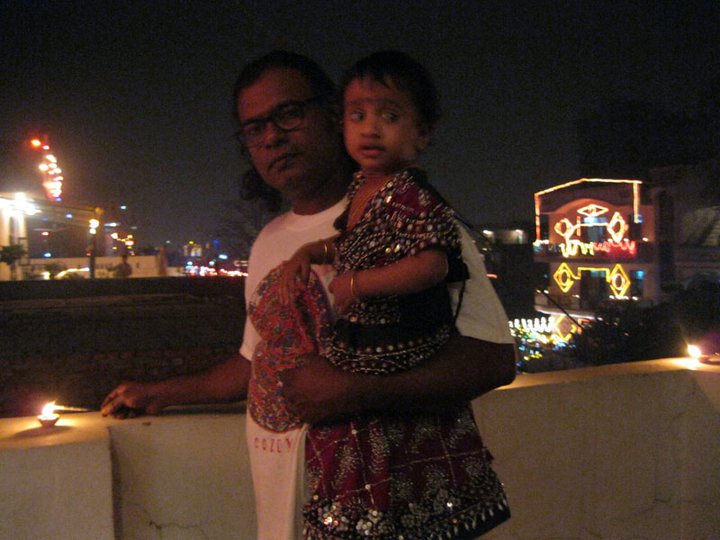
(Me and my daughter Kartyayani on a Diwali Day)

When a daughter is born, they say father changes his outlook. In the name of parenting too many lies are often bartered around. I think it is a vicious circle that helps the parenting ‘industry’ thrive better. When two moms meet they talk about how the arrival of their kids has changed their lives completely. If one of them is a traditional mom, she will go gaga over her son’s virtues. If one of them is a feminist and has only girls, she will say sons will walk out but the girl will stay whether she would be married or not. I do not know how fathers speak about their sons and daughters. However, I have heard fathers speaking about how they have been changed with the arrival of their ‘girl’. I have tried my best to be like one of those fathers, young, happening, cool and changed-for-ever-with-the-arrival-of-the-girl-child types and have failed miserably. When my son came first I was elated and soon I realized how he has brought a bundle of problems too. This could be easily misinterpreted. How rude he is! Obviously some of your would exclaim so. But that is the fact. Kids bring additional responsibilities which most often are not palatable. When my daughter came I was a bit curious because the child was a ‘girl’.

Going by the norms of the society I pretended to be very happy. Some people told me, ‘man, you have now a complete family.’ For a long time, to tell you the truth, I thought that a complete family means a wife, a husband, and two kids. But someone corrected me much later, especially when I was going through a separation. ‘Hey man, what a pity. Look at you. You have a complete family’, someone said. ‘Excuse me, what did you say?’ I asked. ‘You have a complete family; a son and a daughter.’ That was it. So whenever they said someone had a complete family they meant this. One wife, one boy child and one girl child. I was appalled by that generalization. Suppose if I have a loving wife and a son, can’t it be a complete family? Or if I have wife and a girl child, can’t it be a complete family?’ Nobody answered my question because I did not dare to ask this to anyone. There are so many questions in our society that we do not dare to ask because we know that the answers could be quite offensive. Isn’t it a crime when you have a question and you dare not ask and also you have an answer and you kill it because it is not palatable? We are living in a self generated crime ridden society. Right in our mind we are criminals.


(Me and my daughter on a winter day in Delhi)

That was not my point. When my daughter was born I thought something was going to be really different. I may be an intellectual and I may have very good understanding about the psychology of people but the problem is that when it comes to your own case you just don’t understand half of your own things. It is exactly like a doctor who abstain from self diagnosis and like the clairvoyant who avoid seeing her own future. When it came to the case of my daughter, like a naïve person who was brought up with the staple food of Amar Chitra Kathas, I too believed that my daughter would be a very quiet child, obedient and calm. Sooner than later she proved to be otherwise. She did exactly what her brother did. She even fought with her mother. She refused to eat as if she had taken a vow to be an anorexic model when she grew up. She howled and threw tantrums and shamed her brother in mischief making. The adamant nature turned out to be normal to all kids who often fulfilled their desires and or attracted attention by throwing tantrums. My son had strayed away from a greenroom in full make and a few years down the line my daughter also reported have strayed away from a packed bus stand somewhere in Gujarat.  I had read out a lot of stories that taught good behavior and morality through the life of a puppy. But the kids proved that they had learnt little from those stories.

Daughters are also mischievous. But their mischief has a different color scheme as they grown up. I do not know whether it is genetic or not, a girl child behaves differently than a boy child. As they grow up girl children automatically go for the ‘pink’ color. Anything pink will attract them. I do not remember anything of that sort happening in my childhood. I too had an elder sister and also many other little sisters around. We were village kids and we played with twigs, coconut shells, mud and so on. We also used to play ‘House’. It is a peculiar play where even brothers and sisters behaved as if they were husband and wife. We enacted the gender roles available at that time. So naturally, we boys set up stores with an array of differently colored sands, stones, leaves and many other collected items, each of which stood for something real in a grocery store. Girls came to shop, bargained and went back home by buses or cars driven by boys. Often a car could be made with a small loop of rope and if it is a bus a loop size will increase. Train was an easy thing to make as we all held our knicker and skirt ends and ran behind a boy who made a hooting sound and imitated the hissing sound of a steam engine. Girls made food in thatched huts and the ‘men folk’ closed the shops and went home to have lunch. Interestingly, kids imitated whatever they had seen at their homes and some of the kids ended up in violent fights. They were just living a ‘family’ life!

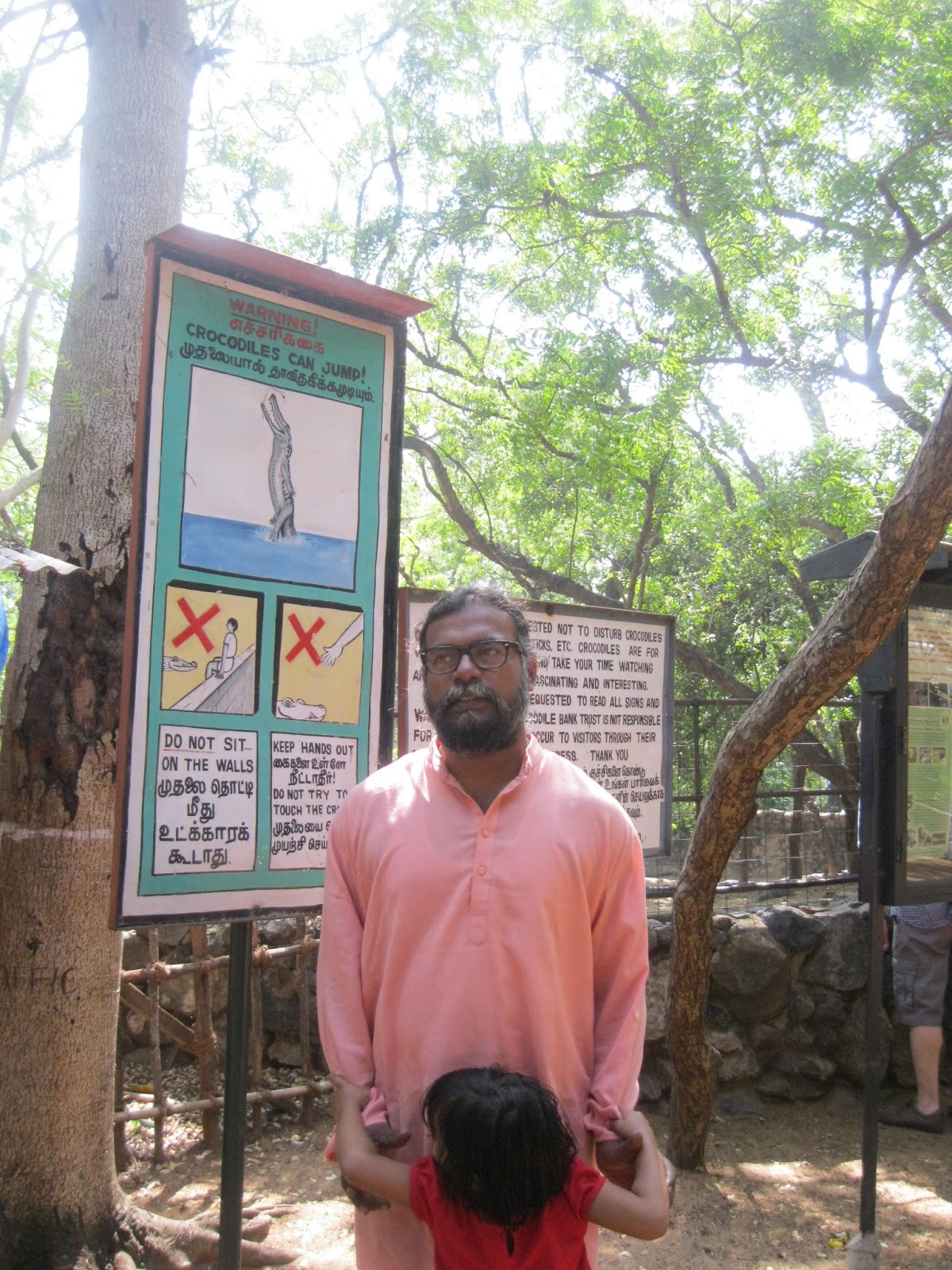
(me and my daughter near a crocodile sanctuary near Mahabalipuram)

Those girls did not opt for pink. Perhaps pink was the color of a ribbon and the cheap nail polish that came with the hawkers once in a year during the temple festivals. Girls wore coarse cotton clothes with huge flowers printed on them; today they may be passed off for curtains or furnishing clothes. But my daughter gravitated to pink as if time had inscribed the rules of global desires in her genetic make up. There was a time you could enter a world of pink once you opened her cupboard. She demanded pink shoes, pink belts, pink caps, pink frocks and pink anything. I think when she was hardly three years old and started browsing Youtube for herself, she chose all those pink related programs that included Barbie dolls from all over the world including Japan. One day I was horrified to see her watching a Barbie doll being cannibalized by some animated characters. This kid was enjoying it thoroughly. That was the first time I thought that there should be some control over the Youtube channels that she watched. My son watched only animations and some games. Violence was not his kind, but a girl child enjoying the cannibalizing of a Barbie doll. Thank god, she did not dwell much into that. Also she did not need any persuasion to leave it behind.

You may not think that my daughter who is all six years now, is another early nerd. She is one of the cutest of girls (see I too got into that one’s own syndrome) in the world and whenever I see a girl of her I just cannot take my eyes away from her. I have been away from her for almost one and half year due to certain familial issues. I could see her in between and whenever she met me she behaved as if nothing had gone wrong between me and the family. Girls are great survivors too. They are cautious and calculating than the sons who would go around and just boast that their fathers were celebrities or big fighters. The most coward and unsocial person, for his son would look like an animation transformer hero who could become anything by just taking different shapes. They think that they belong to the family of the Incredibles. But girl children are more realistic and imaginative at the same time. My daughter is realistic when it comes to the real situations in life. She is imaginative when she asks questions like, ‘Papa, do butterflies wear frocks?’

(Me initiating my daughter into the world of letters)

‘Do butterflies wear frocks?’ What a question…what a question. A question that does not have an answer. I could have cooked up a story, a scientific explanation or anything of that sort. But I chose to remain silent and I gave her a smile, which I thought was wonderful and I am sure she would remember that smile for ages even if I would be dead and gone back. I told you about the questions that we dare not ask and the answers that we dare not utter. I also said that by keeping those questions and answers to ourselves we become criminals. But these are the questions that absolve us from all kinds of criminal thoughts. Even if we do not answer those questions we will be acquitted of that crime. There are questions that do not seek answers in this world. Those are the questions that have gained their answers in the world before and beyond. Children come to this world with those questions, leaving the answers behind. These answers are like memories that are never remembered. When we are grown up and old, suddenly we remember that we had some questions and also they had some answers. But searching for them here would be a vain attempt; that also we know by then. So we would wait for those answers and we know that they would come one day unexpected. Wouldn’t it be interesting to pass over to a world where there are only answers for all the beautiful questions that by now we have forgotten?

My daughter has turned just six. I am very happy about that. I am happy because she would be having such beautiful questions that would put the most intelligent person in confusion. She would have those crystal shoes which she would leave for her Prince (feminists of fundamentalism would say that as a father I could not think anything but marriage). She would have one of the brightest brains so that she could see the light of the world of imagination than earn a fat salary packet from the world of servility and darkness. Her world would be rich with all happiness and luxuries because she is going to the creator of all such luxuries. When she has wings why should she think about flying at all? Flying would come naturally to her because she is made to scale the heights and trace the new trajectories. Ethereal spirits that have blessed her are with me as I was the one who gave her the blessings of letters and lit the lamp of wisdom in her mind. She is not still able to know the vastness she has been containing within her. How come sky measure itself? How come sea hold itself back from lashing out at the shores? How come the air stops itself when it knows only the path of life and movement? My daughter is six years old today and I bless her from this distance and make myself and her immortal through these words that know no distance and geographical borders. 

Tuesday, August 18, 2015

Devika, Good that You Stopped THAT

(Dr.J.Devika)

Dear Devika,

I appreciate your decision to stop subscribing the Mathrubhoomi Newspaper. But at the same time I feel like adding that you should stop reading all the newspapers altogether. In one of his poems, Balachandran Chullikkadu narrated how the ‘blood dripping newspapers would come every day’. They tell us the stories of ‘fires, shocks, nuclear explosions’ and they also inform us about ‘pride, competition, great protests/and the resistance of the greater force of the enslaved lives’. How sharply, intelligently and poignantly he had explained a day’s news in his irresistible lines. Has it changed considerably after three decades? Yes, it has changed; in the place of resistance we have this wonderful pictures and news of submissiveness and yielding. We see how the newspaper giants that claim themselves to be the ‘power of the real newspaper’ (why I resist myself from using the word rag? And why I am tempted to say the power of common man?), ‘Cosmopolitanism and alertness’ and so on fail completely in showing some kind of resistance against the growing Fascist tendencies in our societies.


When protest fails poetry takes over, does it? I do not know. But I am reminded of N.N.Kakkad, who had said, ‘we may amputate a diseased limb/but what about the diseased and helpless mind?’ The self pity that the poet had felt once for himself and for his life partner was capable enough to bring a few drops of tears in our eyes. Project the same lines on to the public and private domain of news production, dissemination and consumption; what do we see? Our society is diseased as I would explain soon within the context of your decision to stop getting a newspaper. Our minds are equally diseased. I see news are made out of nothing and bantered around throughout the day and night as if the very trial methods of the journalists would eventually bring the justice for the people instantly; here and now. The poetic justice of films that deliver justice within thirteen reels does not appear in our daily news castings (of late I found out that the laptops kept open before the news anchor are just props for effect as they say things as prompted to them through ear devices and also by raising documents. Can’t they have all those documents scanned and stored in order to look more sophisticated?)


People enjoy this nonsense of passive news reception. You know, when the major part of our prime time is occupied by the political analysis (no longer political reporting), all the other issues of human-animal-nature rights get no time. While corruption gets prime time slot, human rights issues are pushed to late night or mid noon sensational shows. Corruption in politics is the new porn in a country where the porn sites are under fire. While porn sites are banned, political porn is enjoyed by all. Our public domain is filled with these sound bites of news anchors who demand instant justice and peace. Thank god, I do not watch television news. But that is a general sonic backdrop as you live in a civilized society. I cannot imagine an evening in any home where the television audio track keeps the dominant sonic ambience. It in fact affect our senses differently; whether we are active consumers of television news or passive consumers, we cannot escape this benumbing auditory effects, which eventually makes a news consumer an addict. People like us perhaps are the odd ones who reject the medium itself than succumbing to the allure of it.

I can forget television for the simple reason that I could review my anxieties (did I say anxiety? Yes, for abstinence from anything for a long time causes some sort of anxiety about one’s own performative abilities in the expected field that had caused abstinence) once in a while either in Youtube or in cross postings in the social media. But I cannot do anything about the newspapers that come with a thud; not one but making three different thuds. A newspaper which is unused (means unopened) causes regret and self condemnation by the end of the day and if you open it, you are offended. I do not find any problem with your decision to stop subscribing a particular newspaper because given a chance I would also stop subscribing all the newspapers. But reading newspaper has become an age old habit (but if you can kick the habit of smoking and drinking, which I have done, then you can definitely get out of the habit of reading newspapers). But a newspaper that is read is a newspaper that demands the stoppage of its subscription. This is a daily temptation. But we somehow overcome this temptation, exactly the way you said that you did not have any problem with the weekly journal that comes out of the same stable. 


Most of the media magnates say that they give the news that the people want. They say that what is in demand is newsworthy. Some media magnates say that news is free and news items are just reasons for making the advertisements look good. Hence, what you consume is basically advertisements, news is a bonus. It all depends on what you want to see first, ads or news? But today, both do not make much difference. Both are meant for persuasion. If news is free, then we are obliged to take what is given. When we take what is given, our politico-cultural and socio-economic outlook also would change. If they say that they give what we demand then we would start believing that we demand Dalit bashing and imbalanced reportage on Islamic issues, as you have cited in your open letter to the editor of the said newspaper. Have we asked for it? No, we have not, but the common perception goes; we get what we ask for. In that sense, the society in general demands Dalit bashing and imbalanced views on Muslims. Is it so? Do we really demand that?

In my view, the public domain, the discursive space is an extension of our private domains. The private domain is a creation of the public domain in turn. These mutually depended spaces are parasitic and enriching at the same time. Our private domain is not autonomous as we believe. It is created by the inherited views as well as generated views. While inherited views are within the limited contexts the generated views are largely determined by the private domain’s interactions with the public domain. A woman who is born to a Hindu family in Kerala must be having some inclination towards accepting the male domination without questioning and she would not mind following traditional rules that come with the package of being a Hindu woman. Going to a temple and making pongala (making of rice kheer as offering) are a part of this package. But when she, along with a host of women living in the similar conditions are asked to make pongalas on certain days in a year and these activities are regimented and regulated with a purpose to spread a particular kind of Hindu ideology it should cause concerns in a society. When old temples are renovated and new ritualistic forms are added to it, we should be concerned. When impoverished and emaciated boys from the Dalit and backward castes are trained to speak the Brahminical language (without letting them know that they are excluded from the core discourse of it) we should be concerned.

 (A mainstream newspaper presenting the religious news item as the first news)

Our public domain is now dominated by such visual and sonic symbolism. One cannot escape the predominant Hindutva signs in our society. Our private domain is determined by these changed public domains. We start believing in this symbolism and automatically anything that is alien to it (actively and passively) happens to appear as social irritants rather than inclusive symbols. For example, a group of small girls going to a Madrasa to learn Koran, completely clad in cute little Burqas suddenly becomes an offensive scene while we thoroughly enjoy our little girls wear Hindu bridal dresses and imitate as if they were about to be led to a nuptial chamber. This kind of imbalanced views, in fact should be resisted and protested by the newspapers. There should be strong editorials against such propagations and proliferations of the male dominated Hindutva symbolism in our society. Instead what do these newspapers do? Irrespective of ideologies, they replicate this symbolism in their news and views. This further determines both the public and private domains. It was so disheartening to see, while I was doing a village survey recently, Hindu families having calling bells that shouts ‘Om Bhur Bhuvasvaha’ and Muslim houses having the calling bells ringing out, ‘Allahu Akbar.’

What has happened to our society? I would say, this condition is brought in by our newspapers. They spend so many reams of paper and so many bottles of ink over publishing the festival and ritual news of inconspicuous temples that have come up like mushrooms during the last ten years. It is a fall out of the hate propaganda created by the Hindutva forces. While our political parties of different kinds failed in stopping this cancerous spreading, this was the direct responsibility of the newspapers. They have failed absolutely in this case. To make matters worse, they have become the mouth pieces of these Hindutva ranting and raving, shamelessly. They have started talking about castes and creeds, and they have never failed in politicizing the caste. While we can accept it, we just cannot accept how they take the caste discrepancies in our society into the Hindutva fold and make it a larger Hindu issue, as if everything that has happened so far, including the caste issues, is a self generated thing and a great wrong committed against the Hindu community (but they never say in clear terms who committed this wrong. Who, Muslims? Say it please, how).


(Kerala Kaumudi Managing Editor releasing the first copy of the Onam special at Attukal Shrine)

I have been thinking about responding to your letter to the editor which has become viral within a day. I am happy for that. In fact I am happy because a person like you is still active in our society while some of the women writers in Kerala have already worn saffron shawls. Today morning I saw the classic stroke and I could not help but articulating my views on it to anybody whom I met today. And by evening I am writing this to you. When I opened today’s Kerala Kaumudi, a dear Newspaper that publishes my articles once in a while, and saw on the very first page at the top left where one starts the movement of his/her eye (technically speaking), a soft pastel image of the Lord Ganesh, as today is a special day for him. I was a bit down after seeing it. I thought it could have gone down or in the inside page (okay, I told myself, may be this is what the people want). I skipped so many bits of news that proclaim divine presence in our society and finally reached the last page. I could not believe my eyes. There the Managing Editor of the News Paper releasing the Onam Special of Kerala Kaumudi at the Attukal Shrine giving the first copy to the head priest there.

May be I want to stop subscribing Kerala Kaumudi. Will I? Should I?

Yours faithfully,

JohnyML

PS: From Trivandrum to my village, I heard at least twenty different singers singing a variety of new ‘histories’ about Lord Ganesha in more or less the same tune. 

Saturday, August 15, 2015

The Flag is on Fire: World Without (barbed) Wires


Tomorrow I will celebrate India’s 68th Independence Day. Does that mean anything to me? I do not know. The enthusiasm that I have been showing all day in getting things done for tomorrow’s celebrations, as a disciplined party worker amuses me quite a lot. I have never been so enthusiastic about Independence Day. Once upon a time, when I was in school, on the day of Independence celebrations, we went to our school, hoisted the flag, wondered at the way color paper pieces and flowers came out of it when it unfurled up there and enjoyed the free candies. Headmaster spoke of the relevance of our Independence and the resident poet of our school, an elderly gentleman who handled the affairs of library too recited a poem that he himself had written for the occasion. We took pledge in the name our country and once again reiterated our allegiance to the land of our birth. Then the marching tune led us back to the class rooms from where we dispersed ourselves into thousand little pieces of white and khaki and green, little whiffs of coconut oil smell, mirth and laughter. That was the Independence Day for us.


I look at Nationalism with doubt. In fact I do not believe in any kind of nationalism/s. I am a proud Indian. That’s true because for the time being I carry an Indian passport and have not left the Indian shores for better opportunities in life. However, as I have travelled enough, have seen the world in different perspectives and take a lot of interest in universe without borders made available to me by the world wide web I do not claim myself to be an Indian. I could be living anywhere at any given point of time. Sometimes I live in Alaska and sometimes in Atlanta. Sometimes I am in Kochi and at other times I am in Kachani. I live in a small village but when I am at my computer world lies just next door. It is one click away and could be seen through another window. As I live a life like this, like many others in the world, why should I be exceptionally interested in the country where I live? I understand, as I have developed this sense of wisdom, that people in any part of the world feel the same pride for their country. As everyone is so proud of his or her country, there is no point in saying that my country is better than your country. There is a rich life in every poor country and there is a poor life in every rich country. There are no countries in the world where human rights are not violated. Hence, I need not feel particularly proud of any country. As I need not be particularly proud of any country, I do not think that I should be so proud of my own country.


I like my country. That’s it. It is exactly like the way a fish says that it likes an ocean. A fish does not say that it lives in Arabian Ocean or Indian Ocean. It lives in an ocean. We call it Arabian ocean or Indian Ocean. A fish does not feel or see the difference. The Navy forces of different countries may draw lines on the water and say that our territory ends here and your start there. But a fish easily swims across these lines without heeding to the protocol issues. I am like a fish in the ocean. Even if you say I should be proud of India, I would say I am proud of being an Indian at the same time I am proud of being a Pakistani or Bangaldeshi or a Sri Lankan. What difference does it make to me? You have made so many rules so that I cannot just travel to the other part of the world. If not what would stop me except my own routine habits and laziness? You have given me a map and a flag. So I am supposed to believe in both of these symbols or emblems. What I am going to do with these symbols? Now, you make war with the other country and you ask me to support you? Why should I support you? In the war you kill human beings and they also do the same. What is the use? Can you get the life of the people who have given their lives in the wars if I kiss my national flag or map? Will my pride on these things make any difference to the dead people? Like fish in the sea, dead people also do not have any particular country. They belong to everywhere. They belong to the universe. Nobody ask for passports when they step into the other world of existence. There no map no flag make any sense. What makes sense there is the utter senselessness of things. There is no thing-ness of things there therefore nobody is attached to anything. We are attached to maps, national anthems and national flags.

If I say this, you will call me a traitor. But I am taking the risk. An ordinary person speaks only truth. He cannot speak anything other than truth. I love my country exactly the way I love other countries. I love my people exactly the way I love the people all over the world. If that is the attitude then we can withdraw the soldiers from the extreme conditions of the borders. What is the use of those soldiers when we all love other people? The world is determined by economies and power. When power comes to play love ceases to exist. Suddenly a map is drawn a flag is hoisted. Then everyone is asked to hoist a flag whether you like it or not. I am not particularly attached to my flag or my map. In the world of universal brotherhood where I would like to live the rest of my life, I do not find any reason to hold these things high. But the world does not work the way I want. So there is question of colonization and therefore the relevance of an Independence Day. If I say I do not want to celebrate the Independence Day of my country, some people may ask me to leave this country and go elsewhere. When I am already living elsewhere how can I go elsewhere? I am not a traitor even if you feel so when I say all these things. I happen to take birth here and it became my country. I happen to be born in a Hindu family, so I happened to be a Hindu. Given a chance I can change both and if no chances come I can even make one. However, human beings grown some kind of comfort level with the surroundings they are in. My being an Indian is just a comfort level, nothing more nothing less. Then you may ask me to go and live elsewhere and seek job elsewhere. My question is, why should I? Here I have some comfort level so I live here. We shop from certain supermarkets; that does not mean that we need to celebrate that super market each time we go there or even think of it.


If someone burns the national flag before my eyes what would I do? If someone defiles India’s map what would I do? These questions may be put to you in order to prove your faithfulness to your country. If you are living inside a movie you will jump on a burning flag and save it at the cost of your own body and the resultant burn injuries. You would sacrifice anything for your woman and your nation. Nation and woman are not different, they say. It is ironical that most of the times, despite all the tall claims regarding the equation between woman and nation, people tend to molest women and leave nation alone. Politicians molest both women and nation. So I do not know what I should do? What I know is a simple thing. If a map is defiled, if a flag is burnt before my eyes, I will consider it as the foolish act of some illiterate (because it is not necessary to burn a flag to provoke someone to nationalism) and walk off. Only those people refer constitution for anything and everything, would jump on a burning flag or would pick up a fight with strangers for momentary reputation. I am not living inside a movie so I don’t need to jump on a burning flag. I can walk off. But if my woman is attacked in front of me, I would turn into a monster. I will kill that person. If any woman is molested before my eyes, it would be the same. I would like to do the same for my nation. When I see my country is being molested by the people of this country in the garb of politicians, I want to kill them. But I can’t. I want to do something that’s why I am in politics.

However, I find it really funny when I do all these things to hoist a flag and commemorate my country’s Independence. True that it took a lot of years and a prolonged struggle to gain independence from the colonizers. But what about today? Are we really free? If we are not free what is the point in celebrating the Independence Day? I ask myself while I go around with the preparation rituals for tomorrow. I did all what I could do for celebrating the Independence Day. I did all as if I were in a trance. I do it all for myself for the first time not because that suddenly I became a nationalist. But because I realized that there are so many people in this country who think at least for a day that they are all independent. I want to share that illusionary happiness with those people who believe that they live in a free country. Some time it has some palliative effect. We should not prevent people from having a day’s relief which otherwise they get only when they watch television serials or war news from the borders or watching live cricket between rival countries. Displaced pain is as good as slow death. Eventually it is going to happen. But it is good to make people feel good about the nation that they believe their own. Let them have it. I do not think anything else. I will not be feeling especially elated when the flag goes up (if at all I would feel excited it would be by looking at the crude technology that we have used in hoisting and unfurling it) tomorrow. I will not be feeling so good when I recite the national anthem tomorrow. What I believe is that given a chance I could sing the anthem of any other country provided I live there for long and start feeling that it is my home. I feel at ease when I browse through the world wide web. I could laugh off false nationalisms and wars. But in the real life, one cannot. I would like to undo all what I have done today. But tomorrow morning I will go and hoist the flag and would feel happy about it. I would say unto myself that at times symbolism helps. And also I would be happy to get photographed with my friends who perhaps think absolutely different about the Independence Day tomorrow.