Sunday, January 10, 2021

Babu Maney: A Painter Who Wandered a Lot


(Self-portrait by Babu Maney)

 “Many journeys and meeting many people don’t really help to make art,” says Babu Maney. “You need to sit in one place and make art.” His voice no longer has the agitation and his feet do not itch to set out for another unchartered journey. Rolling stones, they say, do not gather moss, but once they settle down at some place, a major portion of their chunk must have been rubbed off. Some shine and some turn pale and weak. Even in the weakness such stones could reveals the innards of its existence, its veins of pain and a quivering soul. Babu Maney in his early fifties is now like that stone that has settled at Edappady in Kottayam, Kerala, after a long life of a rolling stone.


(Paintings by Babu Maney)

Was it the travel bug or some kind of a search? Babu thinks deeply and he is not able to figure out the answer. Perhaps, it was for both. He wanted to know the lands and also he was in search of something which eventually revealed him the truth of settling down in one place at some point in life and pick up the tools that he once considered dear. After finishing the National Diploma in Painting from the Mavelikara College of Fine Arts in 1990, Babu looked around and saw nothing to support him as an artist. He did not want to become a banner and poster artist. In one of his meetings with a local artist who went by the name ‘Varnam’, Babu chanced upon a book on World Art. Leafing through the book he thought that whatever he had learned in the college were just exercises of minor effect.


(Paintings by Babu Maney)

National Diploma was a kind of educational pattern followed in the Fine Arts learning in which the students were not supposed to give written examinations. That means, those who had a diploma were not supposed to write theory and history papers. Artists, once upon a time, came from artisans communities and many were not good at reading and writing. Diploma helped them to have some qualification. But even after many years into modern education, still many fine arts students preferred diploma over degree because they could escape the tedium of written examinations. Babu Maney got a Diploma and it was enough for him to get an admission in any institution like Santiniketan and MS University, Baroda. (A few diploma holders, with proof said that they too had to write theory and history examinations and pass with 40% marks. I need a bit more evidence to make the difference between a Degree and Diploma). 


(Paintings by Babu Maney)

Babu followed some friends to Delhi and from there to Santiniketan. Failing to get admission there, he reached Baroda in early 1990s and got admission after a couple of attempts. Sooner than later Babu became a ‘figure’ in the faculty, moving around with a promising sculpture student, Gopan Perumbada. Armed with a smile that did not betray any of his emotions, Babu waded through the difficulties of language and money and managed to pass out from the faculty with a Post Diploma in Painting. Lands were calling and he kept moving from one place to another; sometimes as an assistant to a friend and sometimes as a cook to an officer in Kolkata. Upon coming back to Kerala, Babu found himself alone and lost. He couldn’t pursue a lucrative career in the commercial field for he thought his calling as different. Nor could he make anything in the art scene despite his ‘good hand’.


(Portrait of Mother and self-portrait by Babu Maney)

Late Rajan M.Krishnan found Babu’s potential and started helping him by providing him with canvases and colors. Babu bloomed soon; his paintings though stylistically addicted to Rajan’s for some time, took different forms, shapes and hues and the artistic attitude evolved in definite directions. Like an ambitious artist of the time, Babu too attempted to make large scale paintings; dilapidated buildings, old parts of the cities, collapsing architectures and so on became Babu’s favorite subjects. Looking back at those works one could see why the artist was keen on the collapse and decay. He was looking at his own life, collapsed and showing the signs of early decay. Despite his efforts to shake off wanderlust, he found it quite fascinating and his feet were his only carriage that took him to distant lands. He kept on looking for the solution for his art. Epiphany set in when he saw nothing happening to his art in terms of monetary results. He realized that it was imperative to paint and stay in one place. Itinerancy in art is possible only when the artist could find a stable patronage, which was no were to be seen in his case.


(Hampi and Fish by Babu Maney)

The days of boom went by without making many changes in Babu’s life. He was working as a mason in the construction sites. He accompanied his elder brother who is an accomplished mason and got suspended once in a while for his love for bottle became a nuisance in the worksite. “I painted during the days of suspension,” chuckles Babu. During his student days acrylic was not a major medium and today he works more in acrylic for its affordability. Suspension from work turned out blessing in disguise for Babu for he could chuck the habit slowly and steadily while his output grew considerably. He fell in love with himself and started painting self-portraits a la Shibu Natesan. Also he turned his attention to nature and started painting it with a renewed vigor. “I have been traveling and I was not seeing nature, perhaps,” he says, “but once I started painting the immediate nature I recognized the beauty of the surroundings.”


(Paintings by Babu Maney)

Chirico, the Italian painter has been an inspiration for Babu and one could see his works literally making references to the master’s works. He has even painted his mother’s portrait against a famous Chirico works. Once upon a time Babu was obsessed with homes; perhaps, homelessness and incessant wanderings must have triggered such imageries in him. He painted a protagonist carrying homes on his shoulders. Had he been considering homes as a burden or the longing for it was dreaming them down on him? Babu does not say a conclusive answer. Once settled, he is more comfortable with interiors and domestic imageries. Once in a while he makes a small trip to the nearby places and comes back with the mental images of the places and paint.


(Paintings by Babu Maney)

Babu Maney (as in Manet) is not a usual name in Kerala. “It was supposed to be Babu Money,’ he says. He did not know how to make a facebook account and a friend pitched into offer help. While naming him according to the social media requirements, Babu Mony was misspelt as Babu Maney and it got stuck. Money (Mani) is his pet name; an irony, he says as he does not have any money. But it is good to be known as Maney because it gives him the comfort of the great Impressionist, Edward Manet. Babu Maney still goes for his mason work as none has come to pick up his works. “Whatever I have painted in my life are with me,” he says. Unlucky? Not sure, some people strike gold late in life. Babu Maney hopes to make it big as he is a determined painter today. However, he needs help; yes, monetary help to survive.


-JohnyML

Fate of Sculptures in the Age of Tourism Economy: Controversial Conches of Kanai


(Toy Train at Veli Tourist Village)

Paint seems to follow Kanai Kunhiraman, with vengeance. The illustrious sculptor who has been instrumental in neutralizing the obscene gaze of an average Malayali on a painted or sculpted female nude, through his enormous depictions of female nudity in the thematic sculptures like Yakshi and Sagarakanya has now become the eye of another cultural storm. This time the trouble has a twin appearance in a couple of kilometers apart; one, at Sanghumukham and the other one at Veli. At the Veli Tourist Village that Kanai had singlehandedly developed out of a marsh-land in 1986, his sculptures, especially the landmark Conches that rest on a tastefully landscaped mound, are in for a makeover with a fresh coat of ‘white paint’. The decision has come unilaterally from the Cultural Department of Kerala that maintains the ‘village’ which has been given an additional attraction recently with a toy train running through the village.


(Sagara Kanyaka by Kanai Kunhiraman at Sanghumukham)

The toy train has already become the talk of the town but Kanai is not amused. He says that he has never been consulted before or after the laying of rails for the chugging toy, which the cultural activists in the city accuse of being laid taking the pandemic lockdown as an effective shield. Perhaps, the toy train could take the excited people all around the village and one of the ‘added’ attractions could be the sculptures of Kanai. So far the department has not taken such a step. Kanai says that the train could have been shifted to an adjoining land without disturbing his sculptures. To make matters worse the makeover issue of the sculptures has come up and in this case too Kanai is not consulted.


(The Controversial Chopper at Sanghumukham)

It is a norm existing all over the world when it comes to the facelift of cultural monuments. If the artist is alive he/she should be consulted before making any attempt to alter its original state. If the artist is not alive, his estate should be brought into the picture. Still, if such estates don’t exist, the reputed art historians and artists who had worked as contemporaries to the deceased should be asked to make suggestions. Structural engineers and landscape artists and even city planners are to be approached for opinion. Kanai is very much alive and recently his 80th birthday and his ‘Yakshi’s’ 50th birthday were celebrated by the Lalitha Kala Academy. There is nothing wrong to give a fresh coat of paint to the sculpture but the procedure should be done in the presence of the artist himself.


(Kanai cleaning Yakshi at Malampuzha)

In 2018, Kanai’s famous Subhash Chandra Bose, a commemorative sculpture exuding Netaji’s elegance, stature and posture, inviting people into the city of Trivandrum, standing in front of the GV Raja Stadium aka University Stadium at the PMG Junction, was found ‘green’ one day. Someone had painted it green! Kanai himself led the protest and truth came out in the form of a Forward Block leader who thought that Bose was not given enough ‘care’ by the authorities, so he decided to paint it green with emulsion paint overnight! The City Corporation had denied its hand in the makeover and soon experts were called to get Netaji back to his elements. Just a year before the incident Kanai’s another commemorative sculpture of Kumaran Asan, one of the highly influential Kerala Renaissance poets was found sporting a silver coat of paint in yet another ‘reformative’ act. Kanai had to raise voice once again to get the statue back to the initial position as he had conceived it.


(Yakshi after renovation)

A highly literate state Kerala still lacks in visual literacy. A few decades ago, some precious temple murals were overpainted with enamel color as the ‘conservationists’ thought of making them anew. Same figure, same style but a new approach with new paints, what’s your problem was the kind of argument went around in favor of the act of conservation, which in fact was an irrevocable destruction of a rare heritage. A.Ramachandran who has done decades-long studies in Indian murals in general and Kerala murals in particular was really disappointed as his protestations went unheard by the authorities. In 2013, the ‘Kalapravaham’ sculpture by K.S.Radhakrishnan installed right in the middle of the historical Mananchira Maidan of Kozhikode also fell victim to the enthusiasm of some conservationists who painted it with silver color. A curious photographic intervention by a press photographer alerted the artist as well as the concerned people and what had started off as a conservation act ended up in cleaning the sculpture thoroughly.


(Subhash Chandra Bose sculpture by Kanai 'accidentally' painted green by a political outfit)
Kanai is a disappointed man today. And his complaints should be heard by the Tourism Department. Any alterations on the sculptures should be done in consultation with the artist who is very much available in the city. If consultation ends up in the objection of the artist, it should be respected. During the celebration of the 50th birth anniversary of Kanai’s Yakshi, it was given a thorough renovation with Kanai himself leading the team in refurbishing its contours with cement and giving it a greyish blue sheen. Many people in fact even disliked the way Kanai himself had renovated it! The Sagarakanyaka sculpture at the Sanghumukham beach and the newly installed decommissioned Air Force Chopper needs further aesthetic deliberation. Managing the damage does not mean the removal of what has been done by the Cultural Department but a renegotiation of the space and its discursive meaning in the public domain. It needs a lot of work from the artists, authorities, intellectuals and the public. I have certain solutions to suggest. And I think I could put them down in another article.
-JohnyML

Monday, August 31, 2020

The Importance of Being Avinash Karn, the Contemporary Madhubani Artist


(Avinash Karn, artist)

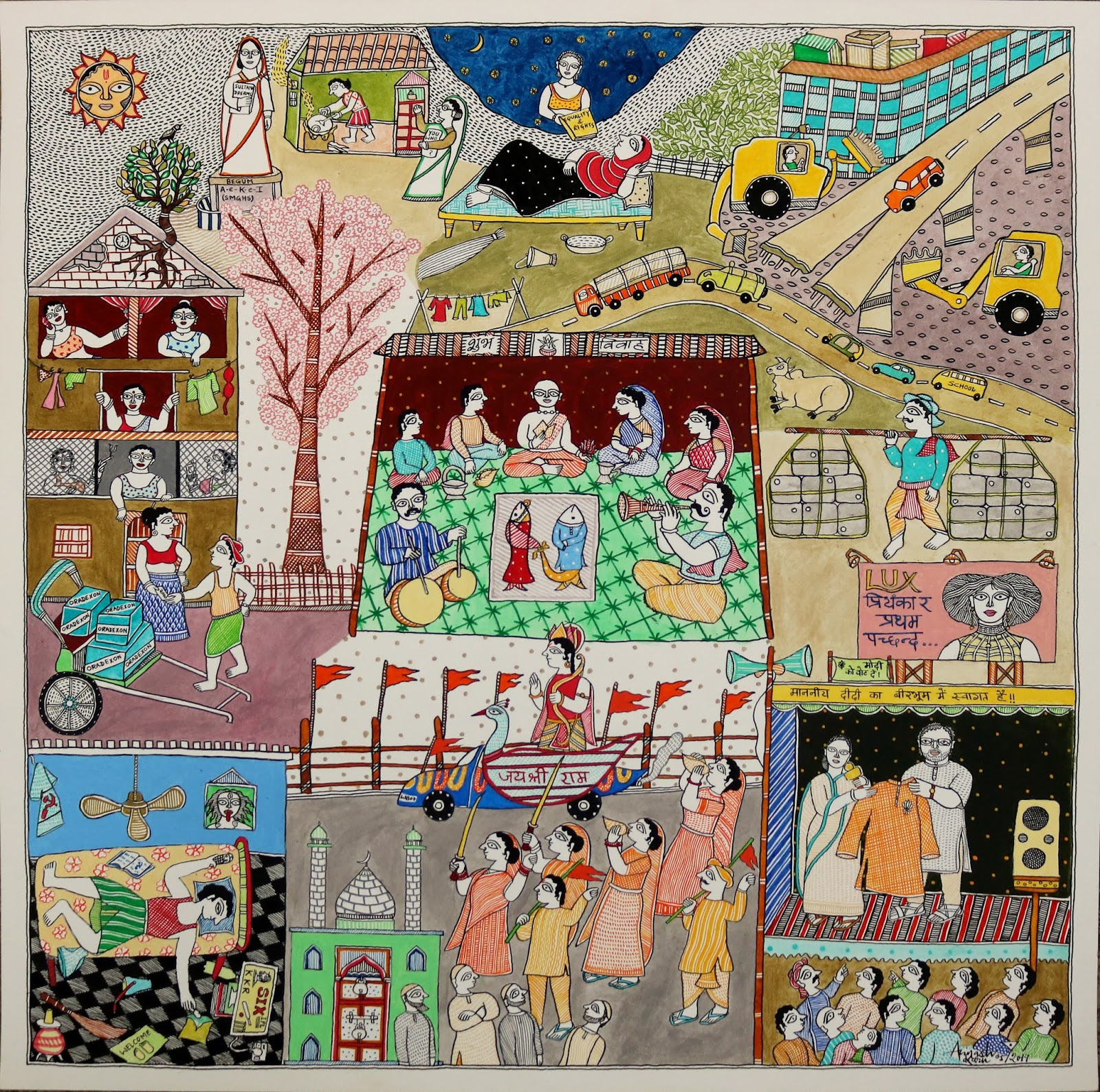
An earthquake in Bihar in 1934 did cause a great damage. But it brought something unexpected to the fore. Hidden inside the homes where the public couldn’t get any access, but now lay opened in devastation before the prying eyes of the rehabilitators were some beautiful paintings done in a peculiar style on the walls hitherto unknown to the world. Those were done by the Brahmin ladies as a part of their religious and daily rituals. As its origin was religious and caste oriented and heavily ridden by gender restrictions none knew about the existence of such exquisite paintings. The scholars among the rehabilitators called it ‘Madhubani’ style of painting. Madhubani, a district in Bihar in Mithila region which is famed to be the birth place of Sita, the epic heroine, lent its name to the painting style not only because of the location of its origin but also because of the honey like sweetness of its rendition. It took a few socio-cultural and caste meanderings before it became a world renowned folk painting style, bringing several nuanced expressions and styles within that umbrella term. Avinash Karn, a young contemporary artist comes from this region and his fame is heavily depended on the ‘Madhubani’ style.


(Paintings by Avinash Karn)

Graduated from the Department of Sculpture, Banaras Hindu University, Uttar Pradesh, Avinash Karn, towards the end of his education had recognized the mission of his life; to become an artist who did all what he could towards propagating the homegrown Madhubani style all over the world, but with a difference. Madhubani paintings have been a staple in most of the India International Festivals, folk and tribal expos and emporium based markets. Traditional Madhubani paintings have found their way to rich home across the world and in some international museums that catered to the global folk and tribal aesthetics. This was a sort of sampling that reduced a vibrant art form into a souvenir product if not a museum piece. Madhubani style, over the years also has become a painting mode of the ‘self-taught’ women artists in urban India who often painted in various styles as they thought art was a safety valve and it could be done in any style they fancied good and practical.


(Paintings by Avinash Karn)

Avinash Karn left his sculptural ambitions for taking up the Madhubani style, which in fact is still seen as a feminine mode of making art due to its homely ritualistic origins. Before him another artist, Santhosh Kumar Das, a veteran from the Fine Arts Faculty, MS University, Baroda, again a native of Mithila region had taken up this mission. Das maintained a track of Madhubani style purely in black and white, infusing it with contemporary narratives, giving an edge to the graphic quality thereby making it a story telling interface while keeping the painterly form intact. He has been successful in doing and is now recognized for his very personal(ized) Madhubani style of paintings. The refinement that the contemporary artists bring to the traditional style of painting is what makes it more dynamic and saves them from becoming a stagnant pool of traditional patterns and repeatable stories and formats. Even the illiterate women artists from the same region, who have picked up the art through apprenticeship under master women artists and transcended both economic and caste barriers, are now capable of expanding the traditional repertoire of images and making way to more contemporary imageries and familial narratives. Perhaps, an artist like Avinash Karn stands as a link between these illiterate women artists from the region and the more refined and sophisticated versions of Madhubani style as practiced by artists like him, facilitating the journey of the art form in a more dignified course that now ekes out not only aesthetic attention but also academic interests at various levels of its reception.


(Paintings by Avinash Karn)

The glossy super-flat surfaces that once beckoned the young artists to create more contemporary art in a homogenized visual cultural approach in order to gain quick traction among the buying class and recognition in the international art market manipulated by the local cartels of galleries somehow did not appeal to Avinash Karn who had experienced the aesthetic finesse of Madhubani art and its inherent ability to move people visually. What he wanted to do was to make himself a sophisticated medium so that he could not only paint in the chosen style but also could articulate his concerns regarding the style before an interested public and aestheticians. He did achieve that feat and could take his art to various national and international platforms, all this while incorporating the new locales that he found himself in in the process. This enriched the visual ensemble of his paintings and the scope of manipulating the images which were traditionally not there in the ‘original’ Madhubani paintings. For example, the traditional women painters knew how to portray godheads and village life in tiered narratives, using adequate distortions and abstractions through spatial arrangements whereas they were not sure how a television set or a gas cylinder was brought into the painting. The major achievement that Avinash Karn made in his works and also contributed to the stylistic repertoire of Madhubani paintings is this that he could bring in anything that he saw around him, be it Qutub Minar, metro trains, Victoria Terminus, Writer’s Building, Gateway of India and so on.


(Paintings by Avinash Karn)

So long as a traditional artistic style remains within the confines of its origin in terms of geographical territory or variable aesthetical grammar maintaining a visual cohesiveness, contemporary urban (read modern) art does not feel any threat from it. It could always be treated as a country cousin of the mainstream art however it tries to be a coat-tie wearing urban lad. The comic interludes may be expected out of such art but not a regular lead. Avinash Karn brought his style and pivoted it right in the middle of the urban contemporary art almost shaking up the claims of modernism upheld by the urban art (especially the ones that came out of the famed art colleges). Here was a new and curious body of works that almost looked folkish but a closer look thwarted such comforts for it was showing all what an urban narrative could do in its modern painterly style. It was both awe-inspiring and moving, and perhaps evoked a discourse more vigorous than the former one could have done. Writing in past tense does not make Avinash Karn’s works a thing of past but my intention is to say that this was what he did to the art world, in the meanwhile smiling all the way to the bank.


(Paintings by Avinash Karn)

By now Avinash Karn has achieved such felicity and skill that he could handle paper, canvas and walls alike. He has also forayed into digital production of his works, not as a copying methodology but the digital technology as a method to enhance the possibilities of the style that he has been instrumental in making and propagating. Interested in local histories, his research has taken him to the history of production of images through crude photographic methods and he has even experimented with a body of works that made use of the paraphernalia of the older traditions of local photography. He travels a lot these days and each sojourn adds to the visual coffer that he gleefully flaunts in his works. Looking carefully at his works, one could see that the traditional hues of Madhubani are no longer there in his works but an aesthetical recalling of them through synthetic colors that allows the artist to go for bigger formats and surfaces. The intimate scale of traditional Madhubani style has been bartered for experimentations, which in fact has become a habit even of the traditional artists from various parts of India as they have started attending national and international art symposiums and camps where they are expected to use modern canvases and synthetic colors. Avinash Karn’s works are a bold intervention in the contemporary scenario of art where the artist’s modern education becomes a tool for him to further his regional art style while taking a great care not to fall into the trap of becoming an internal colonizer of tastes.

-JohnyML

Friday, August 14, 2020

When Janaky and Bhuvan Start to Paint: Art Sprouts in Captivity


(Janaky Sunil)


Captivity triggers creativity. Picasso once said, if they put him behind bars and prevented him from painting by depriving all kinds of mediums, he would lick the walls of the jail and make drawings out of his saliva. Some people know that they are gifted with the ability to sing, draw, paint, write poetry and even dance only when they find themselves in forced confinement. Best pieces of literature and history have taken birth in custody. On the one hand it gives enough space, time and tranquility to the writer to indulge in the art of writing and on the other hand, creativity of any kind takes material shape as a part of the effort to transcend the forced boundaries. Then it becomes a realization and rebellion at once. Realization it is but the rebellious side of it is noticed perhaps by the others only if the works created in captivity get a chance to see the light of the day.


(Works by Janaky Sunil)

Janaky Sunil, a PhD scholar in Physics in an eminent institute in Bangaluru was at her home during the first phase of Covid lockdown in March, April and May 2020. Like everyone else, she too thought the days of confinement would be over sooner than later. She kept her educational routine unaffected and was secretly happy to have an extended holiday with her parents and brother who too had come back from Delhi where he pursued his graduate studies in History. Initial enthusiasm for holidays gave way to boredom and Janaki felt like doing something else than watching television, reading, experimenting with exotic recipes and chatting up with friends and parents in virtual and real space. It was when Janaky found a hidden talent in her; painting. Then it was an unexpected affair with lines, colors, ink, papers and whatnot.


(Works by Janaky Sunil)

The paintings were growing in number and it was difficult to contain them inside the files and Janaky’s secret affair was about to be found out by her parents. It was a great surprise for her mother, Meena, who writes poems occasionally and sees them printed in magazines too. For her father, Sunil, whose identity I withhold for the time being, it came as a pleasant shock because in his busy schedule he had never noticed her artistic inclinations though he knew that she liked photography. For him the children getting attracted to academic pursuits in different areas of knowledge was a thing of pride though he did not particularly want them to follow his footsteps as a public intellectual, unparalleled orator and unrivalled Marxian scholar in Kerala, and an eminent professor of Malayalam literature. Well, now you have guessed his identity. Yes, Janaky’s dad is none other than Sunil P Ilayidom.


(Janaky Sunil, Meena, Sunil P Ilayidom and Madhavan Sunil and Janaky's works)

It wasn’t surprising for Janaki when her dotting parents, upon the relaxation of lockdown, went in search of drawing and painting materials and brought home all she wanted; papers, colors and brushes. Janaky’s paintings show a naïve style which is not deliberate. Considering her mature approach in the other academic field, the paintings are definitely naïve and childlike for it is the ‘withheld language’ of expression that she employs in her works and without the honing of it through formal fine art studies and practice. Sitting in confinement, all what she recollects are the images that had gone into her mind and heart during her growing up years. She has also painted images from her immediate past and present; in one of them she is seen sitting at a library and in another work, one could see a skyline that she has gathered in her memory during her travels in the metro cities.


(Janaky's works)

When the floodgates of memories are opened, the cascading images need a capturing medium which is the artistic language of Janaky. Though she had made some pictures and drawings during her early school days just like any other children of her age at that time, she had lost track of such visual language. So what one sees in her painterly expressions are the ‘recovering’ of an ancient language which once had currency in the private world of her childhood and perhaps does not have a transactional value in the present aesthetic economy. However, such a point of view does not discard or displace the relevance and the intrinsic value of her aesthetics which is absolutely truthful and deep, mainly because it comes out from a ‘lived’ and ‘living’ autobiographical narrative put into a ‘restored’ language. Janaky’s finding of her creative self as a visual artist in that sense has more complex layers than we expected to find in the apparent naïve style. For unravelling such complexities we need a body of work from Janaki done without the sense of confinement or lockdown in her. The evolution of language in both the phases, however minute it may be, could reveal the nuances of her works and the source of their origin than treating them as a hobby or distraction picked up during the days of lockdown. Let’s wait and see whether Janaky would go into making more paintings or not.


(Bhuvan Abraham Modayil)

Vinu Abraham, the famous writer of novels, short stories and film scripts stands at par with Sunil P Ilayidom when it comes to the chance finding of visual creativity in his progeny during the days of lockdown. An outgoing type of person who spends a lot of time in listening to western contemporary music and thinks of becoming a music producer and arranger, Bhuvan Abraham Modayil suddenly found himself with brush and paint, confronting a wall. He kept aside his favorite sports such as football and badminton for a few days and kept working on the wall. A Commerce Graduate by education, by expectation Bhuvan must be painting some super flat image of a pop singer of his choice with bursting energy and inaudible sound. Instead he went into the making of an image that brought out a tender symbolic side in him, which again is filled with a primitive symbolism as we see in the Australian Aboriginal painters and the Gond Painters in India.


(Mural by Bbuvan Abraham Modayil)

Bhuvan also used to paint as a child. When he grew up, he left it along the way and picked up all the other traits that would define him as a young man, definitely unlike his father, who spends many hours in a restaurant in Trivandrum, either reading or imagining scenarios for his forthcoming film or short story or novel, over many cups of tea. Vinu Abraham likes paintings but never tried his hand at one. Nor has he goaded his son to pick up brush to become a painter though his son becoming a painter would have definitely made him proud. But like a modern father, Vinu let Bhuvan have his way and was surprised to see the artist in him manifesting as a mural painter rather than a painter in a notepad or canvas. Bhuvan's mother Suja, an award winning documentary film maker made his life much easier as she created a conducive environment for the artist to flourish. The painting has some meaning for the young man. And obviously the onlooker also should see it.


(Details of Bhuvan's work)

Through the aboriginal design and patterns, a cat masquerading as tiger or a tiger masquerading as a cat comes out with red eyes extending out of the contours of the face and a pair of ears jutting out of the top of the head. The curvy repetitive and colorful patterns give identifiable shapes to the frontal body of the beast whose head has an ornamental pattern that resembles a neo-tantric painting of Biren De. Also it has a pink pattern coming out of the head like a protruding crown. The tribal primitivism (that had come out of the erasure drawings of Rabindranath Tagore too) in a visual art sense has made the artist subconsciously turn the body of the tiger into a field (one could see that in Gond and Worli paintings) where a fantasy landscape is carefully painted. Bhuvan places the whole visual scenario against a black backdrop that generally in the primitive art practices manifest the unfathomable universe.


(Vinu Abraham)

Forced confinement takes people to their origins. They travel through their genetic ladders and reach to the places that otherwise they never thought existed. The Covid lockdown has made people creative and imaginative. The lack of sociality and the unresolved predicament of lockdown have made people innovate mediums and modes to reach out to the people not only in their vicinity but also them around the world. Some act, some sing, some write poems and a need for books in that sense has also increased. This is the new normal in creativity. One does not need a formal training to be an artist. Nor does one need a gallery to exhibit. He/she may be painting secretly, but it would definitely reach other places through new modes of communication. Like Janaki and Bhuvan there must be so many young people painting while in confinement, expressing their hitherto unknown fears, passions, desires, anxieties and hopes.

-JohnyML

(Sunil P Ilayidom and Vinu Abraham are two eminent personalities in the contemporary cultural scenario. They are my personal friends, a fact that gives me added pleasure to write about the creativity of their children. There must be so many young children in the world who have found out their artistic self while in confinement. I wish them all the best and hope to see those works at some point of time though that is too ambitious a thing to ask for.)