Wednesday, May 2, 2012

Is Installation Art Still Sexy?

(Vineesh Vijayan at work)


One of my young artist friends in Facebook, Vineesh Vijayan asked me a question. I quote him:  “I have a question. Many artists are doing installations art using perishable materials like paper cups, house hold items, tooth picks, body fluids etc. In one of Vibha Galhotra's installation 'New Cultivars' she used Grass. 

My question is will works made out of this kind of perishable objects have market in Contemporary art Industry ?

How much importance should an artist have to give in choosing right materials to do installations?

I think it is very pertinent to answer these questions. I could have made it a very private dialogue with Vineesh, however I think it is important to share with other friends who perhaps have similar questions but don’t find an opportunity to ask.

(Fountain by Marcel Duchamp)


First of all let me try to define Installation Art. The origin of installation art should be sought somewhere in the second decade of the 20th century (exactly in 1917) when Marcel Duchamp brought in an industrially produced urinal into the context of art and called it a ‘Fountain’. In the same vein, Duchamp attempted a few more works using cycle rim and stool. Also his drawings like ‘The Bride Stripped by Her Bachelors ‘showed the possibilities of installation art. Art historically speaking installation as a genre of art was not formulated theoretically during the first half of the twentieth century.

However, the Cubists and the Dadaists attempted at various ‘assemblages’ though small in scale, which could be called the precursors of installation art. In India, Abanindranath Tagore had done some kind of installations with found objects in 1920s. Installations, if you observe always had found objects or objects that were not included as dignified ‘art materials’ as the major component. The artists put them together in certain ways in a space of their choice in order to evoke some sort of objective realities or a new meaning to the given objects.


(Bull Head by Picasso)


‘Installation’ comes from the word ‘install’. But going beyond the surface meaning of it, we could discern that in the classical or renaissance or even the late 19th century art traditions, the word installation was not used for ‘installing’ works in a given space. Instead, often the words like display or arrangement was used. Installation was strictly affiliated to the establishment of certain machinery or objects within an industrial or militaristic context. By the turbulent 1970s we see the seeping in of the meaning of this word slowly into the art scene.

Governed and controlled by the Western scholarship of art history, we should take this fact for granted that the idea of installation art came from a western aesthetic discourse. After the Second World War, once America regained its prominence over the world through economics and military aggression, notwithstanding the efforts of counter balancing by the then USSR, it could push the idea of commodification of anything and everything in the field of culture through aggressive marketing and militaristic incursions. The artists in the Western world including those from the US were not that happy with the politico-economic and militaristic strategies of the US during 1960s and 70s.

 (Katum Kutum by Abanindranath Tagore)


Dissatisfied by the growing commercialism and commodification of aesthetics, there was an effort to decommodify art by several conceptual artists as well as the politically inclined artists including the feminists. Decommodification demanded a sort of dematerialization. One has to do away with the object-ness of a work of art in order to de-materialize a work of art. At the same time, they had to strip the objects of their commodity possibilities. It was against this backdrop that many artists started using art povera materials (art made out of poor materials) and this was proposed mostly by the Italian artists.

This became a viable alternative for many and artists like Joseph Beuys propagated the very idea of turning anything and everything into art provided it is done with some level of intelligence. They sought perishable materials and unconventional materials in order to produce their works of art which came to be known as installation. Installation art attempted not only at making art using decommodified materials but also it attempted redefining the spaces around it. There was tremendous amount of site specificity attached to the initial experiments on Installation art. Joseph Beuys, Robert Smithson, Carl Andre, Richard Serra, Christo even Gilbert and George and a whole lot of feminist artists including Marina Abromovic (who used her body as a decommodified and defetishized medium) and Mona Hatoum could be cited as the early exponents of installation art using differently perishable mediums.

(The Pack by Joseph Beuys)


Initially installation art was successful in decommodifying aesthetics because the objects used by the artists were not the ‘collectibles’; either they were abominable or they were perishable. But slowly, by 1990s international museums started catering to the idea of installations and by the time the early installation artists have proven their mastery over the new language they had helped to establish. Once turned into masters, these artists were included in the museum shows and displays and even younger artists were commissioned to create new installations. India resisted installations till new millennium by keeping installations out of museums and galleries. But the inevitable commodification of installations happened all over the world as it became a trend in most of the art fairs and biennales.

Contemporary art market/industry has adequately allotted a space for installation art. Any art form becomes commodity when the market co-opts its different into its fold. Or else market would play up this difference for making it a covetable commodity. It often happens after a period of initial resistance. In India we witnessed resistance against installation art throughout the 1990s only to be co-opted by the new millennium. A movement becomes a ‘school’ when it is accepted by the market as well as academies. The street graffiti art today is one of the hot properties in the market thanks to Banksy. He resisted for a long time and finally he too had to succumb to the pressures of the commodity market. Only sanctity that he keeps himself is the anonymity that he has been keeping about his actual personality.

(Work by Banksy)


Installation art made out of perishable objects now demands its own ways of preservation. That’s why Marc Quinn, the British artist famously said that if the refrigeration fails his sculptures made out of frozen blood would become a pool of blood. Joseph Beuys installations made out of found wood, felt and fat are now preserved spending several thousands of dollars. Similarly, the ephemeral and temporal performances and performative installations are now preserved in commodity forms by making them into digital images or prints or movies. Documentation and archiving itself has become a form of art. Isn’t interesting to see a university setting up a post graduation program in performance art, while this art form is one of the most subversive forms of art that negate commodification and negates all sorts of grammar and structure?

The rise of installation art has a lot to do with the advent of technology, interdisciplinary approaches towards aesthetics and global resistance against market, military and political hegemony. The theoretical anchors of installation art should be sought in Walter Benjamin’s ‘Work of Art in the Age of Mechanical Reproduction.’ Structural linguistics and deconstruction along with the notions of death of author contributed to the production of installation art. Counter hegemonic ideologies helped the installation art practices to grow in a big way till they were subsumed by the very same hegemonic powers.

(Reichstag by Christo)


An artist who does installation art is and should be intensely aware of the material that he or she is going to use. Richard Wilson’s installation with crude oil is an interesting example of it. Christo’s use of clothe, Anthony Gormley’s use of iron and clay, Coco Fusco’s use of documents, Hans Haccke’s use of research materials and so on are the outcome of well thought out strategies. But unfortunately today many of our contemporaries use materials because they are just trendy and aesthetically appealing.


Monday, April 30, 2012

Beads of Spirituality; Meet Sajeev and Madhu- Two World Renowned Choreographers

(Vakkom Sajeev and Madhu Gopinath)


Have you ever seen beads breaking off from a string and falling one by one on the ground, galloping happily, going and hiding in the places that you often find difficult to reach? Cinematic imaginations have done this both in speed and slow motions in order to highlight both love and violence. A pair of sensuous parting lips in the medium range shot and slightly out of focus, and in the tight focus a stream of beads falling one after another accompanied by the tickling resonations of sitar strings; that is love or love making. When the same shot set in a different sonic ambience and torrent of beads ends up in a drop of blood, the scene could be an act of violation. Beads are like that.

Cascading beads from an accidently broken string could take you to a different plane of sensation. I would call it a spiritual sensation. That’s what exactly happened when Madhu Gopinath, one of the lead dancers of the Samudra Dance Group from Trivandrum, let his necklace break and the beads spill when he was performing with his identical pair Sajeev Vakkom, an exquisite performer and choreographer at the Tagore Theatre in Chandigarh. I was in the second row from the stage and I could have a better view of the dancers as if I was seeing them caught in a permanent zoom in mode.

The necklace broke and the beads fell one after another, at times tracing out the body contour of Madhu Gopinath and at times like truant school boys running away from their teacher, uproarious in their own mirthfulness. Finally the locket, gold plated and made out of thin metal sheet with embossed symbols fell on the wooden platform of that wonderful proscenium stage. Sajeev was flying like, if I use the expression that Vandana Shukla of Tribune was using sitting just behind me, ‘a flamingo’. I have seen migratory birds flitting across the sky during their roosting time at twilight. They make godly formations of aerodynamics. Sajeev, Madhu and their troupe members were doing the same.

(From their production, Jalam)

They were like flamingos; but flamingos not permanently floating in the air. They came down on the ground, stamping their feet to the rhythm of music and percussion. I saw the beads moving on the stage and the metal locket lying down there. The dancers stamped and jumped, they floated and flowed like thick fluids thrown into a differently lit large container that the stage was. The moved like the spangles of light in a electrically lit lantern. They moved as if they were the embodiment of movement itself.

But I was in throes. I was watching the movement of the beads and the locket. I knew the landing of the dancers’ feet was so subtle and momentary that an accidental stepping on one of them could have thrown them out of balance. While Madhu and Sajeev rolled on the stage like waves of water, making their brown complexion to merge with the lacquer of the oak panels on the floor I thought the beads would hurt their body. I moved and sat at the edge of the seat as if I were witnessing a suspense thriller. I was feeling the pain on my soles and I was feeling the pressure on my shoulder muscles. The pain was akin to the pain that Maria had experienced in ‘Eleven Minutes’ when she walked barefooted on sharp pebbles submerged in ice cold water. And lo.. to my surprise I found the beads moving on their own away from the body of the dancers. They were behaving as if they had their own lives and they wanted to save the dancers from the pain of accidental collisions and collapsing on the stage thanks to them.

“I shiver and goose pimples come all over me,” says Madhu Gopinath, when I meet him on the next day of the performance. I was there at the Nek Chand Rock Garden, feeling myself like a tourist. Madhu, Sajeev and their team were also there seeing the wonders in the sculpture garden. When I narrated my spiritual experience while looking at the beads and their bodies moving over them, Madhu said something that made me happy about my own conclusions: “There have been a lot of breaking of ornaments on stage in our dancing career. But till date they have never hurt us.” Sajeev Vakkom endorses the fact. Madhu says that the necklace was hurting his neck like anything as the locket had a rough edge which he could not polish before he entered the stage. “And I thought it was necessary to get rid of it. So with a covert movement I broke it,” Madhu tells me.

(Madhu Gopinath and Sajeev Vakkom, a few years back)

I hug them. And I take a photograph with them. I had gone to the greenroom on the previous night after their performance. The performance conceptualized and choreographed by Sajeev and Madhu is titled ‘Jalam’ (Water). It shows how water has emotions like human beings. How water gets happy when people live one with nature and how it gets angry when it is exploited and curbed through damming. And the meeting at the greenroom was an overdue meeting. I hugged Sajeev and Madhu and spoke to the rest of the team.

There is reason when I say the meeting was overdue. Ten years back, when Sajeev and Madhu from my village (Vakkom and Chirayinkeezhu respectively) established their dance troupe, ‘Samudra’ in Trivandrum, they had called me for my blessings. I did not know what I could do for them. They told me that they expected an article written by me on them. I had agreed but I could never fulfil their request or lovable demand. So the meeting now was a sort of atonement. However, I have been following their programs through internet and newspaper articles. I was so happy to meet these two young dancers in an unexpected place and fashion.

Sajeev and Madhu have travelled all over the world. Perhaps they are the most famous contemporary dance troupe in India today. Perhaps you would not believe that the opening ceremony of Commonwealth Games and Venice Biennale were choreographed by these two young men from my village. They have also choreographed for a few movies.

(Madhu Gopinath, JohnyML and Sajeev Vakkom at Nek Chand Sculpture Garden in Chandigarh)

The journey for these two village boys was not so easy. During their school days (we studied in the same school) itself they were learning Bharatanatyam. Then they learned Kalarippayattu and many other traditional dance forms. They went ahead to learn contemporary ballet and choreography from several world masters. And you should know all these while they also learned plumbing and fitting as their parents insisted. They did not believe, fifteen years back that these boys could eke out a living by dancing!

They globe trot these days. But when you see them they are not jet lagged. They don’t throw their weight around. I was shocked when Sajeev and Madhu told me the following: “Brother, we need to sit with you and discuss a lot. We don’t know how to go about with offers. We get a lot of offers. You should advice us.” I was humbled. I hugged them again. I am no authority to advise this internationally known choreographers. Still, the love and confident that they showed towards me brought tears into my eyes. “Whatever I could do, I will do for you,” I told them.

 (Madhu, Sajeev and two other members of their team striking a pose for me)

Before I close this short note on my favourite dancers from my village and its neighbourhood, let me tell you one more thing. Sajeev and Madhu look identical twins. But they are not. They are from neighbouring villages and do not have any blood relationship. “Wherever we go people ask us this question whether we were brothers or twins. But god destined it to be like this. We met in one of the dance competitions and ever since we are together,” says Sajeev Vakkom. And both of them are happily married to their wives with kids. 


Sunday, April 29, 2012

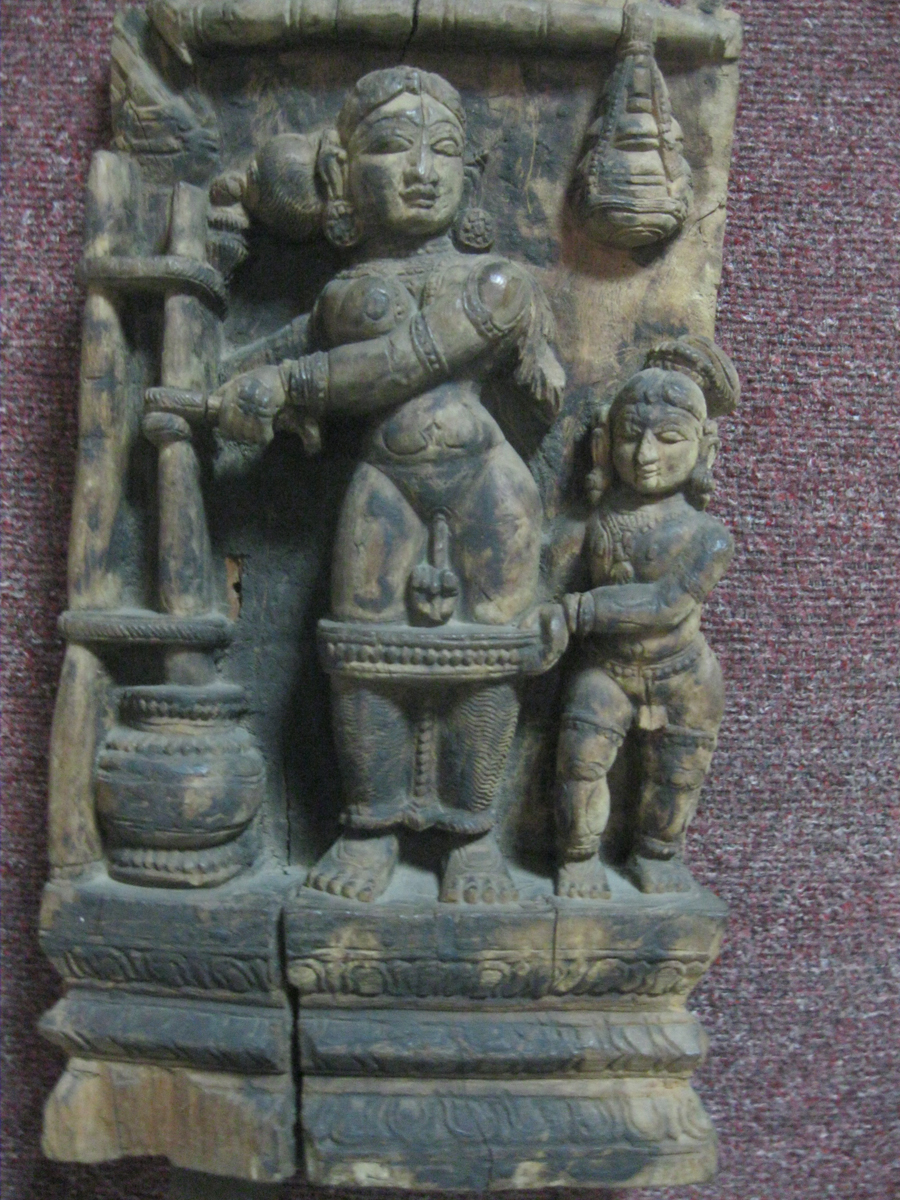
Fingering the Clit and Our Brittle Religious Sentiments

(Lady Churning the Milk- wooden sculpture 19th century AD. South India- Currently at Chandigarh State Museum)


Those who get their religious, moral, political sentiments hurt so fast please read this article. We are a country full of people and almost 1.2 billion of us feel threatened by one single idea called religion. We believe in our gods so much that we don’t let our gods to be a bit playful. We have made headmasters out of our playful gods. Anybody who touches upon religion in a critical way is bound to face the ire of a majority that considers religion as a set of ideas beyond any kind of criticism.

Religion thrives in illusion and spirituality thrives in reality. But unfortunately most of us take it other way round. We believe that religion is ‘the’ reality and spirituality is an illusion. Hence, anybody who touches this assumed reality negatively becomes a culprit prone to larger censorship by the religious establishments that often get the sanction of the so called democratic governments. In Greek mythology we see gods and goddesses intervening in the lives of ordinary human beings and making their lives hell and heaven alike. Indian gods and goddesses (read Hindu gods and goddesses) used to do the same. But over a period of time we have worked well to make them headmasters, who sit in their cabins with a cane always ready on their sides to spank our unruly bottoms.

(Raja Ravi Varma)

In fact it did not take lot many years to turn the ‘leela’ of our gods and goddesses into grave political aloofness. Gods and goddess became so estranged from the human lives that they became the victims of the immature thought process of the human beings. That’s why irrespective of religions, people go to drink dirty water and hail it as a spiritual act. Gods never send chemical water for mass decimation of those people who believe in him or her. If someone says that milk drinking Ganeshas or crying Jesus Christs are scientific realities masquerading as religious frenzy, we take him to court. If someone eats beef, we deny them their food by saying that they are eating our mothers’ body.

Blame it on Raja Ravi Varma. He was the one who gave nav vaari sari to Indian gods and goddesses. We never knew that Indian goddesses dressed up like Maharashtrian women. Had Ravi Varma gone to North East and had set up a studio there I am sure our gods and goddess must be wearing wrap arounds today as their dress. Our sartorial imagination vis-a-vis religion would have been completely different from this. Raja Ravi Varma had his reasons to be in Maharashatra. And Maharashtra had its reasons to be in a revivalist Hindu mode. Theatrical and visual imaginations inspired by the occidental imaginary imports were making our nationalists go a bit overboard. Raja Ravi Varma fell a victim of these sentiments of that time. He did not imagine the goddesses as women wearing mundu and neriyathu as the aristocrat women in the royal households in Kerala wore during the time. We would have got a different set of goddesses had he done that. But Ravi Varma was looking for more a pan national representation of gods and goddesses. It is an irony of the history (not only art history but also history in general) that this pan nationalism took clear Maharashtrian feel as Maharashtra was playing the centre of a resurgent Hinduist nationalism after almost nine centuries of submission to other religions and invasions.

(Lakshmi by Raja Ravi Varma)

Our country was full of playful gods and goddesses. We were not primarily Freudians or Lacanians. So for us playing with sexual imagery was very normal. Our artists let their imaginations take wide leaps into the unknown territories of desire. Many depicted incidents and activities of gods and goddesses as if they were just human beings; they were sexual escapades, extra marital affairs, graphic detailing of sexual intercourses and banal activities of frivolous youth. Gods and goddesses did these things. Perhaps the artists who were depicting these images and figures did not alienate the gods and goddesses during all those years. They were equally playful like the gods and goddesses. According to artist and activist Subodh Kerkar, it took just two hundred years to undo our religious and imaginative liberalism of more than five thousand years and push ourselves into the false morality of Victorian sophistication as forced into our thoughts by the colonial and the religious establishments. Hindu activism perhaps imbibed this Victorian morality a bit too faster than the other segments of the society.

(Detail of Lady Churning the Milk)

Look at the image that I have been using to illustrate this article. This is a one foot tall wooden sculpture dated 19th century and is from South India. This piece of art is currently displayed in the Chandigarh Museum. This work titled ‘Lady Churning Milk’ is a very interesting for two reasons; one, it is created in 19th century. Two, it depicts the legendary Krishna-Gopika relationship. What makes this sculpture all the more interesting is the intense erotic suggestion. Here the unknown artist plays on the word ‘churning’ and he uses it as a pun to connote both the act of churning milk to make butter and the sexual act of titillating the clitoris by fingering the vagina. While the former act is done by a Gopika the latter is done by a much young Krishna for her.

Aesthetically speaking, this subversive work (as in today’s perception) must be from that tradition which made fun of gods and their activities from a human level. You could see several Kalighat paintings depicting the lives of gods and goddesses as if they were just ordinary mortals. From a different perspective we could say that the artist must have been doing a very subversive act against the Brahminical hegemony by the depiction of one of the gods doing such very human act! However, the important thing is that such subversions were allowed or were normal even during the 19th century. The society was more tolerant towards such aesthetical celebrations or aberrations, depending on the perspective of the society towards art during those days.

(detail)


But in no time, by late 19th and early 20th century our idea of morality changed into something absolutely different. The Hindu nationalists imbibed the Victorian moral codes much faster than other religious groups. The historical irony was that in the name of acting against colonialism, it fell for the colonial morality through the exclusion of celebratory aesthetics from the public domain. Here we see a child god enjoying a sexual act with a willing woman. Sociologically speaking such gallivanting must have been quite normal in those days as we know that it is not too unusual even in these days either. What makes the image enthralling is the introduction of a god figure into a very localized situation. Nobody’s sentiments were getting hurt by that.

Art depicts a society’s ways of thinking; it is a like a forensic evidence. However minute it may be in appearance, the traces that it carries contain a larger picture of the society. This act of fingering a woman while she is at churning milk, also connotes a permissible act of finger the vagina of a cow when it refuses to give milk. The vaginal titillation, it is believed, helps the cows to give more milk. It is said that in the rural areas, even today milkmen and women use the same technique to ease their professional activity. The artist brings the same sociological reality into the zone of art and incorporates that act into a different scene of churning linking up social and sexual imaginations within the same body of a work of art. Interestingly, the society was still tolerant and was not a victim of the Victorian Hinduism that we follow today.

(Detail)

Let us undo the Victorian Hinduism and its socio-cultural morale. But it seems to be difficult as the government plans more and more restrictions on freedom of expression. It is when art becomes more subversive than celebratory or a subversive celebration. As of now, artist seems to be less aware of the situation as they go on with their routine based works of art.


Tuesday, April 24, 2012

The Fugitives – Chapter 3


Katrina Kaif gyrates inside the plasma screen. She turns her body towards the viewer and raises her leg in rhythmic intervals. A small bottle that is passed off as a quarter of a local drink dangles from her narrow waist line. She pouts and raises her eye brows alternatively. She is here to titillate and provoke. The boys around her seem to be really provoked. Her movements are quite familiar because these are the same movements choreographed for different item girls in the Bollywood.

“Rakhee Sawant could have done a better job,” says Alok and he turns around to see Ishaan sleeping on the sofa. His head tilts towards the left and it presses against his left hand folded into an unintended triangle. His right hand rests on his chest that moves slowly up and down. He looks absolutely careless about the situation.

“What am I doing here?” Alok asks himself. He just does not understand the pace in which things have been happening in his life. “I should say in our live,” he mutters himself while looking at Ishaan. He wants to go, hug him and sleep by his side. If possible he wants to get an entry into his dreams if at all his is having some right now. In the next moment Alok feels like kicking Ishaan’s butt for bringing him into this situation. He controls his urges to sleep or kick and turns back to the television. Katrina has gone and her place has been taken by another zero size girl who after doing an item number and some cameo appearances in a couple of movies got married to Sunjay Dutt. What is her name?

Alok pulls his hair and curses himself. “I should not forget names. I should not forget events. If I want to become a film writer I should have a information in my finger tips.”

The film is Gangajal. Director is Prakash Jhah. I like Prakash Jha’s movies for the rawness that he brings around in his film. Hero is Ajay Devgun. I love him. His droopy eyes..oh my God. He has several teeth like Shashi Kapoor. Both of them smile well. Shashi Kapoor was very thin when he came to movies. But then he bloated like a drum towards the end of his career. Ajay Devgun has a great body. Unlike many other super stars or what you call the Khans, he does not go gaga over his physical assets. This must be because his father was a fight master. Ajay knows his trade. One day I would like to work with him. Mukesh Tiwari acts as Baccha Yadav. What a fantastic performance. Prakash Jha gives chance to most of the National School of Drama graduated. The song happens when the villain, ‘Raju Bhayya’ rapes a girl who has been abducted from her mother’s place.

And the thin girl who dances is Manyata. Alok claps, gives a thumbs up to himself and feels a lot happier than before. He wants to look at Ishaan again. But he holds himself back for some other reason.

This is a good situation, Alok tells himself. I could write an one liner right now. Any producer would be interested to have such a wonderful story for his film. Why don’t I suggest that the hero should be none other than Ajay Devgun?

Alok smiles vacantly. He looks at the television again. This time he does not see anything special there. Recent hit songs are played out one after another. Commercial break is announced by two animated characters. At times they supply some philosophical doses to the viewers if they wait at the same channels for the commercials to finish and the songs to resume. Perhaps there are many like me, hopelessly waiting for something to happen in one’s own life. People like me could look at any channel for any long hours. The programs do not make much difference in our lives. We need some sights and sounds to fill in our vacant moments. We hate vacant moments.

‘I hate vacant moments like hell’, Alok tells himself. The day he realized that he hated vacant moments he had made a decision to fill them by conjuring up characters and situations. In school friends called him ‘pagal’, a mad boy because Alok’s lips kept moving when he was idle. He could sit still for long hours but his lips moved fast. None could hear anything. But it was through those silent lip movements the world inside Alok’s mind found expression in some way.

The story of the movie that I want to write could be something like this, Alok thinks. A young man from Bhopal wants to become a film story writer. Like many others with dreams to make it big in films, he too goes to Mumbai to try his luck. There he meets a still photographer, Ishaan who interestingly has a degree in engineering but pursues photography as his profession. Ishaan has access to production houses and studios as he has earned a bit of fame as a still photographer and a quick problem solver.

One day, Ishaan takes this young man from Bhopal to meet a very famous producer, Mr.Taporwala, where they meet another young corporate executive in a dapper suit. He looks several times better than the normal heroes in Bollywood. Mr.Taporwala introduces Ishaan to the corporate executive and in turn Ishaan introduces the young man from Bhopal to the producer and the corporate executive. The young man tells a story to the producer and the producer says that it is interesting but a few more changes have to be done to make it a good film story. The young man agrees to write the story with the changes in place. He takes an appointment to come back and see the producer. The producer is somehow impressed by the young man’s spirit and compassionately tells him to do a good job and if things work out well, the story is going to be a script and then to a movie. The young man from Bhopal is very happy and he wants to tell the producer that the hero of the movie could be Ajay Devgun. But he keeps that suggestion for some other time.

Parallel to this talk between the film producer and the young man from Bhopal, another conversation has been progressing between Ishaan and the corporate executive. The man in his dapper suit tells Ishaan that he wants Ishaan to take some photographs for him. Ishaan tells him that he likes to take the photographs of the celebrities and people with exceptional talents even if they are not celebrities. He tells the corporate executive that he has contributed photo features to some mid day newspapers where he has taken the pictures of those people who live a different kind of life in the city of Mumbai.

Ishaan tells him the story of a woman who had lost her husband at the age of twenty. She was from Bihar and was absolutely illiterate. Her husband worked in a mill at Lower Parel. They were living in Borivili and he commuted everyday in the thickly packed local train. On that fateful day he took a half day leave and came out of the factory. He wanted to give a surprise to his young daughter who was turning eight years on that day. The elder daughter was eleven and was good at studies. The younger one too was showing a lot of promise. The girls had been telling him to take them for the movie titled Chandini. In their school all the girls wore white churidar which had become a fashion statement after the release of that movie. This man wanted to buy two pairs of that white churidar from a Borivili shop. He had already arranged money for it. He wanted to take them to the movie in their new dress.

There was a huge rush even if it was a sultry afternoon in Mumbai. Then the city had not become Mumbai; it was still Bombay. He wanted to get out of the train at the Borivili station. The crowd was not moving. Somehow he pushed his way through the crowd. The train had already started moving. Without thinking twice he jumped out. The fall was fatal. The acceleration was so high by that time he was literally thrown from the train. His head hit at one of the iron pillars in the platform and he collapsed. What reached the home at that evening was his dead body.

My feature was not about that incident, tells Ishaan. Perhaps I was not even born then, he continues. My feature was about the woman who survived that incident. Or should I call it an accident in her life? She did not die. The dead one did not know what he had done to his family through that fatal jump. It was unintentional. His jump was triggered by the love for his daughters. Whom to be blamed in such situations? I don’t know. Anyway, my photo feature was not following that thread. I got this story from someone and I thought I should give it a try and I should follow it up and see where this woman has reached now. I got a thread from a journalist friend. He told me that this woman’s life turned around completely after that incident. She was running an orphanage.

An orphanage? The executive exclaims. Yes, Ishaan tells him. She runs an orphanage and she has already been quite famous in her own way. She her husband died she was absolutely illiterate. After that fateful event, she not only educated her daughters but also she educated herself and passed her school final examinations as a private student. All these while she was working as a ‘bai’, a house maid, who washed, cleaned and cooked for the office going Mumbaikars. The story does not end there. She got a graduation in Hindi and did a diploma in a Social Welfare studies. By that time her daughters had become district collectors after passing the Indian Administrative Service examinations. The this lady started running an orphanage. Quite unbelievable a story, right? I was humbled and enamoured by the story. So I decided to do a photo feature, Ishaan looks quite excited.

You are the right person for me, says the executive. “I have been looking for someone who could do some exceptional pictures of artists and their works. How about that? Would you be interested to do some documentation of art works that I have been collecting?” he asks. Ishaan looks at the young man from Bhopal who wants to go back to the room as early as possible and start writing the story. Though he is impatient, he takes some interest in the conversation between them. “I understand that you are a writer. You too can join Ishaan. Why only movie scripts? Why don’t you write something on art and artists? They too are as exciting as film characters? If I put it in this way, the artists are funnier than the film stars, in their vanity and pompousness. Why don’t you give it a try? Let’s make a team. I started liking you guys,” the executive looks into our eyes.

Ishaan looks at the young man from Bhopal and he returns the glance. Then together they look at the young corporate executive. “Okay, let’s go for it,” Ishaan tells the man. “But you have not yet told us where to do the documentation and what to right,” the young man from Bhopal says. “I will tell you all those details soon. Before that, let’s meet for a drink tonight at the Blue Frog. Is that okay with you guys?” asks the executive. They nod. Mr.Taporwala looks our side from his huge oak desk. He exchanges smile with the executive. The young men agree with the executive for the drink date.

“Shiv, you are now completely into it, man. I never thought you would become too passionate about this collecting business,” Mr.Taporwala takes off his reading glass and tells. Below his eyes they could see two bags like pelicans beak. “Tapi...you are drinking off late too much,” says Shiv. For that Mr.Taporwala gives a hollow laugh in return and goes back to his work.

“Alok...man.. what are you upto? Some new ideas?” Ishaan asks. Alok jumps up startled. “You frightened the shit out me, man,” he says, launching a mock punch at Ishaan’s stomach.

“Your lips were moving like crazy and I knew something was on in your mind,” Ishaan laughs.

“Yeah man...I was just thinking about the whole situation. It would make a good movie.”

“But still we don’t know what we are upto. We have been with Shiv for almost five months now. Apart from following this writer and doing some photographing of art works, attending more and more boring exhibition openings, what have we done so far? I just don’t understand this man. Something has been wrong all the time. The man we are stalking and photographing does not look that simple as he looks. Didn’t you look at his face when he was cradled inside the bean bag? There is something more to him. Shiv wants to protect him because he knows too much or Shiv wants to keep him as a shield in some deal. What do you think?” Ishaan asks.

Alok is silent. His lips move, slowly and then it catches up a different momentum. “That man looks stupid to me, Ishaan. All these while we have been stalking him. And look at those pictures in your camera. By the way, have you downloaded last week’s pictures into your computer? Please do. Those pictures could give us some clue. I want to see them again. Because I remember seeing that woman who was sleeping with him that day. I had seen her somewhere else,” Alok whispers.

“But do you have any clue about these people whom Shiv mentions as this man’s possible assassins,” Ishaan asks.

“No idea, Ishaan,” Alok looks at Ishaan. His eyes runs through the flowing locks of Ishaan’s hair, long nose, fair complexion, red lips and a longer stubble. “Do you know Ishaan, you look like Jesus Christ,” Alok laughs and Ishaan joins in the mirth.

Then Ishaan’s phone rings. He picks it up.

“What the hell are you guys doing there? Rush to my apartment...NOW.” Shiv screams from the other end.

(To be Continued)

Monday, April 23, 2012

A Transparent Pact- A Performance for Our Future

(Mathai KT performing A Transparent Pact)


In the times of spectacles, during the days when human beings communicate between each other through understanding the symbolic values created out of the relationship between the circulated images, a project like ‘A Transparent Pact’ by a Kochi based artist, Mathai KT becomes all the more important. As the title shows the project is a transparent pact between human beings and nature. Mathai, in his concept note says, ‘Go local to go global. Protect our village, protect our earth. Submit to the earth like a plant does.’

 (Mathai KT receiving plant from an elder)

‘A Transparent Pact’ held on 21st April 2012 at the Arakunnam Village in Kerala was a performance art project initiated by Mathai and done in collaboration with the people of the village. Inspiration for this project comes from one of the Church rituals called, ‘Adima Veykkal’, which literally means ‘to become a slave of God’. Mathai takes a relook at the ritual and he himself transforms into a slave of nature/God by picking up a plant from the premises of the Church and taking it along the village streets and finally planting it in a barren land created by the constant land digging by the building material contractors.

(The Procession starts)

Mathai is not a performance ‘performance’ artist. As a painter he has been creating works that depict the fading glory of his village thanks to the constant exploitation of land, water and other resources by the land and building mafia. There has been a two pronged approach by this mafia. On the one hand they dig out the laterite soil for building purpose by mauling the village with the sleepless earth moving machines called JCBs. They pilfer earth out of the village and later this land is reserved for future urban developments. This is not an isolated phenomenon in Kerala. Houses, churches, temples, agricultural lands and water bodies are now seen precariously perched on land blokes, which are left untouched by the JCB machines.

(Through the village paths)

In one of his paintings, Mathai shows a man carrying a bucket of water with a few water lilies strewn around as a last ditch effort to save a pond from ultimate and untimely decimation. In another work, he shows a suburb creeping into the precincts of a village by slowly building large Bisleri bottle like structures all around. The performance, ‘A Transparent Pact’ is a result of Mathai’s insuperable concern for nature and earth.

(Along the streets)

At ten in the morning on 21st April 2012, Mathai receives a mango plantain from an elder and starts his procession from the St.George Jacobite Church premises. A drummer leads the way. Friends and family members walk with the artist. Mathai wears a robe specially designed for the purpose. The half open cassock has chess board patterns on it, symbolically suggesting the ways how human beings are made pawn by the vested interests who exploit the natural resources. Like a village farmer, Mathai wears a blue dhoti and covers his head with ‘thorthu’, a locally woven light cotton towel generally used in Kerala. He bears the weight on the plant on his right shoulder. People are excited and enthused by this unexpected procession. Some of them follow Mathai.

(Planting on the top of a small hill)

The procession ends on a hill top where Mathai plants the mango plantain. The whole procession reminds Jesus Christ’s painful travel to the Calvary hills where he was supposed to be crucified. In a metaphorical way Mathai tells his viewers that the plant/nature is his cross now, which he would bear happily for the common good. When he walks up to the hill, he symbolically enacts the death in cross; death of a fighter who stood for the social causes. But through the plant, Mathai suggests the possibilities of resurrection. Mathai asserts that if everyone is ready to bear his or her cross to redeem the world/earth, there could be resurrection; resurrection of earth.

(Watering)

After the planting ceremony- in an Elliot-ian sense it is death and birth at once, a few artists who have come down to Arakunnam to show solidarity and support to Mathai’s performance, along with a few village based artists who do not look for fame or fortune elsewhere, travel to a vast earthen wall created by the JCB machines by their constant gnawing. The artists namely Mathai, Devadas, Roy Thampuran, Sivadas, Gopinath, Sasi, Unni, Abhilash Unny, Hochimin PH, Salim AK, Vibin George and so on work at the wall using lime and house painting brushes to produce some vital images of basic human thinking.

 (Hochimin PH working on the wall)

Their effort is not to create stunning frescos on the wounded earth. They want to tell the world that slowly we are turning ourselves into primitive people, though innocent but condemned to draw the pictures of their basic necessities. The paintings created by the artists on this huge wall look like intentional fossils; a sort of reminders of our imminent destruction. They create a tree of life keeping laterite stones on the vast barren land from where the rich earth has been pilfered off.


 (artists at work and the outcome)

‘A Transparent Pact’ is a pact with the earth and nature. Mathai assures, through his humble effort that he is going to be there to voice against the earth mafia. He wants to tell his own people that if they are not cautious they are going to be doomed forever. “We should protect our local cultures, agriculture, economy and ways of living in order to go global. Being global does not mean mindless intake of anything foreign and celebration of the same. Being local is being global. Our future lies in environmental protection,” says Mathai.  


Sunday, April 22, 2012

The Fugitives- Chapter 2


I enjoy Simrin sitting on me like this. From the raised pillows I could see her toned body that glows by the faint light seeping inside the room through the half opened door that leads to her dressing room.

She sits on me like a sculpture by Reddy; wide eyed, long haired, big bosomed and thick lipped. She is still now. Her heavy eyelids droop as if they were not able to stand the weight of the pleasure that we were enjoying that moment of union. Unlike the other Punjabi girls, Simrin is not so fair and tall. She is five feet five inches in tall and interestingly she looks more like a mulatto. I remember asking her one day whether her parents had some racial mix up at some point in their family’s history. Curly hairs, thick lips and not so fair complexion are not quite normal to a typical Punjabi girl from Chandigarh.

“Mixed race? You must be joking,” she had looked at me with an expression of horror and disbelief when I mentioned for the first time almost a year back. We were having our official ‘dates’. This expression, I thought, could only have emoted by girls of Simrin’s age, education and job profile. They could show the expression of horror and disbelief at anything that they understand well but feel the need to show ignorance.

“No, no, my mother comes from the famous Bawa family of Chandigarh and my father is a distant cousin of my mom. So there is no question of racial mix up,” she asserted while licking away the cream moustache on her upper lip with the tip of her tongue and adjusting her large sun glasses over her forehead. The negation was so vehement but I felt that quite appealing and I should say, ‘sexy’.

“Oh..please don’t get worked up on that issue. Perhaps, it was this curly hair, thick lips and not-so-fair complexion got me going,” I said with a fair amount of vagueness in my voice.

“Come on Mr.Shivnandan Dixit,” she laughed and the people around us turned and stared at us. Her laughter was like a torrent of pebbles fallen unexpectedly on the glass houses that the other couples had created around them inside the cool clime of the cafe.

“Call me Shiv,” I told her.

Simrin did not seem to register my suggestion. “Look Shivnandan, don’t be so silly. It is not my first date. I have already met at least five of them who came to me after doing enough facebook research and late night chats. I know they all have noticed my curly hairs and thick lips. But it is you, first time, who made it so obvious. Let me tell you never make me so conscious of it by mentioning it again and again,” Simrin was dead serious when she said this. As she lowered the glass over her eyes I realized that she did not want to confront my gaze.

We met in facebook and that is how people meet these days. I don’t find people falling in love so desperately in real time and space as they do in the virtual space. As I notice even in my office people have flings, short term affairs and sort of childish friendships amongst the opposite sexes, I wonder why they don’t fall in love. They don’t fall in love because these days people like virtual reality more than real reality. There was a time when people craved for real love, proximity with the person you are in love with. There was a time when people wanted to be together always. Today if you see anybody sitting together in parks or restaurants for endless hours, make sure that they are not working in the same place.

Simrin laughs whenever she listens to my observations about people in love especially the people in love in our urban spaces. She asks me whether we too could become one of them, desperate and looking for spaces to be together.

What I liked in Simrin, of course besides her curly hairs, thick lips and not so fair complexion, was her independence. She had finished her MBA from a reputable academy in Mumbai and had moved to Delhi a few years back. I thought it was natural for any Punjabis to move towards Delhi than to any other city in India. Often Chandigarh girls make it big in Delhi irrespective of their chosen professions. Delhi has a special place for Chandigarh girls. She could be a hair stylist or a gallerist. Delhi would definitely help her to flourish.

Simrin worked in Taj as one of the top executives. When I met her she had already bought a decent apartment in Greater Kailash. Like many other girls she did not have any plan to start a family very soon. Nor did I have any inclination to fall in family line. So we were mutually definitely made for the each other couple. Even if I had my well furnished apartment, she never thought of moving in permanently with me.

“This works for me,” Simrin told me once after a fierce round of love making at my place. I was so pleased, relaxed and floating over happy waves of emotions that I told her to move in with me. She refused that flatly. Silently she walked into the washroom. I waited for her to come out. Even I thought while doing the ablutions she would give my suggestion a second thought. I tried not to listen to the sounds coming from the bathroom. However I tried I could not wish them off completely. I could hear the flush flooding our combined secretions through the fathomless pit of the commode. I could hear her washing her face. I could hear the rustling of the towel. After a few moments she came out.

I did not move from the bed. I had left the habit of smoking after pursuing it for almost ten years throughout my education and after recently. There was an unquenchable desire for smoking a cigarette at that moment. I knew that my home was a sanitized space as far as tobacco was concerned. But still I made a mental search in all the possible places where I could have left a packet of cigarettes. I thought of myself as a hero in one of the Hollywood movies that I often watched in my laptop.

Simrin came out of the bathroom like Botticelli’s Venus. Her hair was not flowing the way Venus’ swayed. She stood in front of the tall mirror fitted on to my wardrobe shelf, giving a full view of her nudity. I looked at her as if I were seeing her for the first time. For some strange reason, her full bosom and shaped buttocks reminded me of Picasso’s cubist portraits of his girlfriends. I could see Simrin from all the angles.

My gaze was not affecting her at all. She looked around for a moment and picked up her clothes that were strewn all over. With practiced moves she wore her panty. The she pushed her legs through a pair of jeans. She picked up her bra and meticulously pushed her breasts inside its cups and with a feminine ease she hooked them by stretching and folding her hands behind her back. In a flash, she put the top over her head and now she was a fully clad woman.

Her face was grave and did not betray any dialogue that had been going on between her heart and mind. She opened her vanity bag, picked up a few things and did some make up work on her face. While doing it she had completely forgotten my presence in the room. Perhaps, wherever it be, when women do their make-up they feel at home. Finally Simrin got up and turned towards me.

There was a smile on her lips. I felt positive. I thought I was going to get an affirmative answer. I thought she was going to move in. Slowly she walked towards me and from her movement I could make out that she was going to play some pranks with me. I sat there without batting my eyelids even for the fraction of a second.

“No dear,” she whispered into my ear. “It would affect both of us. See, you have a dream to follow and I have mine. It is not that we would never stay together. May be at some point, when both of us feel that we had enough of our dream chasing, we could come under one roof. And I am sure, it would be really fantastic,” Simrin smiled at me.

Suddenly I felt Simrin was quite like my mother; calm and composed. Above all she sounded very caring. She talked to me as if she was negotiating with a very rich guest who suddenly turned dissatisfied with the luxuries of her hotel. She was patient, cheerful and stern to the right measure.

“Okay, if you believe that one day we would live together here, then I am okay with that,” finally I said. It was a sort of surrendering. I felt I was school boy whose demand for something expensive was politely turned down by a very caring mother.

“Who are after your friend’s life?” Simrin asks me while she moves rhythmically. I wish she does not talk. All the more I wish she does not even mention what has been going on for quite some time in my life. I don’t want to listen anything from her in these moments our blissful union. Yes, I know I am going to be here for a week. She also feels good about it. After one year, though she has not made up her mind of move in with me permanently, occasional spells of being together for a week   are quite welcome now.

I push my hands forward to grab by her back. It feels so good. I run my fingers through her spine and try to get up. She giggles and forces me down. “No, let me do it completely,” she heaves. She throws her head back and increases her movement. I think these are the best moments in my life. I am going to prolong it for a week while my friend rots there back at my pad alone.

The sudden remembrance of the image of my friend captured like a mouse in a trap works against that moment and Simrin knows it immediately. Without showing irritation she removes herself from me and lies down next to me. “I know you are worried about him. I should not have jumped all over you the moment you came in. I should have controlled myself,” says Simrin. I kiss her to silence and I feel a lot of love for her at this moment. I feel some kind of fear gripping me from all sides. I don’t want to think a lot about it but like an itch in the back of the brain, the image of my friend sitting like a frightened mouse inside my pad comes back to me consistently.

“What has he done for this?” Simrin asks. She has now measured the gravity of the situation from my tensed muscles and disturbing silence.

“They are after his life,” I feel so pathetic that I am not able to reveal who they are even to my Simrin. I look at a series of water colours by Shibu Natesan on the wall. She bought it from a collector when he wanted to offload these watercolours to purchase a large oil on canvas by the same artist. This was Simrin’s first art purchase. I persuaded to collect the series as it came up for sales in the secondary market. I had exhausted my budget as I burnt my pocket last March when I bought a large Sudhir Patwardhan from a Mumbai gallery.

“Why should I buy art at all?” Simrin had laughed as if she went mad at my suggestion. I told her that it was not only a good series of water colours but also it was a good investment. Shibu Natesan was going great in market and his price was appreciating at every passing season. It took almost a week to convince Simrin to put in the money.

“You know Shiv, I love these works now. Every night and every morning I look at them. Those missing kids seem to speak to me a lot of things. I don’t know I would ever buy a work of art in my life. But I am not going to leave them whatever may happen to Shibu Natesan or his market value,” Simrin says.

I try to smile. I am not able to focus on what Simrin says. I think of those people who met me a last month in Mumbai when I was there for a business meeting.

Simrin’s mobile rings. She picks it up from the side table and jumps up with a shriek.

I grab the mobile from her and see the number flashing in the screen. It is not a number, a name: Shiv Home.

Who is that calling in Simrin’s mobile from my home? If at all it is he, how come he knows Simrin’s number? And why should he call Simrin at all when he knows my number?

A shiver passes through my spine and I scramble out of the bed. I don’t know how the moments passed after that.

I honk the horn, against my ethical behaviour on road, furiously. I mutter bad words at those drivers who don’t speed up to clear the road for me. All the while I ask myself a question.

Who entered my home? What happened to him?

(Will be continued....)