Wednesday, February 18, 2015

The Story of our Mothers - 2

(Book cover of Maxim Gorky's Mother)

How many of us consider our mothers as our ideal? Many of us say, yes we do. It would almost sound like a crime if someone says that he or she does not consider their mother as ‘the’ ideal. I have a friend in my village, who for some reason had changed his surname and replaced it with his mother’s name. He had literary ambitions and the adding his mother’s name to his own name perhaps gave some weight to his otherwise ordinary sounding name, or he thought so. Though his literary ambitions did not take off the way he imagined, the name got stuck. There are a few other well known people who use their mothers’ name as their surname. The familiar examples are Sanjay Leela Bansali, the film-maker and Vivek Vilasini, the artist. Selecting a surname or a pen name is generally prompted by some sort of an ideal that we hold closer to our heart and intellect too. During my formative years as a writer or rather during a time when I had cherished the ambition to become a writer, I had adopted a surname and it was ‘Johny Merick Laxman’. I think the Merick part of it came from a novel, Green Mansions by William Henry Hudson. But the name had proven unlucky for me because most of the manuscripts that I had sent to the magazines came back to me by the next post with due apologies from the editors. Then when I was in my late teens, I opted for a name ‘Alex John’, a clearly Christian sounding name because I thought that Christian names were more secular than a Hindu name. The name was lucky as I could publish some articles with that byline though I abandoned it soon for my real name, JohnyML. The only other pen name that I had adopted was ‘Janakiraman’ and a couple of articles were published under that name in late 1990s. Somehow I never felt that I should use my mother’s name as my surname for a change. Of late I see a lot of feminists use their mothers’ names as their surname at least in their facebook pages.

 (legendary author late Vaikom Mohammed Basheer)

I did not opt for my mother’s name as a possible surname because I never considered her as my ideal. I had different ideals at different times and it was never my mother. It may sound slightly ungrateful to her but the truth is that my mother was never my ideal. She has always been there as a force that endorses and corrects at the same time but never leads me to a certain point. She is not even a fellow traveller; maximum I could say that my mother is a spectator in the gallery. She is one amongst many and compared to those many in the crowd she may be understanding her son a little less than others despite the strong emotional connect. I think it is same with all the mothers. They are connected to their sons and daughters and the connection does not naturally get translated as understanding. That’s why, when certain pivotal decisions are taken by the sons and daughters in their lives, the mothers tend to disagree with it. They refuse to understand the logic of your decision. They call it their ‘experience speak’ but they look more hurt than yourself because the connection is always emotional. If a mother says that she understands her children very well, then it should be tinged with some lie. That understanding is more about receptiveness. Do good, bad or ugly, if you are doing it, it should be right, that’s how mothers react to most of their children. It is a sort of receptiveness originated out of love and concern than understanding. You may kill and come back to your mother, she will not reject you. Rejecting mothers could be seen in sentimental movies. They could even shoot their sons down and hack a daughter to death for a larger cause of the nation or patriarchy in general. Such mothers are fictitious than fictional. In fiction mothers are always convincing.

(A stage production still of Brecht's Mother Courage and her Children)

As my mother was not my ideal, I was looking for other women ideals in my life and I found them in fictions and fictionalized facts. When you read a fiction you do not know whether you are reading fictionalized facts or fiction masquerading as facts. Whatever be the case, as they say life is stranger than fiction, I got my women ideals from fictions. One of the strong mother images that comes to my mind is that of the mother of the great Malayalam writer, Vaikom Muhammed Bashir. Bashir left his home to know the world and in the process he came to know that the country was under colonial rule. He was fascinated by the Gandhian ideals and he took the plunge and became a freedom fighter. He was arrested by the British Police and was sent to the jail. One day he was released and he came home late at night. And to his surprise he saw his mother waiting for him with a freshly cooked dinner. He asked how was it so and how did she know that he was coming on that day. To that query his mother replied; ‘ever since you left home, every day and every night, I waited for you with food thinking that you would return that day.’ Bashir could not contain his tears and when I read it for the first time I too could not control my tears. Then I wanted my mother to be like that. But I had never left home. Had I left home, would my mother have waited for me every day and every night like that? It was impossible to imagine my mother doing that. But looking back I realize that every mother in every country does that for their missing children or the children who have gone out of home without mentioning the date of our return.

 (Rosasharn from Grapes of Wrath- stage production still)

I do not like sentimental mothers. For me, a sentimental mother is one who cries for no reason. A mother who cries even when she talks about an imagined calamity, a mother who cries when her son’s or daughter’s name is printed on a local pamphlet for winning some frivolous competition, a mother who cannot say a good thing without crying is a sentimental mother. And our films are full of such sentimental mothers. I hate the actresses who act as sentimental mothers only because their job is to sacrifice and cry. At the drop of a hat they would make some sacrifice and cry. They will bring out small little issues from some past and shed copious tears. My mother, like many other mothers, is exactly like that. So I have named my mother after one of the Malayalm actresses who is famous for her mother roles with full of sentiments. I could not make my mother an ideal in my life primarily because she is very sentimental. One could be sentimental to certain extent but crying for anything and everything cannot be tolerated. However, the irony is that when a crisis comes to their lives, they steel themselves and act. The horrible thing is that after doing that they spend their nights dipped in tears. They make their children’s life hell by indulging in such acts. But you cannot kill your mother. So you tolerate her. You may be surprised why I am talking like that about my mother. I talk about my mother like this because she has taught me how to be sentimental and strong at the same time. While I like the strong part, I hate the sentimental side in me. But that is what many people like to see in a man. An apparently strong looking man appears to be more appealing to others, especially to the opposite sex, when he breaks down. Sometimes I think mothers prepare their children to be worldly wise in a cunning way; by tears.

 (Actress and Director Suhasini Maniratnam)

My search for an ideal mother or woman continued and I was still looking into literature for the role models. It was then I read the Russian writer Maxim Gorky’s novels, ‘Mother’ and ‘My Universities’. In Mother, you see the protagonist’s mother fighting with the jail authorities to see her revolutionary son and also she becomes a revolutionary by smuggling out pamphlets and distributing them amongst the workers and peasants. I was in high school and mentally I was not prepared to take so much political gravity as discussed in the Russian novels. Still I liked the mother in the novel ‘Mother’. My father was a socialist and definitely not a communist. But he was interested in communist ideals and our home library had the collected works of Karl Marx and Frederich Angels, and also most of the famous Russian political thinkers and writers like Plekhanov, Bucchanin, Chekhov and so on. I had tried reading them at that point but it was only Gorky and Tolstoy and later the poet Mayakovsky caught my attention. Mother was a great influence at that time. It was almost during the same time I read John Steinbeck’s ‘Grapes of Wrath.’ In this American exodus novel there is a young mother figure, Rosashan. She in fact breast feeds a dying old man because she could not find any other food nearby. Such kind of sacrifice intrigued me as a young boy and I was questioning the very idea of motherhood. On the one hand we had our mundane mothers toiling in the kitchen and in workplaces and on the other we had these great mothers participating in revolution and exodus. My small mind could not understand that our mothers too had made enough revolution in their lives to survive and to bring us up. This literary interest on mothers intensified in college and Bretolt Brecht’s play, ‘Mother Courage’ came closer to my sensibilities. The irony was after looking for all these ideal mothers, it was in the image of actress Suhasini that I finally found the ideal mother figure. In retrospection, I understand that it was my heart taking over all those intellectual efforts that I had employed to find an ideal mother. To tell you the truth the image of Suhasini also was a passing one and soon it gave way to more abstract feelings about women in general and mothers in particular.

 (A still from Hindi movie , Mother India)

A mother is a mother is a mother, is how I could explain a mother, if I borrow from Gertrude Stein. My mother, like mother of anybody else in the world, was there as a player, stage and a backdrop during my formative years. In the beginning, mother was a feeling, a smell, a touch and a voice. The body odour of my mother is still fresh in my nose as that could not be replaced with any other fragrance in the world. My mother’s sweat had the smell of spices, fire and suppressed dreams. My mother was a government servant so I believe that she had the smell of the old files that contained the sufferings of so many people. Like a fisherwoman who smells of fish and sea, my mother emanated the fragrance of the Revenue Department, which I discerned as the smell of Arabic gum, carbon paper and ink. The general noise that accompanied the image of my mother was her shrill voice that chided me into senses, the noise of the old fans in her office and the tapping sound of the typewriters where beautiful young women like my mother typed away the orders that sealed and opened the fates of many people. My mother was my destiny at that time; without her it was very difficult to function. But she was never the way. The way to reach her was goodness, propriety and dignity. If I was away from these qualities, she looked unapproachable. When I was good and well behaved, she was as close as my shadow and breath.  Yet, she did not become my ideal. I was running behind the mirages. I wanted my mother to be my ideal but that place was stolen by my father. I became the reflection of my father. Father was my destination and my mother was an unchartered path that looked apparently designed and chartered. I had to find my destination through the secret paths of my mother. Hence my mother, like the mothers all over the world remained an enigma to me. Today I am trying to unravel that mystery. Then my mother ceases to be my mother; she becomes the mother of all and a woman in the process. 

Sunday, February 15, 2015

The Story of our Mothers- 1

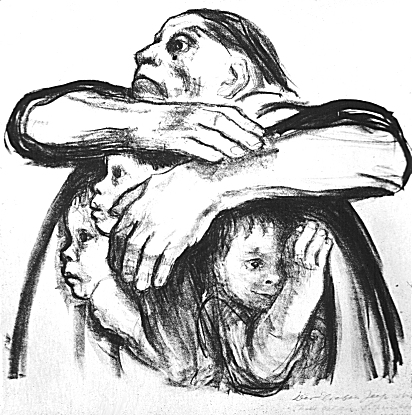
(Drawing by Kathe Kollwitz- all the illustrations used in this chapter are by Kathe Kollwitz)

This writing should be about all mothers, I feel. But it is not that is easy to write about mothers. They look so simple but they are complicated beings. They are caring at the same time they could be equally vengeful. I do not know too many things about the mothers of these days. They are very efficient human beings, who could juggle too many roles simultaneously. I have seen contemporary mothers who entrust their children to others’ hands and run a huge machinery elsewhere efficiently and run back to their family whenever they get time. I have seen contemporary mothers leaving everything behind to become homemakers and child carers as they find it more fulfilling than chasing a career dream. I have also seen contemporary mothers who make a harmonious balance between work and home. I do not want to say anything about those contemporary mothers who think that they are the ultimate human specimens of sacrifice and anything that stands on their way to daily sacrifice they resort to constant complaining and cribbing. I do not want to write about the contemporary mothers because they think they are unique. Mothers all over the world, in their devotion to kids and families, to work and leisure, look the same but they are different. They are different because they are different people with different aspirations and different outlooks. It is very difficult to bring them within a singular narrative of generalizations. Each case should be treated differently and should be treated with care. They are fragile as well as explosive people.


I would like to write about the mothers of my mother’s generation who look alike wherever you go. They almost look alike (one needs a pair of clear eyes to see the similarities amongst them) in their physical attributes as well as in their behaviour. Exceptions are there but those are contextual differences. Within in a given time and space context, these mothers behave in the same pattern and with the same intensity. They make an interesting case of study because they all belong to a generation that came along with the independence of India. They did not know the depth and breadth of the political struggles that had been going on all over the country, but they knew there was a person called Gandhiji and he was fighting against the mighty British Empire for gaining independence for all of them. They respected Khadi clad men and also feared their anger. They were in their petticoats then, looking at the men who went out into the streets with eyes filled with awe and wonder. They knew that their illiterate parents toiled more than their mortal bodies could take in order to bring up an ever growing family. They wore dirty clothes, helped their parents in household works or in farms, and hardly they studied at night. Like people who had lived in caves, they all sat around a lone hurricane lamp or lantern locally made out of discarded glass bottles. They inhaled the dark smoke emitted by the lamp and many of them liked the smell of it as the burning kerosene smell was like the fragrance of manna for many of those undernourished kids. They told stories to each other, giggled and pulled each other hair until sleep came in to their eyes through different forms of shadows that were playing on the walls.


They grew up in crowded families. Their parents did not know the advantages of family planning. The very concept of a planned family was not even existed in those days. Hence their fathers coaxed their reluctant mothers into physical relationships at night after the children were asleep and they became dutifully pregnant every year. Long days of celibacy might have made the men of those times quite potent as their occasional sex yielded fruits dispassionately every year. Therefore, children witnessed their mothers becoming full with another baby as they grew up and the yearly addition to the family was taken care of the other children who were already standing on their legs not in terms of earning but in terms of standing straight without holding anything. The mothers of my mother’s generation had become mothers in their childhood itself. It was not by getting married early or by getting pregnant by frivolous means. They became ‘mothers’ to those children whom their mother had brought them to the earth. Their mothers’ job was to toil in the kitchen and deliver babies every year. There were occasions when the eldest daughters of such mothers and the mothers themselves becoming pregnant at the same time. None considered it a shame. Pregnancy and childbirth were celebrated. Imagine that scene where both the mother and daughter delivering at the same time and other girls in the same family taking care of those two ‘new mothers’ and their babies.

Things were not easy for them though. Birth rate and death rate were high in those days. Children saw their siblings dying. Mothers saw their children dying either in delivery or in childhood itself. I do not know whether the death of children had affected those women so much that time as they used to deliver kids almost every year. Apparently the stories that I have heard from women inform me that they used to be very sad but they overcome that loss very quickly. They knew that it was a masterstroke of the God. If he god calls one has to go, young or old. In belief and the ensuing trust in fate they buried their woes of losing a child and the generation of my mother learnt to live with it. However, I had heard my grandmother saying with her eyes muddied by cataract layers welling up, “had he been alive, he would have got retired from the government service this year.” In my state, Kerala, the retirement age is 55. So if that uncle of mine who had not made it to teenage, was alive he would be at least 75 years old by now. My grandmother delivered twelve times. Six of them perished. And that explains the two years age gap between my mother and her other five siblings. My mother and three other sisters were lucky enough to have survived the childhood calamities. She survived therefore I am here to tell her story.


When I say, I am going to tell my mother’s story, I ask myself what story do I have about her. I have never talked to her about her life. I have heard about her childhood as she had narrated some incidents as a replacement effort for a lullaby after a painful tiff with my father or while walking through the alleys of the village where she was born and brought up, or even while meeting one of her childhood friend somewhere. Those moments had helped her to speak about her own life to us, but most of the part, I believe about our own mothers’ lives remain a closed chapter to us, however they have tried to tell us about themselves. Instead of them telling us their stories, we become observers of their lives; a sort of passive observers. We become witnesses of their ageing the way they witness our growth. This mutual witnessing is not conflict free. Ridden with conflicts of interest, in pure business terms of growing up, we go on, and we solve the issues at time through dialogues and at times through sheer fights. There is no ideal mother. Mothers are also human beings and they are also prone to all kinds of emotional and intellectual fluctuations. At times, without telling they understand everything about you and at times even with so much explanation, they refuse to understand you. Mothers are strange creatures.

Looking back each of us is influenced by his or her mother. There is nothing special about my mother or your mother, yet how different they are! The fortunate ones amongst my mother’s generation had well settled parents with established careers. They could give their children the best education possible. Those women became the first teachers, doctors and engineers of their times. But many of them did not have this luck to have educated and established parents. However, the aspiration level of the country was so high that even within the limited means, their parents wished their children to have good education. They might have been manual labourers or artisans or farmers. But they made all their children to graduate from good universities. The generation of my mother could transcend their position from being a labourer’s children to the members of a nascent middle class. We all hate our mothers as much as we love them. It may be absolutely wrong in the case of some people. But we all have those dark moments with our mothers. They sometimes grow as tall as heavens with their small gestures, but at times they could fall in our own eyes with some of their grand gestures. But we tend to forgive our mothers as much as they have forgiven us.


I decided to write this series on mothers of my mother’s generation when I my mother told me that she would be undergoing a surgery to remove the varicose vein from her legs. These veins have been giving her trouble for a long time and she has been postponing the surgery for one or the other reasons. She was a government servant and retired from the service as a Deputy Collector in the Revenue Department of Kerala. Many years after her retirement, she was diagnosed with all those illness that generally a woman of her age would have; blood pressure, a little bit of sugar issue, joint aches and so on. I have never imagined my mother ill. Generally most of us do not want to see our mothers ill because she has always been our source of strength. There is one place where we can run to when we are in trouble, that is our mothers’ shoulder. But it is a very disturbing thought that our mothers are ill. So I asked her whether it was too dangerous an operation. She said it was a minor thing. I knew then that it was an act of affected courage. She wanted to tell me that I should not worry. Hearing this, I began thinking about all the mothers of her generation. They all live, bring up families, keep the domestic and career front going, lose their husbands on the way, bring up their grand children and then finally die, mostly unsung. They live on as memories and photographs. I want to give them a bit more; more than mere memories and photographs. I want to capture their lives and times in my writing taking my mother’s life as a point of reference. I do not know how far I will be successful in it but I have to write because I feel that it is my duty to write this as there are not too many who are left with time or patience to sit down and write about the mothers of my mothers’ generation. 

Friday, February 13, 2015

Reading Valay Shende with Ram Kinkar Baij

(Transit, sculpture by Valay Shende)

Standing at the Art Plaza behind the main building of the Bhau Daji Lad Museum, Mumbai that houses the not so impressive collection of artefacts from 19th and 20th centuries (especially for someone who has seen extensive and expansive collections like Raja Dinkar Kelkar Museum in Pune), one cannot miss the life size Tata Truck and people standing in it, all made up of small identical polished metal discs. A closer look reveals that this mighty truck is fragile though it looks solid with closely welded discs together. Titled ‘Transit’, this is a sculptural work done by a Mumbai based young artist, Valay Shende, is a pivotal exhibit in his ongoing solo show with a somewhat lengthy title, ‘Migrating Histories of Molecular Identities’ in the museum. Presented jointly by the BDL Museum and the city’s Sakshi Gallery, this show is curated by Veeranganakumari Solanki.

 (Valay Shende)

I am impressed by ‘Transit’ not because it is capable of giving a competition to Subodh Gupta’s or Jitish Kallat’s works but because it is overtly humane and subtly sensitive, and has given a new expression to the people who are ferried like slaves from one construction site to another; or to be precise from one concrete farm to another one. Urbanization in a way de-ruralizes a country. It is said that by 2030 CE, more than half of Indian population will be living in urban spaces. Making of cities, as said before, while unmaking villages, extracts the work force from its core and empties them of their energy and ability to survive. The work force thus extracted goes to the cities to embellish it with more concrete, glass and steel edifices and once on completion is shunted out to the fringes. In the interim phases of making of a city, these populations that constitute the works forces are moved from one place to another, one shelter to another or from one temporary tenement to another, leaving them in a permanent root-less-ness which causes poverty, illness and above all illiteracy amongst such floating populations.

Valay Shende captures one of those moments of impermanency. People are transported from one work place to another like cattle. Herded together they even lose the humorous poignancy that once Charlie Chaplin had presented as the opening shot of his illustrious movie, Modern Times. They are hopeless creatures devoured by the monster called urbanization, bringing the ruthless figure of Goya’s painting where the monster of revolution eats its own children. These urban fodders are not united under flags or unions and the air and sky that they inhale and witness while they are on the trucks like this one created by Shende are the only solace that they get while moving from one place to another. Shende raises the tableaux nature of the work to a different level by adding its rear view mirrors fitted on to either side of the driver’s cabin with the visuals of a highway that runs between two locations in a city or locations in different cities in the world. These videos, that simulate movement, add some kind of agility to the otherwise static sculpture. The more one goes near to the truck, the distorted images of one’s self multiplies into thousands of small disc reflections like distorted selfies, which none would like to post in the social networking sites. The works as a whole seem to tell us how ugly we are, the children of urban spaces, the rulers of urban spaces, the aestheticians of the urban spaces or the law makers of the urban spaces; we are all ugly and distorted. But the occupants of the truck look stately, defying our presence with their firm postures.

(Untitled, sculpture by Valay Shende)

These days even the nearest Paanwala’s profile is available in Wikipedia, irrespective of his contributions to the general jaw training of the city or the large scale graffiti created on the city walls and floors by incessant spitting by the common populace. Only consolation about Wikipedia information is that it never claims to be truth and each point is liable to further editing. When an artist’s major exhibition is held, or an apparently well known person is dead, suddenly someone adds a Wikipedia page. For the former it is a free advertisement and knowledge dissemination, and for the latter it is information sharing for the interested parties. Valay Shende also has a Wikipedia page and the content seems to be created just before the present show ‘Migrating Histories of Molecular Identities.’ There in the page it is said that Shende’s works are often compared to the works of Subodh Gupta. I do not know whether it is a statement of praise or an unadulterated criticism. Whatever it may be, I would like to dispute the fact that Shende’s works are ‘like’ Gupta’s works. First of all, Gupta’s works are done with different home utensils compressed and customised to get the required shape and form. Valay Shende’s works are created out of identical polished metal discs; Gupta’s works are welded together following a random progression (methodical madness), while Shende’s is defined progression where the discs are meticulously welded together in defined lines and curves (clinical precision). You may argue that Gupta’s works too have clinical precision; but I would argue that Gupta’s works are like architectures using engineering and design, while Shende’s works are like sculptures using design and minimum engineering. Even though Gupta has worked on migration (the airport trolley sculptures, sliced Ambassador car top, bronze cast of baggage and so on), Shende’s idea of migration is fundamentally different from Gupta’s. Gupta’s migration is international (people’s movement from nation to nation) and Shende’s migration is intra-national (movement within the nation). Gupta’s works are explosions of materials and ideas, while Shende’s are controlled implosions of materials and ideas.

(A sculptural installation by Subodh Gupta)

I am not sure why I go into the comparison between Subodh Gupta and Valay Shende as if I have taken the contract to dispute a passable Wikipedia statement. I do exercise it mainly to state that this work of Valay Shende is closer to the works of Ram Kinkar Baij, ‘Santal Family’ and ‘the Mill Call’. Now, the staunch supporters of Ram Kinkar Baij should not jump into the arena for a lawless fight with me here. What I am trying to say is simple; this work of Shende exudes the feeling that the aforementioned works of Ram Kinkar Baij has been imparting since 1930s. Baij was a modernist, Shende is a contemporary post-liberalization artist. The materials used here are different (Baij used coarse cement and gravel mix and Shende uses metallic discs). But the idea of movement from one sense of economics to another, a transition from agrarian economy to the industrial economy as suggested in the works of Baij is seen in the work of Shende too. That sense is what makes Shende’s works move beyond its spectacular nature and the new media additions. As static sculptures, both Santal Family and Mill Call have brought in this idea of transition, the movement from one place to another as witnessed by the artist, Baij. In Santal Family, we do not know where the family is going; they may be going to a fair, or they may be going back to their home after the work in the fields. But the family unit with its bundles, kids and dog, a total movement (molecular identities) seen in the work make us wonder where exactly are they going? Are they uprooted? If so who has uprooted them? Perhaps, we get the answer in the ‘Mill Call’. In Mill Call we see two women running towards a factory (as suggest by the title) and while running they even try to dry their wet clothes. These women might have been farm workers, but now they are running to the mill. Their movement is no longer controlled by the movement of sun, clouds, winds or rain. They are now controlled by the siren of the mill.

 (Mill Call by Ram Kinkar Baij)

Shende shares the stand with Baij in capturing this aspect of transition. Remaining true to the modern sculpture tradition, Shende understands how Baij had envisioned the transition from the agrarian economy to the industrial economy. In contemporary time, which is called post information technology times, agrarian economies of the rural areas are replaced not only by the industrial one but by buildings from where a transformed model of profit making operates through the sheer power information technology. These poor folks who toil day in and day out to make these glass, steel and mortar structures into one piece in fact do not exactly know what is going to happen to those structures that they have helped in making. They know only this that once a work is done they would be transported to the next site. In Baij’s work, it could be easy to read that the people are not yet displaced; their work places are shifted. Those places are still accessible to them. May be when we come to Santal Family, the family is in a way uprooted. Still there is a hope in their faces as Baij envisions a brave new world for them. They can run to their work place even if they are asked to live elsewhere. But in our times, as represented by Shende, the workers are totally uprooted and they are never re-rooted elsewhere. While Baij’s transition is humane with fledgling possibilities of re-shaping lives in and around the new temples of modernism, the factories, Shende’s protagonists are devoid of such possibilities. Their hopelessness turns them into the icons of desperation; ironically their desperation is never expressed. They are muted actors in a painful drama which is scripted elsewhere and acted in the direst of conditions.

 (Santal Family by Ram Kinkar Baij)

This muteness is loud in the other works of Valay Shende. Whether it is a water barrel carried around to distribute water to the deprived and dispossessed workers who are represented by the silent and expectant cans or it be the trophy heads of a bull, Shende works on the silence of the castrated, homeless, vote-less human beings who are treated one notch lesser than human beings themselves. But they all have a face and they all have an identity that they keep so dear to themselves. For some it may be the yellow helmet or a work coat with fluorescent stripes, it may be a torch, a calendar, a transistor or a cheap mobile phone. But they have their identities in a different form too. They have the passport size photographs taken against the offering of some hope from authorities. Shende transposes these pictures of the dispossessed, or the underclass, on to these metal discs, which turns the general steel feel of the works into something vulnerable. Their portraits together, look like open wounds and the flesh seen under it. I do not remember what the wall text of the show has to say about these but I remember the molecular identities there in the works itching to migrate into a much more liberated world of existence. But unlike the molecules in matter, they are static giving an apparent consolation to our own belief systems and patterns that help us sleep tight at night as if these people who are in transit just do not exist. 

Wednesday, February 11, 2015

Making Spectacles out of Works of Art at Kala Ghoda Festival 2015

(Work by Brinda Miller in collaboration with Vikram Bawa and Vikram Arora)

Citizens of Mumbai have become Japanese or they have come of age. You may ask why. Japanese tourists, with no intention to hurt their sentiments, it is said that they see things and people through their cameras first and enjoy them when they download it into their computers. Physical location does not matter much to them as they are well capped and often travel by customized Volvo buses. Whether they are in India or France, they see things through their viewfinders. The reason may be that their country produces the maximum number of experimental digital cameras. But gone are the days of clicking pictures and downloading them in computers. Today, we all click pictures and whatsApp them or upload them directly into the social networking site pages. In the age of smart phone cameras and hundred different applications a work of art remains scandalously reproducible.

(work by Pearl Academy students)

If the visual art section of the Kala Ghoda Festival 2015 could be defined in one sentence, then it would read like this: Twenty odd art installations multiplied by innumerable digitally stored or transmitted pictures of it from various angles. As we walk in to the Rampart Row area, beyond the main parking lot, after crossing earnest looking but ill paid security guards, a staggering number of mobile phones appear and we have to duck in several places as if we are caught in a cross fire between two armies who for the heck of it fight with invisible beams for bullets. I look for art and everywhere I see people standing in front of curiously shaped objects mostly with glittering surfaces, taking pictures relentlessly. Nobody seems to be seeing art on the contrary they are turning works of art into some props so that they could get photographed against it. Is it a problem? Does this act of people affect the effect of works of art displayed there? I do not think so. People seem to be enjoying the spectacle around them quite a bit. When people enjoy the works, either as aesthetic objects or useful backdrop properties, we should say public art projects like the ones that we see in Kala Ghoda Festival serve the purpose. But...

(an installation seen in Kala Ghoda festival 2015)

That ‘but’ is the real problem. Kala Ghoda Festival is in the mind map of Mumbai citizens. They deem it as their festival. Though there have been certain disputes about conducting this in the recent times, surmounting all obstacles it has come back once again, bringing joy to many. But....Okay, Kala Ghoda Festival is not a hundred per cent fine arts program. Visual arts or fine arts is a part of it. It is a three sixty degree platform where all finer aspects of life including literature and cooking are showcased. Theatre, dance and music are other integral parts of this festival. However, as an art critic, my focus is on the visual art project. With all due respect to the organizers and the artists who have worked behind this festival, I should say that none of them are up to the mark. As artists and art critics, we all have set some aesthetical parameters so that we could measure up whatever we see around in terms of art. Kala Ghoda’s Visual art section disappoints and it disappoints absolutely.

 (a public art piece from Kala Ghoda festival 2015)

First of all, the visual art section, which is supposed to showcase public art projects, unlike in the previous years are too shrill and they wear slogans in both their sleeves. Each of these works is designed and displayed there for ‘conveying’ a message. Art, for someone behind the scene, seems to be a thing of advertisement. It should speak out a message. It should make people see and ‘read’ the message than thinking about it. The general expressions that runs around the topics like ‘touch’, ‘frame’, ‘cleanliness’ and so on, seriously and playfully act out their roles in various familiar and curious forms. Brinda Miller’s collaborative work with Vikram Bawa and Vikram Arora brings a smile to one’s lips as it is a huge bucket with a tap over it made up of small little taps and a video of dried out taps playing inside the bucket reminds one of the major works by another artist we have seen elsewhere. But the problem is not in similarity or familiarity but the naivity that the artists have approached the problem of water shortage in Mumbai. It does convey the idea but if you look at the work of Atul Bhalla who had clicked the pictures of all free water supply taps, air coolers, manhole covers and so on, we come to know how much sloganeering this work has. The comparison occurs when someone artistically presents an issue without resorting to illustrating the same issue. Then it becomes advertisement.

(From Kala Ghoda Festival 2015)

Advertisement is the catchword. Most of the works seem to have an advertising edge to it. It could be a widely circulated newspaper in the city or a popular television channel, it could be a widely recognized and respected nature and world magazine or some educational institutions in Mumbai and elsewhere, in everything you could see an element of advertisement. May be this is how Kala Ghoda Festival gains its funding. But when it comes to art, I do not think such a pitch on advertising is really needed. There are feeble attempts at art. For example, a Fiat car, which has been a staple ingredient in the daily life of Mumbai for a long time, is given a dream makeover. Doesn’t it look like a description of a Bollywood movie song property? Then you have a pushcart with wings. Hmm..that is slightly pushed and pulled aesthetics, but unfortunately it does not work. Then there is a camel made out of gunny bags. That has a mela interest, but no aesthetical appeal. The national anthem installation looks more like a Doordarshan set than a work of art. There at the parking area too in the midst of innumerable stalls that sell trinkets, shawls, kurtis and sarees, there is an ambassador car jarringly painted over by images from Indian popular culture.

 (Ek Hota Kau by Sumeet Patil)

There are two works that I would cast my vote for. One is ‘Ek Hota Kau’ (once there was a crow) by Sumeet Patil. This set of installation with the avian images impresses though it looks a bit like a piece in a natural history museum. This sculptural assemblage could tell you the story of a survivor bird. It survives playing the roles between scavenging and messaging between the hither world and the nether world. While all the other species of birds slowly go hiding or fading as urbanisation grows steadily, this bird shows its survival instinct by being there all the time, just like a Mumbaikar. This bird is like a man in the streets of Mumbai. He could survive by the sheer force of will. This crow is like the legendary Jimmy Cliff’s ‘Harder they Come’. The other work of art that impresses me is a sliced up Ambassador car by Hetal Shukla. I prefer to avoid the convoluted title ‘Amby-Sad-Err’- the title simply does not make sense. However I am impressed by the presentation of it. It is cut into two halves, just as Damien Hirst had cut a pregnant cow into two, and are kept in two vitrines. Though the formaldehyde is missing from the tubs, the halves have their spongy hide intact on them. It could be a quirky take on Hirst using one of the socio-cultural-economic and transport memories of the Indian collective mind. But I wish it could have been exhibited better without the cool spray graffiti over it, which has almost killed the effect of the work. But it is much better than the 9X Jalwa Amby at the other end or the spruced up fiat next to it.

 (installation at Kala Ghoda 2015 by Hetal Shukla)

It is high time that the organizers of Kala Ghoda Festival think about the visual art part. The works of art displayed there could be really spectacular but they need not necessarily be advertising types. Works of art, even if they are public installations, have some kind of subtlety. It is not public art. It is a public spectacle with very limited sense of aesthetics. All that glitters is not gold. All what is shown in Kala Ghoda is not art. Next time, I wish the organizers would use much discernment in selecting the projects. 

Tuesday, February 10, 2015

Disposable Womaen: Samudra Kalaj Saikia’s Performance Design

(Samudra Kajal Saikia)

I am not an Ahomiya, means Assamese, so I may not be so authentic in my interpretations. I am talking about a stage play/performance designed and directed by the young performance artist and theatre person, Samudra Kajal Saikia. Staged as a part of the ongoing Kala Ghoda Festival 2015, Mumbai, at the MC Ghia Hall, this play deals with, as the subtitle of the play says, ‘mythology, history and folklore’ in Assam. The play progresses through the lives of three women from Assam’s collective cultural memory as interpreted by three women actresses and the pitch is on how these three women protagonists are pushed to the fringes in mythology, history and folklore. Largely the themes could be categorized as unrequited love of a woman (Chitralekha), audacity of an actress to address a man ‘husband’ in an enacted scene (Aideu Handique/Joymoti) and a woman who had been subjected to cruelty but would not go silent on it.

One of the characters in the play says, “She is a modern construct.” It could be read as the image of the women who are dealt with in this play titled ‘Disposable Womaen’ is a ‘modern construct’. The question immediately comes to mind is whether the women who are pushed aside by history and their raising of voice from the fringes are ‘a modern construct’ or the ones who are represented in the play are ‘a modern construct’. The actresses further recite in echoing tones, “She is a sign,” and then, “She is a signifier.” From these pointers which are uttered in English in a predominantly Assamese play which claims to be multilingual and gibberish at the same time, one understands that the women characters who had been subjected to negligence and cruelty by history are capable of displacing and dislocating the attributed meanings upon them and evolve into newer personalities, and are also capable of claiming their rightful space in the mainstream history of the nation in general and Assam in particular.


Watching an Assamese play could be tedious in the beginning and the self evacuation of many from amongst the audience during the initial minutes of its staging proves that we, the mainlanders have once again reiterated the fringe status not only of the women characters in the play but also the language that they speak. If we see the walking out of people from the play in a larger context, from within the cultural context of tolerance, we could say that we are still relegating the North Eastern state into a sort of otherness that we ourselves contest for when it comes to the national mainstream discourse of inclusion and exclusion of race, complexion and language. Interestingly, the characters depicted in the play repeat that their histories are oral and are transported into the layers of progressing time only through oral renditions. Something which is not given status within the scriptural history or something which is denied the right to be scripted find its ways through oral transmission, exactly the way, Tejimola, the young girl killed by her stepmother, comes back to life in various organic forms, mainly plants and flowers.

 (Poster of Disposable Womaen)

Chitralekah’s pangs arises from the very fact that she was expected to be a mediator for her mistress by making a portrait of her lover whom Chitralekha actually adores in her mind. But duty surpasses emotion and passion. Though Usha and Chitralekha are women therefore both of them have a secondary status in the historical/mythological discourse, Usha being the princess, has more ‘voice’ and means to express her love than Chitralekha, who by virtue of being the maid/friend is devoid of voice. Here the paradox is that Chitralekah has the tool for encryption yet she is not the author or even if she has authored the portrait of Aniruddha, she does not have any right over what she has created. The right on the image rightfully falls into the hands of Usha, who here represents the patriarchal forces. The dilemma of Chitralekha, in resolving it also might not end in final union. That is what exactly happens to Joymoti who was portrayed by Adeiu Handique in an Assamese movie. Here the first female protagonist of Assam’s screen, for addressing someone ‘husband’ is ostracised. She dies in destitution and poverty because she had found her tool, voice and expression and had used it. Instead of ending it in an imagined conjugal union, Joymoti is outlasted; she becomes a shame to/in the society. But forced rustication from the mainstream discourse be a reason for one to be silent? No, says Tejimola, the folklore character. She comes back to life in mute but beautiful forms and asks for justice for the blood that she has spilled.
                                                                             
It is interesting to notice the difference between the positioning of the female protagonists in the literary narratives from which Samudra Kajal Saikia takes his inspiration and those from the neighbouring West Bengal. In the Bengali literature women protagonist gain some sense of autonomy while most of the female characters are woven around the myth of an avenging goddess, Durga. But in Assam, it seems that a blood shedding goddess is replaced with a bleeding woman, who in her suffering demands justice. If it is not provided by her own contemporaries, and if the historical constructs have done injustice to her, she asks it from the future generations. Here in the play, Samudra Kajal Saikia turns the oral into textual. There is a predominance of text in the whole set design and also characters/actresses tend to pull out sheets of paper and read out from them. In the opening sequence, the artist/director/sutradhar himself comes up and asks for a pen from the audience so that he could make some amendments to the historical texts. Such an amendment is also done in the very title where ‘woman or women’ is spelt as ‘womaen’. It is a fusing of identities, a sort of going out from the individual suffering and find refuge in the collective agony of womenfolk elsewhere.

Samudra Kajal Saikia uses the possibilities of the proscenium theatre as well as Brechtian theatre to maximum effect. The play that begins without any ‘warning’ makes the audience to lose its cool and composure as they start wondering whether it is a preparation for an ill-rehearsed act or the actual theatre performance. Right under an overhanging installation done by Shilpa Joglekar that resembles a bug, a fish and a space ship at once, completely sanitized inside a polythene envelope, the sutradhar attempts a re-writing of history and gets entangled within it in the process. Then, frustrated he vanishes from there and the protagonists mock his attempt. Then they move to the stage, giving some sort of comfort to an expectant audience. Chitralekha episode takes place there on the stage and Joymoti’s act takes place in an installation created by Mohan mainly with paper and threads. Once again the action comes back to the stage when the story of Tejimola is narrated. The final solution is achieved when all the female protagonists are laid to rest in the middle of the auditorium under Shilpa’s installations. As in an act of sorcery or a modern ritual of fixing, Shilpa tapes them down as the audience showers the lying bodies of the women with lotus petals given to them by the stage helpers.

I am not a theatre critic. But if you ask me, I would say that story narrated in the brochure and the acts designed by Samudra are not too far away from the expected experimental theatre modes that have now become almost a convention and tradition. However, the efforts to push the limits of such expected lines of criticism are palpable at every moment. The most important thing that I found in the play is the sound modulation done by the actresses as a line delivered by one of them is repeated in measured intervals by the others so that it sounds like an echo or dialogues delivered in a hollow space or even from under water. These voices haunt the spectator and they come like voices that refuse to die. Effective in design and rendering, this play by Samudra Kajal Saikia is a commendable effort towards pushing the feminine/feminist ideology in our strained context of cultural discourse. Assam with a strong grounding in film and theatre should be proud of producing a new generation artist like Samudra Kajal Saikia who constantly tries to collapse the boundary walls between performance art and experimental theatre. The actresses who portrayed the protagonists, the woman drummer and all the other behind the stage players deserve a word of praise.

 (No production pictures regretted)

Tuesday, February 3, 2015

Miss-Understood Mrinalini Mukherjee: A Pedestrian Tribute

(Mrinalini Mukherjee 1949-2015)

Art critic, curator and writer, Girish Shahane was on the stage. The occasion was the Parashar Memorial lecture 2014. The new wing auditorium of the National Gallery of Modern Art was not in its full capacity. It looked more like a family get together than a memorial lecture though the topic of it was something very grave like ‘Plural Modernisms’. Girish was not in his elements perhaps because of the disturbances caused by the incoming and outgoing guests and the up and down running of family volunteers in their newly bought stilettos. He struggled a bit to make a connect with the audience but when he found that it was not happening, he went on with his talk which sounded more like a monologue than a spirited presentation. Exactly on the fourth row from the rear right entrance of the auditorium, at the aisle seat of the middle row there, sat Mrinalini Mukherjee focusing her eyes sharply on the speaker. I was at her right, in another aisle seat, taking a glance at her. She was like a huge bird that did not give any damn to the bird watchers. She was famous and respected but she did not carry that air around her. In fact she neglected most of her admirers with due cynicism in her eyes that lit up only for her exclusive crowd of friends that comprised of most of the ex-Baroda-ites. She puffed out her silk clad queenly arrogance from the cigarettes that she chain smoked. Elders gathered around her while the youngsters pretty much avoided her.


I was watching Mrinalini Mukherjee on that day as I could not follow Girish’s talk due to the constant opening and shutting of the door. As you open and close the door the dust settled on the carpeted floor of the auditorium gets disturbed. This had caused a few coughs from the audience. Cough is like a yawn. It is infectious and soon I found many people coughing to clear their throats. It was obviously not an indication of their boredom but when you are at the podium, trying to hammer in some ideas about plural modernism in the minds of the audience, a little cough or squeaking of chair would kill your enthusiasm. Girish was struggling to cope up with the situation. Mrinalini Mukherjee could not contain her coughing. At regular intervals she was coughing and now we were expecting anxiously during the silent intervals for her cough to start. I thought the cough was caused by the dust. Obviously it was. But Mrinalini Mukherjee seemed a bit tired and the chain smoking and over weight of the body seemed to have taken the toll. Taking pity on her, a young girl who was working as a volunteer and obviously a family member, almost resembling a fully decked Christmas tree, brought her a glass of water and politely offered it to Mrinalini Mukherjee. She looked at the girl tilting her head. There was a question in her eyes: Did I ask you to bring water? Though not eloquent, the question was sharp and now the girl was in a fix. Mrinalini Mukherjee was not ready to take any help from her. Finally she gestured to keep down the glass on the floor, which the already crestfallen girl immediately obeyed. Mrinalini Mukherjee did not touch that glass of water.

(A hemp sculpture by Mrinalini Mukherjee)

I saw the artistic arrogance in her and for some strange reason I was feeling happy. Mrinalini Mukherjee was an artist who held her head high, worked alone and lived alone. She did not want to receive pity or charity from anybody. Actually, I do not have intimate experiences or memories to write about her. When I came to Delhi in mid 1990s, I knew that there was one artist named Mrinalini Mukherjee living in the city and she was the daughter of the great master, Benode Behari Mukherjee and Leela Mukherjee. In one of those days, when somebody introduced us to her in an exhibition opening, she gave us a compassionate smile. That was all. Later on whenever she met me in the exhibition openings she just nodded in recognition. Over a period of time that nodding too was gone. Perhaps, Mrinalini Mukherjee never wanted art critics or art historians. Even if she had wanted them I did not belong to that tribe of art critics which she chose to work with. So I remained a common spectator than a member of her inner circle. I do not remember when I had seen her first solo exhibition, but I still do remember her works; the hemp works, which was a novelty at that time. She was a sort of detached artist who did her works in unconventional materials with a strange sense of eroticism.

Mrinalini Mukherjee belonged to that generation of women artists who got somehow de-sexualized by the art historians, critics and their contemporaries. In that sense, we could see that Nasreen Mohammedi, Rumanna Husain, Mrinalini Mukherjee, Nilima Sheikh and to an extent Nalini Malani and Navjot Altaf are not ‘gendered’ in their works. They were either ‘mother figures’ or ‘dispassionate commentators of womanhood’. Their bodies or their cultural bodies (as in their works) were not eroticised for critical reasons. It is not necessary to en-gender a woman artist’s body to create a feminist or feminine discourse around her body of works. But when their works of art are also discussed from within the sanitized zones of asexualization, then we should know that there is an agenda behind it. Amrita Sherghil and B.Prabha are not talked about with the same verve. When Shergil is talked about her sexually charged body was one of the markers to debate the aesthetic relevance of her works. B.Prabha, on the other hand is treated almost like she was N.S.Bendre. Similarly when we come to late 1970s and 1980s, these women artists are talked about more like social commentators than commentators who could talk about sexual parities, disparities or related gender issues. Nalini Malani in her early works and in her later video works takes a feminist position sans erotic connotations of the female body. Though sexuality is an undercurrent in all of their works, when it comes to critical articulation, sexuality is almost treated like a taboo.

 (A Hemp sculpture by Mrinalini Mukherjee)

Feminist critics could contest my arguments. But the truth is that even when we talk about Mrinalini Mukherjee’s works we end up in talking about sexually charged imagery in her hemp works and it all ends there. I do not know whether art critics or historians have written about her old and new body of works in the context of feminist or feminine discourse. Whatever I have gone through about her works generally talk about the tribal goddess, mother goddess and primordial vulva images and so on. I have not seen much why Mrinalini Mukherjee or in that sense Rumanna Hussain has articulated their own sexualities against the sexual stereotyping of women of their times. Rumanna Hussain is unfortunately got fixated as an artist who was primarily a Muslim, therefore a secular artist and she was more affected by her illness and social divides than her feminist or feminine position in the society. When people talk about Navjot Altaf, she is passed off as another male artist or someone who works in the line of Mona Hatoum without the daring aspect. If today Mrinalini Mukherjee’s works are limited to the understanding of hemp material, new bronzes, ceramics and hints at a strange sort of eroticism, the reasons for this should be sought in where these artists were protected from being called as feminist artists by historians. In India, critics seem to take permission from the artist before they call them a feminist or chauvinist. My experience is that most of the women artists I have worked with clearly tell me that they are not feminists.

Somehow, you may find it critically fallacious when I use feminism and femininity as critically interchangeable tropes. Feminism is not a discourse of femininity and vice versa. However at the same time feminist discourse cannot discount the defining feminine dimensions. While a discourse on femininity in exclusion could get away from feminism, feminism in itself cannot get away without addressing femininity. I have a feeling that Mrinalini Mukherjee is less understood or misunderstood because of this critical sanitization happened during the 1980s. I believe that the major critics and historians of that time were mostly looking at the works of the male artists and were making future provenances for them. Anyway, the new age art critics, art historians and critics could take up this angle for further debate.

( a bronze sculpture by Mrinalini Mukherjee)

I did not have any close relationship with Mrinalini Mukherjee. However I thought that I should write about her because I had seen an invitation from the NGMA inviting me along with thousands of others to a retrospective of her works. I was in another city so I could not attend the opening. And yesterday (2nd February 2015), at night around eleven o clock, I saw Sumeshwar Sharma of Clark House Initiative posting a condolence message on the demise of Mrinalini Mukherjee. I thought it was a prank as it came from Sharma who posts things that sounds prankish at times. I googled and found nothing like that in any news channels. But by today morning, it was confirmed. I remembered how she had expressed her wish to go for a long journey with one of my friends; a sort of road trip to do sketch and draw. Now she has gone to a different journey from where, they say there is no return. But who knows. Artists live on in their works and Mrinalini Mukherjee was an artist. 

Monday, February 2, 2015

Story of an Uprooted Banyan Tree: Looking Behind the Vad Fest 2015

(The Banyan Trees, sculpture by Nagji Patel)

Vad Fest 2015 is done. The sky of Baroda has once again been cleared of controversies. But there at Fatehgunj, a nostalgic visitor who has not yet come to terms with the overdevelopment of the city has just found out something missing from the strangely transformed topography there; a gaping gap right in the middle of the circle that marks too many happening around it. Once there stood a pair of sandstone banyan trees tall and inviting the riders in and walkers in to the city which has taken its name from the Banyan trees that embroider the city through it mindboggling root-works. Vadodara means the earth bearing banyan trees. There under these monumental stone trees many a lover had rested down to see stars up there and the eyes of his beloved getting reflected in them or her dimples appearing in the scars on the moon. While the affluent lovers held hands, had coffee at the posh joints and then zipped away by motorbikes to the secrets heavens of sin and pleasure, the lonely ones from the fine arts faculty dreamt ineffable and fragranced dreams under these banyan trees till they were rudely woken up the policemen who did not differentiate love and crime and treated both with a unique sense of sarcasm that is inimitable but definitely inheritable by the ones who join the force in any part of our country.

(Nagji Patel at work)

The gap in the sky, in the space, in the circle and in the firmament where creativity joins hands with business acumen looks so telling and it is impossible not to think of a wrinkled woman with her broken teeth. Had the image that comes to mind been that of a cute child whose teeth have fallen off, a smile would have appeared on the lips of the lonely traveller who is terribly burdened by the sense of nostalgia. A fallen tooth would grow back, if it is of a child, the man thinks and if it is of an old man or woman it will never come back. He wonders whether the sandstone banyan trees would every come back to the place but there is no answer seen etched anywhere in the vicinity. The old Fatehgunj is now surrounded by large malls, cars, bikes and more fashionable girls and boys. Middle aged men and women have become very conscious of their health now. They go for morning and evening walk at the Kamati Gardens, just next to Fatehgunj. They all wear expensive sports shoes and men have started sporting grey stubbles and gold wire rimmed glasses. Given a chance they seem to be ready to sell tea for we have a former seller of tea from Gujarat for Prime Minister. Everyone looks like an aspiring prime minister here but none seems to care much about the missing sandstone banyan trees.

 (Banyan Tree, now at Space studio, Baroda)

These Banyan Trees once defined the art of Baroda. That may sound an overstatement. But grievances and celebrations are always overstated by superlatives. These Banyan Trees were made by Nagji Bhai Patel, the veteran modern sculptor who has sculpted a new contour for Baroda’s three dimensional aesthetic expressions through his marble, granite, sandstone and steel sculptures. Indian Petrochemicals Limited (IPCL) had commissioned this work in 1990. Nagji Patel took up this commission because he always wanted to do a monumental sculpture for Baroda, his adopted home town. He comes from a nearby village, which is also blessed with so many banyan trees. As an advisor to the IPCL and a resident artist in the company for many years, Nagji Patel was instrumental in collecting the early works of many contemporary artists and also for commissioning public and large scale works by them. When the work was finished in 1991, Fatehganj circle was selected as the location for public installation. For almost quarter of a century, Baroda has been seeing this sculpture day in day out and it has become a part of their life. Articles written about this sculpture along with other public sculptures done by Nagji Patel in Baroda and elsewhere proliferated the name and fame of the artist as well as his works. Have you been to Agra? If the answer is yes, then you need not ask, whether you have seen Taj Mahal. If the question is about your visit to Baroda, nobody will ask whether you have seen the Banyan Tree sculpture by Nagji Patel. You cannot miss it. It is there...now as an absence.

 (Nagji Patel's hidden signature now revealed at the dismantled Banyan Tree sculpture)

You may ask where this sculpture has gone. This sculpture, which is almost twenty feet tall from the mound below, weighing thirty four tons is a monumental and impressive sculpture made completely out of sandstone transported from Jodhpur in Rajasthan. This sculpture with its peculiar pink colour, keep changing its sheen as per the climatic conditions. In summer it looks quite white and dusty and in monsoon they look washed pink with flesh tones. Today, the sculpture has gone from there. The nostalgic traveller asks around for the sculpture. Many of them do not know where it has gone. Some of them know, but they do not want to talk about it. But a few of them are very vehement about it and the traveller goes to see this sculpture, now lying dismantled in the Space Studio premises near Charni, which is away from the heart of the city. Space Studio is a privately funded community studio operating from a former industrial building space. Run by an industrialist family, this studio has so far been a nursery for so many budding artists who have just finished their education from the Fine Arts Faculty in Baroda. There are independent studios and an exhibition space. The cover of greenery gives it a peaceful atmosphere. The front courtyard is as spacious as a playground and artists sculpt and carve there and in the evenings this area turns itself into a tennis court. The sad story the traveller hears is that this Space/space is also going to be turned into a glittering mall. Development, the traveller thinks without any emotional turmoil.

(The Procrustes story depicted on a Greek vase)

At the far end of the ground almost touching the boundary wall of the huge estate, there lies our beloved Banyan Tree by Nagji Patel. You feel a shiver passing through your spine. Hey, it is Nagji Patel’s Banyan Tree, screams the traveller. Yes, comes the calm answer from a young sculptor who is giving the final grinding touches to his granite sculpture. Clad in granite dust, he comes forward to tell me more about it. But before he could proceed, the lonely man asks him, “Is it original?” The young sculptor smiles. Then you hear the story of a contemporary Procrustes. The story goes like this:

Fategunj is in a developmental mode. To ease the traffic out there, a flyover is proposed. But the fly over cannot really fly over this twenty feet sculpture of Nagji Patel. So the authorities decided to dislocate the sculpture from the circle. Highways are diverted to save a lonely tree on the path, that is the story we have seen and heard from the western magazines. Here we see the authorities uprooting a sculpture from its original location and dumping it somewhere. Let the flyover come first and let us think about sculpture later. Protests were held and memorandums were presented. So the mighty one suggested: Yes, we will accommodate the sculpture in the same place. But shall we cut the length of the sculpture a few feet down? If the artist is ready then definitely the Banyan Trees could come back to Fategunj once the fly over work is finished. If not.....Yes, that is the Procrustuseque thinking. If your legs are too long, he will cut them to the size of his cot. If your legs are small, he will pull and elongate. Art is an accidental and unsuspecting guest when it comes to the house of our own Procrustes, the Development.

 (Dismantled Banyan Tree, another view at Space studio campus)

Finally, the traveller gathers his information; the sculpture is going to be re-installed at the Charni circle, a far away location from the city. But isn’t it what happens to the people also when development takes place? Those who cannot ‘fit in’ are transported to the fringes and dumped there. Their needs and necessities are not addressed. They are rehabilitated by force, to the places where the words ‘habitat’ and ‘habitation’ look completely out of place. Moving of Nagji Patel’s sculpture to another fringe location is emblematic and an aesthetical marker for mindless and unkind development. This traveller does not hold anybody responsible for this shift. But he holds the city’s conscience responsible for this dislocation. On the one side it pays rich tributes to the art and culture of the city and on the other end it arrogantly uproots the rooted cultural emblems. When culture is uprooted a part of our earth turns barren and one day, may be after ages we all will walk out of the cool innards of glass and steel structures and go in search of the lost emblems. Let’s hope that they will be there at the same place where we had placed them last and let us also hope that we reach there by foot and not by any flyovers.