Friday, December 25, 2015

Those Good Old Greeting Cards


There are a few things in our world whose beauty and tenderness increase as they become cheaper and simpler. Human beings are the foremost examples of this view though many of them do not really believe so. Look at the vintage furniture; they are beautiful, tender because they are simpler. But unfortunately, anything that becomes a vintage item automatically becomes costlier. In my view there are a few things that are still elegant of which I will count an ordinary cycle, clay pots for cooking, an ordinary sewing machine, good old glass bottles and so on as simpler, cheaper therefore beautiful and tender. But I am not going to talk about these things. Instead, I would tell something that has gone out of fashion along with snail mail and STD telephone booths. Its name is a ‘greeting card’.


Greeting cards used to become an important item in the wish list of the school and college going students during the month of December. Christmas and the New Year Eve fall in this month and is an occasion to have a few holidays for most of the students as well as working people. Greeting cards also used to play a major role during the wedding anniversaries, birthdays and also during the Valentine Day celebrations. Before the advent of internet and now the social media and communicating apps there used to be a time when people exchanged greeting cards when they wanted to share a feeling or a message. During the wedding anniversaries and birthdays, people opted to buy very decorative and expensive cards. Valentine’s Day necessitated a bit more fancy cards because it was one of the mediums through which people made their love visible and it had to be tender, fanciful and expensive.

 In our days in schools and colleges, we used to hunt for the cheapest and the simplest looking cards which expressed the same sentiments (so brittle, poetic and over sentimental) that we carried. We were not married so the wedding anniversary cards were not really looked at. To say the truth we did not have anybody to give a wedding card except for our parents who usually were not in the right mood to celebrate their own wedding anniversary. (When I look at those photographs of parents posted by the facebook members remembering their wedding anniversaries, I have this funny feeling to ask them whether they themselves ever remembered their wedding anniversary. Now people scramble through their old chests to find worth posting in the Facebook). Hence, our need for greetings cards arose only when December came.

T.S.Eliot said, ‘April is the cruelest of months’ as the opening line of his magnum opus, Waste Land. We, students liked it for its prophetic nature because most of the exams fell in the month of April. We attributed the month of December also to T.S.Eliot because in December, most of us for the first time felt the pangs of love and a prolonged separation from our love interest due to the impending holidays. Greeting cards were the only way to send across this feeling of pining for the beloved who in most of the cases remain oblivious of your hidden messages and untold love even after getting those cards with overtly sentimental poems and pictures. Anyway, December provided us with a chance to look at something beautiful pictorially and tender poetically.


With all our innocence we felt that the simplest cards conveyed the best emotions, directly, strongly and irrevocably. Those were pre-globalized days. Simplicity was the norm and people liked someone simple and straight forward. If someone wore fashionable clothes we called him or her pompous and vain. This social perception might have affected our aesthetics too. We shunned all kinds of decorated greeting cards. Simple and beautiful were our mantra. Simplicity was defined not only by the cost of it but also by the size of it. Cheaper greeting cards were five or six inches big and the standard size of it assured lesser postal charges. Ah..I forgot to tell you that even if the addressee is a classmate you always took the help of the Indian Postal Service. It should be posted. And you know, if you paste the envelope the stamp charges would be more. When you leave it open it is called ‘book post’. When you send a greeting card to an ordinary friend, you send it as book post. If the contains the dreams of your nights and the poems of your deformed imaginations, then you might skip a few cups evening tea or even starve for a day to save enough money to buy enough stamps to send the cover sealed.

It is absolutely a bliss to shop for the cheap and ‘meaningful’ greeting cards. Generally you don’t tell your friends that you are going to shop for greeting cards and eventually you may meet most of your classmates looking for the same kind of cards in the same shop though all of you know that you are going to get those very same cards from those friends. It becomes a sort of cherry picking for fun. You could really exchange it there itself but you have to go through all those rituals of adding a few extra lines oozing with immature love and also you feel the need to add the sighs, the tear drops (a few lines will be deliberately smudged with carefully plopped water drops). Often the pictures are either of a scenery, a landscape, a shepherd is a must, a flock sheep, a very cute girl child in her polka dotted frock sitting under a tree, a pair of foreign kids holding hands and walking into the sun, a pair of parrots locking beaks, silhouettes of a couple on a seashore etc. Each image is a volume condensed into that particular picture. When you don’t have anything to say to anyone but obliged to send a greeting card, you look for the normal nativity scene or Santa with a smile or a Happy New Year with some bells.


But the real ones are handmade and self-made!! Romantic, sentimental and slightly inclined to art and craft, these kind of people start collecting twigs, feathers, dry leaves, egg shells, buttons and anything that could go into a dust bin for almost a couple of weeks before the holidays begin. Then they start making it. The intensity here is not in the message but as Marshal McLuhan had said, the medium itself is the message. The passion and the pangs, love and the hidden meaning all should be read out from that handcrafted masterpiece masquerading as a greeting card. There will a few lines from Keats or Shelly or depending on the intelligence quotient of the maker and receiver there will be adequate sprinkling of Shakespeare, Bacon and Goethe (depending on the text books that you have finished so far). These collages contained a lot of glue apart from the passion of the maker. And do not take any of these greeting cards lightly. They all go into the drawers or diaries of these people only to be found out much later in life to have some moments of private embarrassment.  Cheap they really were but they were so meaningful. Today E-cards and GIFs (I still do not know what it means), videos and flash programs have replaced the good old greeting cards. I wish those cheap cards come back again to our lives. 

Thursday, December 24, 2015

Can Hema Upadhyay be Lost in the Absence of a Will? Galleries should Have the Answer

(Hema Upadhyay)

Hema Upadhyay did not leave a will regarding her wealth or works. At the age of forty three how many artists, I do not know, think of writing a will. They might be thinking of changing spouses or changing the past altogether. Instead of doing either of this most of them go for a complete body checkup and come out with flying colors, with tick marks in all the columns that suggest life style diseases. They may hit a gym or a yoga mat; there will be sudden changes in the diet chart and the quantity of alcohol intake. Turning spiritual and sprinkling the conversations with philosophical maxims make them officially forty-fied. Unfortunately, Hema couldn’t turn too spiritual yet she was cautious. I did not know whether she was philosophical during the last few years for none of the writers who have tried to deal with her sudden demise seem to have touched this aspect. Legal battles might have given her due wisdom. There is not a single human being in the world who has not changed his/her perspective of life when pain embraced them tightly. If Death is the leveler, pain is the machine of soul cleansing.


A report in the Economic Times daily (published online on 24th December 2015) has attempted to raise a few questions about the works that Hema has left behind without ‘willing’ them to anybody or any agency. Even the two galleries, Chemould in Mumbai and Vadehra in Delhi are not sure about the future of her works. Logically, they believe that the works should go back to her family. One of her works which is currently shown in a project called Sensorium in Goa, sourced through the Vadehra Gallery, is titled ‘Conversation’ and another work which is with the Chemould Gallery is tilted ‘Evening (Home Coming)’ and is to be presented in the India Art Fair in Delhi slated to be in the last week of January 2016. Vadehra has already withdrawn the work from the ‘market’ and it would be a signal to the Chemould gallery that it should also keep the work out of the market even if it is exhibited in the forthcoming India Art Fair.

 (an installation by Hema Upadhyay)

An artist who has lived long enough would naturally be bequeathing his works and properties to the heirs or definitely be ‘willing’ them to Estates, Trusts or Foundations. This takes place along the way as the artists as human beings feel the need to do so in order to avoid further confusions. Bitter feuds for properties have been a common feature in the history of art; modern masters like Picasso and Dali were drawn into property feuds even posthumously though most of them were contained by the negotiations within the respective estates. The latest feud that we heard was between Charles Saatchi and his estranged wife Nigella Lawson. They were not artists but the feud was on the artistic wealth. Closer to home we have the ongoing dispute between so many parties regarding the works of Manjit Bawa.

Absence of a will paves the way for forgery. The concern of the galleries that hold the works of Hema now doubles up when the concern of the collectors and dealers who have invested heavily in the works of Hema added to it. Though it is not the right occasion to say the following, as I feel that it should be said by someone at some point, I take the responsibility of saying it now: Death of an artist ensures enhanced prices of his/her works in the market. The reason is, the existing oeuvre of the artist will be pristine and there will not be any addition to it. The solid set of works currently in the market would behave like rare gems that cannot be replicated. History built around these works also becomes a supporting factor for the added value. Though I do not know how a superstitious market or rather a market with superstitious people would respond to an artist’s works whose life has been cut short by unnatural means. As of now, it looks like Hema’s death has given her a martyr’s halo and the works look very poignant with the given history of the artist. Each work of the artist would be now read back with the tool of the known history of her painful death and the very backdrop would make us believe that those works were prophetic in many ways. It becomes very evident when we understand that Hema’s last works were titled ‘Conversation’ (with a male and female profile done in rice grains but kept apart) and ‘Evening (Home Coming)’ (which sound so ominous).

(Hema installing her Triennale award winning work)

The biggest fraud that could follow is the introduction of works done by ‘Hema’ but not done by her. So many dead artists, who have not left a clear documentation and will regarding their works, have become the targets of fake makers. In the case of Hema, I do not think her works leave a possibility of being forged but my humble submission is that the people who are dealing with her works should be really cautious about the introduction of her forged works in the market.

Hema has never been a prolific sort of artist. In fact most of the artists of her generation are not prolific in nature. They work either according to the demands or as per the schedule of their exhibitions. This is a situation created by the art boom that appeared and disappeared in the last decade. Once upon a time artists worked whenever they sat in their studios without thinking much about them getting exhibited or sold (today also there are artists like that but the present generation does not seem to be like that).  Hema’s generation of artists started off like ‘artists’ who did art because they did not know anything else to do. Economic boom showed them a different scenario. They became busier than ever. The demands on their works were too huge to shoulder alone. The meaning of an artist’s studio changed considerably as it became primarily the office of an artist who ‘managed’ his/her works from there. To meet the demands they had to employ many assistants who painted or sculpted for them. Money and opportunities made them ambitious and their works too grew into ambitious scales. Outsourcing became a norm in the art scene. Strategizing became the job of the artist and most of the Indian contemporary artists in the last decade proved themselves to be the best managers, administrators and businessmen alike. In fact, I would say proudly that in this aspect, Indian artists have become really the ‘Renaissance artists of our contemporary times.’ Besides, they had to do a lot of travelling and most of the artists managed works through phone calls and their primary occupation during these travels became photographing places, people and things with a deliberate intention to use them (not only as experience but also as raw materials) in their works.

 (Hema with her installation in France)

I would say, this kind of busy schedule turned the artists less prolific than the previous generations of the artists. Sitting in the studio and working on canvas, going out for sketching, handling clay on armature, designing things for oneself etc became rare things. Spontaneity comes to have taken the back seat in the process. In my experience,  I have not seen many artists of my generation working spontaneously (a few of them do). Everything is planned and executed. Hema was not different from this. During the initial years in Mumbai she might have worked quite a lot spontaneously. However, later on she too delved herself into the making of ambitious works. Hence, my assumption is that there cannot be an enormous amount of works left in her studio. There will be some unsold works and there will some works half done. There will be some sketches and plans. If I am not wrong, rest of the works will be either with her galleries or already in the hands of the collectors. In this scenario, I want to suggest a few things in order to save the works of Hema from getting forged and also in order to give Hema a dignified place in our history of art:

1.       Both the galleries, Chemould and Vadehra should come out with the number of works that they have sold and the number of works they currently hold.

2.       In the absence of a will, this need not be done in public. Instead, these two galleries could take a few collectors and Hema’s family members into confidence and constitute a body to which the number and details of her works should be presented. If possible, they could include a cultural theorist as an observer.

3.       There should be a request given to Hema’s family to start a Trust or Estate in her name and both Chemould and Vadehra could be two of the executive members.

4.       If her works are floating in the secondary market, there should be an effort to withdraw all of them for the time being, till the Trust takes over the affairs of Hema’s works.

5.       All the major collectors of Hema’s works should come together and make a plan to become ‘Donors’ of her works to the National Gallery of Modern Art (all three establishments) so that there could be the display of her works permanently in these national establishments.

6.       All the efforts to monetize her works at least in the coming five years should be discouraged.

7.       There should be check points created by the art scene to avoid the possible forgery of her works.

8.       There should be a publication of all her works and that should be used as a manual to control her works in the market.


Though it is not time to think about the following points, I would suggest:

1.       There should be an effort to do a Hema Retrospective in one of the National Institutions.

2.       There should be a bursary in Hema’s name to help some bright female students to do a course in one of the foreign universities.

3.       There should be an online counseling platform for all the artist couples going through divorce or property feuds.

4.       There should be an annual seminar on Hema’s name.


Monday, December 21, 2015

A Fiction called Dayanita Singh in her Museum Bhavan

(Dayanita Singh)

‘Museum Bhavan’ by the internationally acclaimed Indian photography artist Dayanita Singh, currently on at the Kiran Nadar Museum in Delhi is a quirky but serious exhibition and both the quirkiness and seriousness of this is all depended on the whimsical logic of the artist herself who will be there present in person throughout the duration of the show as a part of the ‘artist-in-residence program’ and will keep changing the display as per the logic of ‘being’ for these works/images that are exhibited in portable/foldable cabinets, which the artist calls ‘museums’ have been with her for a long time, perhaps growing with Dayanita’s life and career as a human being as well as an artist. Dayanita has twelve books to her credit and here we have twelve museums to browse through. What makes the show very appealing is its design element and the alternative display strategy both the artist has employed in developing and presenting these ‘museums’ which have been ‘travelling’ in different parts of the world till recently.

 (The Ambassadors by Hans Holbein)

In this article, my aim is not to ‘review’ the show in a conventional format of art criticism, instead I would like to deal with the ideas that the exhibition as a whole and the artistic strategy in particular evoke in an informed viewer like me. The word museum is a very loaded term as it has considerable ramifications within the notion of colonialism. Recent studies have made it categorically clear that colonialism is not a western import rather it has been there ever since the human dispersal from the centers of their origin. Initially it was for survival, then for trade and finally for power through subordination of the landmasses, resources and the natives. Along the way, the colonial expansionism also triggered the fundamental nature of the human beings to look at the strange, exotic and wonderful, and at times possess them for keepsake or as souvenirs if possible. Hans Holbein’s work titled ‘The Ambassadors’ tell us clearly that the modern idea of colonialism also gives birth to a series of symbolic representations of power, pride and possession. Curiously, the distorted skull right in front of the Ambassadors underlines the ‘death’ element involved or the eventuality and certainty of death by the end of all conquests.

 (Museum Bhavan by Dayanita Singh)

Such symbolisms had replaced hitherto religious symbolism with those of material possessions and power. Etymologically the word museum comes from the word ‘mausoleum’ where the mortal remnants of the royal and the spiritual are kept. This somehow justifies the death symbol though inadvertent in nature, seen in Holbein’s painting. Pablo Helguera, in his book, Manuel for Surviving in Contemporary Art, says that museums are the places where a work of art loses its monetary value and assumes the value of zero. This could also be seen as a place where the work of art faces its physical death and becomes a mental object. Afterwards its journey is, despite all monetary dealings and insurances etc, it is a zero value dead object with all positive connotations. Perhaps, this is what exactly Carol Duncan speaks about museums as places of ritual including the death ritual. Douglas Crimp calls museums as ‘ruins’ which also has a connotation of death. Interestingly, the very idea of photography in its early days evoked death fear amongst the subjects of photography and even Roland Barthes had acknowledged this fear of the subjects in his ‘Camera Lucida’.

 (from Museum of Chance)

So it makes me rather curious about Dayanita’s very selection of the word ‘museum’ for her show or works in that case for she has been putting her works in accordion folders and keeping it in vitrines of the shop windows etc as sort of ‘dead’ objects which are left out there for scientific as well as aesthetical scrutiny. The intense awareness of museum practice as a ‘dead’ practice (here the word ‘dead’ does carry any negative connotations rather as in the Indian philosophical way, I would argue that ‘death’ becomes a threshold so that the soul/photographs could make a move over to the other world –of interpretations and critical negotiations- and be happily there allowing whatever kind of readings as souls generally do not bother much about the living and their thoughts about them). It is quite normal for a curator to say that Dayanita creates a museum within a museum. But for me, it sounds very generic and commonplace because that is the first layer that anybody could see. The fundamental mood that Dayanita creates with her cabinets is that of ‘death’ (again with no negative connotations but so powerful a way to evoke all kinds of holocausts and genocides happened in the word though that may not be the primary intention of the artist) and one cannot just forget the kind of mood created by the works of Christian Boltansky and Anselm Keifer.

 (from File Museum)

I am particular about using the word ‘cabinet’ vis-à-vis the works of Dayanita displayed in KNMA, Delhi because more than a display strategy it is critical approach to the very idea of developing museums as a part of the colonial socio-cultural discourse, which is spiced up with power and pomp. The history of ‘cabinet of curios’ tells us that these cabinets that contained both the live and dead, organic and inorganic curios, thrown open to the guests once in a while in fact underlined the power and aesthetical prowess of the one how possessed/made it.  When the cabinets of curios become state owned museums, as we know we today, they cover up massive destructions and plundering with information, documentation and sophistication in presentation. Dayanita reverses this process by creating a series of museums that remain in her personal realm at the same time display the capacity to be part of the history of the country or countries. For example, if we take the ‘File Museum’, the primary interest could be looking at the vast numbers of photographs that Dayanita has captured over period time in the public offices. Just behind this layer of primary curiosity, we should be able to see the kind of human history (that too of the most neglected lot that demands land, pensions, loans, loan waiving and so on) of the neglected. Each file, now in use or disuse, carefully kept or discarded in heaps, carries the history of people, invisible and devoid of voices. The subtext of the ‘File Museum’ is as intense and poignant as the files/documents of those genocide victims. It does not take a war, or fascism or genocide for human decimation; a file could do, so says this museum of/by Dayanita.

 (Orhan Pamuk)

Calling Dayanita, the (Orhan) Pamuk of Indian photography would not be an ambitious claim by me. Pamuk’s work, Istanbul was a photo essay elaborated to the level of a travelling museum. And it is not surprising when we see Pamuk’s recent issue was ‘Museum of Innocence’ (the latest being ‘A Strangeness in My Mind’). One with the depth of experience like Pamuk in the case of Istanbul cannot escape the responsibility of making a museum either by words or by visuals. Dayanita does that to India. Pamuk prefers to live in Istanbul but Dayanita would like to travel. Pamuk could see both East and West meeting in his city but Dayanita has to travel to see it and she is not shy of travelling. While the differences end there, they have a lot in common in my view. Pamuk, in most of his novels does not hide the autobiographical content and Dayanita too has no problem in externalizing her autobiographical details. We have a standing example in ‘Museum of Little Ladies’ where we see Dayanita growing up with her sibling, through the lens of her mother and amateur photographer, Noni Singh. Pamuk has, in his characters (I feel they are made up of porcelain with blue prints like the Chinese ones or the minarets in Istanbul), a range of men and women and Dayanita too have them. They come, make their impression and go; both Pamuk and Dayanita do not hold on to them beyond the documentations. Pamuk’s novels are the mantle pieces of vitrines and souvenirs; Dayanita has ‘Museum of Vitrines’. Pamuk’s novels are full of ancient furniture filled with memories of those people who had used them. Dayanita has a beautiful museum of furniture. Pamuk speaks of old machines and presses in his noted work, ‘Black Book’ and here we have in Dayanita, a Museum of Printing Press and a Museum of Machines.  I am not forcing similarities between these cultural icons of our times but what I suggest is that it would be interesting to see these two personalities in the museum context.

(from Museum of Little Ladies)

‘Museum of Chance’ is the one solid museum that Dayanita has created over a period of time, which like the title suggests is the result of many chance encounters with people, both known and unknown. Considering the three and half decades of active photographing by Dayanita, this museum could evolve and change the appearance at any time as there are a number of chances that the artist has come across so far. Each encounter results into a series of photographs and selections from which is beyond the logic of a curator or a viewer. One can make it interactive if need be, but as protective about her works as Dayanita is, she uses her on logic (which perhaps I would not like to know and not even want to question her on that) of changing. She applies the same logic with each museum and one of them which she calls the ‘Kochi Pillar’ is still seen within a shroud and she says that perhaps she would like to see the works through a veil also; why not?

(Mona Ahmed-Dayanita Singh's work)

The very display of these museums is interesting because if these photographs were shown as single frames on walls (more or less in the salon fashion) the effect would have been much different; perhaps then Dayanita would not have felt the need to call them museums. Here, what gives these photographs a special identity is the cabinets in which they are located and find their resting place within the cabinet itself during the display depending on the whimsical logic of the artist. They can be present on the display panel of the cabinet on a day and on the next day they could be resting inside the cabinets. This is an interesting ploy as far as my reading of the works is concerned. We all have small little museums at home. We call it showcases. And it becomes almost a taboo over period of time as the objects displayed in them get some sort of mysterious identity and even touching them or moving the place would look a bit blasphemous. Hence, our little museums are permanent display cases achieving some sort of godhead. Here in her museums Dayanita becomes an iconoclast constantly changing the display and destabilizing the narratives that if anyone tries to develop while looking at them. A kaleidoscope of concrete images contained in these cabinets are played upon by Dayanita like a child who changes the mantle display at her will devoid of any fear of getting caught or scolded.

 (Dayanita and Mona Ahmed)

A graduate from the National Institute of Design, Ahmedabad and an avid book maker, Dayanita Singh has used all her experiences in designing these portable museums. A museum without a curator is a dead museum as only the curator could activate the dead objects there into meaning. Curator is the one who, traditionally, keeps the remnants from decay. In her museums, Dayanita herself is the curator; I do not think any other curator has any role to play in her works or their display. Playing the role of a museum maker and a museum curator, Dayanita almost becomes the mother of these curators. For her, each frame changing the position at a given time has something to do with her own way of defining not only her life but life in general. There is a performance, auto-erotic, involved in this. Dayanita Singh is like a fictional character living inside the museum and changing it constantly in its ultimate effort to be embodied. Dayanita is an embodied being but seen here operating within her museum prompts you to think of her as a fictional character. May be that is the beauty of seeing a show while the artist scramble around her works, answering inane questions by friends and critics alike.      

Saturday, December 19, 2015

What is there Between a Donkey and the Ace Photographer Raghu Rai?

(Raghu Rai)

Donkeys are stupid. But Raghu Rai is not. Somehow Raghu Rai, the ace photographer cannot forget a donkey that had made him aware for the first time that he could be a photographer or rather could do photography for a living. So long as Donkeys do not speak back other than braying and kicking with their hind legs we cannot say for sure whether they approve our views or not. Donkeys appear stupid because they can stand still for a long time without thinking anything. If someone amongst us does so, we call him the enlightened one. They appear terribly servile as the carry heavy loads without any hint of objection. Right form the childhood we are taught to see donkeys as the lost ones like Eeyore in Winnie the Pooh or the foolish donkey that jumps all over the washer man and in return get thrashed thoroughly. Poor donkeys; but even before Raghu Rai tells us why a donkey is important for him as a photographer, we notice the small photograph of a donkey hanging at the Ojas Art Gallery, New Delhi where a comprehensive show of the photographer is currently on. A book with the same title, ‘Picturing Time- the greatest photographs of Raghu Rai’ has also been published by Aleph to celebrate the exhibition.

 (Raghu Rai's first photograph)

Don’t underestimate donkeys for they have helped in establishing a few careers in the history of art and culture. In 1966, the French filmmaker, Robert Bresson directed a movie titled, ‘Au Hasard Balthazar’ with a donkey named Balthazar as the protagonist. In the film Balthazar becomes a saint and in the world of film making Bresson too becomes a master film maker. Later in 1977, Indian filmmaker, late John Abraham made another film titled ‘Agraharathile Kazhuthai’ (Donkey in a Brahmin Neighborhood), which established his career as a genius filmmaker.  When Bresson was making a saint out of Balthazar the donkey, in India, somewhere near Delhi, another nameless donkey was running to make the career of a young man who eventually became the living legend in Indian photography, Raghu Rai. The story goes like this. Raghu Rai came to live with his photographer brother S.Paul who was working with the Indian Express. One day, Rai wished to have a photography trip to one of the suburban farms where he saw a donkey running and after a few minutes standing frozen. He clicked to the amusement of the kids who were following the donkey and the man behind it with a camera. Back home S.Paul developed the film and found the donkey picture had come off good.

 (Bhopal Gas Tragedy)

Camera is a tool that can make a photographer out of donkeys these days. You click there is a picture. And you are a photographer. More than the number of sunsets and sunrises, clouds and flowers ever happened in this universe, there exist photographs of these taken by those who wield a camera in their mobile phones. Narcissism has gone to those heights from where people could fall into their deaths with a few selfies taken while coming down headlong. With the film loading cameras and rationed availability of films, Raghu Rai could not have so easy with his tools as he would tend to these days. Fifty years have been passed since his first image of a donkey and the iconic images that Raghu Rai has created over these decades have become defining images or pictures through which we understand the incidents related to them. The best example is a doll like face of a dead child submerged in earth during the Bhopal Gas Tragedy. Published by the international and national agencies, this picture became the defining picture of the Bhopal Gas Tragedy.

 (Indira Gandhi at AICC session 1966)

Pictures could speak volumes and Raghu Rai’s pictures are (like many those of the internationally acclaimed photographers) like libraries unlimited. Rai started off as a photo journalist with the Hindustan Times, assisting the legendary Kishore Parekh. After a few months he moved to another short lived eveninger called Lok, edited by Rajinder Puri. Soon after that he became a photographer for the Telegraph and remained there for many years. Photo journalists have two different working methods; one, they have a story and they look for the appropriate photograph. Two, they have an eye for an incident, an occurrence, which Cartier Bresson calls as the ‘decisive moment’ and through capturing it they could develop a story around it. Raghu Rai prefers the latter method while many of the contemporary photographers prefer the former one. They are more like narrators and followers of a particular ‘event’ for a longer period and then they pick and choose their frames from the series that they have taken around and along the ‘event’. Photographers like Raghu Rai go for the decisive moments and a series of other moments, out of pure instinct and also by accidents, and come out with wonderful and enduring images. I am not here to say one is better than the other method.

(1971- Bengal migration)

The exhibition currently on at the Ojas in New Delhi, presented by Anubhav Nath, the director of the gallery, has ‘the greatest photographs’ of Raghu Rai and the same tag line is there on the book cover too. I find this adjective ‘greatest’ a bit problematic because the pictures that we see there on display are not the ‘greatest’ as you have seen a few other ‘great’ images by Raghu Rai elsewhere. The book that claims the same has five periods of the photographer’s career and also the representative works from each period. There is a difference between ‘representative’ and ‘greatest’; representative is a humble word that suggests the editorial or curatorial intervention in ‘selecting’ those representative works. But when one says that these works presented here or printed in the books are the ‘greatest’ then we are bound to face a sort of absolutism and unfortunately the images do not do justice to the word ‘great’ though they are classy photographs culled from Raghu Rai’s oeuvre. The problem of such qualification inadvertently puts the genius and apparent greatness of the photographer in question as the selection here are not definitely the ‘greatest’ even when they are great.

(Darjeeling toy train)

I justify my argument with the concrete examples from the images that are taken by the photographer during the last two decades. The master class Raghu Rai is definitely during the first three and half decades of his career starting from mid 1960s to mid 1990s. The photojournalists had a greater access to the fortresses of political power by virtue of their profession and the tool that they have around their necks besides them being there in Delhi. See the great photographs that have come out of post-independence India or just during the anti-colonial struggle in India and you could see that all of them are politically charged images even when they have sociological and anthropological interests in them. Take the examples of Homai Vyaravala, Kulwant Roy or anybody of their ilk, you understand that all of them had the access to the circles of the movers and shakers of Indian politics. Kishore Parekh and Raghu Rai (though Raghu Rai was ten years younger to Parekh) caught the most pivotal moments in Indian politics during the immediate post-independence decades. 1960s we see Raghu Rai’s ambivalence in the early years with a donkeys and streets giving way to much assured images of political wheeling dealings in Delhi. When he decides, by instinct, Indira Gandhi as his focus of attention, he gets the best pictures of the decade.

 (Church Gate, Mumbai 1994)

In 1970s, Kishore Parekh makes the most poignant images at the streets of Bangladesh where Indian Army had fought on behalf of the freedom seeking Bangladeshis against the displaced Pakistani Army. Rai’s works during this period looks weak compared to the works of Parekh. But he is comfortable with the Indian politics even then. The images of Indira Gandhi, General Sam Manekshaw, Jayaprakash Narayan and so on have now become iconic and historical. Once again 1980s give ample chances to Raghu Rai to explore Indian politics and Indian landscape. By the time he reaches the new millennium, he too is forced to do a lot of experiments with printing and digital cameras. Raghu Rai became an internationally renowned photographer by 1990s and he got the chances to travel abroad. His travels both within India and abroad had helped him to come up with some interesting images from European countries and Jerusalem.

 (1971, Bengal)

Raghu Rai is the photographer of people; he excels when he trains his camera at people. With an iota of erotic gaze or an authoritative male gaze he captures the most defining features of the people both well-known and unknown. There is a picture of a house painter’s family from Rajasthan. The photograph almost reminds one of the paintings of Amrita Sherghil titled the ‘Hill Women’. A little bit of skin has appeared in Rai’s pictures at times when he has extensively photographed Benares. But when he takes the stark portraits of people, he becomes over sensitive about their personality than their sex appeal. Author Arundhati Roy is seen sitting in her winter casuals with her sharp eyes staring back at the camera, Indira Gandhi is seen sitting thoughtfully with a sort of tenderness that she rarely displayed, Shehnai Maestro Ustad Bismillah Khan enjoy is a cheroot and so on are wonderful portraits that time would remember forever. Similarly, unknown people gain iconic status and also a lot of human dignity when they pose for him against the artificially painted portable backdrops, in his Backdrop series.

 (Father, Son, Grandson)

While speaking about his works, Raghu Rai says that his act of photographing and also seeing a photograph done are like a ‘darshan’, a sort of seeing with ‘reverence, awe, devotion, love and illogical admiration’. One could understand when the image of Raghu Rai (or any photographer with a sense of his own vocation and mission) waiting for the ‘event’ for the image to ‘happen’ comes to one’s mind , what he means by the word darshan. He elucidates it with an incident. He was waiting for clicking a flock of sparrows. But the ‘event’ was not happening despite the presence of a lot of sparrows. Then suddenly a crow landed right in the middle of these birds and it was the moment and he clicked. Rai remembers that the black bird flying evening after giving him the ‘moment’ from the ‘event’.  Rai also feels that the photographic experience is like getting and returning a smile from stranger in the street with nothing to give or nothing to take from each other. We too can smile at the images of this exhibition and feel good. 

Thursday, December 17, 2015

Solar Panels of the Earth


I sit on the same park bench. Today sun is not that strong. I close my eyes and see the same orange sea. I open my eyes and witness the blades of the leaves fencing the walkway. They appear as silver blades brandished in the air with their green almost losing its sheen against the rays of the pale sun. Taking advantage of my position I run my eyes across the near horizon created out of a silvery haze along the canopies of the trees that line the park in undulating rows. Suddenly I remember the solar panels planted in a billionaire’s home to produce energy for the internal use.


Leaves are the natural solar panels of the world, though we forget their roles when we nip them casually and chew them in absolute oblivion. How many roles they have to play in our lives? May be that single leaf out there painted by a dexterous hand could save a dying man from the impending death for he thinks that if that leaf falls he would die with it. When absurdity rules our lives, when nobody comes, nobody goes and nothing happens, and when like the vagabonds we stand at the cross roads and wait for the ultimate one to appear, as the last hope we see the sprouting of some leaves on the branches of a dying tree.


Behind the leaves there sits the bird that imagines that he has been separated from his beloved who is sitting just there at the other side of it, still not knowing that she is there. When the one who has gone like that, Siddhartha feels the thirsty, on his parched lips the shepherdess drips milk from a bowl made of leaves. Under the banyan tree, when we sit and look up, at the touch of a mild breeze those thousand leaves go shivering as if they have just turned beautiful girls ticked behind their necks by the tender fingers of thousand lovers. In a strong wind, they move like the maestro’s fingers on the percussion instrument. And at night they dance with Shiva.

Throughout the day the leaves are like those thousand women in the remote villages, nameless but beautiful, struggling yet patient, cook for their beloved husbands and children who have gone to the fields to till and to learn respectively. When they come back tired yet happy, with beaming faces they serve food before them and for a change, the men and kids insist that these women sit with them and share food. They make a complete family, happy in their frugal meal. Leaves are like those men who till. Leaves are like those children who lead their flock on the holidays to the hills to graze with their neck bells tinkling and the flutes that the children play flooding the plain with ethereal music.


 Pastoral metaphors soothe a romantic writer who has no other way of being a pragmatist than singing songs in praise of leaves. At the faraway lands, when he stands at the top of a mountain like a wonderer amongst the clouds, he could see nuclear reactors, thermal power houses and the windmills that look like fragmented aircrafts refusing to fly. The giant monsters of these power houses emit invisible energies that make him cringe even from this far distance. The he goes and hugs those trees and plants, and he bends his knees before those thousand loving mothers, the leaves who cook food for the human race. But he knows that somehow the people have forgotten these mothers, who are like thousands of eyes, vigilant and devoid of sleep. Yet they are not tired; they just remain there doing their work and they die without letting the world know that she has gone like a silent cry into oblivion. But before she makes the humble exist she gives birth a thousand of leaves, eyes and energy houses of the world.

We do not need solar panels. We need more plants and trees. When did I see a solar panel for the first time? It was decades ago when I was a school kid. Someone had gifted a calculator to my father and it had a solar panel on its top. You cannot operate it without it being exposed to sunlight. I used to hold it against the sunlight and what exactly made the calculator wink open its eyes and show me the world’s most meaningful digit ‘0’. I played with it adding, subtracting, dividing, multiplying and what not. The most interesting game was dividing a smaller number with a bigger number. And also multiplying a bigger number with another bigger number gave a lot of pleasure to me. My tryst with solar panels ended there till it became a sex related political scandal in Kerala in the recent years.

 (Wandered above the sea of fog by Casper David Friedrich)

When I look at the leaves, I see innumerable solar panels there. I understand that solar panels are the most energy efficient, eco-friendly and adoptable mechanism in producing electricity. I have seen streetlights powered by solar panels. Television sets operated with solar energy. Water heater, cooking ovens and even air-conditioners are run on solar energy. Only hazard on having solar panels on our terraces is the arrival of monkey packs. But then how to blame them? Their natural dwellings have been turn into multistoried housing complexes. They too need to survive. They raid our trees, kitchens and terraces. They do not know solar panels are like leaves. They jump over it and break the sensitive and brittle panels.

Let’s look forward to a world with more trees, plants and creepers so that we need not worry about our air and food. If we consider leaves as our natural solar panels, then none would even dare to pluck a leaf from a plant; even if he or she is so hopeless in love that he or she feels the need to nip and chew a leaf. A poet said, when you plant a tree, you plant a shade. Let me add to it: When we plant a tree, we plant a thousand solar panels. 

Wednesday, December 16, 2015

From a Pair of Gloves


It is a very small story; a real story. I want to tell this story, which in fact is a stream of associations that I thought about today morning while sitting on a park bench against the rising sun, to all those children in this world. May be I want to tell this story to all those children who are still trying to show up through the chinks in the façade of seriousness that we, all the grownups have assumed along the way.


Sitting on a park bench on a very cold morning against the rising sun perhaps is the most beautiful experience one can have in this life. Close your eyes, there you see a strong, deep and vast field of still orange flames with two or three bright white spots burning like snow on blue fire. As you focus on these spots, they keep moving upwards and disappear into the ocean of frozen orange flames. Then you would feel like bring at least one of those white spots back. With a lot of effort you succeed and you start enjoying this game. And let me tell you nothing spiritual about it. It is as simple and silly a play as the attempt of a child to step on its own shadow.


After playing with the white spots for some time I opened my eyes and looked at the black gloves that I had worn for my morning walk. My fingers were like ten ice sticks stored in ten black tubes and I could feel the heaviness of my own fingers. They were about to burst and the very feeling made me sick and roll and unroll my fists. I thought of the soldiers standing at the ice clad peaks of our nation’s border at the western and the north western frontiers and thought of all kinds of frost bites in the history of mountaineering. Once, in London, artist Ivan Smith had told me a story of a mountaineer who chopped off his right hand with the axe held in the left hand in order to save the rest of his body from gangrene.

Gloves, then are wonderful innovations, I think, still sitting there on the park bench facing the sun. Gloves , when worn by grownups like me makes them a bit stupid and childish. May be gloves are always attached with the iconography of the cartoon characters. One cannot imagine a Mickey Mouse without its exaggerated palms inside a pair of gloves. These appendages are intricately related to our literary imaginations. All those Russian characters in Tolstoy, Dostoevsky, Chekhov, Turgenev and so on wore gloves. All those characters of Lawrence, Wild, Maupassant, Henry, Dickens and so on wore gloves. Charlie Chaplin taught us to wear disposable gloves sourced from garbage dumps. Michael Jackson wore gloves that danced. In Indian films mostly villains wore gloves. White gloves are worn by chefs. Plastic gloves are worn by ice cream and sweet vendors.


I look at the pair of gloves that I recently bought from a peddler. They are black in color and have two white lines running parallel to each other. Before I wore it, I had removed a tag from it which said, ‘Made in China’. These gloves are made in China; in some sweat shops. Now they are in my hands. I think of those series of machines that stitch these gloves for mass consumption. They are made of synthetic wools. Millions of these gloves get made and are shipped to different countries in order to be hawked at the streets. These gloves are lucky one that could travel the world. They start listening to the Chinese language. Once shipped out to the world, they get to listen to so many different languages. As they are light weight and cushion like, even if they are thrown down they do not get hurt. Inside the polythene covers they are safe and free from dust. From the transparent abodes they could see the world passing by. They could see, from the heaps they lie different kinds of people, rich, poor, trendy, fashionable, shabby and so on haggling for a better price with the vendor.

In a man’s hand gloves are prone to be lost. In the hands of the children, they could extremely cute and at the same time oily, smelly and dirty. In the hands of the dainty women, gloves look like another piece of ornament. Gloves, like other piece of wears, suddenly develop an intimate relationship with the wearer. Some people toss these gloves away when they are torn and perforated. Some still keep them as the last remnants of some faint memories. We chance upon them in the old boxes and drawers of our mothers and fathers; and be sure, they were in love when they bought them. Only problem these days is that all the smart phones have touch screens and you cannot operate a phone with the gloves on.


Gloves are like thresholds between reality and dream. Inside the gloves, the palm belongs to its reality and the world of tactility out there remains a bit removed due to the presence of gloves. You could touch anything with a pair of gloves on but you never get the feeling of reality of the thingness of the thing that you have just touched. Gloves are like veils that keep the shy face of the girl away from the gaze of the suitors out there. The palms inside could see the world out but the world just cannot see them.

Nobody wears a pair of gloves in all the seasons. Nor does one keep the same pair of gloves ready for all occasions. When the wool is loose, the stitches are off, holes are developed through which the fingers jut out and ogle at the world as if they were greedy kids eying the sweets inside a glass case, one just leaves that behind. None keeps too much attached to a pair of gloves though it has given him/her sufficient protection during the piercing winter. They are forgotten just like another piece of cloth. People keep gloves and the fragrances and memories related to it only when those were bought or made in love.


Relationships are also like gloves. You cannot stitch the holes in a glove and make it look perfect as before. When the threads of a relationship turn loose, when holes are developed and the ugly fights show up like finger tips for the whole world to turn its eyes contemptuously at it, then it is time for one to toss it off to oblivion, just like the way we do with the gloves. Relationships are also like a threshold between reality and dream. You can see the reality but you just cannot understand it. For carrying a glove around one needs a perpetual winter. As that is not possible, we could keep it safe with us till the next winter. A relationship becomes worthwhile when it protects the parties involved from the winter of life. When it does not, just throw it away in style, exactly the way Chaplin does it in his films. 

Tuesday, December 15, 2015

Enviably Vernacular: Ceramics of G.Reghu

(G.Reghu with Mr.O.P.Jain of Sanskriti Kendra)

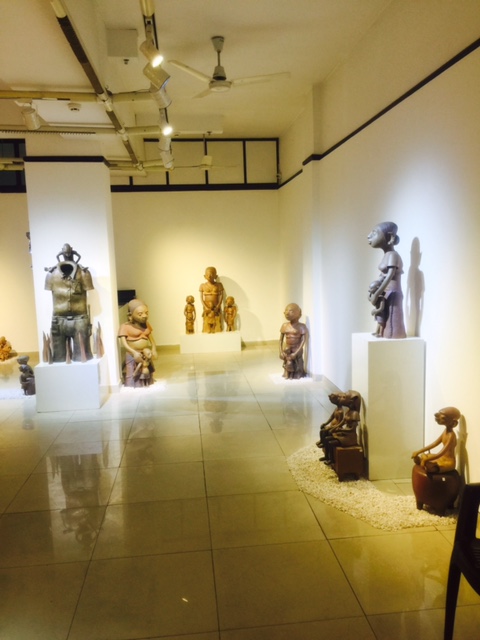
G.Reghu, the noted ceramic sculptor is a very unique presence in the Indian contemporary art scene. Anywhere in the world, art scene is a ‘special economic circle’ where unlike in the case of marriages everyone would like to ‘jump into the circle’ sooner than later but never feels like jumping out of it once inside. The glamour and glitter of the art world somehow cover up the pain and pangs, and the unexpected tragedies. Here everyone tries to keep a shiny and happy face even when the pearls that adorn those countenances are tears and the music that plays in the background is the clamors of the private demons. Keeping out of it and living a true life need a lot of mental and spiritual strength; the kind of strength that could be imbibed through the ultimate understanding of the purifying effects of art on oneself. G.Reghu is one such successful artist who has succeeded both in the material world as well as in the spiritual world by defeating the need and desire to be there in the glamorous world of pretensions. His works are currently exhibited in the Art Heritage Gallery, New Delhi.

 (work by G.Reghu)

The works of art created by Reghu in fired clay consist of the images from a slow paced world where people have enough time to sit, gaze upon the beauties of nature, wander and wonder at the things that the urban dwellers like us consider as insignificant. Reghu lives in Bangalore and before that he spent almost fifteen years in Bhopal where he established his ceramic studio called ‘Mati Ghar’ (the House of Clay). Both the places were not rural. Living in an urban space does not mean that one should be enamored by the psychedelic developments seen in the cities. One needs a very tender and fine sensibility developed over a period of time by seeing and experiencing the simplest kinds of lives lived elsewhere in order to come up with a series of sculptures in fired clay with such sincerity and force. Reghu’s world is a world that is still there just around us, yet we refuse to see or acknowledge. It would be exotic if someone tells that rural life style is rejuvenating and if someone goads us to pay and take us to those places as a part of tourism package then definitely we would see the ‘beauty’ of it through our digital cameras. But to make it a part of the living philosophy and a livable principle one should carry the village within oneself forever. Reghu is an artist who carries a village (and many villages within him).

(work by G.Reghu)

The world of Reghu is full of magical beings; yes I call them magical beings because they are human beings with that magical power to live a slow life which perhaps we have forgotten and would like to wonder at once shown. He makes bodies of these magical human beings in clay by meticulously pressing, rolling and slicing it. Their eyes are open in childlike wonderment. Their lips are pouted in whistling out happy tunes or simply chattering and gossiping. Their clothes are simple extensions of their bodies with minimum designs and decorations. They are involved in such fantastic activities of passing time; someone in an easy chair, smoking while a group of buffaloes play in the water body around him. Some are just lying down and reading. Some of the magical human figures are just flying up or flowing down. They could sit on the walls the ways spiders and lizards do. In some of the clusters of human beings we see the multiple generations of women; mother’s mother, daughter, daughter’s daughter and the daughters of that daughter. They all look at us/artist exactly the way they would see a foreigner who comes to photograph them with an alien machine called camera.

(work by G.Reghu)

An art writer friend of mine speaks of the mentality of those people who prefer to look at the poorer side of living deliberately as ‘slumming’. The slang is which has an American origin is definitely applicable to those people who are touristic in their minds. They could go back to their rich living conditions once the curiosity to be inside a slum is over. In the case of Reghu it is not just about slumming. It is more of a noble cause of seeing, respecting and reproducing not only the life style but also of the creative traditions of those poor people living in extreme rural areas. Here, as an art critic, I need to correct myself. Reghu’s interest in the villages is not the interest of a missionary, on the contrary, after having educated in the western style of creating sculptures, Reghu decided to walk into the rural areas where the tribal people, and the artisans and crafts people lived, only to re-educate himself in the traditional processes of sculpture making. He tested the durability of the medium of the fired clay and since then he has not touched any other medium except for bronze once in a while.

 (works by G.Reghu)

For Reghu, villages are not just the spaces time where stands frozen and the crafts people there trapped in the limitations of geography. He sees village as a continuity that we generally forget to acknowledge, which passes through the present existence of every human being and entering into the unknown zone of future. In that sense, the artist believes that village is not a static body though it appears like that but a self-regenerating and autonomous entity. What makes it backward in our eyes is the conscious withholding of economic support with an intention to turn those rich lands and people into the slaves of urban expansionism through the exploitation of human labor as well as natural resources. While celebrating the rural culture, Reghu stands against the tide of the time that considers visible and skin deep sophistication as development. According to him and also as per the works tell us, such blind belief in the skin deep progress is nothing but foolishness. In Reghu’s world, we see an animated living structure. They are like cartoon characters who could have their own lives and the ability to influence and persuade us through their simple but profound living philosophy.

 (work by G.Reghu)

Reghu ekes out the vernacular in us. I have noticed this hilarious expression of the rich and the affluent who come to enjoy the works of our artist. They see the works with a smile in their lips and assume that the person who has done all these works must obviously be too sophisticated, wearing the trendiest of clothes and holding all the gadgets available in the market like a multi-limbed typical Indian god. When introduced, the first expression that comes to their faces is of disbelief. Then as they willingly suspend it, the whole conversation that follows turns into an absolute poetry of epithets. What they expect is a trendy man. But Reghu could be passed off as a rural worker. He does not dress himself down to look like that. He has always been like that and the success in the art world seems to have never forced him to change his clothes or accent. He remains simple as the famous architect couple, Laurie Baker and Elizabeth Baker whom Reghu joined as an eight year old boy decades ago. Baker taught the world to live simple in simple and natural abodes. Reghu learned the secret of clay from the couple. Then after his education in sculpture from Trivandrum College, he went to Bhopal. Legendary J.Swaminathan became his mentor. Reghu started assisting the pioneering ceramic artist, P.Daroz who in fact was skeptical at Reghu’s attempts to make sculpture in ceramics as ceramics was considered to be the art of plates and cups. Reghu visited Bastar and Wynad, the tribal localities to learn the traditional technics of making sculpture in clay.

(work by G.Reghu)

Gurus make their kind of Shishyas. It is not just in physical appearance alone. It is a very deep mental act of conversion into a living philosophy. J.Swaminathan was an example for Reghu to emulate simple life. More than Swaminathan perhaps, the rural folks in Wyanad and Bastar might have taught Reghu of simple living. When I say Reghu invokes the vernacular in us, I mean it. We cannot be so urban before the overwhelming simplicity of the rural exuded by Reghu. That’s why the rich and the affluent suddenly switch from chaste English to Dettol washed, starched and ironed Hindi in order to make Reghu feel that they too belong to his world. May be they think that Reghu cannot understand English. Anyway, for a few minutes at least one could become helplessly rural when they stand in front Reghu and his works, completely disarmed, dispossessed and literally slummed. Reghu’s works transport us to the world of leisure where people are happy in their own ways. And happily Reghu has created some tiny figures that do some yoga stretches. Reghu has only one explanation to it. “People seem to be suddenly yoga conscious than health conscious. Besides, I live in Bangalore near the ashram of Sri Sri Ravi Shankar. There is a lot of yoga in the air,” smiles Reghu.